Cognitive Load: the Silent Killer of Saas Sales and How to Reduce It
Cognitive Load: the Silent Killer of Saas Sales and How to Reduce It concept 1
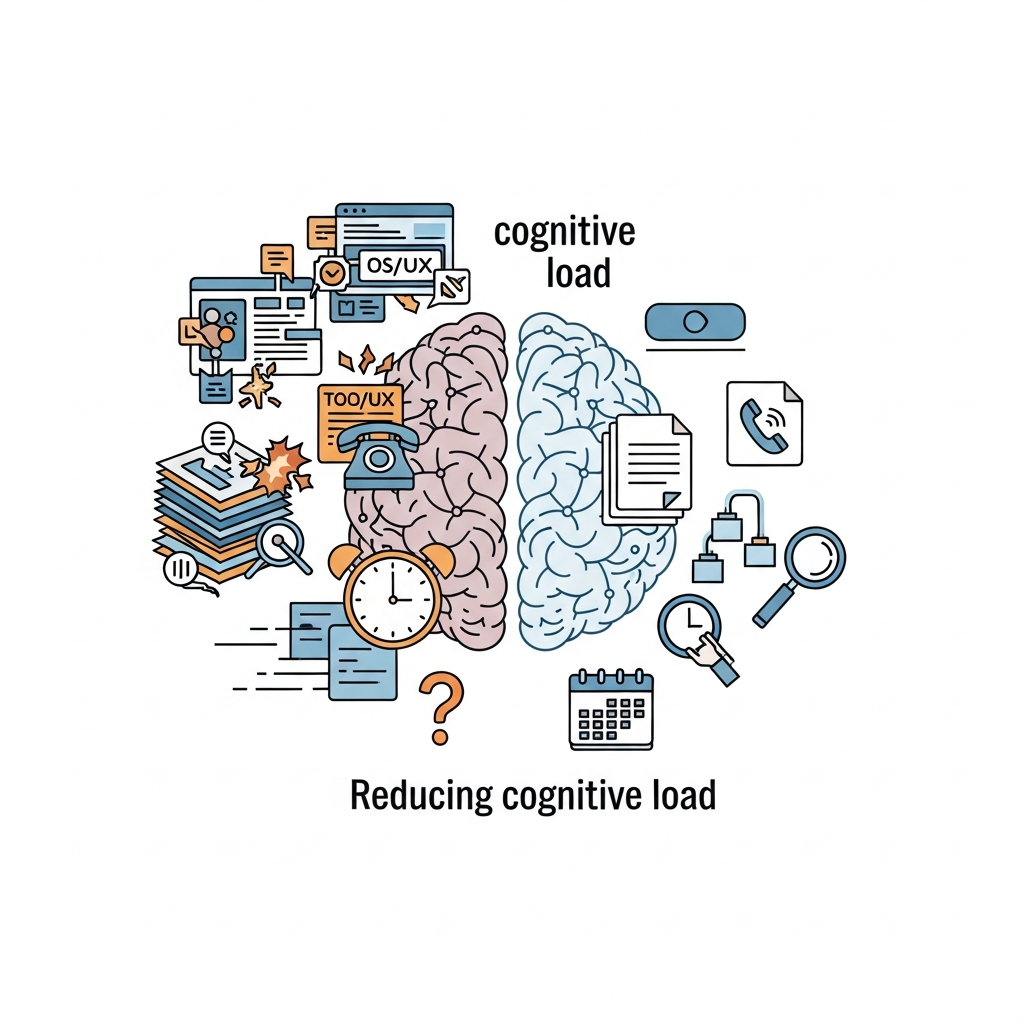
The Invisible Tax on Your Revenue: Why Mental Friction is Killing Your Close Rate

I remember sitting in a glass-walled conference room in midtown Manhattan back in 2016. I was the “technical expert” on a high-stakes enterprise SaaS deal. My Account Executive—let’s call him Dave—was a powerhouse. He knew the product inside out. He had a slide deck that was, quite literally, eighty-four slides long. He was prepared. He was thorough. He was, as it turned out, the primary reason we lost that $200k ARR deal.

As Dave navigated through the fourteenth sub-menu of our platform, explaining the granular permissions of our API integration, I watched the prospect. Not the CEO, but the actual decision-maker—the VP of Operations. Her eyes didn’t just glaze over; her entire posture shifted. She leaned back, crossed her arms, and started checking her watch. She wasn’t bored. She was exhausted.

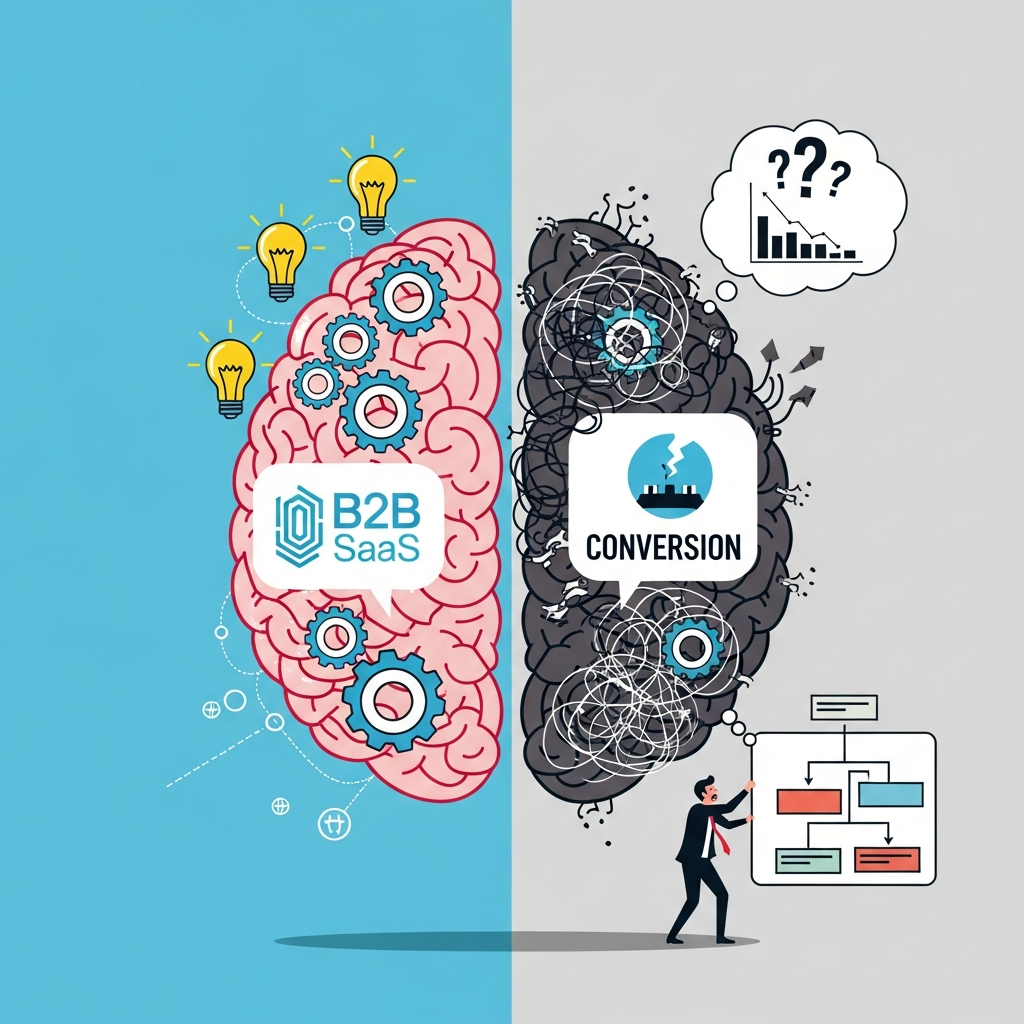
She was suffering from a massive spike in cognitive load. In that moment, her brain decided that our “solution” was more work than the problem she was already facing. This is the silent killer of SaaS sales. It’s not your price point. It’s not your lack of an AI feature. It’s the sheer amount of mental calories you’re forcing your prospects to burn just to understand what you do.
Cognitive Load: the Silent Killer of Saas Sales and How to Reduce It concept 2

What is Cognitive Load Theory, Really?

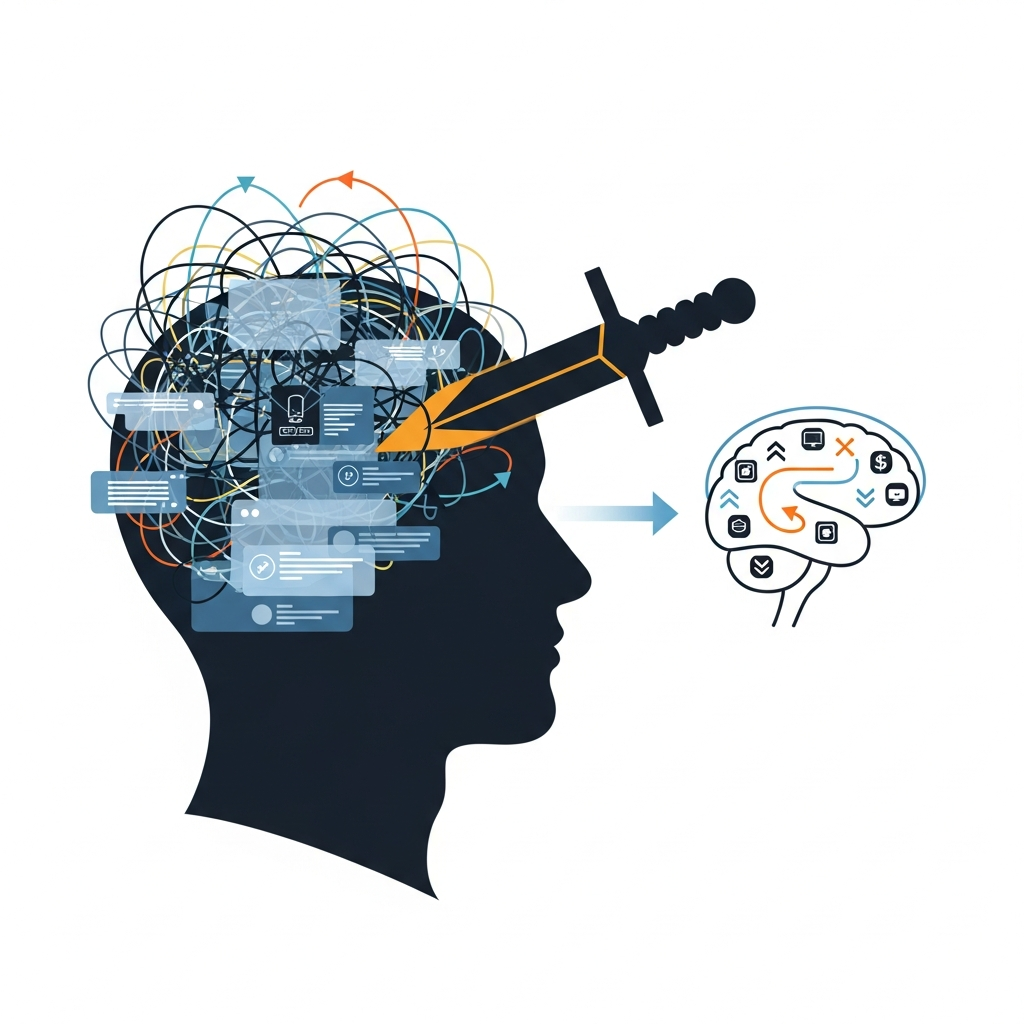
To fix the leak in your sales funnel, we have to look at the psychology. Cognitive Load Theory (CLT), originally developed by John Sweller in the 1980s, posits that our working memory has a limited capacity. Think of it like the RAM in a computer. If you try to run Chrome with fifty tabs, Photoshop, and a high-end video game at the same time, the system freezes. The human brain is no different.

In the context of a SaaS sale, the prospect’s “RAM” is being used for three things simultaneously:

  • Intrinsic Load: This is the inherent difficulty of the task. If you’re selling a complex Kubernetes orchestration tool, there is a baseline level of mental effort required to understand it. You can’t change this, but you can manage it.
  • Extraneous Load: This is the “noise.” This is the bad UI, the cluttered slides, the jargon, and the AE who talks too fast. This is the stuff that adds no value but consumes mental energy. This is where deals go to die.
  • Germane Load: This is the “good” load. It’s the mental effort used to process, practice, and automate new schemas. This is the prospect thinking, “How will this actually fit into my workflow?”

Your goal isn’t to eliminate effort. It’s to ruthlessly eliminate the extraneous so the prospect has enough room for the germane. If they are busy trying to figure out where your “Next” button is or what “synergistic paradigm shifting” means, they have zero capacity left to visualize their own ROI.
Cognitive Load: the Silent Killer of Saas Sales and How to Reduce It concept 3

The Biology of the “No”: Prefrontal Cortex vs. The Amygdala

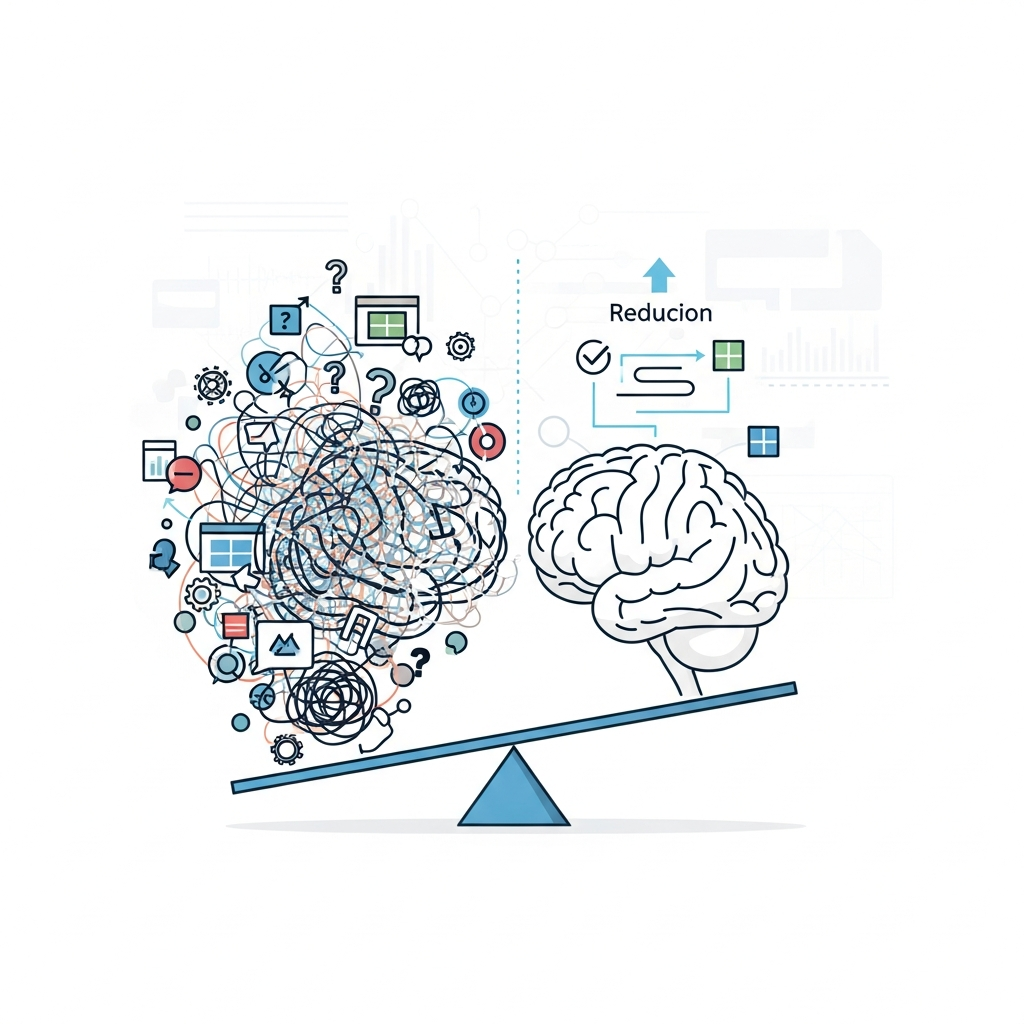
Let’s get analytical for a second. When the cognitive load becomes too high, the prefrontal cortex—the part of the brain responsible for logic, planning, and executive decision-making—begins to shut down. It’s metabolically expensive to think hard. The brain, which is a survival machine designed to conserve energy, triggers a “flight” response.

In sales, “flight” doesn’t mean they run out of the room. It means they say, “Let me think about it and get back to you next quarter.” It means they go with the “safe” legacy incumbent because, even though that incumbent is worse, the brain already knows how to navigate it. The “status quo” isn’t just a competitor; it’s a neurological sanctuary.

The Glucose Drain

Decision fatigue is real. There is a reason Steve Jobs wore the same turtleneck every day. Every minor decision we make depletes our store of mental energy. By the time your prospect gets to your 4 PM demo, they’ve already made a thousand decisions. If your demo requires them to learn a new vocabulary and navigate a complex hierarchy, you are asking for energy they simply do not have.
Cognitive Load: the Silent Killer of Saas Sales and How to Reduce It concept 4

The “Feature Fallacy” and the Death of the Demo

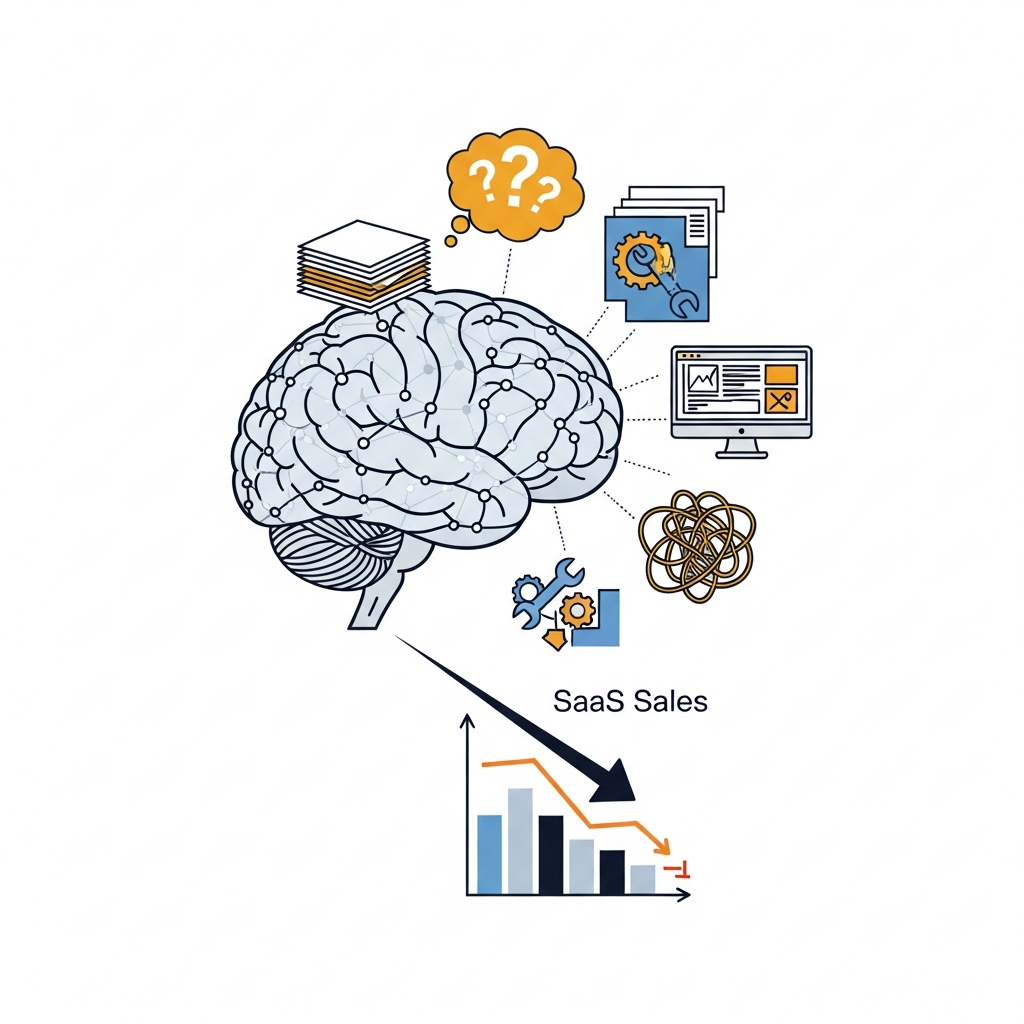
The most common way SaaS companies spike cognitive load is through “The Harbor Tour.” You know the one. You’ve probably done it. You show the prospect every single bell and whistle your engineering team has shipped in the last three years. You think you’re showing “value.” In reality, you’re showing “work.”

Every feature you show that a prospect doesn’t immediately need is a tax. It’s a cognitive burden. They have to process what it is, decide if they need it, realize they don’t, and then try to discard that information. Multiply that by twenty features, and you’ve effectively given your prospect a migraine.

The Minimum Viable Demo (MVD)

I’ve moved my teams toward a philosophy of the “Minimum Viable Demo.” We don’t show the software; we show the transformation. If the prospect needs to solve X, we show them exactly how to get to X in the fewest clicks possible. We hide the sidebars. We ignore the settings menu. We keep the UI clean. We want the “Aha!” moment to happen before the “Huh?” moment.

>Pricing Pages: Where Clarity Goes to Die

Have you looked at your pricing page lately? I mean, really looked at it? Many SaaS companies have pricing structures that require a PhD in mathematics to decipher. “It’s $12 per user, but only for the first 50 users, then it’s $10, but API calls are metered, and SSO is an add-on of $500 per month…”

Stop. You’re killing your conversion rate. When a prospect looks at a pricing table and has to pull out a calculator, you’ve increased the extraneous cognitive load to a breaking point.

The Power of Three (and the Curse of Choice)

The “Paradox of Choice” is a well-documented psychological phenomenon. Give people two options, and they choose. Give them twenty, and they freeze. The classic SaaS “Good, Better, Best” (Standard, Pro, Enterprise) model works because it maps to the brain’s natural categorization. Any more than four tiers and you’re entering the danger zone. If you have “Add-ons,” “Bundles,” and “Modules” all vying for attention, you aren’t being flexible; you’re being confusing.

>Information Architecture in the Sales Process

It’s not just the software or the pricing. It’s the documentation. We love sending over 30-page whitepapers and 15-page “Security Questionnaires.” We think we’re being helpful. We think we’re providing “enablement.”

The reality? Most sales collateral is mental junk mail. To reduce cognitive load, your sales assets must be “Scannable, Not Readable.” High-level headers, bolded key terms, and clear “Next Steps.” If I have to read three paragraphs to find out what the next meeting is about, I’m probably going to cancel that meeting.

The “Reverse Discovery” Strategy

Traditional discovery involves asking 50 questions to “understand the business.” While necessary, it’s also exhausting for the buyer. It feels like an interrogation. To lower the load, try “Reverse Discovery.”

Instead of: “Tell me about your current workflow for X.”
Try: “Usually, companies your size are struggling with A, B, and C because of the current market shift. Which of those sounds most like your current situation?”

By providing the options, you move the prospect from a “Recall” task (high cognitive load) to a “Recognition” task (low cognitive load). You’re doing the heavy lifting for them.

>The Role of UX in Sales Friction

Sales and Product are often viewed as separate silos. This is a mistake. The Sales UX—how it feels to buy from you—is just as important as the Product UX. If your “Book a Demo” flow involves a 12-field form, you’ve already failed. If your contract requires a manual signature and a scanned PDF return, you are adding “Transaction Friction” which is just another form of cognitive load.

Every step in your sales cycle should be examined through a single lens: How can we make this easier for the buyer to say “Yes”?

  • Shorten the forms. Use enrichment tools like Clearbit to find data so the prospect doesn’t have to type it.
  • Automate the scheduling. Use Calendly or Chili Piper. Don’t play “calendar tag.”
  • Use digital contracts. PandaDoc or DocuSign. One click. Done.
  • Pre-fill the paperwork. If you know their company name and address, why are you asking them to type it into the contract?

>The “Mental Model” Trap

One of the hardest parts of selling innovative SaaS is that you’re often asking people to adopt a new mental model. If you’re selling a “No-Code Platform,” you’re asking people who think in terms of “Developers and Sprints” to think in terms of “Drag-and-Drop and Instant Deployment.”

This shift is a massive germane load. To mitigate this, you must use Analogies. Analogies are cognitive shortcuts. They allow the prospect to “hook” your new, complex concept onto an old, simple one they already understand.

“It’s like Excel, but for your customer database.”
“It’s like having a 24/7 security guard for your cloud infrastructure.”

When you use a powerful analogy, you instantly clear the mental fog. The prospect doesn’t have to build a new schema from scratch; they just have to modify an existing one.

>Strategies for Sales Leaders: Reducing the Burden

If you’re managing a team, how do you operationalize this? You can’t just tell AEs to “make it easier.” You need systems.

1. The Five-Minute Rule

If an AE cannot explain the core value proposition of your software to a five-year-old in under sixty seconds, your messaging is too heavy. Audit your team’s “elevator pitches.” If they sound like they’re reading a technical manual, they’re losing deals in the first five minutes.

2. The “Powerpoint Detox”

Challenge your team to run a discovery call or even a demo without a single slide. Forces them to engage in a conversation. Conversations are dynamic and adaptive, which naturally regulates cognitive load. Slides are static and relentless.

3. Visual Anchoring

Human beings process visuals 60,000 times faster than text. Instead of a list of features, use a simple diagram of the “Before” and “After.” A simple flowchart showing how data moves through your system is worth more than ten slides of bullet points. It allows the brain to map the process spatially, which is much lower load than processing linguistic strings.

>The Support-Sales Paradox

Ironically, being “too helpful” can increase cognitive load. When you offer a prospect ten different ways to solve a problem, you aren’t being flexible—you’re being an obstacle. You are the expert. Act like it.

Don’t say: “We could do A, or B, or C. What do you think?”
Say: “Based on what you’ve told me, B is the most efficient path for your team. Here’s why.”

This is Prescriptive Selling. It reduces the decision-making burden on the prospect and positions you as a trusted advisor rather than just another vendor throwing options at the wall.

>Emotional Resonance: The Cognitive Load Bypass

There is one way to bypass cognitive load entirely: Emotion. When we are emotionally engaged—through a story or a shared pain point—our brain processes information differently. We move from the slow, analytical System 2 thinking to the fast, intuitive System 1 thinking (as described by Daniel Kahneman).

If you can make the prospect *feel* the relief of solving their problem, the “how” becomes secondary. They will endure a higher cognitive load if the emotional payoff is clear. Tell stories about other customers who were just as overwhelmed as they are. Use “feel-felt-found.”

“I know exactly how it feels to manage that much data in a spreadsheet. One of our clients, Sarah at Acme Corp, felt the same way last year. What she found was that by automating the ingest, she got ten hours of her week back.”

That narrative is easy to process. It’s sticky. It’s low load.

>Conclusion: The Competitive Advantage of Simplicity

We live in an era of “Software Fatigue.” The average enterprise uses over 300 SaaS apps. Your prospects are tired. They are overwhelmed. They are looking for an exit, not another entry on their to-do list.

In this market, the company that wins isn’t necessarily the one with the most features. It’s the one that is the easiest to buy and easiest to use. By ruthlessly auditing your sales process for cognitive load, you aren’t just “improving UX.” You are removing the neurological barriers to revenue.

Go back to your demo. Look at your pricing. Read your last five sales emails. Ask yourself: “Am I making them think, or am I making them feel?” If you’re making them think too hard, you’ve already lost. Reduce the load. Clear the path. Let them breathe. The “Yes” will follow.
Why Decision Fatigue Is Killing Your B2b Saas Conversions (and How to Fix It)
Why Decision Fatigue Is Killing Your B2b Saas Conversions (and How to Fix It) concept 1

The Hidden Cognitive Tax: Why Your Prospects Are Ghosting You

It is 3:17 PM on a Tuesday. Your ideal customer—let’s call him Marcus, a VP of Engineering at a mid-market fintech firm—has just finished his fifth back-to-back meeting. He is running on lukewarm coffee and the fumes of a dwindling attention span. He clicks your ad. He lands on your “Features” page. He is greeted by a sprawling grid of 45 different capabilities, three distinct pricing tiers with “Contact Us” buttons scattered like digital confetti, and a chatbot that pops up asking if he’d like a “quick whitepaper.”

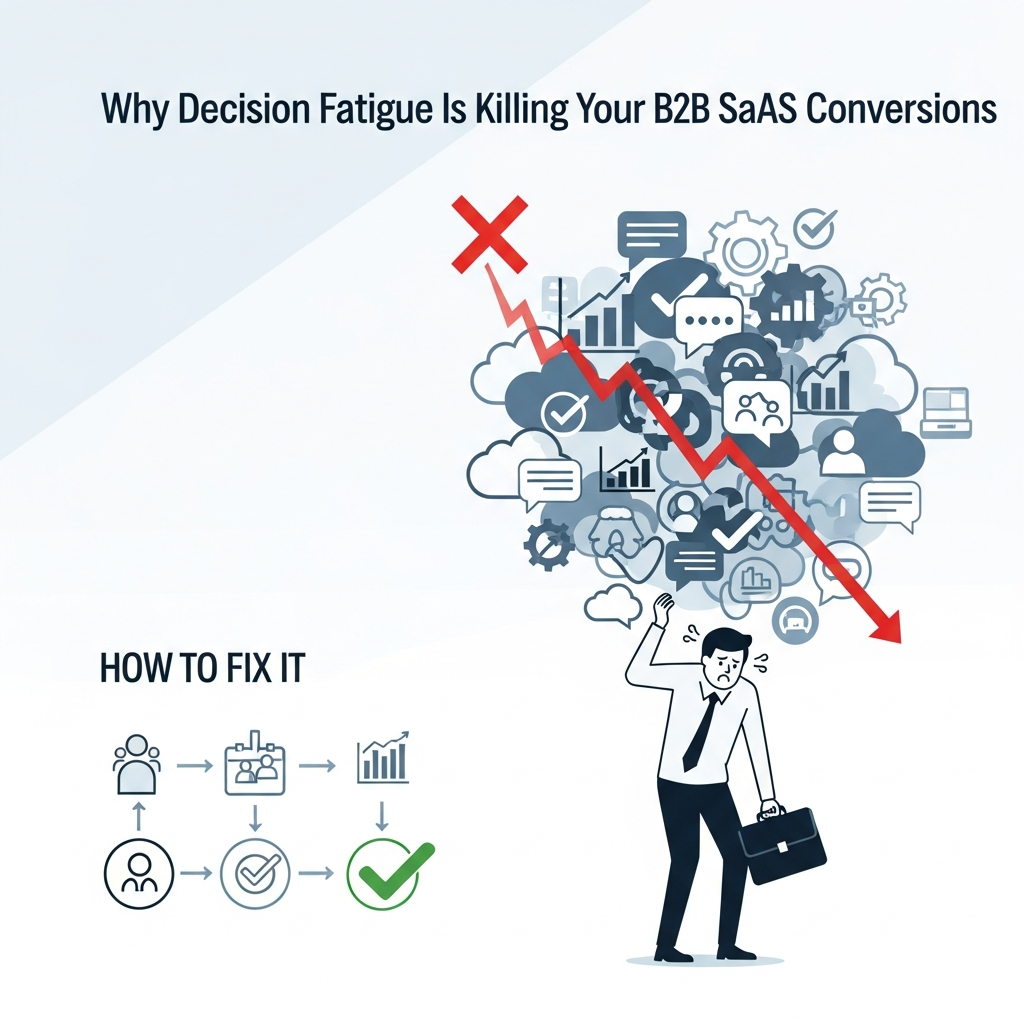
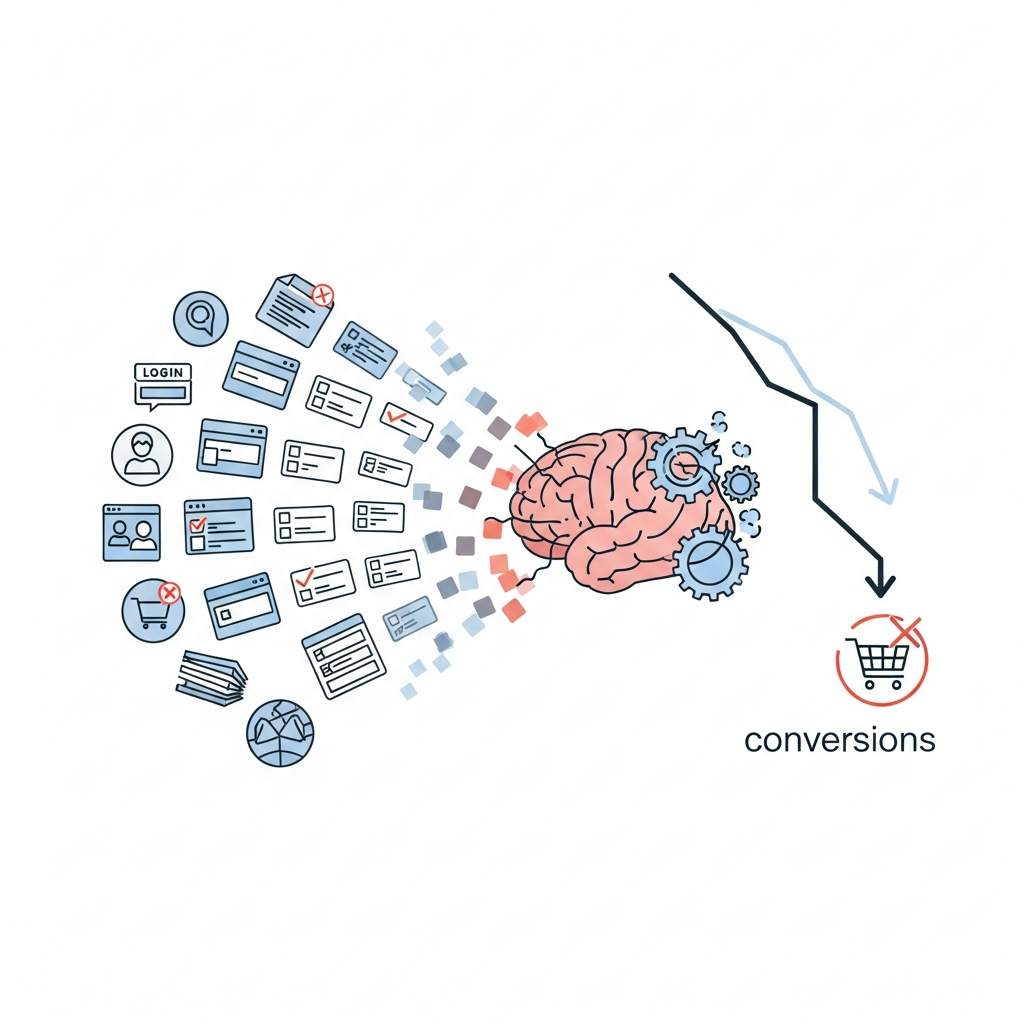
Marcus doesn’t sign up. He doesn’t even bookmark the page. He closes the tab with a heavy sigh. It’s not that your software isn’t good. It might be revolutionary. But in that moment, Marcus wasn’t suffering from a lack of interest. He was suffering from decision fatigue. His brain simply ran out of the metabolic fuel required to process one more choice. And in the high-stakes world of B2B SaaS, where the sales cycles are long and the stakeholders are many, decision fatigue is the silent killer of conversions.

Why Decision Fatigue Is Killing Your B2b Saas Conversions (and How to Fix It) concept 2

The Neurobiology of the “No”: What’s Happening Under the Hood

To understand why your conversion rate is hovering at a dismal 2%, we have to look at the prefrontal cortex. This is the executive center of the brain. It handles logic, planning, and—crucially—decision-making. Here’s the catch: the prefrontal cortex is incredibly energy-intensive. Unlike our primal “lizard brain” which can run on autopilot for days, the executive brain has a finite battery.

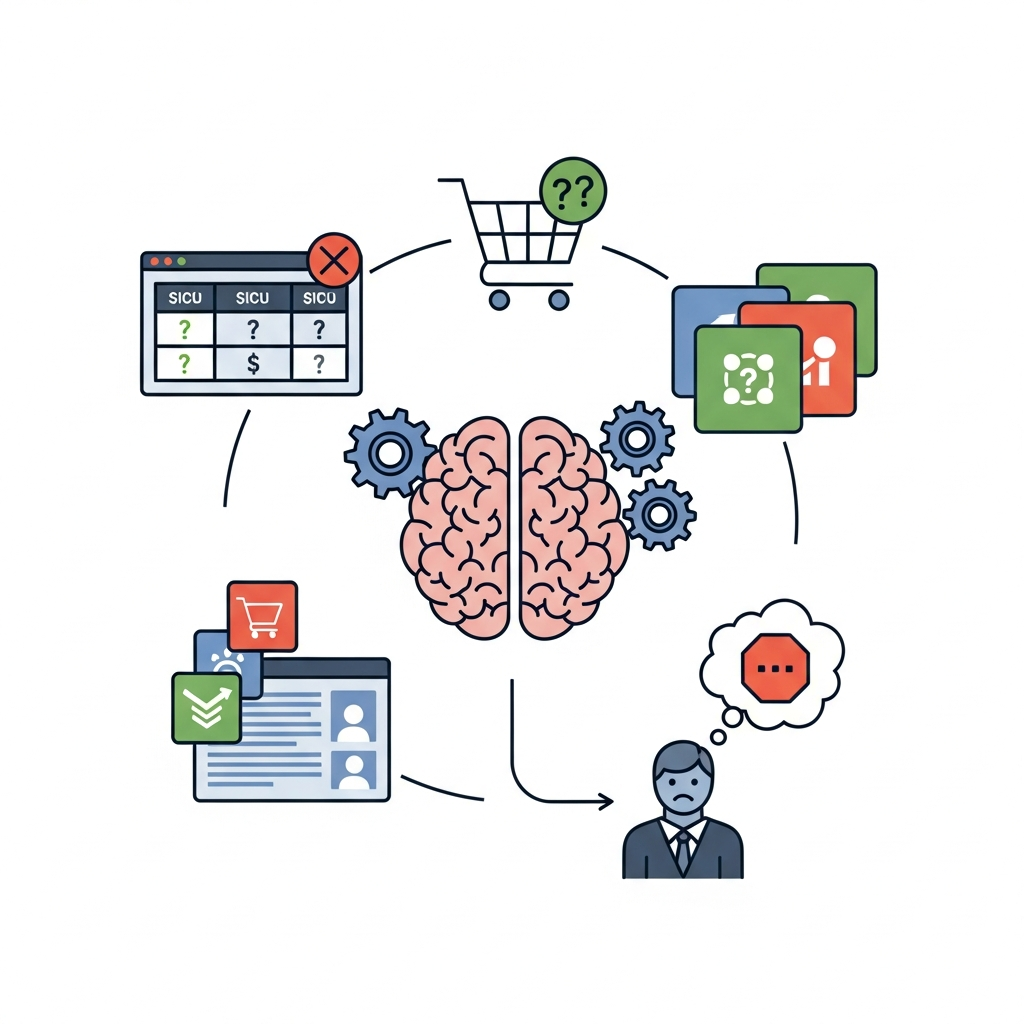
In the academic world, this is often referred to as Ego Depletion. While the concept has faced some replication debates, the core psychological reality remains: making choices wears us down. Every time you ask a prospect to choose between “Starter” and “Growth,” or “See Demo” vs. “Start Free Trial,” you are making a withdrawal from their cognitive bank account. If the balance hits zero before they reach the “Thank You” page, you lose. It’s a binary outcome driven by biological exhaustion.

Hick’s Law and the Paradox of Choice

You’ve likely heard of Hick’s Law. It’s a staple of UX design. It states that the time it takes for a person to make a decision increases logarithmically with the number and complexity of choices. But in B2B SaaS, we often ignore this in favor of “feature-rich” marketing. We think more features equals more value. Psychology says the opposite. Barry Schwartz, in his seminal work The Paradox of Choice, argues that an abundance of options actually leads to anxiety and indecision. For your prospect, a crowded pricing page isn’t an opportunity; it’s a threat to their mental peace.

Why Decision Fatigue Is Killing Your B2b Saas Conversions (and How to Fix It) concept 3

The B2B Context: A Multi-Layered Fatigue

Decision fatigue in B2C is simple. Do I buy the blue shoes or the red shoes? If I pick wrong, I lose fifty bucks. In B2B SaaS, the stakes are tectonic. If Marcus chooses the wrong CRM, he’s not just out of a few thousand dollars; he’s potentially responsible for a failed implementation that costs his company millions and stains his career. This adds a layer of anticipatory regret to the decision fatigue. He isn’t just tired; he’s scared of being tired and wrong.

Furthermore, B2B decisions are rarely made in a vacuum. We’re talking about “Buying Committees.” Now, you aren’t just dealing with Marcus’s decision fatigue; you’re dealing with the collective fatigue of Marcus, the CFO, the Head of Security, and the end-users. Every friction point in your funnel is a moment where the committee can collectively decide that it’s simply “too much work” to move forward.

Why Decision Fatigue Is Killing Your B2b Saas Conversions (and How to Fix It) concept 4

Where SaaS Companies Get It Wrong (The Usual Suspects)

I’ve spent a decade auditing SaaS funnels, and the same patterns emerge like clockwork. We are our own worst enemies. We love our products so much that we want to show every bell and whistle on the first date. It’s the digital equivalent of a first date showing you their entire 20-year career plan before the appetizers arrive. It’s overwhelming.

1. The “Kitchen Sink” Pricing Page

If your pricing page requires a PhD to decode, you’ve already lost. I see companies with seven different tiers, each with a 20-item checklist of “included” vs. “excluded” features. The prospect looks at this and realizes they have to spend 45 minutes doing a gap analysis just to figure out which version they need. Result? They decide to “think about it.” And in SaaS, “I’ll think about it” is the graveyard where deals go to die.

2. The CTA Identity Crisis

Look at your homepage right now. How many primary buttons do you have? “Request a Demo,” “Start for Free,” “Watch Video,” “Talk to Sales.” Each of these is a different cognitive path. By offering four doors, you’re forcing the user to stop and evaluate which door is the right one. This micro-evaluation is a friction point. It creates a stutter in the user’s flow. You want a slip-and-slide, not a hurdle race.

3. Progressive Disclosure (Or Lack Thereof)

The onboarding process is often the worst offender. Most SaaS platforms dump the user into a dashboard that looks like a NASA control center. The user wanted to solve one problem—say, sending an automated email—but now they have to set up integrations, invite team members, and configure their “workspace.” This is cognitive overload at the most critical juncture of the customer journey.

>How to Fix It: Engineering the Path of Least Resistance

Fixing decision fatigue isn’t about removing options; it’s about curating them. You need to act as a sherpa, not a librarian. A librarian shows you where the books are. A sherpa tells you exactly where to step so you don’t fall off the mountain. Here is the blueprint for a low-fatigue B2B SaaS funnel.

The “Power of One” Strategy

Every page on your site should have exactly one goal. One. If it’s your landing page for a specific ad campaign, the only thing the user should be able to do is the thing you paid for them to do. Remove the navigation bar. Kill the footer links. Eliminate the “Related Blog Posts.” If you want them to book a demo, make the “Book a Demo” button the only logical exit point. This reduces the choice set to a binary: Do I want this or not? Binary decisions are much easier on the brain than multivariate ones.

Opinionated Onboarding

Stop asking users how they want to set up their account. Tell them. Deploy “Opinionated UX.” Use templates that are 90% pre-configured based on their industry. If they are a marketing agency, their dashboard should already look like a marketing agency’s dashboard. By providing a default state, you harness the power of the Status Quo Bias. People are much more likely to stick with a pre-set option than they are to build one from scratch.

Tiered Pricing for Humans, Not Robots

Limit your pricing to three tiers. Why three? Because it allows for Price Anchoring. You have the “Basic” (too small), the “Enterprise” (too expensive for most), and the “Professional” (the ‘Goldilocks’ choice). Most users will naturally gravitate toward the middle. By highlighting the middle tier as “Most Popular,” you provide a social heuristic. You’re telling the prospect, “People like you usually pick this.” You’ve just done the hard work of decision-making for them.

>The Power of “Progressive Disclosure”

This is a concept borrowed from human-computer interaction (HCI). It’s the idea of only showing information when it is absolutely necessary. Don’t show the advanced reporting features until the user has successfully completed their first basic task. In your sales deck, don’t talk about your SOC2 compliance in slide two unless you’re talking to the CISO. For the Marketing Manager, that’s just extra noise that drains their battery.

Think of it like a video game. You don’t get the “Ultimate Sword” at Level 1. You get a wooden stick. You learn to swing the stick. Then you get a shield. If you gave a Level 1 player the entire inventory, they’d quit the game out of sheer confusion. Your SaaS is the same. Drip-feed the complexity.

>Using Social Proof as a Cognitive Shortcut

Social proof isn’t just about showing off; it’s about reducing the perceived risk of a decision. When Marcus sees that three of his competitors use your software, his brain can offload the “Is this safe?” calculation. He thinks, “If it works for them, it’ll work for me.” You’ve just bypassed a massive amount of analytical heavy lifting. But be careful—don’t overwhelm him with fifty logos. Show him the three most relevant logos. Again, curation is king.

>The “Default” Effect: Why Less Is More in Configuration

I recently worked with a DevOps tool that had a 12-step setup process. Conversion was in the gutter. We changed the setup so that the tool automatically detected the user’s environment and pre-filled 10 of the 12 steps. The user just had to click “Confirm.” Conversions jumped by 40% overnight. We didn’t change the product’s value. We just stopped asking the user to make 12 decisions when they only really cared about one: “Does this work?”

>The Role of Empathetic Copywriting

Your copy should acknowledge the fatigue. Instead of “Our platform offers robust multi-channel orchestration,” try “Stop jumping between 10 different tabs. Manage everything in one place.” The first sentence is a feature that requires mental translation. The second is a relief of cognitive burden. It speaks directly to the pain of the fatigued brain. Support your user. Be the aspirin, not the headache.

A Quick Checklist for Auditing Your Funnel

  • The 5-Second Test: Can a user identify exactly what they should do next within 5 seconds of landing on your page?
  • CTA Density: Do you have more than two different primary calls-to-action on your homepage? (If yes, kill one).
  • Pricing Clarity: Can a prospect figure out their likely monthly cost without talking to a human?
  • Onboarding Friction: How many clicks does it take from “Sign Up” to “Aha Moment”? If it’s more than five, you have a problem.

>The Strategic Advantage of Simplicity

In the “Feature Wars” of the SaaS world, simplicity is the ultimate weapon. Everyone is trying to be the “all-in-one” solution. But “all-in-one” often translates to “everything-is-confusing.” If you can be the company that makes the decision easy, you will win. Not because your code is better, but because your user experience respects the biological limits of the human brain.

Look, I get it. You’ve worked hard on those features. Your engineers are proud of them. Your investors want to see “Enterprise” readiness. But none of that matters if Marcus closes the tab because his brain is too tired to figure out how to buy from you. Reduce the options. Clear the path. Make the “Yes” the easiest thing he does all day.

It’s not just about conversion optimization; it’s about empathy. It’s about recognizing that on the other side of that screen is a tired, stressed-out human being who just wants their problems to go away. If you can be the one who doesn’t add to their mental load, they won’t just buy your software—they’ll thank you for it.

>Final Thoughts for the Over-Thinkers

If you take nothing else from this, remember: Constraints are a gift to your customer. By limiting what they can do, you are guiding them toward what they should do. In the crowded, noisy, exhausting landscape of B2B SaaS, the brand that provides the most clarity—not the most features—is the one that scales. Stop making your prospects think so hard. They’re already tired enough.

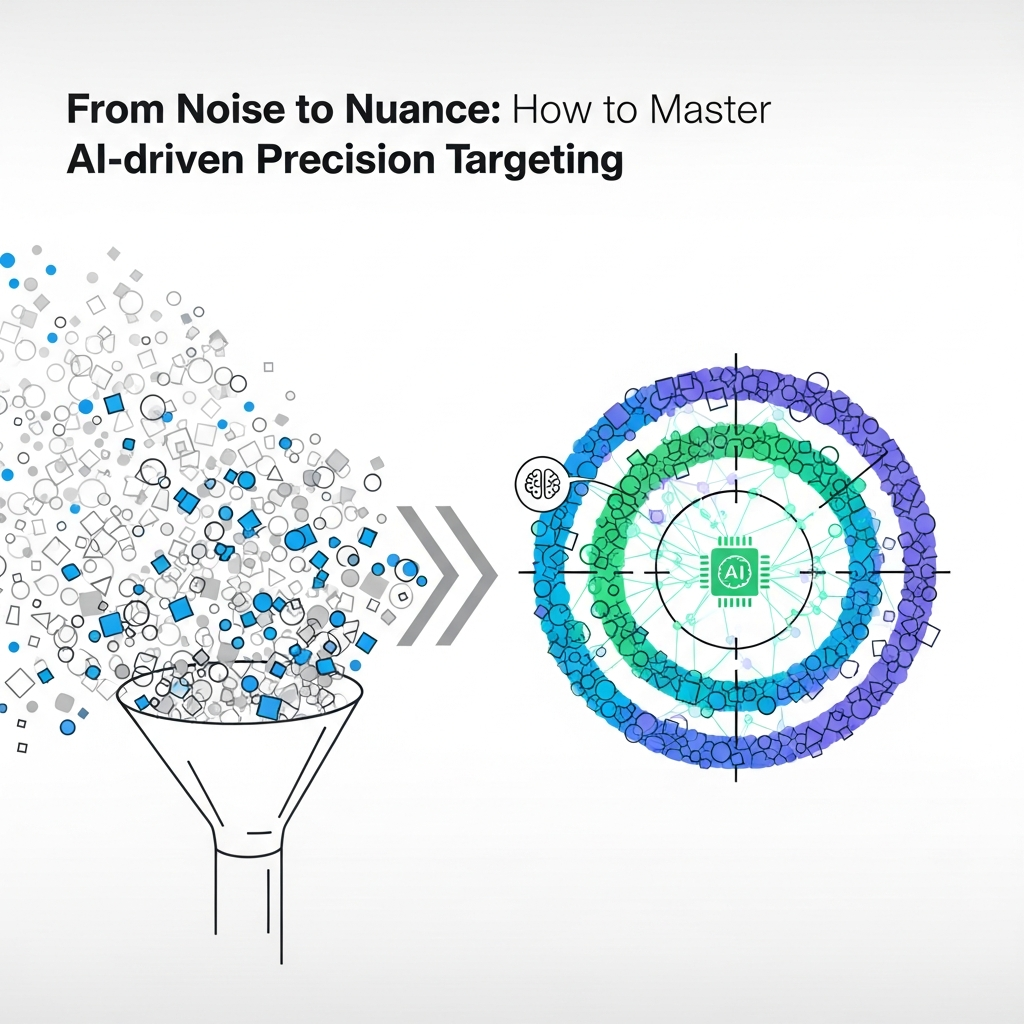
From Noise to Nuance: How to Master Ai-driven Precision Targeting
From Noise to Nuance: How to Master Ai-driven Precision Targeting concept 1

Beyond the Persona: Why Your “Average Customer” Is a Myth

I remember sitting in a boardroom circa 2014, staring at a PowerPoint slide that featured “Marketing Mary.” Mary was 32, lived in a suburban zip code, liked yoga, and supposedly represented our entire targetable universe. It felt wrong then; it looks like a prehistoric relic now. The fundamental problem with traditional targeting—the kind we all cut our teeth on—is that it relies on categorical averages. But here is the cold, analytical truth: nobody is average. When we aggregate data into broad buckets, we don’t find clarity; we find noise. We lose the individual in the spreadsheet.

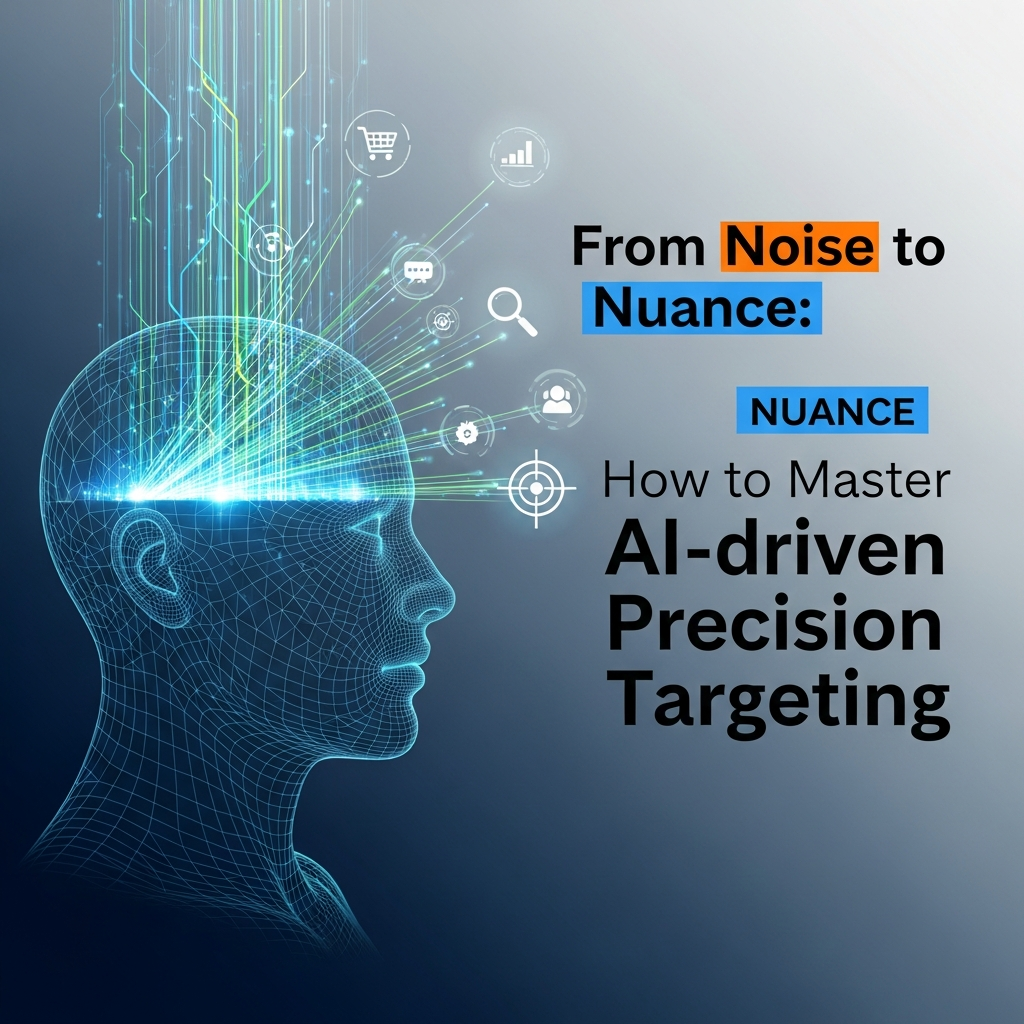
AI-driven precision targeting isn’t just a faster way to find Mary. It’s the tool that finally allows us to kill her off. In the modern landscape, we are moving from demographic proxies (who someone is on paper) to behavioral intent (what someone is actually doing in the moment). This shift requires a radical empathetic leap. We have to stop thinking of our audience as data points and start seeing them as a series of high-intent signals. It’s about recognizing that a 60-year-old grandfather in rural Nebraska might have more in common—behaviorally—with a 22-year-old coder in Berlin than with his own neighbor. AI sees the commonality in the chaos. It finds the nuance.

To master this, we have to embrace the messy reality of human digital behavior. People don’t follow linear paths. They bounce from TikTok to a white paper, from a podcast to an abandoned cart. Managing this “noise” requires a level of computational heavy lifting that the human brain simply isn’t wired for. We need the machines to do the sorting, but we need the human heart to provide the context.

The Architecture of Intent: Moving from Static to Dynamic Modeling

Static models are the death of ROI. If your targeting criteria are updated monthly, you’re already behind the curve. AI allows for dynamic propensity modeling. This means the system is constantly recalculating the likelihood of a conversion based on real-time inputs. It’s the difference between a paper map and a live GPS that reroutes you the second there’s an accident ahead.

  • Temporal Relevance: Understanding that a “high-intent” signal has a shelf life. A search for “best strollers” is a high-value signal for about three months, then it drops to zero. AI tracks this decay.
  • Cross-Channel Synthesizing: Your customer isn’t a different person on Instagram than they are on LinkedIn. AI bridges the identity gap, stitching together fragmented sessions into a cohesive “identity graph.”
  • Lookalike Evolution: Traditional lookalike audiences are often “garbage in, garbage out.” Precision targeting uses seed audiences based on lifetime value (LTV), not just one-off conversions.
From Noise to Nuance: How to Master Ai-driven Precision Targeting concept 2

The Mechanics of Precision: Vector Space and Latent Intent

Let’s get technical for a moment, because “AI” is often used as a nebulous buzzword by people trying to sell you something you don’t need. When we talk about precision targeting, we’re often talking about vector embeddings. Imagine every customer interaction exists as a point in a multi-dimensional space. In a traditional database, you might have ten columns of data. In a vector space, you might have thousands.

This is where the “nuance” happens. AI doesn’t just see “Customer bought a shirt.” It sees the speed of the scroll, the time of day, the semantic relationship between the product description and the customer’s previous search history, and the subtle “clumping” of similar behaviors across millions of other users. It identifies latent intent—desires the customer hasn’t even articulated to themselves yet. It’s eerie, yes, but from a marketing perspective, it is the holy grail of efficiency.

I’ve seen campaigns where we ignored demographics entirely and targeted solely based on behavioral clusters. The results? A 40% reduction in CPA (Cost Per Acquisition). Why? Because the machine found customers that our human biases told us to ignore. We thought our audience was “professionals”; the AI found that our most engaged users were actually hobbyists with high disposable income who happened to browse at 11 PM on Tuesdays. That is the power of letting go of your assumptions.

The Signal-to-Noise Ratio: Filtering the Digital Exhaust

The world is drowning in data, most of it useless “digital exhaust.” Every click, like, and hover creates a data point, but not all data points are created equal. A “like” on a Facebook post is a weak signal. A three-minute dwell time on a pricing page is a strong signal. Precision targeting is, at its core, the art of signal amplification.

To master this, you need to implement rigorous data hygiene. AI is an incredible force multiplier, but it multiplies whatever you feed it. If you feed it messy, biased, or incomplete data, you will simply arrive at the wrong conclusion faster. You must define your “north star” metrics with clinical precision. Are you optimizing for clicks? Sales? Retention? The machine doesn’t know what “success” looks like unless you define it with absolute clarity.

From Noise to Nuance: How to Master Ai-driven Precision Targeting concept 3

The “Creepiness” Threshold: Navigating the Ethics of Precision

We need to talk about the elephant in the room: the “uncanny valley” of targeting. We’ve all had that moment where we mention a product in conversation and an ad for it appears ten minutes later. It feels like surveillance. As practitioners, we have a responsibility to balance precision with privacy. If you cross the line into “creepy,” you don’t just lose a sale; you lose brand equity that might take years to rebuild.

Empathy is the antidote to intrusion. When we use AI, we should use it to be helpful, not just ubiquitous. Precision targeting should feel like a well-timed recommendation from a knowledgeable friend, not a stalker following you through the mall. This means being transparent about data usage and giving users control. It also means using “soft” targeting—showing related content rather than the exact product they just looked at—to ease the psychological tension of being “watched.”

Building a Trust-First Data Strategy

The regulatory landscape is shifting. GDPR, CCPA, and the death of the third-party cookie are not obstacles; they are guardrails. They force us to move toward Zero-Party Data (data the user intentionally shares) and First-Party Data (data you collect directly). This is where the real nuance lies. AI can help you predict what a user wants based on the limited, high-quality data they’ve actually given you permission to use. It’s about doing more with less.

  • Contextual Targeting 2.0: Using AI to analyze the content of a page and placing ads that match the mood and intent of that content, rather than following the user.
  • Federated Learning: Training models on decentralized data so you never actually “own” the raw personal information, keeping privacy intact while maintaining predictive power.
  • The Value Exchange: Always ask: “Is this ad providing enough value to justify the data used to serve it?” If the answer is no, rethink your strategy.
From Noise to Nuance: How to Master Ai-driven Precision Targeting concept 4

The Infrastructure of Nuance: What Your Stack Actually Needs

You cannot achieve precision targeting with a fragmented tech stack. If your CRM doesn’t talk to your ad platform, and your email tool is in its own silo, your AI is essentially blind in one eye. Mastering this requires an integrated Customer Data Platform (CDP). This serves as the single source of truth, the “brain” that feeds the various execution arms of your marketing department.

But having the tools isn’t enough. I’ve seen companies spend seven figures on Salesforce or Adobe suites and still fail because they didn’t have the analytical talent to ask the right questions. You need people who understand both the “why” and the “how.” You need “translators”—people who can bridge the gap between a data scientist’s Python script and a creative director’s vision.

The Role of Algorithmic Auditing

Algorithms drift. Over time, an AI model can become biased or lose its edge as market conditions change. A model built in 2019 would have been disastrous in 2020. Mastering precision targeting requires constant algorithmic auditing. You need to pull the curtain back and ask: Why is the AI making these decisions? Is it ignoring a profitable sub-segment? Is it over-weighting a specific channel because it’s “cheap” even if the quality is low?

Think of your AI as a high-performance engine. It needs tuning. It needs the right fuel. And occasionally, it needs a mechanic to take it apart and make sure everything is still running as intended. This isn’t a “set it and forget it” situation. It’s a “supervise and iterate” situation.

>The Human-in-the-Loop: Why Machines Can’t Do It Alone

There is a dangerous tendency in our industry to outsource our thinking to the machine. We assume that because an algorithm is “smart,” it understands human culture. It doesn’t. AI is brilliant at identifying patterns, but it is blind to cultural context. It doesn’t know why a specific meme is funny, or why a certain phrase might be offensive in a specific political climate. It lacks the “gut feeling” that has driven great marketing for a century.

The most successful precision targeting happens when we use AI to handle the scale and humans to handle the strategy. The machine finds the “who” and the “when,” but the human must define the “what” and the “why.” This is the “Human-in-the-Loop” (HITL) model. It’s about creating a feedback loop where human insights refine the machine’s parameters, and the machine’s data challenges the human’s assumptions.

The Anatomy of a Precision Campaign

To move from noise to nuance, follow this framework for every campaign you launch:

  1. Hypothesis Generation: Start with a human insight. “I think people who buy our product are also interested in sustainable gardening.”
  2. Data Seeding: Feed the AI high-quality data related to that hypothesis.
  3. Algorithmic Expansion: Let the AI find the “lookalike” patterns you missed. Maybe it’s not gardening; maybe it’s “minimalist home design.”
  4. Creative Variance: Use AI to generate hundreds of micro-variations of your creative to match the specific nuances of each sub-segment.
  5. Human Review: Stop. Look at what the AI is doing. Does it make sense? Is it on-brand? Is it empathetic?
  6. Optimization: Scale the winners, kill the losers, and feed the results back into the model.

>Future-Proofing Your Targeting: The Post-Cookie Paradigm

We are entering the “Great Reset” of digital marketing. The old ways of tracking—those sticky little cookies that followed you across the web—are crumbling. This is actually a good thing. It’s forcing us to be smarter. It’s forcing us to move toward predictive modeling based on aggregated signals rather than individual tracking.

The future of precision targeting belongs to those who can build first-party ecosystems. This means creating content, tools, and experiences so valuable that users want to give you their data. Think of it as a “loyalty loop.” Once you have that data, AI becomes your secret weapon for maximizing its value. You can predict churn before it happens, recommend products before the customer knows they need them, and personalize every touchpoint of the journey.

It’s a shift from “stalking” to “service.” And in a world filled with digital noise, service is the only thing that actually cuts through. It’s the ultimate nuance.

A Final Thought for the Weary Marketer

If this feels overwhelming, that’s because it is. We are asking you to be a data scientist, a psychologist, an ethicist, and a creative all at once. But remember: you don’t have to master it all overnight. Start by questioning your “Personas.” Start by looking at your data hygiene. Start by asking your AI provider better questions. Precision isn’t a destination; it’s a discipline. It’s a commitment to seeing your customers as the complex, nuanced individuals they actually are. The machines are just here to help us see them more clearly.

The noise is loud, but the nuance is where the growth is. Go find it.

The Precision Revolution: Why Ai Automation Is Your Brand’s Most Targeted Tool
The Precision Revolution: Why Ai Automation Is Your Brand’s Most Targeted Tool concept 1

The Ghost in the Machine: Beyond the “Spray and Pray” Trauma

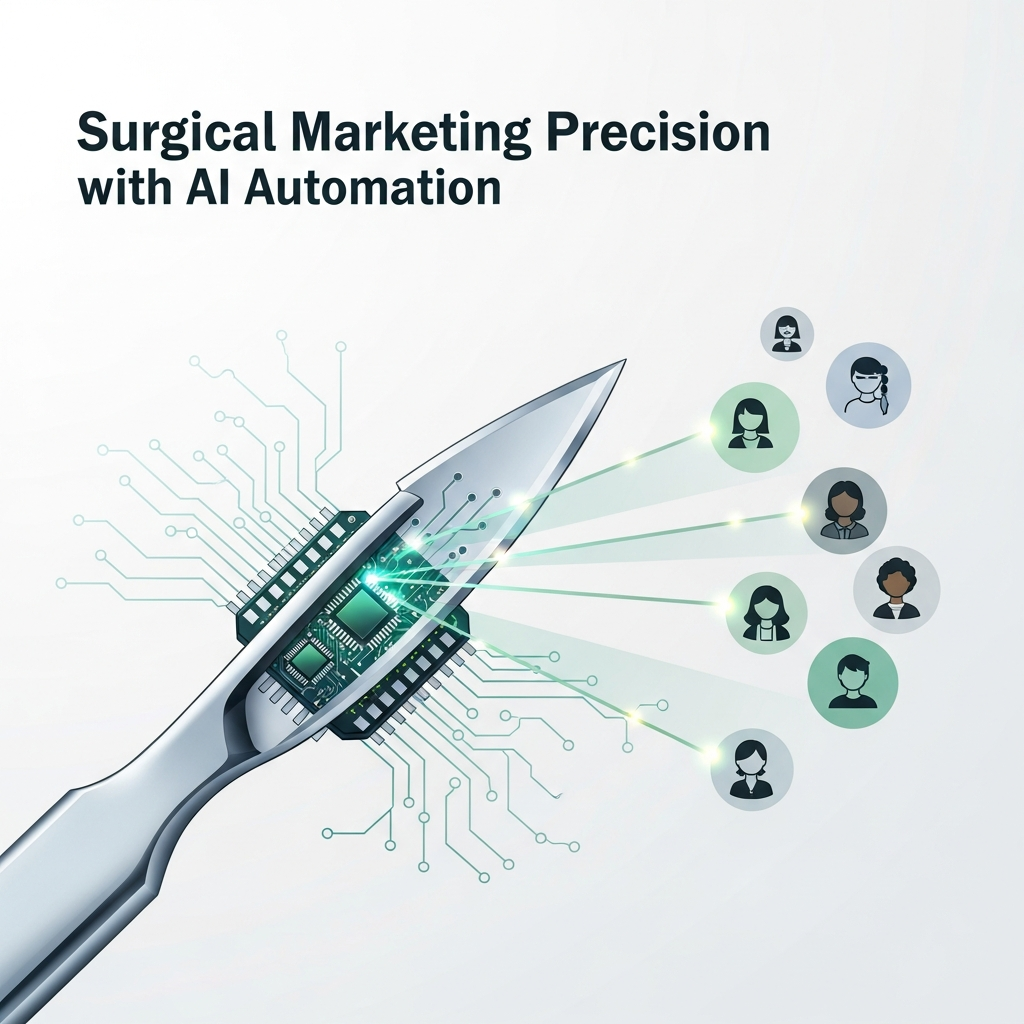
I remember sitting in a dimly lit office back in 2014, staring at a Facebook Ads Manager dashboard that felt like a gambling terminal. We were burning through a client’s budget—fifty grand a month—on what we called “broad interest targeting.” We were basically throwing spaghetti at a very expensive wall and hoping something stuck. It was soul-crushing. You’d see the bounce rates and feel a physical pang in your chest. That wasn’t marketing; it was a desperate plea for attention in a room full of people screaming. Fast forward to today, and the landscape hasn’t just changed; it’s undergone a molecular restructuring. AI automation isn’t a “plugin” or a “feature”—it is the surgical scalpel replacing the blunt trauma of traditional advertising.

When we talk about “The Precision Revolution,” we aren’t just talking about algorithms that work faster than humans. We’re talking about the end of the average. In the old world, we built personas like “Marketing Mary” or “Tech-Savvy Tom.” These were caricatures—hollowed-out versions of real humans. AI doesn’t care about your caricatures. It looks at the stochastic noise of human behavior and finds the signal. It’s analytical, yes, but for the first time, it allows us to be deeply empathetic because we stop bothering people with things they don’t want.

The Precision Revolution: Why Ai Automation Is Your Brand’s Most Targeted Tool concept 2

The Neuroscience of Micro-Relevance

Why does a perfectly timed notification feel like magic, while a generic email feels like a violation? It comes down to cognitive load. Humans are biologically wired to filter out irrelevant stimuli; it’s a survival mechanism. If our ancestors paid attention to every rustle in the grass, they’d have died of nervous exhaustion. Modern digital noise is that rustling grass. AI-driven precision works because it bypasses the “relevance filter” by mimicking the way our brains prioritize information.

The Bayesian Brain and Predictive Modeling

Most people think AI predicts the future. It doesn’t. It calculates the probability of a specific outcome based on a recursive loop of past data points. In academic circles, we often look at this through the lens of Bayesian inference. Essentially, the system starts with a “prior” belief (e.g., “People who buy organic coffee might like artisanal honey”) and constantly updates that belief as new evidence arrives. For your brand, this means the automation is learning in real-time. If a user lingers on a product image for 4.2 seconds instead of 1.8, the “prior” updates. The precision comes from the fact that the machine doesn’t get tired of calculating these updates. It does it billions of times per second.

I’ve watched brands struggle because they treat AI like a static tool—set it and forget it. That’s a mistake. You have to feed the beast high-quality data. If you feed it garbage, it will give you precisely targeted garbage. But when you align your brand values with these probabilistic models? That’s when you stop being a “vendor” and start being a “solution.”

The Precision Revolution: Why Ai Automation Is Your Brand’s Most Targeted Tool concept 3

Deconstructing the “Black Box”: How Logic Meets Automation

There’s a lot of fear-mongering about “black box” algorithms—the idea that we don’t know why the AI does what it does. While the internal weights of a neural network are complex, the logic of precision automation is actually quite elegant. It’s built on three pillars: Signal Identification, Latency Reduction, and Iterative Refinement.

  • Signal Identification: This is the ability to distinguish between “intent” and “noise.” A user searching for “how to fix a leaky faucet” has a different intent than someone searching for “designer kitchen faucets.” AI looks at the semantic context to ensure your brand appears only when the intent matches your value proposition.
  • Latency Reduction: In the manual days, we’d run a report, analyze it on Monday, and change the ads on Tuesday. By then, the “moment” was gone. Automation acts in milliseconds. It’s the difference between catching a falling glass and reading a report about how the glass broke.
  • Iterative Refinement: The AI is constantly running micro-experiments (A/B testing on steroids). It might test 5,000 variations of a headline across 5,000 different micro-segments. No human team, no matter how caffeinated, can compete with that level of granular optimization.

>The Death of the Demographic: Long Live the Psychographic

Stop targeting “Women aged 25-34 in urban areas.” It’s lazy. It’s ineffective. It’s a relic of the Mad Men era. Two women in that demographic could have nothing in common—one might be a minimalist ultra-marathoner, while the other is a maximalist gourmet chef. AI allows us to target behavioral clusters and psychographic profiles.

Through Natural Language Processing (NLP), AI can analyze the sentiment of a user’s social media interactions or the nuance of their search queries. It understands the “why” behind the click. If your brand sells high-end hiking gear, you don’t want someone who just likes the “aesthetic” of mountains; you want the person who is currently researching the topographical maps of the Dolomites. AI finds that person by connecting dots that aren’t visible to the naked eye. It’s about finding the “inner state,” not just the “outer zip code.”

The Empathetic Edge

This is where it gets personal. We’ve all been followed around the internet by a pair of shoes we already bought. That is *bad* automation. It’s clunky. True precision automation—the kind I advocate for—knows you bought the shoes. It stops showing you the ad. Instead, it might show you a video on how to care for that specific leather, or suggest the perfect socks to match. Precision is an act of service. When you use AI to respect a customer’s journey, you build a level of brand loyalty that “lookalike audiences” can never touch.

>The Plumbing Problem: Why Your Data Architecture is Leaking

I have to be the bearer of bad news here: your AI is only as good as your data plumbing. I’ve consulted for Fortune 500 companies that wanted “AI Revolution” results but had their data stored in five different siloes that didn’t talk to each other. It’s like trying to run a Ferrari on swamp water.

To achieve actual precision, you need a Single Source of Truth (SSOT). This means your CRM, your website analytics, your social data, and your email platforms must be integrated. AI requires a holistic view of the customer. If the AI doesn’t know that “User A” who clicked the ad is the same “User A” who called support yesterday, the precision fails. You end up sending a promotional “buy now” email to someone who is currently furious about a shipping delay. That’s not just a missed sale; it’s a brand-killer.

>Hyper-Personalization at Scale: The Holy Grail

We used to say “Personalization doesn’t scale.” You could either be personal with ten people or generic with ten million. AI shattered that dichotomy. We are now in the era of Dynamic Creative Optimization (DCO). This isn’t just swapping out a first name in an email. This is the AI generating unique landing pages, visual assets, and pricing structures for every individual user in real-time.

Imagine a world where your website morphs based on who is visiting. A first-time visitor sees educational content and a “warm” welcome. A returning loyalist sees their “frequently bought” items and a loyalty discount. A price-sensitive browser sees a “limited time offer.” This isn’t science fiction; it’s what top-tier brands are doing right now to crush their competition. The precision lies in the timing—hitting the user with the right message at the exact point in their “Circadian Rhythm of Commerce.”

The Concept of “Stochastic Resonance” in Marketing

In physics, stochastic resonance is a phenomenon where a signal that is too weak to be heard can be boosted by adding white noise. Marketing automation does something similar. By analyzing the “noise” of the market, AI identifies the tiny, weak signals of interest that a human would miss. It then amplifies those signals by delivering targeted content. It’s about finding the “whisper” of intent in a “scream” of data.

>Ethics, Privacy, and the “Creepiness” Threshold

We have to talk about the elephant in the room. There is a fine line between “highly targeted” and “stalking.” As someone who has spent years in the trenches of data analytics, I’ve seen where that line is, and it’s thinner than you think. The Precision Revolution must be built on a foundation of Data Sovereignty and Radical Transparency.

If you use AI to manipulate people’s insecurities, you will fail in the long run. The “uncanny valley” of marketing occurs when the AI knows something about the user that they haven’t explicitly shared. The goal is to be helpful, not omniscient. Use automation to solve problems, not to exploit psychological vulnerabilities. Brands that prioritize privacy-first AI—using zero-party data (information the user intentionally shares)—are the ones that will survive the upcoming regulatory storms like GDPR and CCPA. Precision is not a license to pry; it’s a responsibility to be relevant.

>The Human-in-the-Loop: Why Robots Won’t Replace Your CMO

There’s a common anxiety that AI will make brand managers obsolete. I actually believe the opposite is true. AI makes the human element more important than ever. The AI provides the precision, but the human provides the purpose.

AI can tell you that a certain segment of your audience responds better to the color blue and a 10% discount. It can’t tell you *why* your brand should exist in the first place. It can’t feel the “vibe” of a cultural movement. It can’t understand the nuance of irony or the depth of human grief. We need “Human-in-the-Loop” (HITL) systems where the AI handles the heavy lifting of data processing, and the human provides the creative guardrails and ethical oversight. The most successful brands I’ve seen are the ones where the creative directors and data scientists are best friends, not rivals.

A Personal Note on the “Aha!” Moment

I once worked with a small e-commerce brand that was struggling to find its footing. They were using basic automated bidding on Google. We switched them to a custom-built AI model that factored in local weather patterns, stock market fluctuations (their product was a luxury item), and even local “mood” data from social media. Within three months, their ROAS (Return on Ad Spend) jumped from 2.1 to 8.4. But the coolest part? Their customer support tickets dropped by 40%. Because we were so precise in who we targeted, the people buying the product were the ones who actually needed it. We weren’t “selling” anymore; we were “matching.” That’s the dream.

>Practical Steps: Navigating the Transition

If you’re feeling overwhelmed, good. That means you’re paying attention. The transition to AI-driven precision isn’t a weekend project; it’s a cultural shift. Here’s how you start without losing your mind:

  1. Audit Your Data Integrity: Before buying a single AI tool, look at your data. Is it clean? Is it accessible? If not, fix that first.
  2. Start with “Low-Hanging Fruit”: Don’t try to automate your entire brand at once. Start with automated bidding or predictive lead scoring. Get a win, then expand.
  3. Invest in “Translation” Talent: You need people who can bridge the gap between technical data science and brand storytelling. These “translators” are the most valuable assets in the modern economy.
  4. Test, Break, and Learn: Automation allows for rapid failure. Embrace it. If a model isn’t working, kill it and start over. The cost of failure in an automated world is much lower than the cost of stagnation.

>The Future is Non-Linear

We are moving toward a world of Anticipatory Marketing. This is where your brand provides a solution before the customer even realizes they have a problem. It sounds like sci-fi, but it’s just the logical conclusion of high-precision AI. When you combine massive computing power with deep human empathy, you create a brand experience that feels less like a transaction and more like a relationship.

The “Precision Revolution” isn’t about being colder or more mechanical. It’s about using technology to strip away the irrelevance, the noise, and the waste, leaving behind only the most meaningful connections. It’s about being right—not just loud. And in a world that is louder than ever, being right is the only thing that matters.

Are you ready to stop screaming and start connecting? Because the machine is ready when you are.

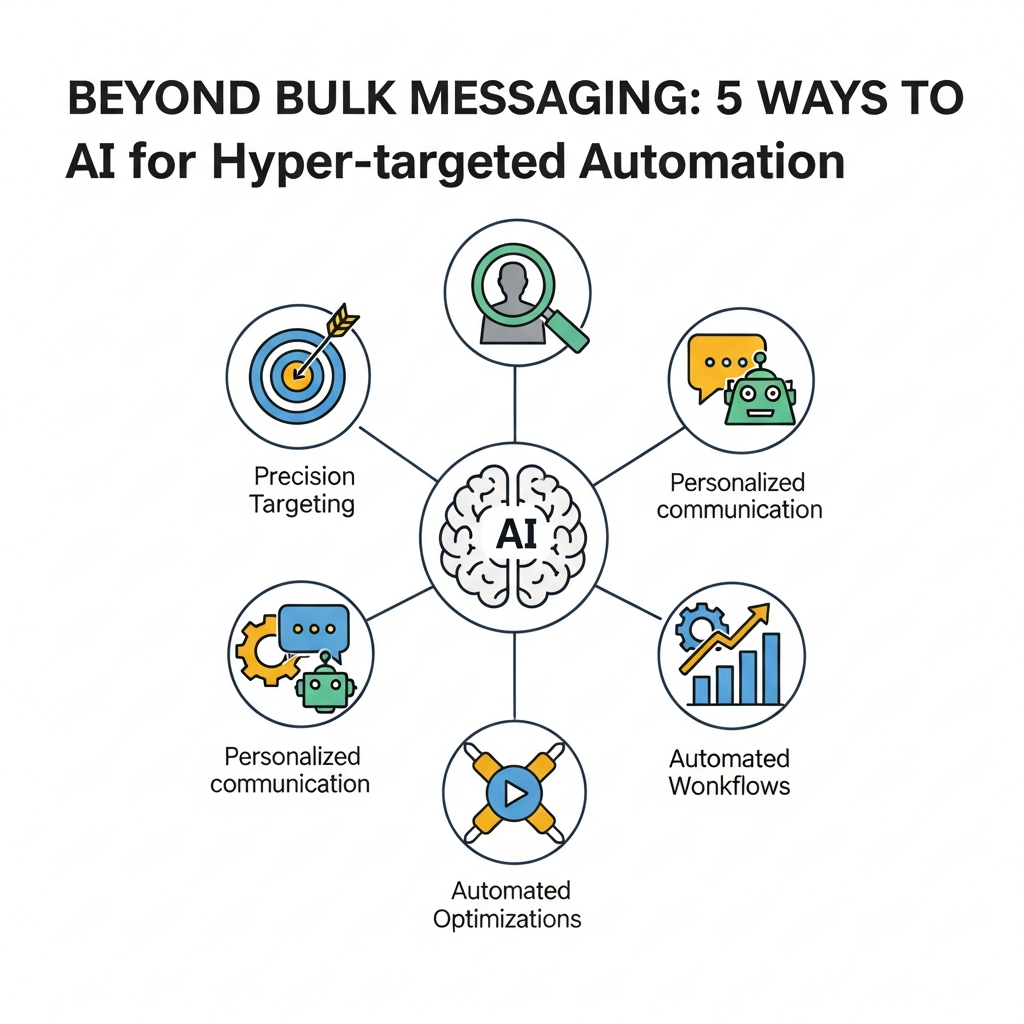
Beyond Bulk Messaging: 5 Ways to Use Ai for Hyper-targeted Automation
Beyond Bulk Messaging: 5 Ways to Use Ai for Hyper-targeted Automation concept 1

The Death of the “Spray and Pray” Era: Why Bulk Messaging is a Liability

I remember the specific moment I realized the old way of doing things was utterly, irredeemably dead. It was 2018. I was working with a mid-sized SaaS firm that had just invested six figures into a “cutting-edge” bulk-sending platform. We fired off a campaign—beautifully designed, grammatically perfect—to 50,000 leads. The result? A 0.2% click-through rate and a permanent blacklisting from three major ISP servers. It felt like shouting into a hurricane and expecting someone to hear a whisper. It wasn’t just a failure of technology; it was a failure of empathy. We were treating human beings like rows in a CSV file.

Today, the landscape is even more unforgiving. Our inboxes are digital fortresses. Gatekeepers are no longer just human assistants; they are sophisticated AI filters designed to detect “automated” patterns with surgical precision. If your outreach feels like a template, it dies in the spam folder. Period. But here is the paradox: to achieve true, human-level scale, we need the very thing that created the problem—Artificial Intelligence. The difference lies in how we wield it. We are moving beyond the era of bulk messaging and into the age of Hyper-targeted Automation.

This isn’t about sending more emails. It’s about sending the right message, to the right person, at the exact moment their pain point becomes unbearable. It’s about using Large Language Models (LLMs) and predictive analytics to simulate the thoughtfulness of a boutique consultancy at the scale of a global enterprise. Let’s peel back the layers on how we actually do this without losing our souls in the process.

Beyond Bulk Messaging: 5 Ways to Use Ai for Hyper-targeted Automation concept 2

1. Psychographic Segmentation and Semantic Intent Mapping

Traditional segmentation is lazy. We usually group people by job title, industry, or geography. “Marketing Managers in Chicago.” That tells us nothing about their current psychological state or their immediate business needs. Psychographic segmentation powered by AI looks at the why behind the person. By leveraging Natural Language Processing (NLP), we can scrape a prospect’s recent LinkedIn posts, their company’s quarterly earnings reports, or even their interviews on podcasts to determine their “Semantic Intent.”

Think about it. Is the prospect currently in a “Defensive” posture (cutting costs, optimizing existing stacks) or an “Aggressive” posture (hiring rapidly, expanding into new markets)? An AI can analyze thousands of data points to categorize leads into these nuanced buckets. When you know a CTO is currently obsessed with “Technical Debt” because they mentioned it three times in a recent webinar, your automation shouldn’t talk about “Innovation.” It should talk about “Refactoring and Efficiency.”

The “Digital Body Language” Framework

  • Linguistic Mirroring: AI identifies the specific vocabulary a prospect uses. If they use academic language, your automation adapts. If they are punchy and informal, the AI softens the tone.
  • Sentiment Velocity: Is the prospect’s public sentiment becoming more frustrated or more optimistic? AI tracks this shift, triggering messages when a “frustration peak” is detected.
  • Thematic Clustering: Instead of static lists, AI creates fluid clusters based on shared challenges. You’re not messaging “HR Directors”; you’re messaging “Leaders struggling with remote culture retention.”

By the time the message hits their inbox, it doesn’t feel like marketing. It feels like synchronicity. It feels like you’ve been paying attention—because, through the lens of your AI, you have.

Beyond Bulk Messaging: 5 Ways to Use Ai for Hyper-targeted Automation concept 3

2. Generative Contextualization: Moving Beyond {First_Name}

We’ve all seen the {First_Name} tag fail. “Hi [FIRST_NAME], I saw you work at [COMPANY_NAME]!” It’s the digital equivalent of a limp handshake. Generative AI, specifically through Retrieval-Augmented Generation (RAG), allows us to inject actual, live context into every single outgoing message. This isn’t just “personalization”; it’s “contextualization.”

Imagine an automation workflow that, before sending an email, performs a real-time Google search for the prospect’s company. It finds a news article from three hours ago stating they just won a green energy award. The AI then synthesizes that information and writes a custom opening sentence: “I noticed your team just took home the Green Tech Excellence award this morning—quite a feat considering the competitive landscape in the Pacific Northwest.”

Implementing the “Reason for Outreach” (RFO) Engine

To do this at scale, you need an RFO engine. This is a middleware layer where your CRM talks to an LLM (like GPT-4 or Claude 3) and a search API. The process looks like this:

  • Step A: Triggered by a lead entering a stage.
  • Step B: AI scrapes the most recent “signal” (a new hire, a funding round, a specific social media comment).
  • Step C: The LLM drafts a unique “bridge” paragraph connecting that signal to your value proposition.
  • Step D: A human (or a high-level “Reviewer AI”) checks for hallucinations before the “Send” button is cleared.

This level of idiosyncratic detail is impossible for a human to do for 500 leads a day, but it’s trivial for an AI. The result is a message that passes the “Turing Test” of sales outreach every single time.

>3. Predictive Lead Scoring and Behavioral Decay Models

Most automation is chronological. “Send Email 1 on Day 1, Email 2 on Day 3.” This is fundamentally flawed because humans don’t operate on a linear schedule. Life happens. Projects blow up. People go on vacation. Predictive Lead Scoring uses machine learning to determine the “Propensity to Engage” in real-time.

Instead of a static sequence, imagine a dynamic web. If a prospect opens your initial email three times in one hour but doesn’t reply, that is a high-intent signal. Most legacy systems would just wait for the next scheduled email. An AI-driven system, however, recognizes this “Engagement Spike” and immediately triggers a low-friction “nudge”—perhaps a LinkedIn connection request or a highly specific case study related to the link they clicked.

The Concept of “Lead Decay”

On the flip side, we have to talk about Negative Signals. If a lead hasn’t interacted with your content in 14 days, their “score” decays. Rather than continuing to pepper them with “Just circling back!” emails (which is the quickest way to get marked as spam), the AI shifts them into a “Passive Nurture” track. This track might only send a high-value, non-salesy industry report once a month. We are using AI to respect the prospect’s silence, which is a form of empathy that builds long-term brand equity.

Data science allows us to look at historical patterns. If the data shows that VPs of Engineering are most likely to book a demo on Tuesday mornings after their department stand-up, the AI holds your message until that precise window. We are optimizing for receptivity, not just delivery.

>4. Autonomous Conversational Nurturing (The “Anti-Bot” Bot)

The most exhausting part of any outreach is the “in-between.” It’s the “Can you send me more info?” or the “Check back in six months” replies. These are often where deals go to die because humans are inconsistent at follow-ups. However, standard “If-This-Then-That” chatbots are too rigid. They can’t handle the nuance of a human saying, “I’m interested, but my budget is currently tied up in the Q3 restructuring.”

Modern Autonomous Agents can. By using specialized LLMs trained on your specific product documentation and past successful sales transcripts, these agents can handle the “Middle of the Funnel” conversations with startling fluidity. They don’t just provide canned answers; they negotiate, they clarify, and they empathize.

Bridging the Gap Between Automation and Human Intervention

The secret is the “Hand-off Protocol.” You don’t want an AI closing a million-dollar contract (yet). You want the AI to handle the 80% of repetitive clarifying questions so that when a human salesperson steps in, the prospect is “warm” and informed.

I’ve seen this work brilliantly in high-ticket consulting. The AI handles the initial vetting, asks about the prospect’s current roadblocks, and even provides a few “quick win” suggestions. By the time the consultant jumps on a Zoom call, the prospect already feels like they’ve received value. The AI has acted as a sophisticated concierge, not a telemarketer.

>5. Multi-Channel Orchestration and Attribution AI

Hyper-targeted automation cannot exist in a vacuum. If you are only using email, you are missing 70% of the conversation. But the problem with multi-channel (Email, LinkedIn, Twitter, Direct Mail, SMS) is that it usually becomes a disjointed mess. The prospect receives an email and a LinkedIn message that say the exact same thing. It’s robotic and annoying.

Attribution AI solves this by creating a “Single Source of Truth.” It tracks the prospect’s journey across every touchpoint and adjusts the automation accordingly. If the prospect engaged with a specific whitepaper on your website via a LinkedIn ad, the subsequent email automation should acknowledge that specific whitepaper’s content. It’s about creating a cohesive narrative arc.

The “Surround Sound” Strategy

  • Phase 1: Awareness. AI triggers targeted ad placements on the prospect’s social feeds based on their psychographic profile.
  • Phase 2: Engagement. Once the AI detects a “View” or a “Like,” it triggers a personalized LinkedIn message referencing the ad’s topic.
  • Phase 3: Validation. If they respond, an automated (but highly contextual) email is sent with a bespoke video or document.
  • Phase 4: Conversion. A direct mail piece (yes, physical mail) is triggered via an API, containing a QR code that leads to a personalized landing page.

This isn’t bulk messaging; it’s an orchestrated symphony. Each channel plays a different part, but they are all reading from the same sheet music. The AI acts as the conductor, ensuring that no note is played too loudly or out of turn.

>The Ethics of Precision: Staying Human in a Machine World

As we lean into these incredibly powerful tools, there is a visceral danger of becoming “too efficient.” There is a fine line between “highly targeted” and “creepy.” If you tell a prospect you know what they had for breakfast because your AI scraped their Instagram, you’ve lost. The goal of hyper-targeted automation is to reduce friction, not to eliminate the human element.

I always tell my teams: “Use AI to do the research, but use humans to set the intent.” AI is a multiplier. If you multiply “cynical, salesy aggression,” you just get a faster version of what everyone hates. But if you multiply “genuine curiosity and a desire to help,” you create something transformative. We must use these tools to buy back our time so we can spend that time on the high-level creative strategy and deep relationship building that no machine can ever replicate.

The future of business isn’t “AI vs. Human.” It’s “Human + AI vs. The Old Way.” By moving beyond the blunt instrument of bulk messaging and embracing the surgical precision of hyper-targeted automation, we aren’t just sending better messages. We are building better businesses. We are treating our prospects with the respect of a tailored experience, and in return, they are giving us the one thing money can’t buy: their attention. And in today’s economy, attention is the only currency that truly matters.

It’s time to stop shouting. It’s time to start whispering the right things into the right ears.

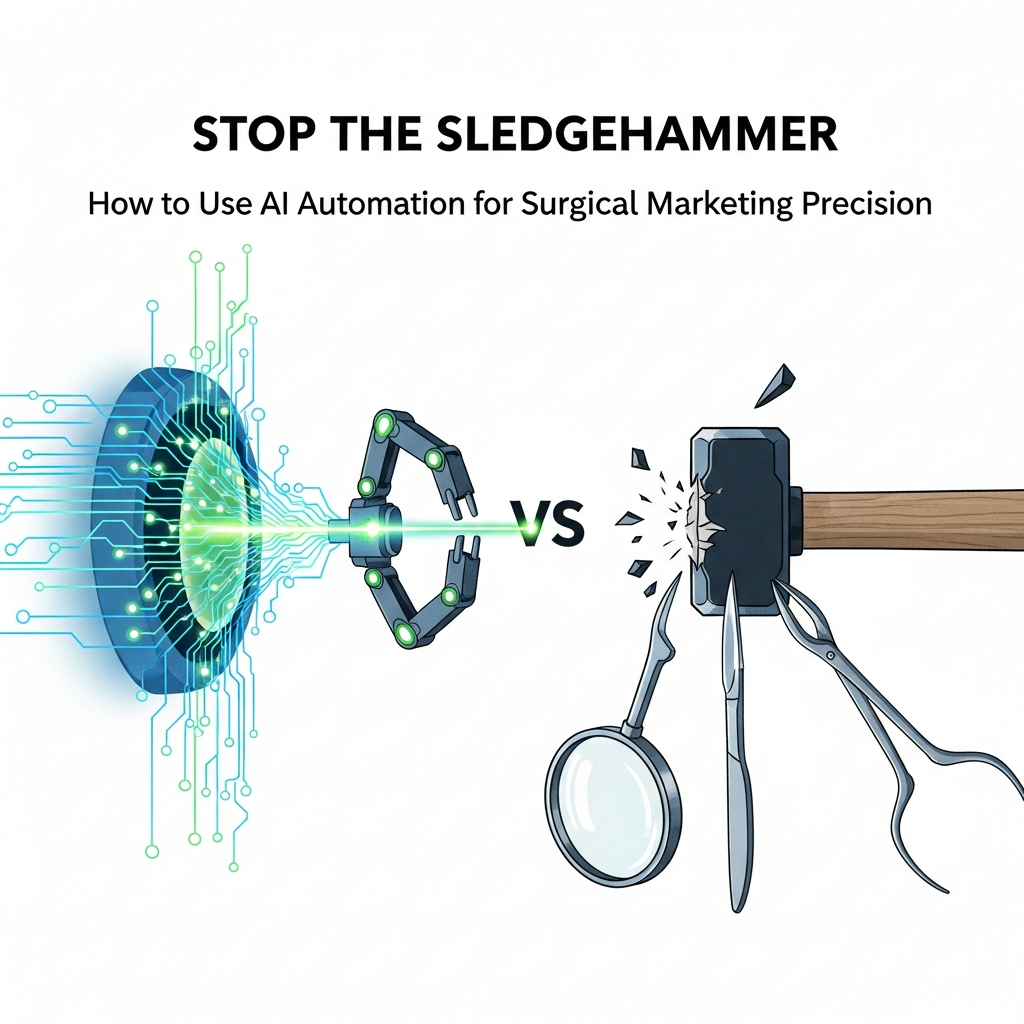
Stop the Sledgehammer: How to Use Ai Automation for Surgical Marketing Precision
Stop the Sledgehammer: How to Use Ai Automation for Surgical Marketing Precision concept 1

The Morning the Sledgehammer Broke

It was 3:00 AM on a Tuesday when I finally hit “delete” on a sixty-page marketing strategy I’d spent three months building. Why? Because I realized I was just designing a more expensive sledgehammer. We’ve all been there—staring at a dashboard, watching conversion rates flatline despite having “state-of-the-art” automation tools screaming at us that everything is optimized. It wasn’t optimized. It was just loud. In our desperate rush to adopt AI, we’ve collectively traded our scalpels for blunt instruments, battering our audiences with generic, high-frequency “content” that has the nutritional value of wet cardboard.

I’ve spent fifteen years in the trenches of digital strategy, and I’ve seen the pendulum swing from manual labor to mindless automation. Right now, we’re in the “mindless” phase. We use AI to generate 5,000 blog posts a month, hoping the sheer volume will crack the algorithm. We use it to blast “personalized” emails that feel about as personal as a court summons. This is the Sledgehammer Approach, and frankly, your customers are tired of the noise. They don’t want more; they want better. They want surgical precision.

Precision marketing isn’t about doing things faster. It’s about doing fewer things, but with such calculated accuracy that the impact is undeniable. It’s the difference between carpet bombing a city and a laser-guided delivery. If you’re ready to put down the heavy tools and start operating with a surgeon’s steady hand, let’s talk about how AI actually works when you stop treating it like a glorified intern.

Stop the Sledgehammer: How to Use Ai Automation for Surgical Marketing Precision concept 2

The Cognitive Dissonance of Modern Automation

We’re living in a strange paradox. We have access to the most sophisticated Large Language Models (LLMs) and predictive engines in human history, yet marketing has never felt more robotic. This happens because most teams use AI as a generative crutch rather than an analytical engine. They use it to fill space. If you’re using ChatGPT to “write a LinkedIn post about synergy,” you’re using a sledgehammer. You’re contributing to the entropy of the internet.

The “Mid-Wit” Trap in AI Adoption

There’s a specific curve to AI adoption. At the bottom, you have people who fear it. In the middle—where most “growth hackers” live—you have the sledgehammer users. They automate everything, create massive “top-of-funnel” noise, and wonder why their Brand Equity is bleeding out. At the top of the curve? That’s where the surgeons live. These are the practitioners who use AI to identify micro-segments of 50 people who are exactly 72 hours away from making a purchase decision based on a specific pain point they haven’t even articulated yet.

To move from the middle to the top, you have to embrace Perplexity. In linguistics, perplexity is a measure of how well a probability model predicts a sample. In marketing, it’s your ability to surprise and delight a customer with something so relevant it feels like you’re reading their mind. Sledgehammers have zero perplexity. They are predictable. And in a world of infinite scrolls, predictable is invisible.

Stop the Sledgehammer: How to Use Ai Automation for Surgical Marketing Precision concept 3

Step 1: Diagnostic Data—Sharpening the Blade

Before you can operate, you need a clear view of the patient. Most companies sit on mountains of “dark data”—customer interactions, support tickets, abandoned carts, and social sentiment that never gets analyzed. They look at Google Analytics and see “Users” and “Sessions.” That’s a sledgehammer metric. It’s too broad to be useful.

Surgical marketing requires Vectorized Intent. Instead of seeing a user who visited your pricing page, a surgical AI system analyzes the *sequence* and *velocity* of their actions. Did they come from a technical whitepaper? Did they spend four minutes on the “Integrations” section but only ten seconds on “Pricing”? This isn’t just data; it’s a narrative.

  • Natural Language Processing (NLP) on Support Tickets: Use AI to categorize the *emotional state* of your customers. Are they frustrated with a feature or confused by the UI? Stop sending them “feature update” emails if they’re currently angry about a bug.
  • Predictive Churn Modeling: Instead of reacting when someone cancels, use machine learning to identify the “quiet withdrawal”—the moment a user’s engagement frequency drops by 15% over a three-day rolling average. That’s when the surgeon steps in with a targeted intervention.
  • Zero-Party Data Enrichment: Stop guessing. Use AI-driven micro-surveys that adapt in real-time based on the user’s previous answer. This isn’t a static form; it’s a conversation.

The Myth of the “Ideal Customer Persona”

I’m going to say something controversial: The ICP is dead. Or at least, the way we use it is dead. “Marketing Mary, 35, lives in the suburbs” is a sledgehammer. People are too complex for that now. Surgical marketing replaces static personas with Dynamic Cohorts. These are clusters of individuals who share a specific behavior or problem at a specific moment in time. AI allows us to manage 500 micro-cohorts simultaneously, something no human marketing team could ever do manually.

>Step 2: Predictive Content Architectures

Once you have the data, what do you do with it? Most people just make more content. “We need more top-of-funnel!” they scream. No. You need more High-Context Content. This is where the surgical precision of AI automation really starts to shine. We’re moving away from “The Big Campaign” and toward “The Continuous Stream of Relevance.”

Think about the last time you received an automated email that actually made you stop. It probably didn’t just have your name in the subject line. It probably referenced a specific problem you were having or a goal you were chasing. That’s Retrieval-Augmented Generation (RAG) in action. By connecting your AI to your proprietary data (your blog, your case studies, your product docs), the AI can generate responses that are deeply rooted in your specific expertise, not just generic web-scraped noise.

Building the “Context Engine”

To do this, you need a tech stack that talks to itself. It’s not just about having an ESP (Email Service Provider) and a CRM. It’s about an Orchestration Layer. Here is how a surgical content workflow looks:

  1. Trigger: A prospect downloads a technical guide on “Scalable Infrastructure.”
  2. Analysis: The AI cross-references this with their LinkedIn profile (via API) and realizes they are a Lead Engineer at a Series B startup.
  3. Syntheses: Instead of a generic “Thanks for downloading” email, the AI pulls a specific paragraph from a case study involving another Series B company in the same industry.
  4. Execution: It generates a personalized video script for the sales rep, highlighting exactly why this lead engineer should care about Section 4 of that guide.

This is surgical. It’s quiet. It’s hyper-relevant. It doesn’t feel like marketing; it feels like service.

>Step 3: The Human-in-the-Loop (HITL) Imperative

Here is the “imperfect” truth: AI is a brilliant idiot. It can process a billion data points in a second, but it doesn’t know what it feels like to be afraid of losing a job. It doesn’t understand the subtle political nuances of a boardroom. This is where most automation strategies fail—they remove the human entirely because they want “efficiency.”

True surgical precision requires a Human-AI Symbiosis. The AI provides the data, the scale, and the initial draft; the human provides the empathy, the ethics, and the “soul.” If your marketing feels robotic, it’s because you’ve outsourced your taste to an algorithm. Never outsource your taste.

In my own workflow, I use AI to “stress test” my ideas. I’ll feed it my pitch and say, “Act as a cynical CFO who hates spending money on marketing. Rip this apart.” The AI gives me the analytical pushback, which allows me to refine my human-centric message. That’s using the tool for precision, not just production.

The “Cringe” Filter

We need to talk about the “Uncanny Valley” of marketing. You know that feeling when you get an AI-generated message that *almost* sounds human, but something is just… off? It’s too polished. It’s too “LinkedIn-fluencer.” It’s cringey. Surgical marketing avoids this by intentionally leaning into Human Imperfection. Sometimes, a short, plain-text email with a typo is more effective than a perfectly formatted, AI-optimized newsletter because the typo proves a human was there.

>Step 4: Real-Time Optimization (The “Closing” Phase)

A surgeon doesn’t just cut and walk away; they monitor vitals throughout the entire procedure. Most marketers “set and forget” their automations. They build a drip sequence and let it run for six months. That’s a sledgehammer move. The market moves too fast for that.

Surgical automation uses Feedback Loops. If an AI-generated subject line isn’t performing with a specific micro-segment after 100 sends, the system should automatically pivot, test a new hypothesis, and alert the human strategist. This is “Continuous Discovery.”

  • Multi-Armed Bandit Testing: Instead of traditional A/B testing (which is slow and often inconclusive), use Multi-Armed Bandit algorithms. These dynamically shift traffic toward the winning variant in real-time, minimizing the “regret” of showing low-performing content to potential leads.
  • Sentiment Drift Monitoring: Use AI to monitor how the conversation around your brand is changing. If a competitor launches a new feature, your automation should be able to detect the shift in customer inquiries and adjust the “surgical” focus of your outbound messaging within hours, not weeks.
  • Micro-Conversion Tracking: Stop obsessing over the “Final Sale.” Track the small wins—did they click the ‘technical docs’? Did they watch more than 30 seconds of the demo? These micro-conversions are the “vitals” that tell you if the surgery is succeeding.

>The Ethical Scalpel: Privacy as a Feature

We cannot talk about precision without talking about privacy. The more surgical you get, the closer you get to the “creepy” line. There is a very fine line between “Wow, this is exactly what I needed” and “How did they know I was talking about that in my kitchen?”

Surgical precision requires Radical Transparency. Use AI to be better at respecting boundaries, not finding ways around them. Use it to scrub your lists of people who haven’t engaged. Use it to ensure you aren’t over-targeting the same individual across seven different channels. Precision is as much about restraint as it is about action. A surgeon doesn’t cut more than they have to. A precision marketer doesn’t send more emails than necessary.

In an era of GDPR and CCPA, your AI should be your first line of defense in compliance, automatically flagging data that shouldn’t be there and ensuring that “Personalization” never turns into “Surveillance.”

>Implementing the Precision Stack: A No-Fluff Guide

I promised no fluff, so here is the actual architectural logic you need. You don’t need a million-dollar budget; you need a cohesive logic. You need to move from a “Linear Funnel” to a “Circular Ecosystem.”

The Foundation: The Vector Database. If you’re serious about surgical AI, you need to move beyond relational databases. A vector database (like Pinecone or Weaviate) allows your AI to understand the “semantic meaning” of your data. It allows the AI to find connections between a customer’s LinkedIn comment and their behavior on your pricing page that a standard CRM would miss.

The Logic Layer: Low-Code Automation. Tools like Make.com or Zapier are the “connective tissue.” They allow you to build complex, conditional logic. If the AI detects “High Intent” + “High Technical Knowledge,” then send them to the “Expert Workflow.” If it detects “Confusion” + “Low Engagement,” then send them to the “Education Workflow.”

The Execution Layer: Modular Content. Stop writing “Emails.” Start writing “Content Modules.” These are small snippets of value—a testimonial, a technical tip, a discount code—that the AI can assemble in real-time like Lego bricks based on the recipient’s specific needs. This is how you achieve “Surgical Personalization” at scale without losing your mind.

>The Final Reckoning: Putting Down the Sledgehammer

Transitioning to surgical marketing is painful. It requires you to admit that much of what you’ve been doing—the mass blasts, the generic social calendars, the “volume-first” mindset—isn’t working. It requires you to slow down so you can eventually move much, much faster. It requires an empathetic understanding that there is a human being on the other side of that data point.

I’ve seen companies double their revenue by cutting their email volume in half. I’ve seen brands go from “ignored” to “essential” by simply using AI to listen better than they talk. The sledgehammer is easy. It’s heavy, it’s loud, and it feels like work. But the surgery? That’s where the healing happens. That’s where the growth is.

Stop trying to break down the door. The door isn’t even locked; you just need to find the right key. Use your AI to find that key. Use it to understand the nuance, the timing, and the quiet signals that everyone else is ignoring. Be the surgeon in a world of demolition crews. Your customers will thank you for it, and your bottom line will reflect the difference between a mess and a masterpiece.

The era of the sledgehammer is over. It’s time to pick up the scalpel. Are you ready to operate?

Ai as a Scalpel: Why Precision Targeting Beats Bulk Messaging Every Time
Ai as a Scalpel: Why Precision Targeting Beats Bulk Messaging Every Time concept 1

The Great Digital Noise: Why Your Inbox Feels Like a War Zone

I’ll be honest with you. Last Tuesday, I went through my “Promotions” tab and deleted 442 emails without opening a single one. It wasn’t because I was busy. It was because I felt invaded. My digital space has become a dumping ground for the “spray and pray” methodology—a relic of 2010 marketing that refuses to die. We’ve all been there, haven’t we? The generic “Hi [First_Name],” the follow-up that “just wants to bubble this to the top of your inbox,” and the desperate LinkedIn pitches that read like they were written by a blender.

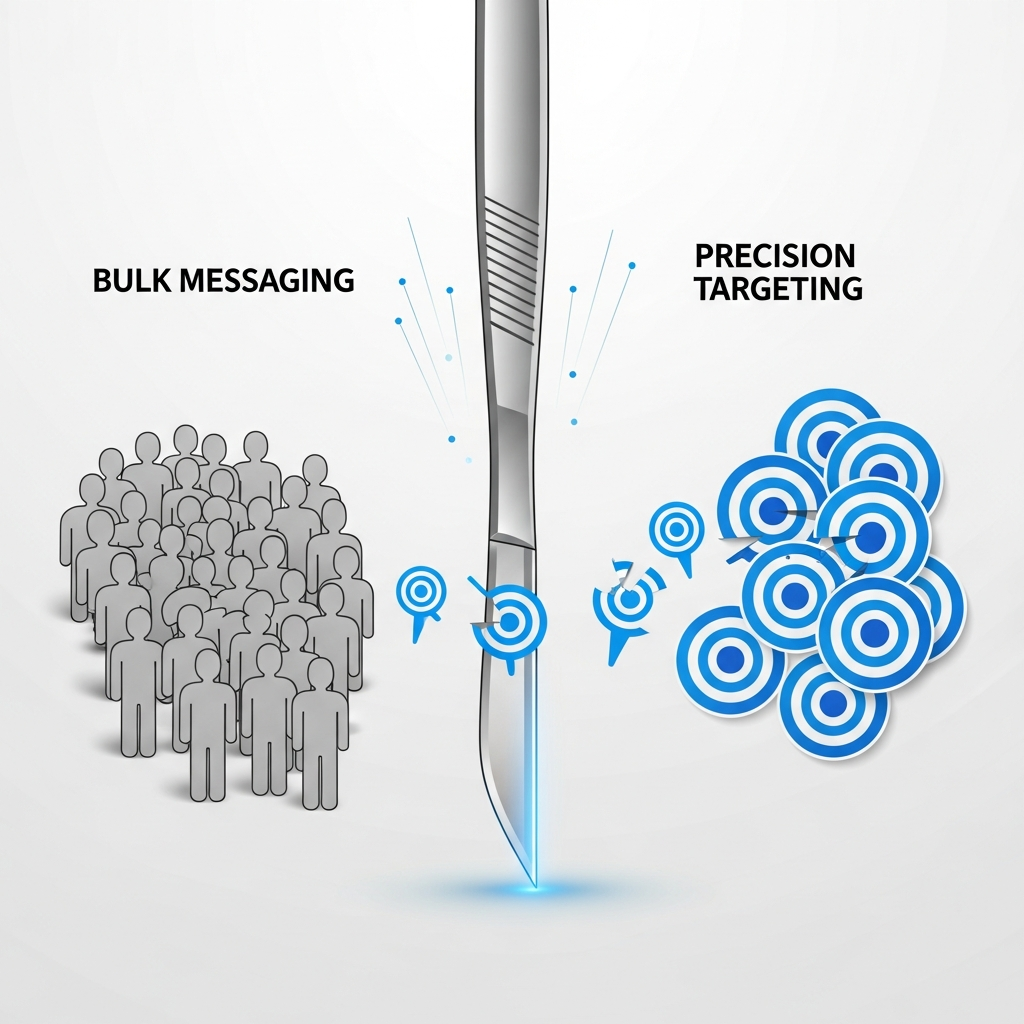
The problem isn’t just that these messages are annoying; it’s that they represent a fundamental misunderstanding of human psychology and modern technology. We are currently living through the “Tragedy of the Digital Commons.” Marketers have overgrazed the fields of our attention, leaving behind a barren landscape of cynicism. This is where the AI Scalpel comes in. It’s not just a tool; it’s a philosophical shift. It is the transition from being a loud, clumsy giant with a megaphone to being a precision surgeon who knows exactly where to make the incision to save the patient’s time—and your ROI.

In this guide, we’re going to dissect why bulk messaging is a fast track to brand irrelevance and how you can leverage AI to perform “surgical” strikes that actually resonate. This isn’t about “hacks.” It’s about the brutal, beautiful efficiency of relevance.

Ai as a Scalpel: Why Precision Targeting Beats Bulk Messaging Every Time concept 2

The Blunt Trauma of Bulk Messaging: A Post-Mortem

Let’s get analytical for a moment. Why does bulk messaging fail so spectacularly in the current era? It comes down to Cognitive Load. Every time a person interacts with a piece of content that is irrelevant to them, they experience a micro-friction. They have to expend energy to categorize it as “trash.” Do this enough times, and the brain builds a permanent firewall against your brand.

The Math of Diminishing Returns

Old-school marketers love the “numbers game.” They argue that if you send 100,000 emails and get a 0.01% conversion rate, you’ve still made 10 sales. But they ignore the Brand Erosion Cost. You didn’t just get 10 sales; you also alienated 99,990 potential future customers who now associate your logo with a mild sense of irritation. That is a massive, unquantified liability on your balance sheet.

The Algorithmic Penalty

It’s not just humans who hate bulk. The gatekeepers—Google, Outlook, Apple Mail—have evolved. Their spam filters are no longer just looking for keywords like “Viagra” or “Free Money.” They are looking at engagement signals. If your bulk messages have low open rates and high “delete-without-reading” rates, the algorithms learn that you are a nuisance. You aren’t just missing an inbox; you’re being buried in a digital shallow grave.

Ai as a Scalpel: Why Precision Targeting Beats Bulk Messaging Every Time concept 3

The Scalpel Philosophy: AI as a Tool for Radical Relevance

When we talk about AI as a scalpel, we’re talking about intent-based targeting. It’s the ability to move beyond demographics (Age, Gender, Location) and into the realm of psychographics and behavioral triggers. Bulk is “Who are they?” Precision is “What do they need *right now*, and how do they feel about it?”

Semantic Understanding vs. Keyword Matching

Most traditional targeting is based on keywords. If a user searches for “running shoes,” they get bombarded with ads for running shoes for three weeks. But what if they already bought the shoes? What if they were actually searching for “how to fix a running shoe injury”? AI allows us to understand the semantics—the meaning behind the action. A precision AI model looks at the context. It realizes the user is in “problem-solving mode,” not “buying mode.” Instead of a discount code, the “scalpel” delivers an article on injury prevention. That is how you build trust.

The End of the Funnel, The Rise of the Labyrinth

We’ve been taught to think of marketing as a funnel. You pour a lot in the top, and a little comes out the bottom. That’s a blunt-force metaphor. Modern customer journeys are more like a labyrinth. People move sideways, they double back, they pause. AI allows us to track these movements in real-time, providing the exact piece of information needed at that specific turn in the maze. It’s supportive, not pushy.

>Deconstructing the “Surgical” AI Stack

To move from bulk to precision, you need a different kind of infrastructure. It’s not about having more data; it’s about having refined data. Here is how the “scalpel” is actually built in a modern enterprise environment.

1. Vector Databases and Latent Intent

Forget standard SQL tables for a second. Precision targeting often utilizes vector databases. These allow us to map “embeddings”—mathematical representations of concepts. If a customer is looking at “sustainable leather,” the AI understands the proximity to concepts like “ethical sourcing,” “durability,” and “minimalism.” It doesn’t just look for the word “leather.” It understands the values of the consumer. This allows you to message them with content that aligns with their worldview, which is a far more powerful hook than a 10% off coupon.

2. Predictive Lead Scoring (The “Why” Behind the Score)

Traditional lead scoring is often arbitrary. “Oh, they clicked a link? Give them 5 points.” AI lead scoring is nuanced. It uses machine learning to identify patterns that a human would never see. For example, it might find that users who visit your pricing page on a mobile device on a Saturday afternoon but have previously watched a 3-minute video on your “About” page are 80% more likely to convert if they receive a case study, not a sales call. The AI finds the “invisible” correlations.

3. Hyper-Personalized Synthetic Content

This is where it gets interesting—and where you have to be careful. Large Language Models (LLMs) allow us to generate unique messages for every single recipient. I’m not talking about swapping out a name tag. I’m talking about changing the tone, the examples used, and the narrative structure based on the recipient’s past interactions. If I know a lead is an analytical engineer, my AI-generated reach out will be data-heavy and concise. If they are a creative director, it will be visual and narrative-driven. One message, ten thousand variations, zero human fatigue.

>The Anatomy of a Precision Campaign: A Hypothetical Case Study

Let’s look at two companies. Company A uses the “Blunt Hammer.” Company B uses the “AI Scalpel.”

The Scenario: A B2B SaaS company selling project management software.

Company A (Bulk): They buy a list of 50,000 “CTOs and Project Managers.” They send a sequence of 5 emails. “Struggling with deadlines? Our tool helps you stay organized. Click here for a demo.”
Result: 0.2% open rate. 5 demos booked. 400 “Unsubscribe” requests. Brand reputation: “Just another spammer.”

Company B (Precision): They use AI to monitor LinkedIn job postings and GitHub activity. They identify 200 companies that have recently hired 5+ new developers—a sign of scaling friction. They then use an LLM to analyze the specific tech stack mentioned in those job posts.
The Message: “Hey [Name], I saw you’re scaling the engineering team at [Company] and moving toward [Specific Tech Stack]. Usually, that transition creates a bottleneck in sprint planning. Here’s a 2-minute breakdown of how we handled that specific friction point for [Similar Competitor].”
Result: 35% open rate. 12 demos booked. 0 unsubscribes. Brand reputation: “These people actually understand my job.”

Company B spent more time on the “cut,” but they didn’t waste any “blood.” They didn’t need 50,000 people to listen. They needed 200 of the right people to feel understood.

>The Cognitive Cost of Being Wrong: Why “Close Enough” Isn’t Good Enough

There is a dangerous middle ground in marketing: the “Uncanny Valley” of personalization. This happens when you try to use AI but do it poorly. You’ve seen it—the email that says, “I saw you’re a fan of [Niche Hobby]!” when you just clicked a link by accident once. This feels creepy and manipulative.

As a copywriter, I advocate for the Supportive Tone. When you use a scalpel, you must do so with the intent to heal (or help), not just to extract. If your AI targeting feels like a “gotcha,” you’ve failed. It should feel like a “finally.” As in, “Finally, someone sent me something I actually needed to read.”

The “Is This Helpful?” Litmus Test

Before deploying any AI-driven precision campaign, ask yourself: If this person were standing in front of me, would I feel comfortable saying this to them based on what I know? If the answer is no, your AI is being a stalker, not a strategist. Precision requires empathy. You are using data to better understand a human being’s frustrations, not to exploit their weaknesses.

>Overcoming the Infrastructure Inertia

I know what you’re thinking. “This sounds expensive and complicated.” It’s actually less expensive than wasting $50,000 a month on bulk ads that get ignored. The shift to precision is an investment in efficiency.

Clean Your Room (Data Hygiene)

You cannot perform surgery with a dirty scalpel. Most companies have “dirty” data—duplicate entries, outdated titles, and fragmented touchpoints. The first step to AI precision isn’t buying a fancy LLM; it’s data orchestration. You need a single source of truth where all customer interactions are logged. If your CRM doesn’t talk to your website analytics, your scalpel is blunt.

Start with Micro-Segments

Don’t try to hyper-personalize for your whole audience on Day 1. Pick your top 5%—your “Whales” or your most loyal advocates. Use AI to analyze their patterns. Why do they stay? What was the “Aha!” moment for them? Once you understand the precision needed for your best customers, you can start to model that for the rest of your leads.

>The Ethical Scalpel: Privacy in the Age of Precision

We have to address the elephant in the room: Privacy. In an era of GDPR and CCPA, the “Scalpel” approach might seem like it’s skirting the line of surveillance. However, I’d argue that precision is actually more ethical than bulk. Bulk messaging is “Attention Theft.” You are stealing seconds of life from thousands of people for something they didn’t ask for.

Precision targeting, when done correctly, relies on Zero-Party and First-Party Data. This is data the user has willingly given you or generated through their direct interaction with your brand. By using AI to make that experience better, you are fulfilling the “Implicit Contract” of digital commerce: I give you my data, and in return, you don’t waste my time.

Transparency as a Feature

One of the best ways to humanize your AI is to be transparent about it. I’ve seen incredible results from companies that literally say: “Our system noticed you’ve been struggling with [Topic], so we generated this specific report for you.” It turns the “creepiness” into utility. It shows the recipient that you are using your technology to serve them, not just to track them.

>The Future: From Precision to Prediction

Where does the scalpel go from here? We are moving into the era of Predictive Empathy. This isn’t just reacting to what a user did; it’s anticipating what they will need before they even realize it. Imagine an AI that notices a change in a user’s typing rhythm or interaction frequency—indicators of stress or frustration—and automatically simplifies the interface or offers a direct human support line.

That is the ultimate expression of the scalpel. It’s not just about “Targeting.” It’s about care. In a world that is increasingly automated and cold, the brands that use AI to become more “human”—by being more relevant, more timely, and more thoughtful—are the ones that will survive the Great Noise.

>Your Next Step: Laying Down the Megaphone

If you take nothing else from this, let it be this: Scale is a vanity metric; resonance is a sanity metric. Stop looking at how many people you reached. Start looking at how many people you touched. Turn off the bulk sequences for a week. Take a small segment of your audience, use every AI tool at your disposal to understand their specific, current pain points, and send them something so relevant it feels like a gift.

The scalpel is in your hand. The question is: are you ready to stop swinging and start cutting?

Precision isn’t just a strategy. It’s a sign of respect for your audience. And in the modern economy, respect is the only currency that doesn’t depreciate.

Dynamic Audience Segmentation: Moving Beyond Demographics to Behavioral Intent

The marketing industry has long been obsessed with the caricature. For decades, we have relied on the comfortable, albeit reductive, practice of building “buyer personas” that look more like a police sketch than a living, breathing human being. We speak of “Millennial Mike,” who lives in a metropolitan area, earns $75,000 a year, and enjoys artisanal coffee. We treat these demographic clusters as if they were destiny. But here is the uncomfortable truth that keeps Chief Marketing Officers awake at 3:00 AM: Millennial Mike does not exist. Or, more accurately, the version of Mike who buys a laptop is fundamentally different from the version of Mike who buys a mattress, regardless of his age, zip code, or affinity for medium-roast beans.

The tectonic plates of digital marketing are shifting. We are moving away from the static, ossified world of demographic targeting and toward the fluid, high-velocity realm of Dynamic Audience Segmentation. This isn’t just a buzzword to justify a software upgrade; it is a fundamental ontological shift. We are stoping asking “Who is this person?” and starting to ask “What is this person trying to achieve in this exact micro-moment?”

Visual for Dynamic Audience Segmentation: Moving Beyond Demographics to Behavioral Intent

The Demographic Delusion: Why Your Personas are Lying to You

To understand the necessity of behavioral intent, we must first perform a post-mortem on the demographic model. Demographics are descriptive, not predictive. They tell you what a person looks like on a census form, but they reveal absolutely nothing about the psychological triggers that lead to a conversion.

Consider the classic marketing paradox involving two men: both born in 1948, both raised in the UK, both incredibly wealthy, and both twice married with children. One is King Charles III; the other is Ozzy Osbourne. On a demographic spreadsheet, they are identical. In reality, if you try to sell a Gothic-themed bat-shaped velvet recliner to the King of England using the same creative you used for the Prince of Darkness, your ROI will be a tragic comedy. This is the “Demographic Delusion”—the mistaken belief that shared identity traits equal shared purchase intent.

Demographics provide the skeleton, but behavioral intent provides the nervous system. While demographics remain useful for broad-stroke media buying and top-of-funnel brand awareness, they are woefully inadequate for the sophisticated middle and bottom-of-funnel orchestration required in a hyper-competitive digital landscape.

Visual for Dynamic Audience Segmentation: Moving Beyond Demographics to Behavioral Intent

Defining Dynamic Audience Segmentation

Dynamic Audience Segmentation is the practice of categorizing users into groups based on their real-time interactions, psychological states, and digital body language. Unlike static segments, which are updated weekly or monthly, dynamic segments are “living” entities. A user may enter a “High-Intent Luxury Shopper” segment at 2:15 PM and, after viewing a shipping policy or a negative review, exit that segment by 2:17 PM.

This approach leverages first-party data to monitor how a user moves through your digital ecosystem. It tracks the “velocity” of their engagement. Are they skimming headers, or are they lingering on the technical specifications page? Did they arrive via a generic search term like “best sneakers,” or a high-intent long-tail query like “Nike Air Zoom Pegasus 40 size 10 discount code”?

The Anatomy of Behavioral Intent

Behavioral intent is comprised of several layers of data that, when synthesized, create a high-fidelity picture of the consumer’s current mission. These layers include:

  • Transactional History: What they have bought in the past, the frequency of those purchases, and the average order value (AOV).
  • Engagement Recency: How long has it been since their last meaningful interaction with the brand?
  • Content Consumption: Which topics are they obsessing over? A user reading four articles on “Tax Implications of Crypto” is signaling a very different intent than a user reading “Top 10 Crypto Memes.”
  • Technical Signals: Device type, browser, and even the speed of their scroll can indicate whether they are “window shopping” on a mobile device during a commute or “power shopping” on a desktop with a credit card in hand.

“The modern consumer is a moving target. If your segmentation model is rooted in the past—even if that past was only five minutes ago—you are already irrelevant.”

>From Static Buckets to Fluid Flows: The Technical Pivot

Transitioning to dynamic segmentation requires a departure from the traditional “list-based” marketing approach. In the old world, you would export a CSV of “In-Active Users” from your CRM and upload it to your email service provider. By the time that email is sent, 10% of those users may have already re-engaged, making your “We miss you” discount code look redundant and desperate.

In the dynamic world, we utilize Customer Data Platforms (CDPs) and Real-Time Interaction Management (RTIM) tools. These systems act as a central nervous system, ingesting data from your website, mobile app, customer support tickets, and point-of-sale systems. They then use “If-This-Then-That” logic—often augmented by machine learning—to move users between segments instantaneously.

The Role of Machine Learning in Intent Detection

Human marketers are excellent at strategy, but we are terrible at processing millions of data points in milliseconds. This is where machine learning (ML) earns its keep. ML algorithms can identify “lookalike behaviors” rather than just “lookalike audiences.”

For example, an ML model might discover that users who view the “Careers” page and then the “Pricing” page are not actually prospective customers, but rather job seekers trying to research the company’s stability. A static demographic filter wouldn’t catch this. A dynamic behavioral filter, however, would immediately exclude these users from your expensive retargeting campaigns, saving you thousands in wasted ad spend.

>Mapping the Intent Spectrum

Not all intent is created equal. To master dynamic segmentation, you must map your audience along an Intent Spectrum. This allows you to tailor your messaging not just to who they are, but to where they are in their cognitive journey.

1. Informational Intent (The Researcher)

These users are looking for answers, not products. They use “How-to” and “What is” queries.
Dynamic Action: Serve them high-value educational content. Do not push for a sale; push for a newsletter sign-up or a whitepaper download. If you hit them with a “Buy Now” pop-up, you’ll trigger “marketing friction” and drive them away.

2. Navigational Intent (The Brand Seeker)

These users know who you are and are trying to find a specific page (e.g., “Brand Name Login”).
Dynamic Action: Make their path as frictionless as possible. If they are an existing customer, the homepage should dynamically change to show a “Welcome Back” message with a link to their most recent activity.

3. Commercial Investigation (The Comparison Shopper)

These users are in the “messy middle” of the funnel. They are comparing you against competitors. They are looking at “Reviews,” “Top 10,” and “Versus” pages.
Dynamic Action: This is the time for social proof. Serve them case studies, testimonials, and comparison charts that highlight your unique value proposition. Use dynamic overlays to offer a “Limited Time Trial” to tip the scales.

4. Transactional Intent (The Buyer)

The “Buy” signal is screaming. They have visited the pricing page three times in the last hour and have added an item to the cart.
Dynamic Action: Remove all distractions. Simplify the checkout. If they hesitate, trigger a real-time “Abandoned Cart” sequence via SMS or email within minutes, not days.

>Psychographic Nuance: The “Why” Behind the “What”

While behavioral intent tells us what a user is doing, psychographics tell us why they are doing it. When we combine behavioral triggers with psychographic profiling, we reach the zenith of dynamic segmentation.

Imagine two users both searching for “Electric SUVs.”
User A is motivated by status and innovation. They want the fastest 0-60 time and the most advanced autopilot features.
User B is motivated by environmental ethics and safety. They want to know about the sustainability of the battery supply chain and the car’s crash test ratings.

A dynamic system would analyze their previous content consumption. Has User A been reading articles about “Cutting Edge Tech”? Has User B been browsing “Eco-Friendly Living”? The dynamic segment would then serve User A a video of the SUV on a racetrack and User B a video of the SUV being safely driven through a pristine forest. Same product, same intent (to buy an SUV), but vastly different psychological drivers.

>The Privacy Paradox: Ethical Dynamic Segmentation

We cannot discuss advanced tracking without addressing the elephant in the room: privacy. With the demise of the third-party cookie and the rise of regulations like GDPR and CCPA, the “Wild West” of data collection is over. However, this is actually a boon for behavioral intent modeling.

Static demographics often relied on invasive, third-party data scraped from across the web. Dynamic segmentation, by contrast, thrives on First-Party Data—data the user has willingly given you through their interactions on your own properties. This is a value-exchange. Most consumers are willing to share their “digital body language” if it results in a more personalized, less annoying experience.

The key to ethical segmentation is transparency and “zero-party data” (data the user intentionally and proactively shares with a brand). For example, a “Style Quiz” on a clothing website is a goldmine for dynamic segmentation. The user gets a personalized recommendation, and the brand gets a deep understanding of intent without resorting to “creepy” cross-site tracking.

>Implementing a Dynamic Strategy: A Step-by-Step Framework

Moving from a static model to a dynamic one is not a weekend project. It requires a structural overhaul of how you view your audience. Follow this framework to begin the transition:

Step 1: Audit Your Data Silos

You cannot be dynamic if your email data lives in one tool, your website data in another, and your CRM in a third. Your first step is data orchestration. Ensure that every touchpoint is feeding into a centralized profile. If a customer complains on Twitter, your website should know about it ten seconds later.

Step 2: Define “High-Intent” Signals

Work with your sales and analytics teams to identify the “Golden Paths.” What are the specific behaviors that most often lead to a conversion? Is it visiting the “About Us” page? Is it downloading a specific case study? Assign a “Lead Score” to these behaviors. Once a user crosses a certain score, they are dynamically moved into a “High-Priority” segment.

Step 3: Create Modular Content Blocks

Dynamic segmentation is useless if you don’t have the content to support it. Instead of creating one large “Generic Homepage,” create modular content blocks that can be swapped out based on the user’s segment. A first-time visitor sees a “Brand Intro” block; a returning high-intent user sees a “Product Demo” block.

Step 4: Test, Learn, and Refine

The beauty of dynamic segmentation is that it is inherently measurable. Use A/B testing to see if your intent-based segments are actually outperforming your demographic ones. (Spoiler: They will.) Monitor your “Segment Decay”—how quickly users move in and out of groups—and adjust your triggers accordingly.

>The Burstiness of Human Interest

Traditional marketing assumes a linear progression: Awareness → Interest → Desire → Action. In reality, human interest is “bursty.” We might ignore a category for six months, then spend 48 hours in an obsessive research frenzy before making a purchase. Static demographics cannot capture this “burstiness.” They see a “35-year-old male” even when that male is in the middle of a 2:00 AM deep-dive into high-end espresso machines.

Dynamic segmentation honors this human erraticism. It recognizes that our interests are not our identities. We are not “The Outdoor Enthusiast”; we are a person who happens to be planning a hiking trip this week. By focusing on the intent of the moment, brands can be present when they are needed and invisible when they are not. This is the hallmark of sophisticated, human-centric marketing.

>The Future: Predictive Intent and Beyond

As we look toward the horizon, the next evolution of dynamic audience segmentation is Predictive Intent. This goes beyond reacting to what a user is doing and starts predicting what they will do. By analyzing the behavior of millions of previous customers, AI can identify the “pre-intent” signals that even the user isn’t aware of yet.

For example, a travel brand might notice that users who suddenly start checking the weather in multiple tropical locations while simultaneously browsing “noise-canceling headphones” have an 85% probability of booking a long-haul flight within the next 72 hours. Predictive segmentation allows the brand to serve the perfect offer before the user even types “flights to Bali” into a search engine.

>Conclusion: The End of the “Average” Customer

The era of “Average Joe” is over. In a world of infinite choice and dwindling attention spans, the only way to break through the noise is through radical relevance. This relevance cannot be found in a person’s age, gender, or income. It is found in the patterns of their clicks, the speed of their scrolls, and the specific questions they ask of the digital void.

Dynamic Audience Segmentation is more than a marketing tactic; it is an act of respect. It is a commitment to seeing the consumer not as a static data point, but as a dynamic individual with evolving needs and fleeting desires. By moving beyond demographics to behavioral intent, we stop shouting at crowds and start conversing with people. And in the world of elite copywriting and high-stakes marketing, that conversation is where the magic—and the profit—really happens.

Are you still marketing to the person your customer was yesterday, or are you ready to meet the person they are right now?

Bid Optimization via Machine Learning: Why Manual Bidding is Costing You 40% More ROI.

In the nascent days of digital advertising, managing a Google Ads account was a tactile, almost artisanal pursuit. You would log in once a day, perhaps once a week, adjust a few CPC bids by a nickel or a dime, and feel the smug satisfaction of a job well done. It was the era of the “hand-cranked” auction—a world where human intuition could actually compete with the relatively slow-moving data streams of the early internet.

Fast forward to the present. The landscape has transitioned from a leisurely stroll through a data park to a high-frequency trading environment that would make a Wall Street quant sweat. Today, every single ad auction—which occurs in milliseconds—evaluates thousands of signals simultaneously. We are talking about device type, location intent, browser history, time of day, OS version, and even the atmospheric pressure of the user’s current city (well, perhaps not quite, but the granularity is staggering).

To suggest that a human media buyer can manually process these variables and assign a perfect bid for every individual impression is not just ambitious; it is statistically impossible. If you are still relying on manual bidding, you are essentially trying to win a Formula 1 race on a penny-farthing bicycle. Research and empirical data from high-scale accounts suggest that this stubborn adherence to “manual control” is costing advertisers, on average, 40% in potential ROI. Here is why the era of the manual bid is dead, and how Machine Learning (ML) is the only scalpel sharp enough for modern bid optimization.

>The Cognitive Ceiling: Why Humans Fail at High-Frequency Auctions

The human brain is an extraordinary piece of biological hardware, particularly skilled at pattern recognition and creative synthesis. However, it is fundamentally ill-equipped for the “Cold Calculus” of real-time bidding. When we bid manually, we are forced to aggregate. We look at the “average” performance of a keyword over the last 30 days and set a bid based on that average.

The problem? There is no such thing as an average user.

Consider two users searching for “enterprise CRM software” at 2:00 PM on a Tuesday. User A is a researcher at a Fortune 500 company who has visited your pricing page three times in the last 48 hours. User B is a college student writing a thesis who just happened to click an organic link earlier. To a manual bidder, these users are identical because they used the same keyword. To a Machine Learning algorithm, User A represents a high-probability conversion event worth a $50 bid, while User B represents a bounce worth $0.50.

By bidding the “average” (say, $25), the manual bidder overpays for User B and loses the auction for User A. This inefficiency—multiplied by thousands of auctions—is where that 40% ROI leakage occurs. Machine Learning operates at the Request Level, while humans operate at the Aggregate Level. This is a fundamental structural disadvantage that no amount of human “gut feeling” can overcome.

Visual for Bid Optimization via Machine Learning: Why Manual Bidding is Costing You 40% More ROI.

The Architecture of an ML Bidder: Beyond Simple Automation

It is a common misconception that Machine Learning bidding (or “Smart Bidding”) is just a fancy set of “if-then” rules. It is significantly more sophisticated. Most modern ML bidding engines rely on a combination of Bayesian Inference and Deep Neural Networks to predict the likelihood of a conversion.

1. Predictive Modeling and Signal Synthesis

Unlike a human, an ML model doesn’t just look at what happened; it calculates the probability of what will happen. It uses a process called cross-signal analysis. For instance, it might discover that users on iOS devices in New York City have a 15% higher conversion rate on rainy Tuesdays between 5:00 PM and 7:00 PM. A human would never find that correlation, or if they did, they couldn’t possibly implement a bid adjustment for it in real-time. The ML model adjusts the bid for that specific micro-moment instantly.

2. The Epsilon-Greedy Strategy: Exploration vs. Exploitation

One of the most powerful aspects of ML in bidding is how it handles uncertainty. In the world of Reinforcement Learning, this is known as the Exploration vs. Exploitation trade-off. The algorithm “exploits” known winning segments to maximize current ROI, but it also “explores” new, untested segments (new times of day, new audiences) with a small portion of the budget. This ensures the account never stagnates—a feat manual buyers rarely achieve because they tend to be risk-averse with client capital.

“In the context of bid optimization, the algorithm is not just a calculator; it is a laboratory, constantly running thousands of micro-experiments to find the path of least resistance to a conversion.”

>The Mathematical Reality of the 40% ROI Gap

How do we arrive at the figure of 40%? It isn’t just a marketing hyperbole; it’s rooted in the concept of Diminishing Marginal Returns.

In manual bidding, the bidder often hits a “performance plateau.” To get more volume, they raise bids across the board. This increases the Cost Per Acquisition (CPA) because they are now paying more for the same low-quality traffic alongside the high-quality traffic.

ML-driven bid optimization flattens the efficiency curve. Because the algorithm can bid less for low-probability impressions and more for high-probability ones, it effectively reallocates “wasted” spend from the bottom 30% of your traffic and pushes it into the top 10% of high-intent auctions. The result? You often see a simultaneous increase in conversion volume and a decrease in CPA. That delta—the gap between the wasteful “flat” bidding and the surgical “dynamic” bidding—typically accounts for a 30% to 50% improvement in total return.

>Deconstructing the “Google Just Wants My Money” Myth

The most frequent objection to automated bidding is a cynical one: “Why would I trust the platform (Google/Meta) to set my bids? They just want to drain my budget.”

While a healthy dose of skepticism is required in any relationship with Big Tech, this logic falls apart under analytical scrutiny. The platforms are incentivized by long-term retention. If an advertiser spends $10,000 and sees $0 in return because the “automation” was predatory, they will stop spending. If the automation delivers a $50,000 return, they will increase their spend to $100,000.

Furthermore, the platforms possess First-Party Data that you will never have access to. They know the user’s recent search history across different sites, their app usage patterns, and their proximity to physical store locations. When you use manual bidding, you are intentionally blinding yourself to 90% of the data used to determine the auction’s winner. You are essentially playing poker while your opponent (the ML algorithm) can see half of your cards.

>The Hidden Cost of Human Intervention: Latency and Bias

Beyond the data processing limits, manual bidding suffers from two distinct human pathologies: Latency and Cognitive Bias.

The Latency Penalty

Digital markets change by the hour. A competitor might run out of budget at 3:00 PM, leaving a vacuum of cheap, high-quality traffic. A manual bidder might not check the account until the next morning. By then, the opportunity is gone. An ML algorithm detects the change in auction pressure in real-time and lowers the bids to capture that traffic at a discount. Manual bidding is inherently reactive; ML bidding is inherently proactive.

The Bias Trap

Humans are prone to the Recency Bias. If a keyword performed poorly yesterday, a manual bidder might slash the bid today, ignoring the fact that yesterday was a national holiday or a freak technical glitch on the website. Machine Learning models use decay functions and stochastic gradients to weight data appropriately, ensuring that a single outlier doesn’t derail the entire strategy.

>Strategizing for the Shift: How to Transition Without Breaking Your Account

If you are currently 100% manual, jumping headfirst into “Maximize Conversions” can feel like throwing your car into reverse while driving 60 mph. The transition requires a phased, academic approach.

  • Step 1: Clean the Data Stream. ML is “Garbage In, Garbage Out.” Before turning on automated bidding, ensure your conversion tracking is flawless. If the algorithm thinks a “Newsletter Signup” is worth as much as a “$5,000 Purchase,” it will optimize for the wrong thing.
  • Step 2: Use “Enhanced CPC” as a Training Wheel. ECPC allows the algorithm to adjust your manual bids by a small percentage based on conversion probability. It is a low-risk way to let the machine start learning your account’s nuances.
  • Step 3: Run a Controlled Experiment. Use the “Experiments” feature in Google Ads to split your traffic 50/50. Run Manual Bidding on one half and Target ROAS (tROAS) on the other. Do not touch it for 30 days. The statistical significance of the results will usually end the manual bidding debate permanently.
  • Step 4: Define Your Constraints. Automation works best when it has a clear North Star. Instead of telling the machine to “Get more sales,” tell it “Get more sales at a minimum 400% ROAS.” This provides the guardrails necessary to prevent budget runaway.

>The Evolution of the Media Buyer: From Pilot to Architect

Does the rise of Machine Learning bidding mean that the digital marketer is becoming obsolete? On the contrary. It means the boring parts of the job are becoming obsolete.

The role is shifting from Tactical Execution (changing bids) to Strategic Orchestration. In the ML era, the elite copywriter and strategist focus on:

  • Creative Excellence: Since everyone will eventually use the same bidding algorithms, the only true competitive advantage left is the Ad Creative. The machine can’t write a compelling hook or understand the emotional pain points of your customer.
  • Value-Based Optimization: Feeding the machine better data. This involves integrating your CRM so the algorithm optimizes for Lifetime Value (LTV) rather than just a one-time lead.
  • Market Context: The algorithm doesn’t know your company is launching a new product next month or that a global supply chain issue has halved your inventory. Humans provide the context; machines provide the scale.

>Conclusion: The High Price of “Control”

The 40% loss in ROI associated with manual bidding is effectively a “Control Tax.” It is the price advertisers pay for the illusion of being in charge. In the hyper-competitive landscape of modern PPC, this is a tax that most businesses cannot afford to pay indefinitely.

Machine Learning in bid optimization is no longer a “luxury feature” for big spenders; it is the baseline requirement for survival. By relinquishing the granular, millisecond-level decisions to the algorithms, you free yourself to focus on the elements of marketing that truly move the needle: psychology, offer resonance, and long-term brand strategy.

The question is no longer whether you should automate your bidding—the question is how much more ROI you are willing to lose before you do.

The 40% Efficiency Gap: Why Algorithmic Bidding is No Longer Optional

In the high-stakes theater of digital advertising, there exists a persistent, almost romantic delusion: the myth of the “Master Bidder.” You know the type—the media buyer who treats a Google Ads dashboard like a pipe organ, pulling levers and twisting knobs with the frantic energy of a 19th-century industrialist. They swear by their “intuition,” their “feel for the market,” and their meticulously curated spreadsheets that track CPC fluctuations by the hour. But while these practitioners are busy playing checkers, the ecosystem has moved to multidimensional quantum chess. The harsh, analytical reality is that manual bidding is no longer a viable strategy; it is a fiduciary leak. It is a slow, silent hemorrhage that, according to aggregate performance data and econometric modeling, is likely costing your organization upwards of 40% in potential Return on Investment (ROI).

To understand why machine learning (ML) has effectively deprecated human-led bidding, we must first confront the sheer biological limitations of the Homo sapien. We are creatures of heuristics. We love patterns, even when they are illusory. In an auction environment that processes millions of signals in milliseconds, the human brain is a dial-up modem trying to download the Library of Congress. This guide will dissect the structural inefficiencies of manual bidding and explore the mathematical superiority of ML-driven optimization, providing a roadmap for those ready to trade their manual levers for algorithmic engines.

Visual for Bid Optimization via Machine Learning: Why Manual Bidding is Costing You 40% More ROI.

The Cognitive Gap: Why Humans Fail at the Auction

The core problem with manual bidding is one of dimensionality. When a human sets a bid, they might consider three or four variables: the keyword, the device, perhaps the time of day, and maybe a geographic modifier. This is what we call “low-dimensional optimization.” It feels comprehensive, but it is actually a gross oversimplification of the consumer journey.

In a modern programmatic or search auction, there are thousands of signals available at the precise moment of the impression. These include:

  • User Intent Signals: Previous search history, site interactions, and cross-device behavior.
  • Environmental Context: Current weather patterns, local events, and real-time economic shifts.
  • Temporal Nuance: Not just “Tuesday at 2 PM,” but the specific millisecond-level traffic density and historical conversion latency.
  • Device Sophistication: Operating system versions, screen resolution, and connection speed—all of which correlate to conversion probability.

A machine learning model, particularly those utilizing deep neural networks or gradient-boosted decision trees, can ingest these thousands of signals simultaneously. It calculates a unique “propensity to convert” for every single auction. For a human to replicate this, they would need to update their bids millions of times per second across every possible combination of variables. The gap between manual and ML isn’t just a matter of “better” bids; it is the difference between a static guess and a dynamic prediction.

The Problem of Linear Thinking in a Non-Linear World

Humans tend to think linearly. If we increase our bid by 10%, we expect a proportional increase in visibility or conversions. However, the ad auction is inherently non-linear and stochastic. The relationship between bid price and conversion volume is often asymptotic—there is a point of diminishing returns where every additional dollar spent yields exponentially less value. Manual bidders frequently fall into the trap of “The Winner’s Curse,” where they overpay for high-volume keywords simply to maintain a vanity position, oblivious to the fact that the marginal cost per acquisition (CPA) has eclipsed the lifetime value (LTV) of the customer.

Visual for Bid Optimization via Machine Learning: Why Manual Bidding is Costing You 40% More ROI.

The Mechanics of Machine Learning Bid Optimization

To appreciate the 40% ROI lift, we must peek under the hood of how these algorithms actually function. We aren’t just talking about “auto-bidding”; we are talking about sophisticated predictive modeling. Most modern ML bidding systems operate on three fundamental pillars of data science.

1. Bayesian Inference and Predictive Modeling

Machine learning models don’t just look at what happened; they calculate the probability of what will happen. Using Bayesian inference, the model starts with a “prior” (historical data) and constantly updates its “posterior” (current prediction) as new data points stream in. This allows the system to adjust bids based on the likelihood of a conversion, even for users it has never seen before, by drawing parallels from similar cohorts. This “lookalike” logic at the auction level is something a manual bidder can never replicate at scale.

2. Reinforcement Learning: The Feedback Loop

Unlike a static manual rule (e.g., “If CPA > $50, lower bid”), ML uses reinforcement learning. The algorithm is given an objective function—such as “Maximize ROAS”—and is allowed to experiment. It makes a bid, observes the outcome, and receives a “reward” or a “penalty.” Over time, the algorithm learns which combinations of signals lead to the highest rewards. It essentially trains itself to become a better bidder every single day, while the manual bidder is still stuck analyzing last week’s performance report.

3. Real-Time Signal Integration (Auction-Time Bidding)

This is the “secret sauce.” Platforms like Google and Meta offer “Auction-Time Bidding.” This means the bid is calculated during the auction, not before it. Manual bids are “pre-set.” You set a $2.00 bid, and it stays $2.00 regardless of whether the user is a high-intent shopper or a casual browser. ML bidding adjusts that $2.00 to $4.50 for the high-intent user and $0.10 for the casual browser. This surgical precision ensures you aren’t wasting money on low-probability clicks, which is where the bulk of that 40% ROI loss occurs.

“The transition from manual bidding to algorithmic optimization is not merely a change in tactics; it is an admission that the complexity of the digital marketplace has exceeded the bandwidth of human cognition.”

>The Anatomy of the 40% ROI Loss

Why exactly does manual bidding result in such a massive loss of efficiency? It isn’t because the media buyers are incompetent; it’s because the system is rigged against manual intervention. Let’s break down the sources of this 40% “Efficiency Tax.”

The Overbidding on Low-Value Traffic

In a manual setup, you apply a blanket bid to a keyword. Let’s say you’re bidding on “luxury watches.” Not everyone searching for that term is a buyer. Someone might be doing research for a school paper, or looking for a repair shop, or simply “window shopping” with no intention of spending $10k. A manual bid treats all these users the same. You pay the same $5.00 CPC for the student as you do for the millionaire. ML identifies the student’s lack of purchase signals and bids pennies, while aggressively pursuing the millionaire. That saved “waste” is immediately reinvested into high-intent auctions, driving the ROI upward.

The Underbidding on “Unicorn” Opportunities

Conversely, manual bidding often misses out on high-value conversions because the bid is capped too low. There are moments when a user’s signals (recent high-value purchases, browsing history on competitor sites, specific time of day) indicate a 90% conversion probability. In these cases, paying a $15.00 CPC for a $500 profit is a logical move. However, a manual bidder, fearful of high CPCs, sets a cap at $8.00. The result? You lose the auction, the competitor gets the sale, and you’ve missed a high-margin opportunity. ML doesn’t have “sticker shock”; it only cares about the math.

The Latency Tax

Markets move fast. A competitor might go out of stock, a news event might spike interest in your product, or a platform algorithm might change its weighting. A human might notice this in their Monday morning reporting. By then, the opportunity has passed. ML reacts in real-time. This ability to capitalize on transient market conditions adds a layer of “alpha” that manual bidding simply cannot achieve.

>Deconstructing the “Black Box” Fear

The most common objection to ML bidding is the “Black Box” argument. “I don’t know what it’s doing with my money!” advertisers cry. While it is true that the specific weights of a neural network are not human-readable, the inputs and outputs are entirely under your control. Moving to ML bidding is not about giving up control; it is about shifting your control to a higher level of the stack.

From Pulling Levers to Setting Guardrails

In the manual era, your job was to manage outputs (the bids). In the ML era, your job is to manage inputs (the data) and objectives (the goals). You are no longer the pilot; you are the air traffic controller. Your value as a marketer shifts to:

  • Data Integrity: Ensuring the conversion tracking is flawless. If you feed the machine “garbage” data, it will optimize for “garbage” results.
  • Value Definition: Assigning different values to different conversion types (e.g., a newsletter sign-up is worth $5, a purchase is worth $100).
  • Strategic Constraints: Setting Target ROAS or Target CPA goals that align with the business’s actual margins, not just arbitrary industry benchmarks.

When you provide the machine with a clear profit-based objective and high-quality conversion data, the “Black Box” becomes a high-performance engine that works for you 24/7 without needing a coffee break or a vacation.

>The Strategic Implementation of ML Bidding

If you are still operating manually, you cannot simply flip a switch and expect a 40% lift overnight. The “Cold Start” problem is real. The algorithm needs a period of “learning” where it gathers data to build its predictive models. Here is the analytical approach to transitioning:

Step 1: The Data Audit

Before touching a bid strategy, audit your conversion tracking. Are you tracking micro-conversions? Are you passing back dynamic conversion values? Machine learning requires a high signal-to-noise ratio. If your conversion data is sparse or inaccurate, the algorithm will flounder. You need at least 30 to 50 conversions per month per campaign for most ML models to begin showing their true potential.

Step 2: The “Shadow Bidding” Phase

Most platforms allow for “Experiments” or “A/B Tests.” Run a split test where 50% of your traffic is managed manually and 50% is managed by an ML strategy (like Target ROAS). This provides the empirical evidence needed to silence the skeptics. Watch not just for the CPA, but for the total conversion value and the volume. Often, ML will slightly increase your CPC but drastically increase your conversion rate, leading to a superior ROI.

Step 3: Feed the Algorithm “First-Party Data”

The death of the third-party cookie has made first-party data the new oil. By uploading customer lists and using tools like Google’s “Enhanced Conversions” or Meta’s “Conversions API,” you give the ML model a much clearer picture of who your best customers are. This allows the model to bid more aggressively for users who “look like” your highest-LTV customers, further widening the ROI gap between you and your manual-bidding competitors.

>Why “Hybrid” Approaches Often Fail

Many advertisers try to play it safe with a hybrid approach—using automated bidding but then “tweaking” it with manual overrides and bid caps. This is often the worst of both worlds. When you set a low bid cap on an automated strategy, you effectively “choke” the algorithm. You prevent it from exploring the high-value auctions that it has identified as profitable. It’s like buying a Ferrari and then putting a speed governor on it that limits it to 25 mph. To get that 40% ROI lift, you must trust the mathematics of the system once the guardrails are set.

The Fallacy of “Manual for Small Budgets”

There is a lingering myth that ML is only for big spenders. While it’s true that more data equals faster learning, even small accounts benefit from the structural efficiencies of ML. Even with limited data, the algorithm can draw on “global signals”—data learned from millions of other advertisers—to make better decisions than a human guessing in the dark. For small budgets, the 40% loss is even more painful because every dollar counts.

>The Future: From Bid Optimization to Creative Optimization

As bidding becomes a solved problem—a utility that is baked into the platforms—the competitive advantage shifts. If everyone is using ML bidding, how do you win? The answer lies in what the machine cannot do: empathy, storytelling, and creative strategy.

When the machine handles the bid, the marketer is freed to focus on the creative assets. We are seeing a move toward “Creative-Led Growth,” where the algorithm uses the ad creative itself as a targeting signal. By testing vastly different visual hooks and psychological angles, you provide the ML model with the “fuel” it needs to find new pockets of profitable audience. The 40% ROI lift from bidding is just the baseline; when you combine ML bidding with ML-informed creative testing, the results become exponential.

>Conclusion: The Fiduciary Responsibility to Automate

In any other department of a modern enterprise, a 40% inefficiency would be treated as a crisis. If supply chain logistics or manufacturing processes were underperforming by such a margin, heads would roll. Yet, in digital marketing, manual bidding is often defended as “prudent management.”

It is time to reframe the conversation. Manual bidding isn’t prudent; it’s an ego-driven attachment to an obsolete workflow. The mathematical complexity of the modern auction environment has surpassed human capacity. By embracing Machine Learning for bid optimization, you aren’t losing control—you are gaining the ability to compete at the actual speed of the market. You are trading a blunt instrument for a laser-guided scalpel. The 40% ROI is sitting on the table, waiting for you to stop clicking buttons and start scaling strategy. The question isn’t whether you should transition to ML bidding; the question is how much more ROI you are willing to lose before you do.

Summary Checklist for Transitioning to ML Bidding:

  • Step 1: Verify conversion tracking accuracy and ensure dynamic values are being passed.
  • Step 2: Implement first-party data feeds (Conversion API, Enhanced Conversions).
  • Step 3: Set a clear business objective (ROAS vs. CPA) based on actual profit margins.
  • Step 4: Launch a controlled experiment (A/B test) against manual bidding.
  • Step 5: Resist the urge to “tweak” during the 14-day learning phase.
  • Step 6: Reallocate the time saved from bid management to high-level creative strategy.

The era of the “Master Bidder” is over. Long live the Strategic Architect.