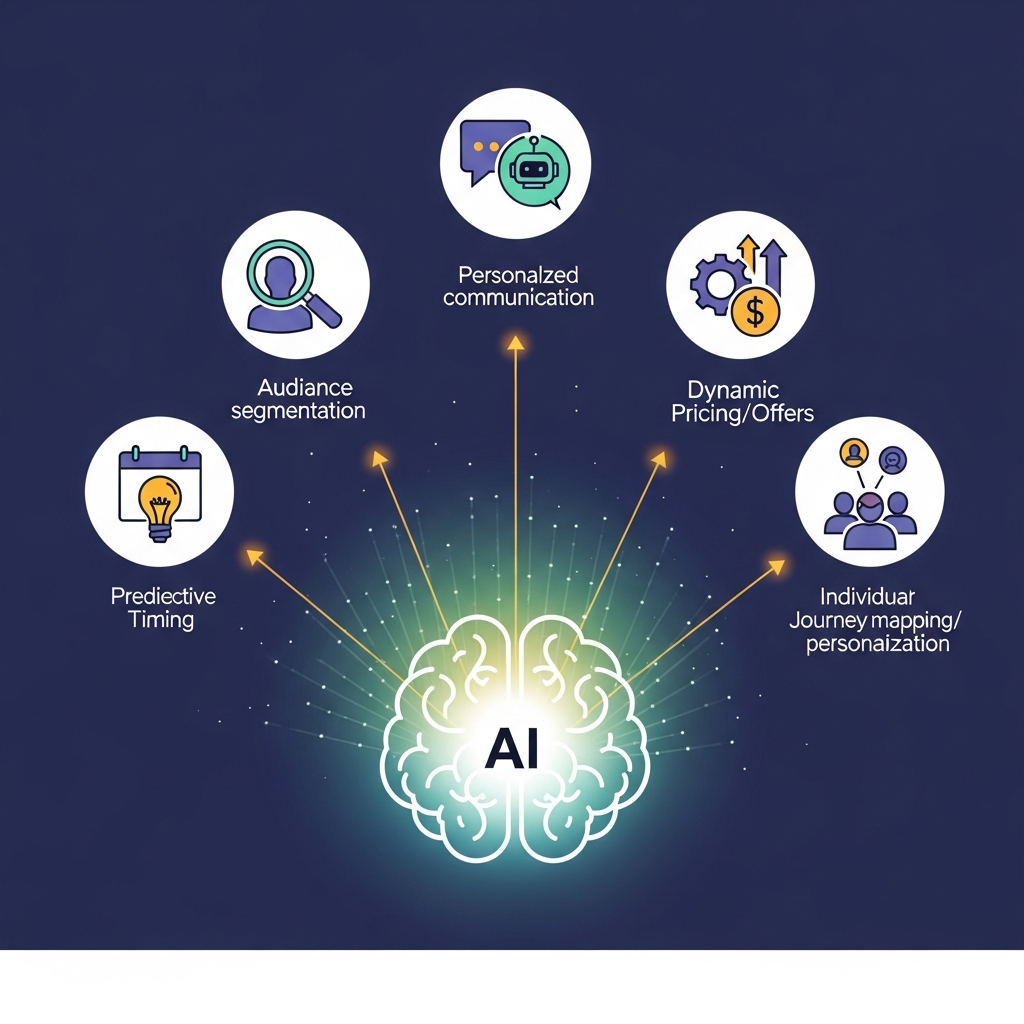
From Noise to Nuance: How to Master Ai-driven Precision Targeting
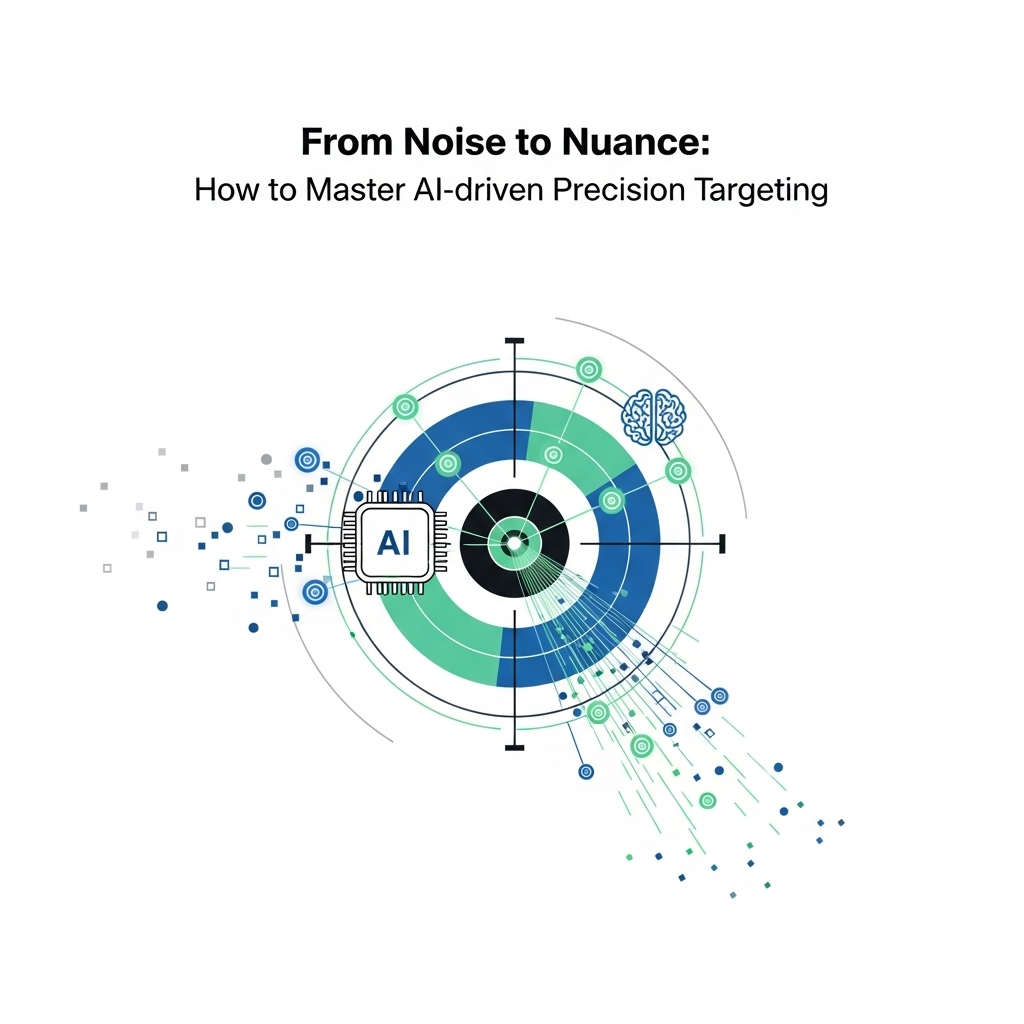
From Noise to Nuance: How to Master Ai-driven Precision Targeting concept 1
Beyond the Persona: Why Your “Average Customer” Is a Myth

I remember sitting in a boardroom circa 2014, staring at a PowerPoint slide that featured “Marketing Mary.” Mary was 32, lived in a suburban zip code, liked yoga, and supposedly represented our entire targetable universe. It felt wrong then; it looks like a prehistoric relic now. The fundamental problem with traditional targeting—the kind we all cut our teeth on—is that it relies on categorical averages. But here is the cold, analytical truth: nobody is average. When we aggregate data into broad buckets, we don’t find clarity; we find noise. We lose the individual in the spreadsheet.

AI-driven precision targeting isn’t just a faster way to find Mary. It’s the tool that finally allows us to kill her off. In the modern landscape, we are moving from demographic proxies (who someone is on paper) to behavioral intent (what someone is actually doing in the moment). This shift requires a radical empathetic leap. We have to stop thinking of our audience as data points and start seeing them as a series of high-intent signals. It’s about recognizing that a 60-year-old grandfather in rural Nebraska might have more in common—behaviorally—with a 22-year-old coder in Berlin than with his own neighbor. AI sees the commonality in the chaos. It finds the nuance.

To master this, we have to embrace the messy reality of human digital behavior. People don’t follow linear paths. They bounce from TikTok to a white paper, from a podcast to an abandoned cart. Managing this “noise” requires a level of computational heavy lifting that the human brain simply isn’t wired for. We need the machines to do the sorting, but we need the human heart to provide the context.

The Architecture of Intent: Moving from Static to Dynamic Modeling

Static models are the death of ROI. If your targeting criteria are updated monthly, you’re already behind the curve. AI allows for dynamic propensity modeling. This means the system is constantly recalculating the likelihood of a conversion based on real-time inputs. It’s the difference between a paper map and a live GPS that reroutes you the second there’s an accident ahead.

  • Temporal Relevance: Understanding that a “high-intent” signal has a shelf life. A search for “best strollers” is a high-value signal for about three months, then it drops to zero. AI tracks this decay.
  • Cross-Channel Synthesizing: Your customer isn’t a different person on Instagram than they are on LinkedIn. AI bridges the identity gap, stitching together fragmented sessions into a cohesive “identity graph.”
  • Lookalike Evolution: Traditional lookalike audiences are often “garbage in, garbage out.” Precision targeting uses seed audiences based on lifetime value (LTV), not just one-off conversions.
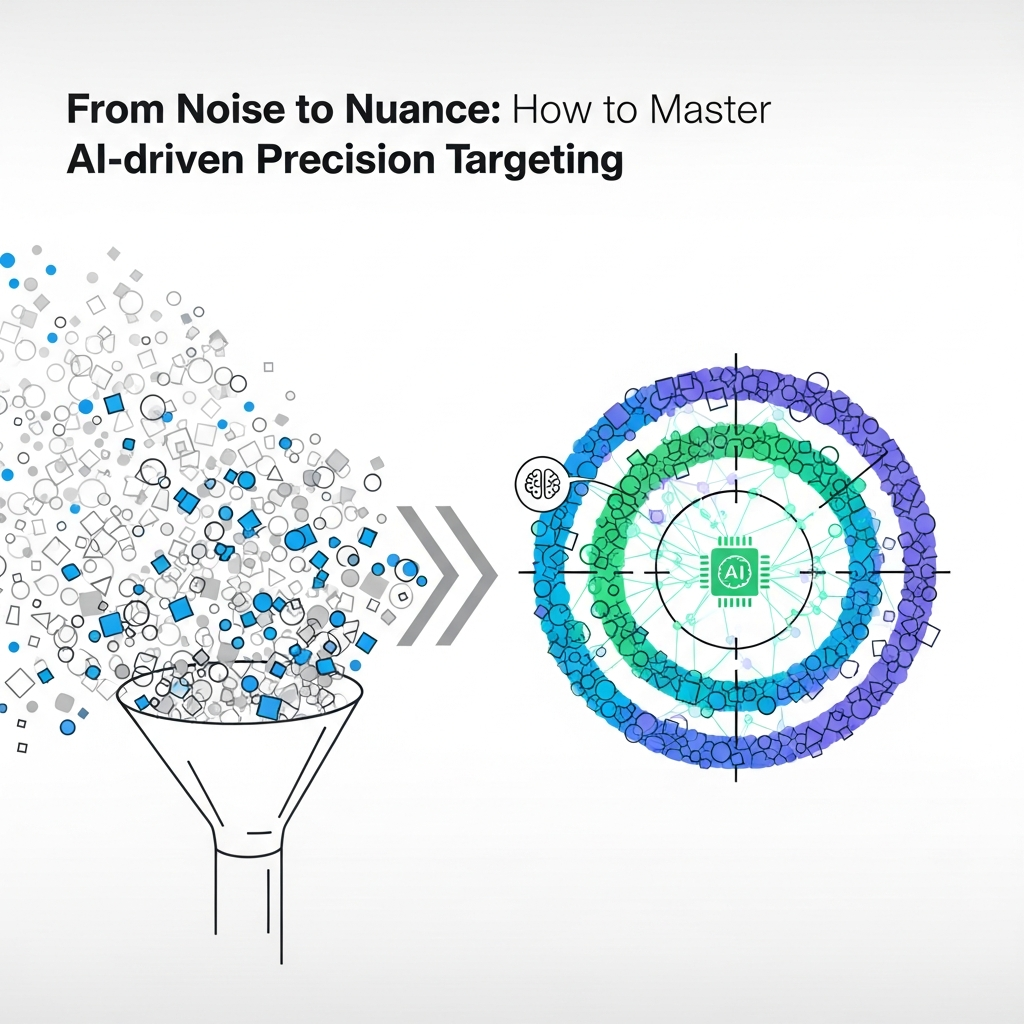
From Noise to Nuance: How to Master Ai-driven Precision Targeting concept 2

The Mechanics of Precision: Vector Space and Latent Intent

Let’s get technical for a moment, because “AI” is often used as a nebulous buzzword by people trying to sell you something you don’t need. When we talk about precision targeting, we’re often talking about vector embeddings. Imagine every customer interaction exists as a point in a multi-dimensional space. In a traditional database, you might have ten columns of data. In a vector space, you might have thousands.

This is where the “nuance” happens. AI doesn’t just see “Customer bought a shirt.” It sees the speed of the scroll, the time of day, the semantic relationship between the product description and the customer’s previous search history, and the subtle “clumping” of similar behaviors across millions of other users. It identifies latent intent—desires the customer hasn’t even articulated to themselves yet. It’s eerie, yes, but from a marketing perspective, it is the holy grail of efficiency.

I’ve seen campaigns where we ignored demographics entirely and targeted solely based on behavioral clusters. The results? A 40% reduction in CPA (Cost Per Acquisition). Why? Because the machine found customers that our human biases told us to ignore. We thought our audience was “professionals”; the AI found that our most engaged users were actually hobbyists with high disposable income who happened to browse at 11 PM on Tuesdays. That is the power of letting go of your assumptions.

The Signal-to-Noise Ratio: Filtering the Digital Exhaust

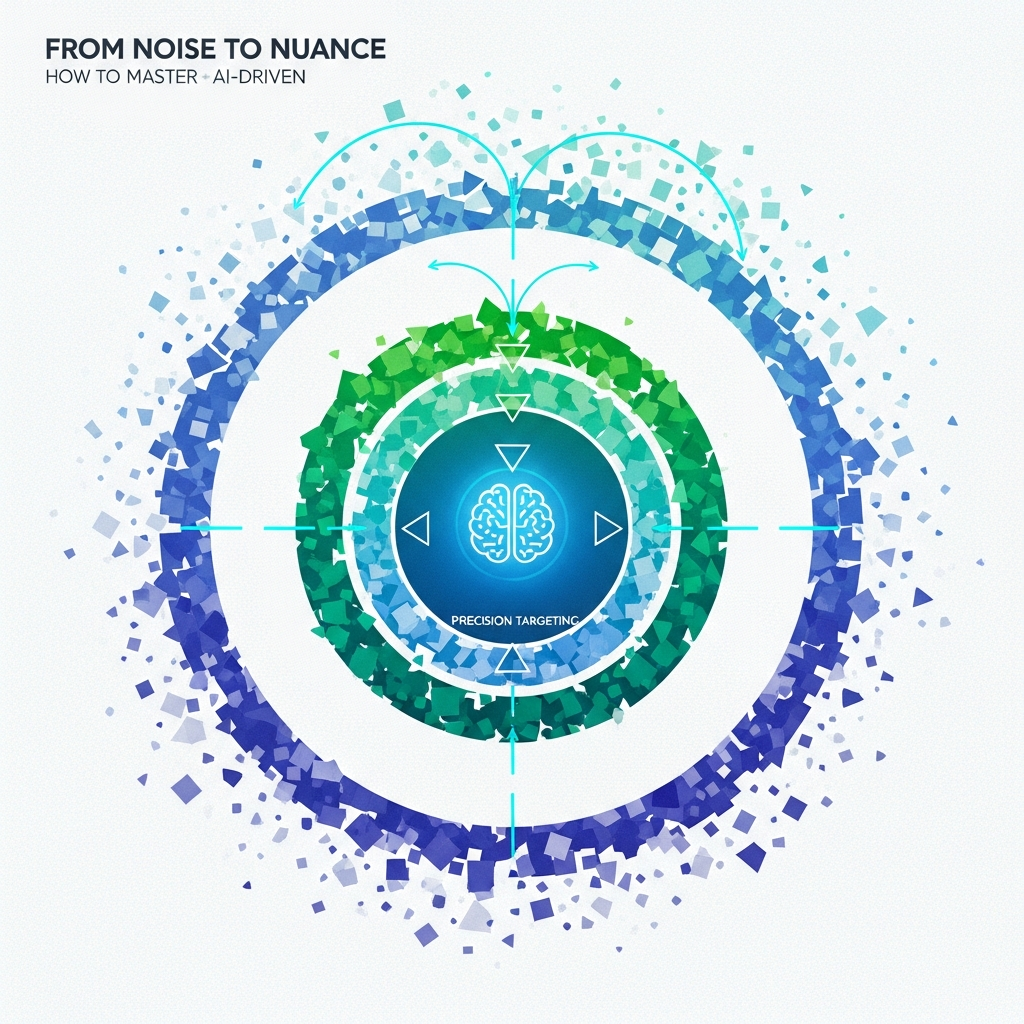
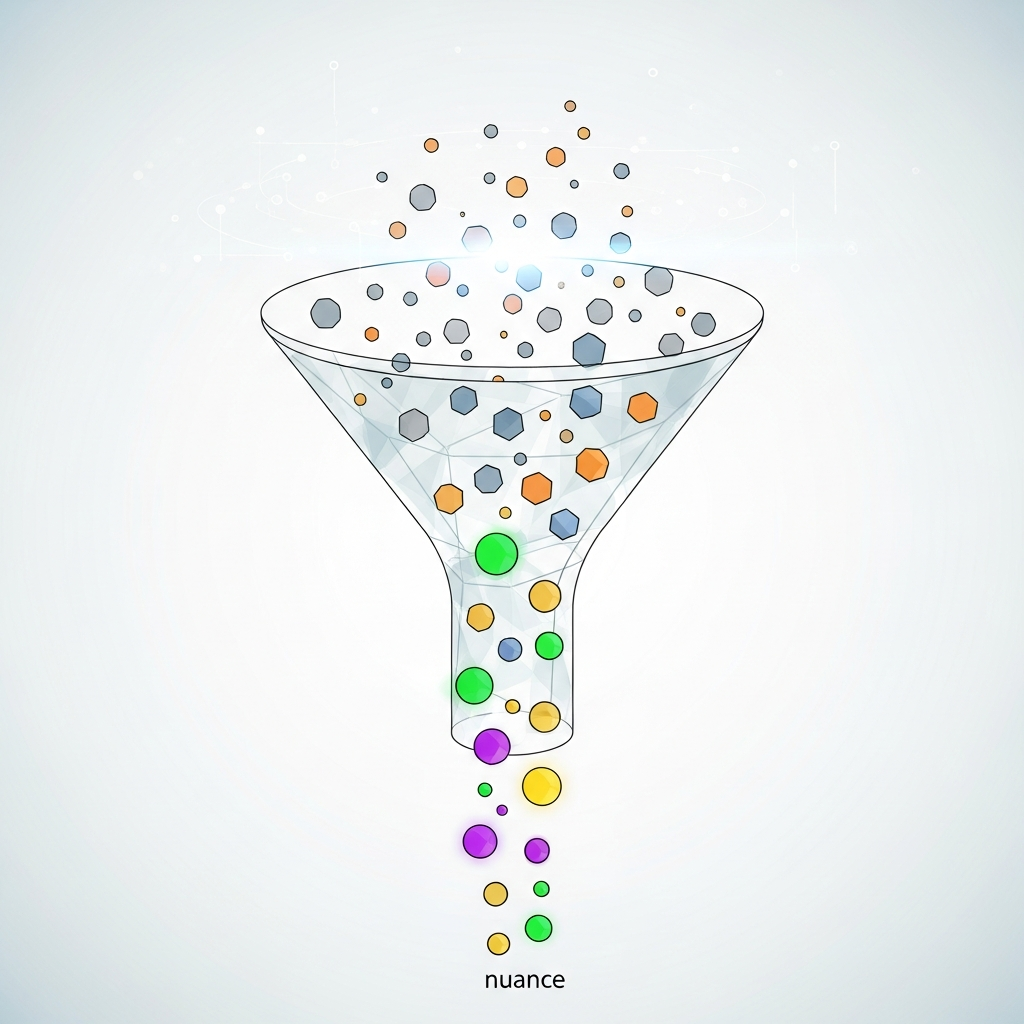
The world is drowning in data, most of it useless “digital exhaust.” Every click, like, and hover creates a data point, but not all data points are created equal. A “like” on a Facebook post is a weak signal. A three-minute dwell time on a pricing page is a strong signal. Precision targeting is, at its core, the art of signal amplification.

To master this, you need to implement rigorous data hygiene. AI is an incredible force multiplier, but it multiplies whatever you feed it. If you feed it messy, biased, or incomplete data, you will simply arrive at the wrong conclusion faster. You must define your “north star” metrics with clinical precision. Are you optimizing for clicks? Sales? Retention? The machine doesn’t know what “success” looks like unless you define it with absolute clarity.
From Noise to Nuance: How to Master Ai-driven Precision Targeting concept 3

The “Creepiness” Threshold: Navigating the Ethics of Precision

We need to talk about the elephant in the room: the “uncanny valley” of targeting. We’ve all had that moment where we mention a product in conversation and an ad for it appears ten minutes later. It feels like surveillance. As practitioners, we have a responsibility to balance precision with privacy. If you cross the line into “creepy,” you don’t just lose a sale; you lose brand equity that might take years to rebuild.

Empathy is the antidote to intrusion. When we use AI, we should use it to be helpful, not just ubiquitous. Precision targeting should feel like a well-timed recommendation from a knowledgeable friend, not a stalker following you through the mall. This means being transparent about data usage and giving users control. It also means using “soft” targeting—showing related content rather than the exact product they just looked at—to ease the psychological tension of being “watched.”

Building a Trust-First Data Strategy

The regulatory landscape is shifting. GDPR, CCPA, and the death of the third-party cookie are not obstacles; they are guardrails. They force us to move toward Zero-Party Data (data the user intentionally shares) and First-Party Data (data you collect directly). This is where the real nuance lies. AI can help you predict what a user wants based on the limited, high-quality data they’ve actually given you permission to use. It’s about doing more with less.

  • Contextual Targeting 2.0: Using AI to analyze the content of a page and placing ads that match the mood and intent of that content, rather than following the user.
  • Federated Learning: Training models on decentralized data so you never actually “own” the raw personal information, keeping privacy intact while maintaining predictive power.
  • The Value Exchange: Always ask: “Is this ad providing enough value to justify the data used to serve it?” If the answer is no, rethink your strategy.
From Noise to Nuance: How to Master Ai-driven Precision Targeting concept 4

The Infrastructure of Nuance: What Your Stack Actually Needs

You cannot achieve precision targeting with a fragmented tech stack. If your CRM doesn’t talk to your ad platform, and your email tool is in its own silo, your AI is essentially blind in one eye. Mastering this requires an integrated Customer Data Platform (CDP). This serves as the single source of truth, the “brain” that feeds the various execution arms of your marketing department.

But having the tools isn’t enough. I’ve seen companies spend seven figures on Salesforce or Adobe suites and still fail because they didn’t have the analytical talent to ask the right questions. You need people who understand both the “why” and the “how.” You need “translators”—people who can bridge the gap between a data scientist’s Python script and a creative director’s vision.

The Role of Algorithmic Auditing

Algorithms drift. Over time, an AI model can become biased or lose its edge as market conditions change. A model built in 2019 would have been disastrous in 2020. Mastering precision targeting requires constant algorithmic auditing. You need to pull the curtain back and ask: Why is the AI making these decisions? Is it ignoring a profitable sub-segment? Is it over-weighting a specific channel because it’s “cheap” even if the quality is low?

Think of your AI as a high-performance engine. It needs tuning. It needs the right fuel. And occasionally, it needs a mechanic to take it apart and make sure everything is still running as intended. This isn’t a “set it and forget it” situation. It’s a “supervise and iterate” situation.

>The Human-in-the-Loop: Why Machines Can’t Do It Alone

There is a dangerous tendency in our industry to outsource our thinking to the machine. We assume that because an algorithm is “smart,” it understands human culture. It doesn’t. AI is brilliant at identifying patterns, but it is blind to cultural context. It doesn’t know why a specific meme is funny, or why a certain phrase might be offensive in a specific political climate. It lacks the “gut feeling” that has driven great marketing for a century.

The most successful precision targeting happens when we use AI to handle the scale and humans to handle the strategy. The machine finds the “who” and the “when,” but the human must define the “what” and the “why.” This is the “Human-in-the-Loop” (HITL) model. It’s about creating a feedback loop where human insights refine the machine’s parameters, and the machine’s data challenges the human’s assumptions.

The Anatomy of a Precision Campaign

To move from noise to nuance, follow this framework for every campaign you launch:

  1. Hypothesis Generation: Start with a human insight. “I think people who buy our product are also interested in sustainable gardening.”
  2. Data Seeding: Feed the AI high-quality data related to that hypothesis.
  3. Algorithmic Expansion: Let the AI find the “lookalike” patterns you missed. Maybe it’s not gardening; maybe it’s “minimalist home design.”
  4. Creative Variance: Use AI to generate hundreds of micro-variations of your creative to match the specific nuances of each sub-segment.
  5. Human Review: Stop. Look at what the AI is doing. Does it make sense? Is it on-brand? Is it empathetic?
  6. Optimization: Scale the winners, kill the losers, and feed the results back into the model.

>Future-Proofing Your Targeting: The Post-Cookie Paradigm

We are entering the “Great Reset” of digital marketing. The old ways of tracking—those sticky little cookies that followed you across the web—are crumbling. This is actually a good thing. It’s forcing us to be smarter. It’s forcing us to move toward predictive modeling based on aggregated signals rather than individual tracking.

The future of precision targeting belongs to those who can build first-party ecosystems. This means creating content, tools, and experiences so valuable that users want to give you their data. Think of it as a “loyalty loop.” Once you have that data, AI becomes your secret weapon for maximizing its value. You can predict churn before it happens, recommend products before the customer knows they need them, and personalize every touchpoint of the journey.

It’s a shift from “stalking” to “service.” And in a world filled with digital noise, service is the only thing that actually cuts through. It’s the ultimate nuance.

A Final Thought for the Weary Marketer

If this feels overwhelming, that’s because it is. We are asking you to be a data scientist, a psychologist, an ethicist, and a creative all at once. But remember: you don’t have to master it all overnight. Start by questioning your “Personas.” Start by looking at your data hygiene. Start by asking your AI provider better questions. Precision isn’t a destination; it’s a discipline. It’s a commitment to seeing your customers as the complex, nuanced individuals they actually are. The machines are just here to help us see them more clearly.

The noise is loud, but the nuance is where the growth is. Go find it.
The Precision Revolution: Why Ai Automation Is Your Brand’s Most Targeted Tool
The Precision Revolution: Why Ai Automation Is Your Brand’s Most Targeted Tool concept 1

The Ghost in the Machine: Beyond the “Spray and Pray” Trauma

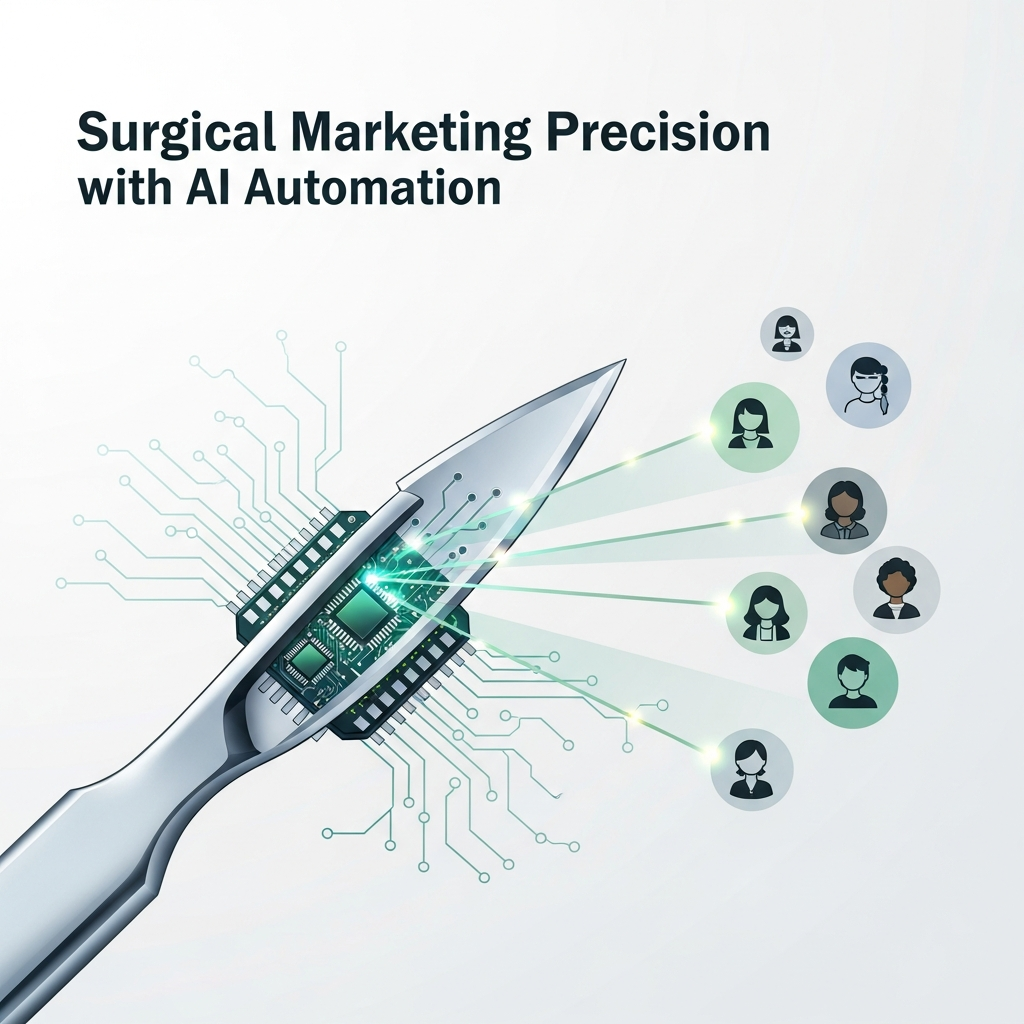
I remember sitting in a dimly lit office back in 2014, staring at a Facebook Ads Manager dashboard that felt like a gambling terminal. We were burning through a client’s budget—fifty grand a month—on what we called “broad interest targeting.” We were basically throwing spaghetti at a very expensive wall and hoping something stuck. It was soul-crushing. You’d see the bounce rates and feel a physical pang in your chest. That wasn’t marketing; it was a desperate plea for attention in a room full of people screaming. Fast forward to today, and the landscape hasn’t just changed; it’s undergone a molecular restructuring. AI automation isn’t a “plugin” or a “feature”—it is the surgical scalpel replacing the blunt trauma of traditional advertising.

When we talk about “The Precision Revolution,” we aren’t just talking about algorithms that work faster than humans. We’re talking about the end of the average. In the old world, we built personas like “Marketing Mary” or “Tech-Savvy Tom.” These were caricatures—hollowed-out versions of real humans. AI doesn’t care about your caricatures. It looks at the stochastic noise of human behavior and finds the signal. It’s analytical, yes, but for the first time, it allows us to be deeply empathetic because we stop bothering people with things they don’t want.

The Precision Revolution: Why Ai Automation Is Your Brand’s Most Targeted Tool concept 2

The Neuroscience of Micro-Relevance

Why does a perfectly timed notification feel like magic, while a generic email feels like a violation? It comes down to cognitive load. Humans are biologically wired to filter out irrelevant stimuli; it’s a survival mechanism. If our ancestors paid attention to every rustle in the grass, they’d have died of nervous exhaustion. Modern digital noise is that rustling grass. AI-driven precision works because it bypasses the “relevance filter” by mimicking the way our brains prioritize information.

The Bayesian Brain and Predictive Modeling

Most people think AI predicts the future. It doesn’t. It calculates the probability of a specific outcome based on a recursive loop of past data points. In academic circles, we often look at this through the lens of Bayesian inference. Essentially, the system starts with a “prior” belief (e.g., “People who buy organic coffee might like artisanal honey”) and constantly updates that belief as new evidence arrives. For your brand, this means the automation is learning in real-time. If a user lingers on a product image for 4.2 seconds instead of 1.8, the “prior” updates. The precision comes from the fact that the machine doesn’t get tired of calculating these updates. It does it billions of times per second.

I’ve watched brands struggle because they treat AI like a static tool—set it and forget it. That’s a mistake. You have to feed the beast high-quality data. If you feed it garbage, it will give you precisely targeted garbage. But when you align your brand values with these probabilistic models? That’s when you stop being a “vendor” and start being a “solution.”

The Precision Revolution: Why Ai Automation Is Your Brand’s Most Targeted Tool concept 3

Deconstructing the “Black Box”: How Logic Meets Automation

There’s a lot of fear-mongering about “black box” algorithms—the idea that we don’t know why the AI does what it does. While the internal weights of a neural network are complex, the logic of precision automation is actually quite elegant. It’s built on three pillars: Signal Identification, Latency Reduction, and Iterative Refinement.

  • Signal Identification: This is the ability to distinguish between “intent” and “noise.” A user searching for “how to fix a leaky faucet” has a different intent than someone searching for “designer kitchen faucets.” AI looks at the semantic context to ensure your brand appears only when the intent matches your value proposition.
  • Latency Reduction: In the manual days, we’d run a report, analyze it on Monday, and change the ads on Tuesday. By then, the “moment” was gone. Automation acts in milliseconds. It’s the difference between catching a falling glass and reading a report about how the glass broke.
  • Iterative Refinement: The AI is constantly running micro-experiments (A/B testing on steroids). It might test 5,000 variations of a headline across 5,000 different micro-segments. No human team, no matter how caffeinated, can compete with that level of granular optimization.

>The Death of the Demographic: Long Live the Psychographic

Stop targeting “Women aged 25-34 in urban areas.” It’s lazy. It’s ineffective. It’s a relic of the Mad Men era. Two women in that demographic could have nothing in common—one might be a minimalist ultra-marathoner, while the other is a maximalist gourmet chef. AI allows us to target behavioral clusters and psychographic profiles.

Through Natural Language Processing (NLP), AI can analyze the sentiment of a user’s social media interactions or the nuance of their search queries. It understands the “why” behind the click. If your brand sells high-end hiking gear, you don’t want someone who just likes the “aesthetic” of mountains; you want the person who is currently researching the topographical maps of the Dolomites. AI finds that person by connecting dots that aren’t visible to the naked eye. It’s about finding the “inner state,” not just the “outer zip code.”

The Empathetic Edge

This is where it gets personal. We’ve all been followed around the internet by a pair of shoes we already bought. That is *bad* automation. It’s clunky. True precision automation—the kind I advocate for—knows you bought the shoes. It stops showing you the ad. Instead, it might show you a video on how to care for that specific leather, or suggest the perfect socks to match. Precision is an act of service. When you use AI to respect a customer’s journey, you build a level of brand loyalty that “lookalike audiences” can never touch.

>The Plumbing Problem: Why Your Data Architecture is Leaking

I have to be the bearer of bad news here: your AI is only as good as your data plumbing. I’ve consulted for Fortune 500 companies that wanted “AI Revolution” results but had their data stored in five different siloes that didn’t talk to each other. It’s like trying to run a Ferrari on swamp water.

To achieve actual precision, you need a Single Source of Truth (SSOT). This means your CRM, your website analytics, your social data, and your email platforms must be integrated. AI requires a holistic view of the customer. If the AI doesn’t know that “User A” who clicked the ad is the same “User A” who called support yesterday, the precision fails. You end up sending a promotional “buy now” email to someone who is currently furious about a shipping delay. That’s not just a missed sale; it’s a brand-killer.

>Hyper-Personalization at Scale: The Holy Grail

We used to say “Personalization doesn’t scale.” You could either be personal with ten people or generic with ten million. AI shattered that dichotomy. We are now in the era of Dynamic Creative Optimization (DCO). This isn’t just swapping out a first name in an email. This is the AI generating unique landing pages, visual assets, and pricing structures for every individual user in real-time.

Imagine a world where your website morphs based on who is visiting. A first-time visitor sees educational content and a “warm” welcome. A returning loyalist sees their “frequently bought” items and a loyalty discount. A price-sensitive browser sees a “limited time offer.” This isn’t science fiction; it’s what top-tier brands are doing right now to crush their competition. The precision lies in the timing—hitting the user with the right message at the exact point in their “Circadian Rhythm of Commerce.”

The Concept of “Stochastic Resonance” in Marketing

In physics, stochastic resonance is a phenomenon where a signal that is too weak to be heard can be boosted by adding white noise. Marketing automation does something similar. By analyzing the “noise” of the market, AI identifies the tiny, weak signals of interest that a human would miss. It then amplifies those signals by delivering targeted content. It’s about finding the “whisper” of intent in a “scream” of data.

>Ethics, Privacy, and the “Creepiness” Threshold

We have to talk about the elephant in the room. There is a fine line between “highly targeted” and “stalking.” As someone who has spent years in the trenches of data analytics, I’ve seen where that line is, and it’s thinner than you think. The Precision Revolution must be built on a foundation of Data Sovereignty and Radical Transparency.

If you use AI to manipulate people’s insecurities, you will fail in the long run. The “uncanny valley” of marketing occurs when the AI knows something about the user that they haven’t explicitly shared. The goal is to be helpful, not omniscient. Use automation to solve problems, not to exploit psychological vulnerabilities. Brands that prioritize privacy-first AI—using zero-party data (information the user intentionally shares)—are the ones that will survive the upcoming regulatory storms like GDPR and CCPA. Precision is not a license to pry; it’s a responsibility to be relevant.

>The Human-in-the-Loop: Why Robots Won’t Replace Your CMO

There’s a common anxiety that AI will make brand managers obsolete. I actually believe the opposite is true. AI makes the human element more important than ever. The AI provides the precision, but the human provides the purpose.

AI can tell you that a certain segment of your audience responds better to the color blue and a 10% discount. It can’t tell you *why* your brand should exist in the first place. It can’t feel the “vibe” of a cultural movement. It can’t understand the nuance of irony or the depth of human grief. We need “Human-in-the-Loop” (HITL) systems where the AI handles the heavy lifting of data processing, and the human provides the creative guardrails and ethical oversight. The most successful brands I’ve seen are the ones where the creative directors and data scientists are best friends, not rivals.

A Personal Note on the “Aha!” Moment

I once worked with a small e-commerce brand that was struggling to find its footing. They were using basic automated bidding on Google. We switched them to a custom-built AI model that factored in local weather patterns, stock market fluctuations (their product was a luxury item), and even local “mood” data from social media. Within three months, their ROAS (Return on Ad Spend) jumped from 2.1 to 8.4. But the coolest part? Their customer support tickets dropped by 40%. Because we were so precise in who we targeted, the people buying the product were the ones who actually needed it. We weren’t “selling” anymore; we were “matching.” That’s the dream.

>Practical Steps: Navigating the Transition

If you’re feeling overwhelmed, good. That means you’re paying attention. The transition to AI-driven precision isn’t a weekend project; it’s a cultural shift. Here’s how you start without losing your mind:

  1. Audit Your Data Integrity: Before buying a single AI tool, look at your data. Is it clean? Is it accessible? If not, fix that first.
  2. Start with “Low-Hanging Fruit”: Don’t try to automate your entire brand at once. Start with automated bidding or predictive lead scoring. Get a win, then expand.
  3. Invest in “Translation” Talent: You need people who can bridge the gap between technical data science and brand storytelling. These “translators” are the most valuable assets in the modern economy.
  4. Test, Break, and Learn: Automation allows for rapid failure. Embrace it. If a model isn’t working, kill it and start over. The cost of failure in an automated world is much lower than the cost of stagnation.

>The Future is Non-Linear

We are moving toward a world of Anticipatory Marketing. This is where your brand provides a solution before the customer even realizes they have a problem. It sounds like sci-fi, but it’s just the logical conclusion of high-precision AI. When you combine massive computing power with deep human empathy, you create a brand experience that feels less like a transaction and more like a relationship.

The “Precision Revolution” isn’t about being colder or more mechanical. It’s about using technology to strip away the irrelevance, the noise, and the waste, leaving behind only the most meaningful connections. It’s about being right—not just loud. And in a world that is louder than ever, being right is the only thing that matters.

Are you ready to stop screaming and start connecting? Because the machine is ready when you are.

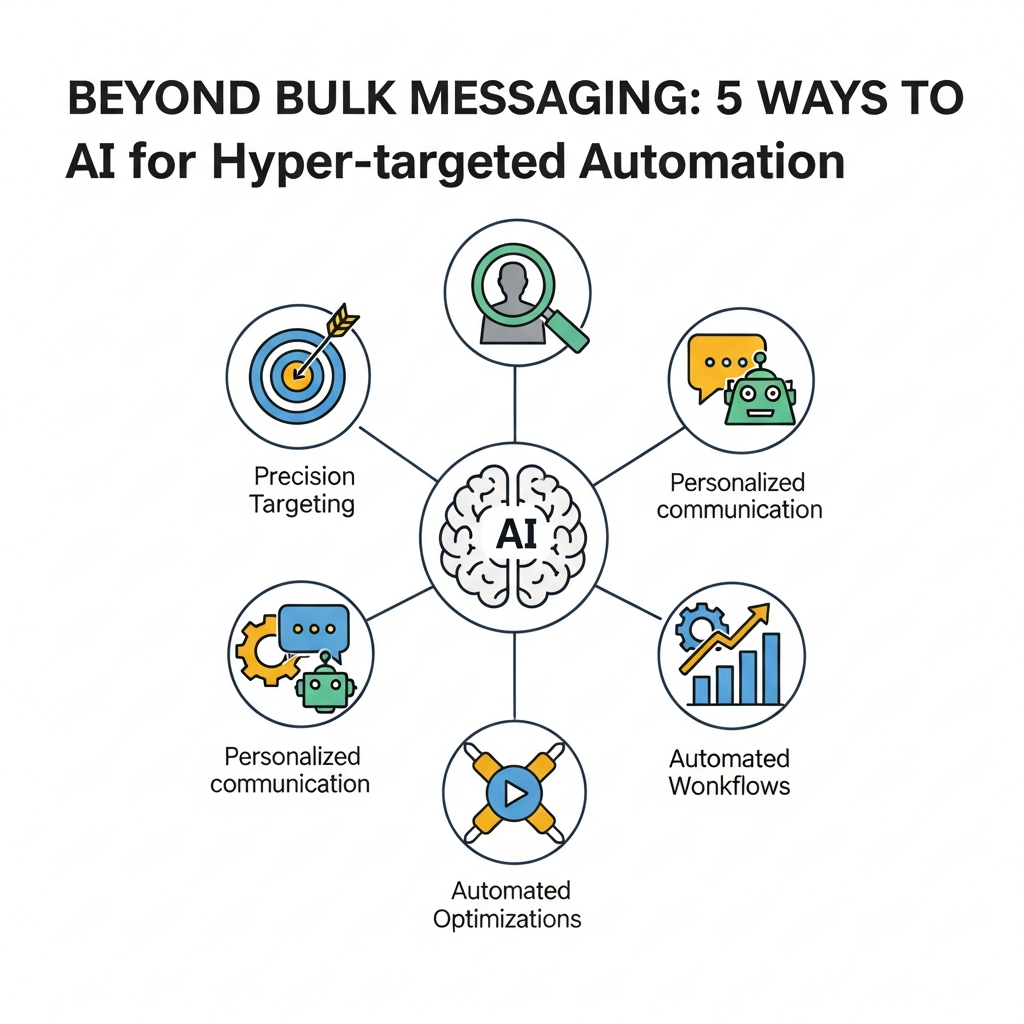
Beyond Bulk Messaging: 5 Ways to Use Ai for Hyper-targeted Automation
Beyond Bulk Messaging: 5 Ways to Use Ai for Hyper-targeted Automation concept 1

The Death of the “Spray and Pray” Era: Why Bulk Messaging is a Liability

I remember the specific moment I realized the old way of doing things was utterly, irredeemably dead. It was 2018. I was working with a mid-sized SaaS firm that had just invested six figures into a “cutting-edge” bulk-sending platform. We fired off a campaign—beautifully designed, grammatically perfect—to 50,000 leads. The result? A 0.2% click-through rate and a permanent blacklisting from three major ISP servers. It felt like shouting into a hurricane and expecting someone to hear a whisper. It wasn’t just a failure of technology; it was a failure of empathy. We were treating human beings like rows in a CSV file.

Today, the landscape is even more unforgiving. Our inboxes are digital fortresses. Gatekeepers are no longer just human assistants; they are sophisticated AI filters designed to detect “automated” patterns with surgical precision. If your outreach feels like a template, it dies in the spam folder. Period. But here is the paradox: to achieve true, human-level scale, we need the very thing that created the problem—Artificial Intelligence. The difference lies in how we wield it. We are moving beyond the era of bulk messaging and into the age of Hyper-targeted Automation.

This isn’t about sending more emails. It’s about sending the right message, to the right person, at the exact moment their pain point becomes unbearable. It’s about using Large Language Models (LLMs) and predictive analytics to simulate the thoughtfulness of a boutique consultancy at the scale of a global enterprise. Let’s peel back the layers on how we actually do this without losing our souls in the process.

Beyond Bulk Messaging: 5 Ways to Use Ai for Hyper-targeted Automation concept 2

1. Psychographic Segmentation and Semantic Intent Mapping

Traditional segmentation is lazy. We usually group people by job title, industry, or geography. “Marketing Managers in Chicago.” That tells us nothing about their current psychological state or their immediate business needs. Psychographic segmentation powered by AI looks at the why behind the person. By leveraging Natural Language Processing (NLP), we can scrape a prospect’s recent LinkedIn posts, their company’s quarterly earnings reports, or even their interviews on podcasts to determine their “Semantic Intent.”

Think about it. Is the prospect currently in a “Defensive” posture (cutting costs, optimizing existing stacks) or an “Aggressive” posture (hiring rapidly, expanding into new markets)? An AI can analyze thousands of data points to categorize leads into these nuanced buckets. When you know a CTO is currently obsessed with “Technical Debt” because they mentioned it three times in a recent webinar, your automation shouldn’t talk about “Innovation.” It should talk about “Refactoring and Efficiency.”

The “Digital Body Language” Framework

  • Linguistic Mirroring: AI identifies the specific vocabulary a prospect uses. If they use academic language, your automation adapts. If they are punchy and informal, the AI softens the tone.
  • Sentiment Velocity: Is the prospect’s public sentiment becoming more frustrated or more optimistic? AI tracks this shift, triggering messages when a “frustration peak” is detected.
  • Thematic Clustering: Instead of static lists, AI creates fluid clusters based on shared challenges. You’re not messaging “HR Directors”; you’re messaging “Leaders struggling with remote culture retention.”

By the time the message hits their inbox, it doesn’t feel like marketing. It feels like synchronicity. It feels like you’ve been paying attention—because, through the lens of your AI, you have.

Beyond Bulk Messaging: 5 Ways to Use Ai for Hyper-targeted Automation concept 3

2. Generative Contextualization: Moving Beyond {First_Name}

We’ve all seen the {First_Name} tag fail. “Hi [FIRST_NAME], I saw you work at [COMPANY_NAME]!” It’s the digital equivalent of a limp handshake. Generative AI, specifically through Retrieval-Augmented Generation (RAG), allows us to inject actual, live context into every single outgoing message. This isn’t just “personalization”; it’s “contextualization.”

Imagine an automation workflow that, before sending an email, performs a real-time Google search for the prospect’s company. It finds a news article from three hours ago stating they just won a green energy award. The AI then synthesizes that information and writes a custom opening sentence: “I noticed your team just took home the Green Tech Excellence award this morning—quite a feat considering the competitive landscape in the Pacific Northwest.”

Implementing the “Reason for Outreach” (RFO) Engine

To do this at scale, you need an RFO engine. This is a middleware layer where your CRM talks to an LLM (like GPT-4 or Claude 3) and a search API. The process looks like this:

  • Step A: Triggered by a lead entering a stage.
  • Step B: AI scrapes the most recent “signal” (a new hire, a funding round, a specific social media comment).
  • Step C: The LLM drafts a unique “bridge” paragraph connecting that signal to your value proposition.
  • Step D: A human (or a high-level “Reviewer AI”) checks for hallucinations before the “Send” button is cleared.

This level of idiosyncratic detail is impossible for a human to do for 500 leads a day, but it’s trivial for an AI. The result is a message that passes the “Turing Test” of sales outreach every single time.

>3. Predictive Lead Scoring and Behavioral Decay Models

Most automation is chronological. “Send Email 1 on Day 1, Email 2 on Day 3.” This is fundamentally flawed because humans don’t operate on a linear schedule. Life happens. Projects blow up. People go on vacation. Predictive Lead Scoring uses machine learning to determine the “Propensity to Engage” in real-time.

Instead of a static sequence, imagine a dynamic web. If a prospect opens your initial email three times in one hour but doesn’t reply, that is a high-intent signal. Most legacy systems would just wait for the next scheduled email. An AI-driven system, however, recognizes this “Engagement Spike” and immediately triggers a low-friction “nudge”—perhaps a LinkedIn connection request or a highly specific case study related to the link they clicked.

The Concept of “Lead Decay”

On the flip side, we have to talk about Negative Signals. If a lead hasn’t interacted with your content in 14 days, their “score” decays. Rather than continuing to pepper them with “Just circling back!” emails (which is the quickest way to get marked as spam), the AI shifts them into a “Passive Nurture” track. This track might only send a high-value, non-salesy industry report once a month. We are using AI to respect the prospect’s silence, which is a form of empathy that builds long-term brand equity.

Data science allows us to look at historical patterns. If the data shows that VPs of Engineering are most likely to book a demo on Tuesday mornings after their department stand-up, the AI holds your message until that precise window. We are optimizing for receptivity, not just delivery.

>4. Autonomous Conversational Nurturing (The “Anti-Bot” Bot)

The most exhausting part of any outreach is the “in-between.” It’s the “Can you send me more info?” or the “Check back in six months” replies. These are often where deals go to die because humans are inconsistent at follow-ups. However, standard “If-This-Then-That” chatbots are too rigid. They can’t handle the nuance of a human saying, “I’m interested, but my budget is currently tied up in the Q3 restructuring.”

Modern Autonomous Agents can. By using specialized LLMs trained on your specific product documentation and past successful sales transcripts, these agents can handle the “Middle of the Funnel” conversations with startling fluidity. They don’t just provide canned answers; they negotiate, they clarify, and they empathize.

Bridging the Gap Between Automation and Human Intervention

The secret is the “Hand-off Protocol.” You don’t want an AI closing a million-dollar contract (yet). You want the AI to handle the 80% of repetitive clarifying questions so that when a human salesperson steps in, the prospect is “warm” and informed.

I’ve seen this work brilliantly in high-ticket consulting. The AI handles the initial vetting, asks about the prospect’s current roadblocks, and even provides a few “quick win” suggestions. By the time the consultant jumps on a Zoom call, the prospect already feels like they’ve received value. The AI has acted as a sophisticated concierge, not a telemarketer.

>5. Multi-Channel Orchestration and Attribution AI

Hyper-targeted automation cannot exist in a vacuum. If you are only using email, you are missing 70% of the conversation. But the problem with multi-channel (Email, LinkedIn, Twitter, Direct Mail, SMS) is that it usually becomes a disjointed mess. The prospect receives an email and a LinkedIn message that say the exact same thing. It’s robotic and annoying.

Attribution AI solves this by creating a “Single Source of Truth.” It tracks the prospect’s journey across every touchpoint and adjusts the automation accordingly. If the prospect engaged with a specific whitepaper on your website via a LinkedIn ad, the subsequent email automation should acknowledge that specific whitepaper’s content. It’s about creating a cohesive narrative arc.

The “Surround Sound” Strategy

  • Phase 1: Awareness. AI triggers targeted ad placements on the prospect’s social feeds based on their psychographic profile.
  • Phase 2: Engagement. Once the AI detects a “View” or a “Like,” it triggers a personalized LinkedIn message referencing the ad’s topic.
  • Phase 3: Validation. If they respond, an automated (but highly contextual) email is sent with a bespoke video or document.
  • Phase 4: Conversion. A direct mail piece (yes, physical mail) is triggered via an API, containing a QR code that leads to a personalized landing page.

This isn’t bulk messaging; it’s an orchestrated symphony. Each channel plays a different part, but they are all reading from the same sheet music. The AI acts as the conductor, ensuring that no note is played too loudly or out of turn.

>The Ethics of Precision: Staying Human in a Machine World

As we lean into these incredibly powerful tools, there is a visceral danger of becoming “too efficient.” There is a fine line between “highly targeted” and “creepy.” If you tell a prospect you know what they had for breakfast because your AI scraped their Instagram, you’ve lost. The goal of hyper-targeted automation is to reduce friction, not to eliminate the human element.

I always tell my teams: “Use AI to do the research, but use humans to set the intent.” AI is a multiplier. If you multiply “cynical, salesy aggression,” you just get a faster version of what everyone hates. But if you multiply “genuine curiosity and a desire to help,” you create something transformative. We must use these tools to buy back our time so we can spend that time on the high-level creative strategy and deep relationship building that no machine can ever replicate.

The future of business isn’t “AI vs. Human.” It’s “Human + AI vs. The Old Way.” By moving beyond the blunt instrument of bulk messaging and embracing the surgical precision of hyper-targeted automation, we aren’t just sending better messages. We are building better businesses. We are treating our prospects with the respect of a tailored experience, and in return, they are giving us the one thing money can’t buy: their attention. And in today’s economy, attention is the only currency that truly matters.

It’s time to stop shouting. It’s time to start whispering the right things into the right ears.

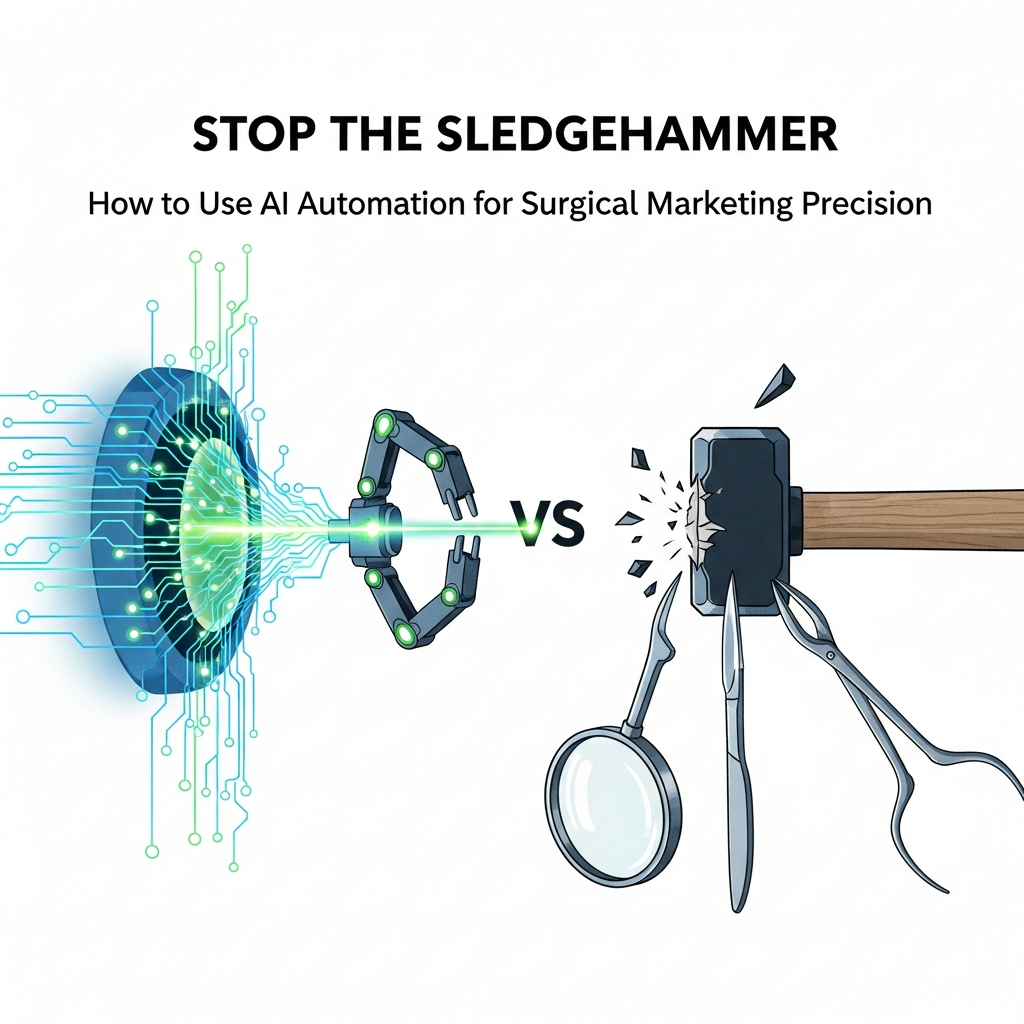
Stop the Sledgehammer: How to Use Ai Automation for Surgical Marketing Precision
Stop the Sledgehammer: How to Use Ai Automation for Surgical Marketing Precision concept 1

The Morning the Sledgehammer Broke

It was 3:00 AM on a Tuesday when I finally hit “delete” on a sixty-page marketing strategy I’d spent three months building. Why? Because I realized I was just designing a more expensive sledgehammer. We’ve all been there—staring at a dashboard, watching conversion rates flatline despite having “state-of-the-art” automation tools screaming at us that everything is optimized. It wasn’t optimized. It was just loud. In our desperate rush to adopt AI, we’ve collectively traded our scalpels for blunt instruments, battering our audiences with generic, high-frequency “content” that has the nutritional value of wet cardboard.

I’ve spent fifteen years in the trenches of digital strategy, and I’ve seen the pendulum swing from manual labor to mindless automation. Right now, we’re in the “mindless” phase. We use AI to generate 5,000 blog posts a month, hoping the sheer volume will crack the algorithm. We use it to blast “personalized” emails that feel about as personal as a court summons. This is the Sledgehammer Approach, and frankly, your customers are tired of the noise. They don’t want more; they want better. They want surgical precision.

Precision marketing isn’t about doing things faster. It’s about doing fewer things, but with such calculated accuracy that the impact is undeniable. It’s the difference between carpet bombing a city and a laser-guided delivery. If you’re ready to put down the heavy tools and start operating with a surgeon’s steady hand, let’s talk about how AI actually works when you stop treating it like a glorified intern.

Stop the Sledgehammer: How to Use Ai Automation for Surgical Marketing Precision concept 2

The Cognitive Dissonance of Modern Automation

We’re living in a strange paradox. We have access to the most sophisticated Large Language Models (LLMs) and predictive engines in human history, yet marketing has never felt more robotic. This happens because most teams use AI as a generative crutch rather than an analytical engine. They use it to fill space. If you’re using ChatGPT to “write a LinkedIn post about synergy,” you’re using a sledgehammer. You’re contributing to the entropy of the internet.

The “Mid-Wit” Trap in AI Adoption

There’s a specific curve to AI adoption. At the bottom, you have people who fear it. In the middle—where most “growth hackers” live—you have the sledgehammer users. They automate everything, create massive “top-of-funnel” noise, and wonder why their Brand Equity is bleeding out. At the top of the curve? That’s where the surgeons live. These are the practitioners who use AI to identify micro-segments of 50 people who are exactly 72 hours away from making a purchase decision based on a specific pain point they haven’t even articulated yet.

To move from the middle to the top, you have to embrace Perplexity. In linguistics, perplexity is a measure of how well a probability model predicts a sample. In marketing, it’s your ability to surprise and delight a customer with something so relevant it feels like you’re reading their mind. Sledgehammers have zero perplexity. They are predictable. And in a world of infinite scrolls, predictable is invisible.

Stop the Sledgehammer: How to Use Ai Automation for Surgical Marketing Precision concept 3

Step 1: Diagnostic Data—Sharpening the Blade

Before you can operate, you need a clear view of the patient. Most companies sit on mountains of “dark data”—customer interactions, support tickets, abandoned carts, and social sentiment that never gets analyzed. They look at Google Analytics and see “Users” and “Sessions.” That’s a sledgehammer metric. It’s too broad to be useful.

Surgical marketing requires Vectorized Intent. Instead of seeing a user who visited your pricing page, a surgical AI system analyzes the *sequence* and *velocity* of their actions. Did they come from a technical whitepaper? Did they spend four minutes on the “Integrations” section but only ten seconds on “Pricing”? This isn’t just data; it’s a narrative.

  • Natural Language Processing (NLP) on Support Tickets: Use AI to categorize the *emotional state* of your customers. Are they frustrated with a feature or confused by the UI? Stop sending them “feature update” emails if they’re currently angry about a bug.
  • Predictive Churn Modeling: Instead of reacting when someone cancels, use machine learning to identify the “quiet withdrawal”—the moment a user’s engagement frequency drops by 15% over a three-day rolling average. That’s when the surgeon steps in with a targeted intervention.
  • Zero-Party Data Enrichment: Stop guessing. Use AI-driven micro-surveys that adapt in real-time based on the user’s previous answer. This isn’t a static form; it’s a conversation.

The Myth of the “Ideal Customer Persona”

I’m going to say something controversial: The ICP is dead. Or at least, the way we use it is dead. “Marketing Mary, 35, lives in the suburbs” is a sledgehammer. People are too complex for that now. Surgical marketing replaces static personas with Dynamic Cohorts. These are clusters of individuals who share a specific behavior or problem at a specific moment in time. AI allows us to manage 500 micro-cohorts simultaneously, something no human marketing team could ever do manually.

>Step 2: Predictive Content Architectures

Once you have the data, what do you do with it? Most people just make more content. “We need more top-of-funnel!” they scream. No. You need more High-Context Content. This is where the surgical precision of AI automation really starts to shine. We’re moving away from “The Big Campaign” and toward “The Continuous Stream of Relevance.”

Think about the last time you received an automated email that actually made you stop. It probably didn’t just have your name in the subject line. It probably referenced a specific problem you were having or a goal you were chasing. That’s Retrieval-Augmented Generation (RAG) in action. By connecting your AI to your proprietary data (your blog, your case studies, your product docs), the AI can generate responses that are deeply rooted in your specific expertise, not just generic web-scraped noise.

Building the “Context Engine”

To do this, you need a tech stack that talks to itself. It’s not just about having an ESP (Email Service Provider) and a CRM. It’s about an Orchestration Layer. Here is how a surgical content workflow looks:

  1. Trigger: A prospect downloads a technical guide on “Scalable Infrastructure.”
  2. Analysis: The AI cross-references this with their LinkedIn profile (via API) and realizes they are a Lead Engineer at a Series B startup.
  3. Syntheses: Instead of a generic “Thanks for downloading” email, the AI pulls a specific paragraph from a case study involving another Series B company in the same industry.
  4. Execution: It generates a personalized video script for the sales rep, highlighting exactly why this lead engineer should care about Section 4 of that guide.

This is surgical. It’s quiet. It’s hyper-relevant. It doesn’t feel like marketing; it feels like service.

>Step 3: The Human-in-the-Loop (HITL) Imperative

Here is the “imperfect” truth: AI is a brilliant idiot. It can process a billion data points in a second, but it doesn’t know what it feels like to be afraid of losing a job. It doesn’t understand the subtle political nuances of a boardroom. This is where most automation strategies fail—they remove the human entirely because they want “efficiency.”

True surgical precision requires a Human-AI Symbiosis. The AI provides the data, the scale, and the initial draft; the human provides the empathy, the ethics, and the “soul.” If your marketing feels robotic, it’s because you’ve outsourced your taste to an algorithm. Never outsource your taste.

In my own workflow, I use AI to “stress test” my ideas. I’ll feed it my pitch and say, “Act as a cynical CFO who hates spending money on marketing. Rip this apart.” The AI gives me the analytical pushback, which allows me to refine my human-centric message. That’s using the tool for precision, not just production.

The “Cringe” Filter

We need to talk about the “Uncanny Valley” of marketing. You know that feeling when you get an AI-generated message that *almost* sounds human, but something is just… off? It’s too polished. It’s too “LinkedIn-fluencer.” It’s cringey. Surgical marketing avoids this by intentionally leaning into Human Imperfection. Sometimes, a short, plain-text email with a typo is more effective than a perfectly formatted, AI-optimized newsletter because the typo proves a human was there.

>Step 4: Real-Time Optimization (The “Closing” Phase)

A surgeon doesn’t just cut and walk away; they monitor vitals throughout the entire procedure. Most marketers “set and forget” their automations. They build a drip sequence and let it run for six months. That’s a sledgehammer move. The market moves too fast for that.

Surgical automation uses Feedback Loops. If an AI-generated subject line isn’t performing with a specific micro-segment after 100 sends, the system should automatically pivot, test a new hypothesis, and alert the human strategist. This is “Continuous Discovery.”

  • Multi-Armed Bandit Testing: Instead of traditional A/B testing (which is slow and often inconclusive), use Multi-Armed Bandit algorithms. These dynamically shift traffic toward the winning variant in real-time, minimizing the “regret” of showing low-performing content to potential leads.
  • Sentiment Drift Monitoring: Use AI to monitor how the conversation around your brand is changing. If a competitor launches a new feature, your automation should be able to detect the shift in customer inquiries and adjust the “surgical” focus of your outbound messaging within hours, not weeks.
  • Micro-Conversion Tracking: Stop obsessing over the “Final Sale.” Track the small wins—did they click the ‘technical docs’? Did they watch more than 30 seconds of the demo? These micro-conversions are the “vitals” that tell you if the surgery is succeeding.

>The Ethical Scalpel: Privacy as a Feature

We cannot talk about precision without talking about privacy. The more surgical you get, the closer you get to the “creepy” line. There is a very fine line between “Wow, this is exactly what I needed” and “How did they know I was talking about that in my kitchen?”

Surgical precision requires Radical Transparency. Use AI to be better at respecting boundaries, not finding ways around them. Use it to scrub your lists of people who haven’t engaged. Use it to ensure you aren’t over-targeting the same individual across seven different channels. Precision is as much about restraint as it is about action. A surgeon doesn’t cut more than they have to. A precision marketer doesn’t send more emails than necessary.

In an era of GDPR and CCPA, your AI should be your first line of defense in compliance, automatically flagging data that shouldn’t be there and ensuring that “Personalization” never turns into “Surveillance.”

>Implementing the Precision Stack: A No-Fluff Guide

I promised no fluff, so here is the actual architectural logic you need. You don’t need a million-dollar budget; you need a cohesive logic. You need to move from a “Linear Funnel” to a “Circular Ecosystem.”

The Foundation: The Vector Database. If you’re serious about surgical AI, you need to move beyond relational databases. A vector database (like Pinecone or Weaviate) allows your AI to understand the “semantic meaning” of your data. It allows the AI to find connections between a customer’s LinkedIn comment and their behavior on your pricing page that a standard CRM would miss.

The Logic Layer: Low-Code Automation. Tools like Make.com or Zapier are the “connective tissue.” They allow you to build complex, conditional logic. If the AI detects “High Intent” + “High Technical Knowledge,” then send them to the “Expert Workflow.” If it detects “Confusion” + “Low Engagement,” then send them to the “Education Workflow.”

The Execution Layer: Modular Content. Stop writing “Emails.” Start writing “Content Modules.” These are small snippets of value—a testimonial, a technical tip, a discount code—that the AI can assemble in real-time like Lego bricks based on the recipient’s specific needs. This is how you achieve “Surgical Personalization” at scale without losing your mind.

>The Final Reckoning: Putting Down the Sledgehammer

Transitioning to surgical marketing is painful. It requires you to admit that much of what you’ve been doing—the mass blasts, the generic social calendars, the “volume-first” mindset—isn’t working. It requires you to slow down so you can eventually move much, much faster. It requires an empathetic understanding that there is a human being on the other side of that data point.

I’ve seen companies double their revenue by cutting their email volume in half. I’ve seen brands go from “ignored” to “essential” by simply using AI to listen better than they talk. The sledgehammer is easy. It’s heavy, it’s loud, and it feels like work. But the surgery? That’s where the healing happens. That’s where the growth is.

Stop trying to break down the door. The door isn’t even locked; you just need to find the right key. Use your AI to find that key. Use it to understand the nuance, the timing, and the quiet signals that everyone else is ignoring. Be the surgeon in a world of demolition crews. Your customers will thank you for it, and your bottom line will reflect the difference between a mess and a masterpiece.

The era of the sledgehammer is over. It’s time to pick up the scalpel. Are you ready to operate?

Ai as a Scalpel: Why Precision Targeting Beats Bulk Messaging Every Time
Ai as a Scalpel: Why Precision Targeting Beats Bulk Messaging Every Time concept 1

The Great Digital Noise: Why Your Inbox Feels Like a War Zone

I’ll be honest with you. Last Tuesday, I went through my “Promotions” tab and deleted 442 emails without opening a single one. It wasn’t because I was busy. It was because I felt invaded. My digital space has become a dumping ground for the “spray and pray” methodology—a relic of 2010 marketing that refuses to die. We’ve all been there, haven’t we? The generic “Hi [First_Name],” the follow-up that “just wants to bubble this to the top of your inbox,” and the desperate LinkedIn pitches that read like they were written by a blender.

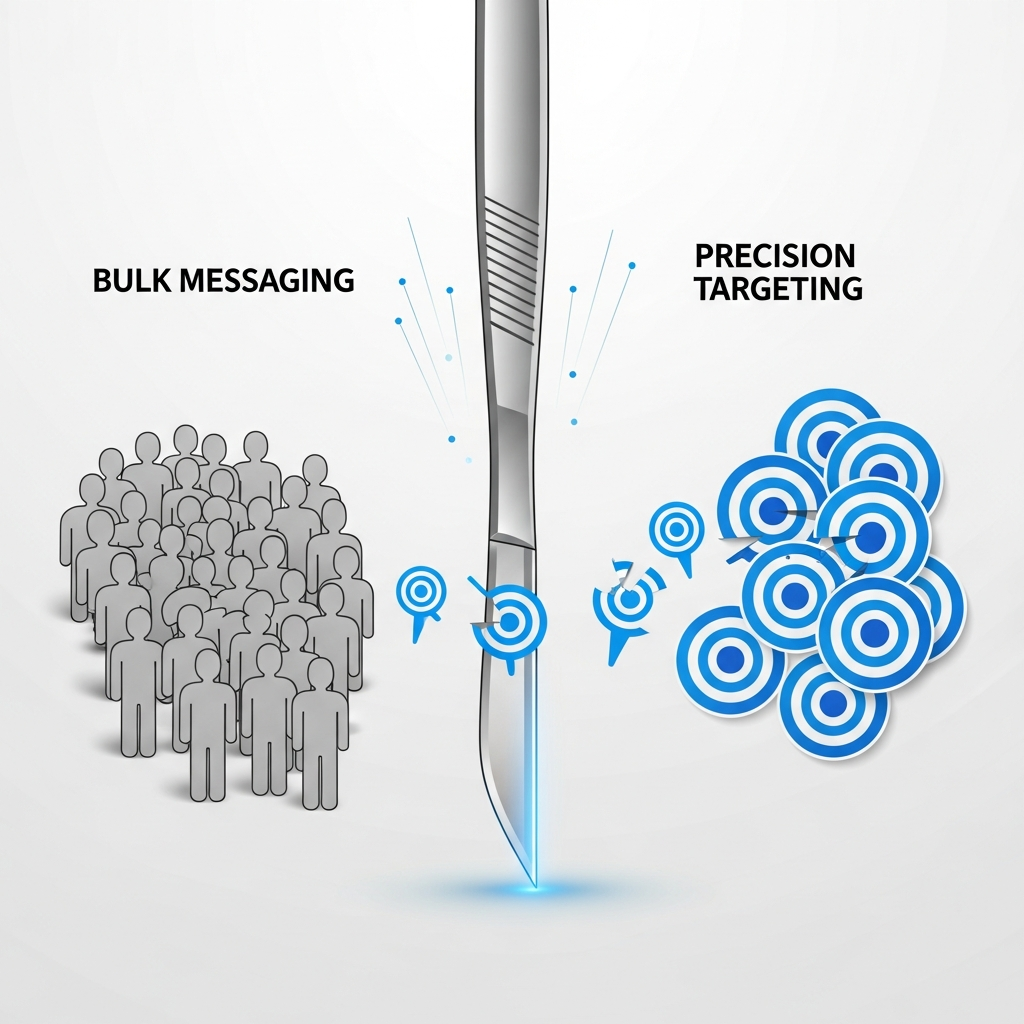
The problem isn’t just that these messages are annoying; it’s that they represent a fundamental misunderstanding of human psychology and modern technology. We are currently living through the “Tragedy of the Digital Commons.” Marketers have overgrazed the fields of our attention, leaving behind a barren landscape of cynicism. This is where the AI Scalpel comes in. It’s not just a tool; it’s a philosophical shift. It is the transition from being a loud, clumsy giant with a megaphone to being a precision surgeon who knows exactly where to make the incision to save the patient’s time—and your ROI.

In this guide, we’re going to dissect why bulk messaging is a fast track to brand irrelevance and how you can leverage AI to perform “surgical” strikes that actually resonate. This isn’t about “hacks.” It’s about the brutal, beautiful efficiency of relevance.

Ai as a Scalpel: Why Precision Targeting Beats Bulk Messaging Every Time concept 2

The Blunt Trauma of Bulk Messaging: A Post-Mortem

Let’s get analytical for a moment. Why does bulk messaging fail so spectacularly in the current era? It comes down to Cognitive Load. Every time a person interacts with a piece of content that is irrelevant to them, they experience a micro-friction. They have to expend energy to categorize it as “trash.” Do this enough times, and the brain builds a permanent firewall against your brand.

The Math of Diminishing Returns

Old-school marketers love the “numbers game.” They argue that if you send 100,000 emails and get a 0.01% conversion rate, you’ve still made 10 sales. But they ignore the Brand Erosion Cost. You didn’t just get 10 sales; you also alienated 99,990 potential future customers who now associate your logo with a mild sense of irritation. That is a massive, unquantified liability on your balance sheet.

The Algorithmic Penalty

It’s not just humans who hate bulk. The gatekeepers—Google, Outlook, Apple Mail—have evolved. Their spam filters are no longer just looking for keywords like “Viagra” or “Free Money.” They are looking at engagement signals. If your bulk messages have low open rates and high “delete-without-reading” rates, the algorithms learn that you are a nuisance. You aren’t just missing an inbox; you’re being buried in a digital shallow grave.

Ai as a Scalpel: Why Precision Targeting Beats Bulk Messaging Every Time concept 3

The Scalpel Philosophy: AI as a Tool for Radical Relevance

When we talk about AI as a scalpel, we’re talking about intent-based targeting. It’s the ability to move beyond demographics (Age, Gender, Location) and into the realm of psychographics and behavioral triggers. Bulk is “Who are they?” Precision is “What do they need *right now*, and how do they feel about it?”

Semantic Understanding vs. Keyword Matching

Most traditional targeting is based on keywords. If a user searches for “running shoes,” they get bombarded with ads for running shoes for three weeks. But what if they already bought the shoes? What if they were actually searching for “how to fix a running shoe injury”? AI allows us to understand the semantics—the meaning behind the action. A precision AI model looks at the context. It realizes the user is in “problem-solving mode,” not “buying mode.” Instead of a discount code, the “scalpel” delivers an article on injury prevention. That is how you build trust.

The End of the Funnel, The Rise of the Labyrinth

We’ve been taught to think of marketing as a funnel. You pour a lot in the top, and a little comes out the bottom. That’s a blunt-force metaphor. Modern customer journeys are more like a labyrinth. People move sideways, they double back, they pause. AI allows us to track these movements in real-time, providing the exact piece of information needed at that specific turn in the maze. It’s supportive, not pushy.

>Deconstructing the “Surgical” AI Stack

To move from bulk to precision, you need a different kind of infrastructure. It’s not about having more data; it’s about having refined data. Here is how the “scalpel” is actually built in a modern enterprise environment.

1. Vector Databases and Latent Intent

Forget standard SQL tables for a second. Precision targeting often utilizes vector databases. These allow us to map “embeddings”—mathematical representations of concepts. If a customer is looking at “sustainable leather,” the AI understands the proximity to concepts like “ethical sourcing,” “durability,” and “minimalism.” It doesn’t just look for the word “leather.” It understands the values of the consumer. This allows you to message them with content that aligns with their worldview, which is a far more powerful hook than a 10% off coupon.

2. Predictive Lead Scoring (The “Why” Behind the Score)

Traditional lead scoring is often arbitrary. “Oh, they clicked a link? Give them 5 points.” AI lead scoring is nuanced. It uses machine learning to identify patterns that a human would never see. For example, it might find that users who visit your pricing page on a mobile device on a Saturday afternoon but have previously watched a 3-minute video on your “About” page are 80% more likely to convert if they receive a case study, not a sales call. The AI finds the “invisible” correlations.

3. Hyper-Personalized Synthetic Content

This is where it gets interesting—and where you have to be careful. Large Language Models (LLMs) allow us to generate unique messages for every single recipient. I’m not talking about swapping out a name tag. I’m talking about changing the tone, the examples used, and the narrative structure based on the recipient’s past interactions. If I know a lead is an analytical engineer, my AI-generated reach out will be data-heavy and concise. If they are a creative director, it will be visual and narrative-driven. One message, ten thousand variations, zero human fatigue.

>The Anatomy of a Precision Campaign: A Hypothetical Case Study

Let’s look at two companies. Company A uses the “Blunt Hammer.” Company B uses the “AI Scalpel.”

The Scenario: A B2B SaaS company selling project management software.

Company A (Bulk): They buy a list of 50,000 “CTOs and Project Managers.” They send a sequence of 5 emails. “Struggling with deadlines? Our tool helps you stay organized. Click here for a demo.”
Result: 0.2% open rate. 5 demos booked. 400 “Unsubscribe” requests. Brand reputation: “Just another spammer.”

Company B (Precision): They use AI to monitor LinkedIn job postings and GitHub activity. They identify 200 companies that have recently hired 5+ new developers—a sign of scaling friction. They then use an LLM to analyze the specific tech stack mentioned in those job posts.
The Message: “Hey [Name], I saw you’re scaling the engineering team at [Company] and moving toward [Specific Tech Stack]. Usually, that transition creates a bottleneck in sprint planning. Here’s a 2-minute breakdown of how we handled that specific friction point for [Similar Competitor].”
Result: 35% open rate. 12 demos booked. 0 unsubscribes. Brand reputation: “These people actually understand my job.”

Company B spent more time on the “cut,” but they didn’t waste any “blood.” They didn’t need 50,000 people to listen. They needed 200 of the right people to feel understood.

>The Cognitive Cost of Being Wrong: Why “Close Enough” Isn’t Good Enough

There is a dangerous middle ground in marketing: the “Uncanny Valley” of personalization. This happens when you try to use AI but do it poorly. You’ve seen it—the email that says, “I saw you’re a fan of [Niche Hobby]!” when you just clicked a link by accident once. This feels creepy and manipulative.

As a copywriter, I advocate for the Supportive Tone. When you use a scalpel, you must do so with the intent to heal (or help), not just to extract. If your AI targeting feels like a “gotcha,” you’ve failed. It should feel like a “finally.” As in, “Finally, someone sent me something I actually needed to read.”

The “Is This Helpful?” Litmus Test

Before deploying any AI-driven precision campaign, ask yourself: If this person were standing in front of me, would I feel comfortable saying this to them based on what I know? If the answer is no, your AI is being a stalker, not a strategist. Precision requires empathy. You are using data to better understand a human being’s frustrations, not to exploit their weaknesses.

>Overcoming the Infrastructure Inertia

I know what you’re thinking. “This sounds expensive and complicated.” It’s actually less expensive than wasting $50,000 a month on bulk ads that get ignored. The shift to precision is an investment in efficiency.

Clean Your Room (Data Hygiene)

You cannot perform surgery with a dirty scalpel. Most companies have “dirty” data—duplicate entries, outdated titles, and fragmented touchpoints. The first step to AI precision isn’t buying a fancy LLM; it’s data orchestration. You need a single source of truth where all customer interactions are logged. If your CRM doesn’t talk to your website analytics, your scalpel is blunt.

Start with Micro-Segments

Don’t try to hyper-personalize for your whole audience on Day 1. Pick your top 5%—your “Whales” or your most loyal advocates. Use AI to analyze their patterns. Why do they stay? What was the “Aha!” moment for them? Once you understand the precision needed for your best customers, you can start to model that for the rest of your leads.

>The Ethical Scalpel: Privacy in the Age of Precision

We have to address the elephant in the room: Privacy. In an era of GDPR and CCPA, the “Scalpel” approach might seem like it’s skirting the line of surveillance. However, I’d argue that precision is actually more ethical than bulk. Bulk messaging is “Attention Theft.” You are stealing seconds of life from thousands of people for something they didn’t ask for.

Precision targeting, when done correctly, relies on Zero-Party and First-Party Data. This is data the user has willingly given you or generated through their direct interaction with your brand. By using AI to make that experience better, you are fulfilling the “Implicit Contract” of digital commerce: I give you my data, and in return, you don’t waste my time.

Transparency as a Feature

One of the best ways to humanize your AI is to be transparent about it. I’ve seen incredible results from companies that literally say: “Our system noticed you’ve been struggling with [Topic], so we generated this specific report for you.” It turns the “creepiness” into utility. It shows the recipient that you are using your technology to serve them, not just to track them.

>The Future: From Precision to Prediction

Where does the scalpel go from here? We are moving into the era of Predictive Empathy. This isn’t just reacting to what a user did; it’s anticipating what they will need before they even realize it. Imagine an AI that notices a change in a user’s typing rhythm or interaction frequency—indicators of stress or frustration—and automatically simplifies the interface or offers a direct human support line.

That is the ultimate expression of the scalpel. It’s not just about “Targeting.” It’s about care. In a world that is increasingly automated and cold, the brands that use AI to become more “human”—by being more relevant, more timely, and more thoughtful—are the ones that will survive the Great Noise.

>Your Next Step: Laying Down the Megaphone

If you take nothing else from this, let it be this: Scale is a vanity metric; resonance is a sanity metric. Stop looking at how many people you reached. Start looking at how many people you touched. Turn off the bulk sequences for a week. Take a small segment of your audience, use every AI tool at your disposal to understand their specific, current pain points, and send them something so relevant it feels like a gift.

The scalpel is in your hand. The question is: are you ready to stop swinging and start cutting?

Precision isn’t just a strategy. It’s a sign of respect for your audience. And in the modern economy, respect is the only currency that doesn’t depreciate.

How to Scale Your Small Business With Facebook Ads: a Step-by-step Blueprint

>The Quiet Anxiety of the Scaling Pivot

Most small business owners treat Facebook Ads like a sophisticated slot machine. You put a dollar in, you pull the lever of the “Publish” button, and you pray for a three-cherry ROAS (Return on Ad Spend). It works for a while. Then, suddenly, the machine jams. Your cost per acquisition (CPA) spikes. Your creative “fatigues.” You feel that familiar, cold knot in your stomach—the realization that what got you to six figures won’t drag you to seven. I’ve been there, staring at a red dashboard at 2:00 AM, wondering if the algorithm had a personal vendetta against my brand. It doesn’t. It just demands a different level of rigor once you decide to scale.

Scaling is not a linear function of budget. It is a complex reorganization of data, creative psychology, and technical infrastructure. If you simply double your budget tomorrow, you won’t double your revenue; you’ll likely just double your waste. This guide is the blueprint I wish I had when I was burning my own cash trying to figure out why my “winning” ads died the moment I touched the budget toggle.

How to Scale Your Small Business With Facebook Ads: a Step-by-step Blueprint concept 2

Phase 1: The Technical Infrastructure (The “Truth” Layer)

Before you spend another dime, we need to talk about data integrity. Post-iOS 14.5, the “signal” Facebook receives from your website is degraded. If the algorithm is flying blind, your scaling efforts will crash. You cannot scale on a broken foundation.

The Conversion API (CAPI) and Server-Side Tracking

The standard browser-based Pixel is no longer enough. Ad blockers, cookie restrictions, and privacy settings “leak” data. You need Conversion API (CAPI). This creates a direct server-to-server connection between your website (Shopify, WooCommerce, etc.) and Meta. It ensures that when a purchase happens, Meta knows about it, even if the user’s browser tried to hide it. Without CAPI, your “Event Match Quality” will be poor, and the algorithm won’t know which users are actually worth bidding on.

Advanced Matching and Event Priority

Go into your Events Manager. Ensure “Advanced Matching” is turned on for all parameters (email, phone, city). Why? Because Meta needs to “stitch” a user’s identity across devices. If a customer clicks an ad on their iPhone but buys later on their MacBook, Advanced Matching is the thread that connects those two events. Without it, your attribution is a mess, and you’ll kill ads that are actually making you money because the dashboard says “0 sales.”

“In the world of algorithmic bidding, the person with the cleanest data wins. It’s not about who has the best product; it’s about who feeds the machine the highest quality signals.”

>Phase 2: The Creative-Led Growth Strategy

In the old days of Facebook Ads, we obsessed over “ninja” targeting. We’d layer interests like “People who like luxury watches AND organic kale AND live in a 5-mile radius of a Whole Foods.” Those days are dead. Creative is the new targeting.

The Algorithmic Bias of Creative

The Meta algorithm is now so sophisticated that it analyzes the visual elements and text of your ad to determine who to show it to. If your ad features a woman doing yoga, the algorithm will naturally find people interested in wellness. You don’t need to tell it to find “yoga lovers.” In fact, if you use tight interest targeting, you often increase your costs by limiting the algorithm’s ability to find cheaper pockets of the auction.

The “Big Three” Creative Archetypes for Scaling

  • The Social Proof Heavyweight: This isn’t just a testimonial. It’s a “mashup” video of five different customers saying the same thing. It builds immediate, unshakeable trust.
  • The Educational “How-To”: Scale often requires moving from “Warm” audiences to “Cold” ones. Cold audiences don’t know why they need you. A high-production (or intentionally lo-fi) video explaining the *mechanism* of your product solves the “Problem Awareness” gap.
  • The Aesthetic Lifestyle: High-quality static images or “cinematic” reels that sell the *identity* associated with your brand. This lowers the “friction of the scroll.”

The Concept of “Hook Rate” and “Hold Rate”

Stop looking at ROAS as your primary creative metric. It’s a “lagging” indicator. To scale, you need “leading” indicators.
Hook Rate (3-Second Video Views / Impressions): If this is below 25%, your creative is failing to stop the thumb. Change the first 2 seconds.
Hold Rate (ThruPlays / 3-Second Video Views): If this is low, your content is boring. You’re losing them before the pitch. Scale is only possible when your creative is “sticky” enough to keep people off the “Next” button.

>Phase 3: The “Simplified” Account Structure

Small businesses often suffer from “Campaign Bloat.” They have 15 campaigns, each with 10 ad sets, all with $5/day budgets. This is the fastest way to stay small. It traps your account in the “Learning Phase.”

Consolidation is Your Friend

To scale, you need to exit the Learning Phase as quickly as possible. Meta requires roughly 50 conversion events per ad set, per week, to optimize. If you spread your budget across too many ad sets, none of them will hit that 50-conversion threshold. They will perpetually underperform. Aim for a “Simplified Structure”:

  • One Prospecting Campaign (TOF): Use Broad targeting (Age, Gender, Location only) or very wide Lookalikes (3-5%). Let the creative do the heavy lifting.
  • One Retargeting Campaign (MOF/BOF): Only if your audience is large enough. Often, for small businesses, it’s better to use “Advantage+ Shopping Campaigns” (ASC) which handle prospecting and retargeting in one go.
  • The Testing Sandbox: A separate campaign where you test new creatives with small budgets before moving them into the “Scale” campaign.

>Phase 4: The Scientific Method of Scaling

Scaling is not just “increasing the budget.” It is the systematic reduction of uncertainty. There are two primary ways to scale: Vertical and Horizontal.

Vertical Scaling: The 20% Rule

If an ad set is performing well, the temptation is to double the budget. Don’t. Facebook’s auction is sensitive. A massive budget increase resets the learning phase and can cause your CPA to explode. Increase the budget by 20% every 48 to 72 hours. This allows the algorithm to adjust its bidding strategy without losing the “scent” of your ideal customer.

Horizontal Scaling: The Multi-Angle Approach

Vertical scaling eventually hits a ceiling where the “audience saturation” kicks in. To move past this, you scale horizontally. This means taking your winning product and finding a *new reason* for people to buy it.
Example: If you sell ergonomic chairs to “office workers,” horizontal scaling involves creating a new ad set targeting “gamers” with specific “gamer-focused” creative. You aren’t just spending more on the same people; you’re opening new doors to new rooms of people.

Using CBO (Campaign Budget Optimization)

When you are ready to scale, switch to CBO. You give the budget to the Campaign level, and Meta distributes it to the ad sets that are performing best in real-time. This is the “autopilot” of scaling. It prevents you from wasting money on an ad set that’s having a “bad day” and shifts those funds to the one that’s converting.

>Phase 5: The Math of the “Messy Middle”

You cannot scale what you cannot measure. Most small businesses look at the Facebook Ads Manager ROAS and think that’s the whole story. It’s not. As you scale, you must look at your MER (Marketing Efficiency Ratio).

MER = Total Revenue / Total Ad Spend.

Why does this matter? Because as you scale on Facebook, you will see “halo effects.” People will see your ad, not click, but search for you on Google three days later. Or they’ll see your ad, go to your Instagram, and buy through a link in your bio. If you only look at Facebook’s “Last Click” or “7-day Click” attribution, you’ll think the ads aren’t working as well as they are. You need to understand your Contribution Margin. If your MER is healthy, keep scaling, even if the individual ad ROAS looks slightly lower than it did at a $50/day spend.

>Phase 6: Avoiding the “Death Spirals”

Scaling creates friction. Things will break. Here is how to handle the most common failures.

Creative Fatigue: The Silent Killer

When you scale, you are showing your ads to more people, more often. Your “Frequency” will go up. When people see the same ad three or four times without clicking, they become “blind” to it. Your CTR (Click-Through Rate) will drop, and your CPMs will rise. To fight this, you must have a Creative Pipeline. You should be testing 2-3 new creatives every single week in your “Sandbox” so that when your “Scale” creative starts to die, you have a replacement ready to go.

The Post-Purchase Experience Gap

Scaling your ads scales your problems. If you double your orders, can your shipping department handle it? Can your customer service team answer the emails? I’ve seen businesses scale their ads beautifully only to be shut down by Facebook because their “Customer Feedback Score” tanked due to shipping delays. A low feedback score will increase your CPMs so high that your ads become unprofitable. Scaling is a holistic business effort, not just a marketing one.

“Your ads are only as good as your fulfillment. The algorithm prioritizes user experience; if your customers are unhappy, Meta will tax your greed with higher ad costs.”

>Conclusion: The Stoic Approach to Scaling

Scaling a small business via Facebook Ads is not a “set it and forget it” endeavor. It is a disciplined practice of hypothesis testing. You will have days where the data makes no sense. You will have weeks where you feel like you’re just donating money to Menlo Park. But the blueprint remains the same: Fix your data, lead with creative, simplify your account, and scale with mathematical patience.

Success in this arena belongs to the analytical and the empathetic. You must be analytical enough to read the spreadsheets, but empathetic enough to understand the human on the other side of the screen. They aren’t a “conversion event.” They are a person with a problem, looking for a solution. Solve their problem better than anyone else, and the algorithm will eventually reward you with the scale you’re looking for. Now, go back into your Ads Manager. Look at your Hook Rates. Check your CAPI status. Stop gambling and start scaling.

How to Scale Your Digital Business: the Ultimate Growth Strategy Roadmap

>The Great Scaling Delusion: Why Most Businesses Stagnate

Growth is a seductive siren. To the uninitiated digital founder, revenue and scaling are often conflated as synonymous twins. They are not. Growth is linear; it is the act of adding resources at the same rate you add revenue. If you hire one salesperson to close ten deals, and then hire ten more to close a hundred, you aren’t scaling. You are merely bloating. Scaling, in its purest, most academic sense, is the decoupling of the revenue curve from the cost curve. It is the pursuit of the exponential.

The digital landscape is littered with the corpses of companies that “grew” themselves into bankruptcy. They mistook a temporary spike in customer acquisition for a sustainable business model. To scale a digital business is to perform open-heart surgery on a marathon runner while they are mid-stride. It requires an analytical rigor that borders on the obsessive and a willingness to dismantle the very systems that brought you your initial success.

In this guide, we will dissect the anatomical requirements of a scalable digital enterprise. We will move beyond the “hustle-and-grind” platitudes of LinkedIn influencers and dive into the cold, hard mechanics of unit economics, operational infrastructure, and the psychological fortitude required to let go of the steering wheel without crashing into a ditch.

>Infrastructure: Moving Beyond “Bubble Tape and Prayer”

Most digital startups begin as a collection of frantic workarounds. You have a spreadsheet that talks to a CRM, which is manually updated by a founder who hasn’t slept since the Obama administration. This “scrappy” phase is necessary for survival, but it is the primary inhibitor of scale. You cannot build a skyscraper on a foundation of damp cardboard.

The Tech Debt Tax

In the early days, you make compromises. You choose the cheaper API. You write “quick and dirty” code. You ignore documentation. This is “tech debt,” and like any high-interest loan, the payments eventually become due. When you attempt to scale, this debt manifests as system crashes, data silos, and a development team that spends 90% of their time fixing bugs rather than building features. Scaling requires a ruthless audit of your stack. If your current architecture cannot handle 10x the traffic or 100x the data without a catastrophic failure, you aren’t ready to scale.

The Automation Paradox

Automation is the holy grail of scaling, yet it is frequently misunderstood. You cannot automate a broken process; you can only automate the speed at which it breaks. Before applying the “magic” of AI or automated workflows, you must map your business processes with such granularity that a reasonably intelligent golden retriever could follow them. Standard Operating Procedures (SOPs) are not bureaucratic busywork; they are the source code of your business. If a task requires “founder intuition” every time it’s performed, it is a bottleneck. Kill it or document it.

“The first rule of any technology used in a business is that automation applied to an efficient operation will magnify the efficiency. The second is that automation applied to an inefficient operation will magnify the inefficiency.” — Bill Gates

>The Mathematical Reality of the Leap

Scaling is a numbers game where the stakes are your sanity. To scale successfully, you must possess a visceral understanding of your unit economics. This isn’t just “revenue minus expenses.” It’s about the surgical isolation of what it costs to acquire a customer and what that customer is worth over their lifetime.

LTV/CAC: The Only Ratio That Truly Matters

If you don’t know your Customer Acquisition Cost (CAC) and your Lifetime Value (LTV), you aren’t running a business; you’re participating in an expensive hobby. In a scalable digital model, your LTV should ideally be at least 3x your CAC. But even that is a simplification. You must also consider the CAC Payback Period. If it takes you 18 months to recoup the cost of acquiring a customer, but your cash reserves only last for six months, you will scale yourself directly into a liquidity crisis. High-growth scaling requires a short payback window—ideally under six months—to ensure that your capital is constantly being recycled back into acquisition.

The Churn Silent Killer

Churn is the gravity of the digital world. It doesn’t matter how fast you pour water into the bucket if the bottom is missing. A 5% monthly churn rate might seem manageable at a small scale, but as you grow, that 5% represents an increasingly massive number of customers who must be replaced just to stay level. Scaling requires a shift in focus from Acquisition to Retention. Negative churn—where the expansion revenue from existing customers outweighs the loss from departing ones—is the true engine of the world’s most successful SaaS and digital platforms.

>The Product-Market Fit Fallacy

One of the most common mistakes in the digital space is assuming that Product-Market Fit (PMF) is a static achievement. It is not. PMF is a fleeting state of grace that must be constantly defended. As you scale, the “market” changes. You move from early adopters—who are forgiving of bugs and lack of features—to the early majority, who are demanding, impatient, and remarkably unenthusiastic about your “innovative” vision.

Horizontal vs. Vertical Expansion

When scaling, you face a fork in the road: do you go deeper into your current niche (vertical) or expand into adjacent markets (horizontal)? Most founders succumb to the “shiny object syndrome” and go horizontal too early. They launch new products before the flagship is stable. True scaling usually involves doubling down on the core “unit of value” until you have achieved near-total market saturation. Only then do you have the brand equity and cash reserves to colonize new territories.

The “Minimum Viable Bureaucracy”

As you scale, the product must evolve from a “tool” into a “platform.” This requires a shift in engineering philosophy. You move from building features to building systems. This is where many digital businesses lose their soul. The trick is to implement what I call “Minimum Viable Bureaucracy.” You need enough structure to prevent chaos, but not so much that you stifle the creativity that made you successful in the first place. If a developer needs three meetings and a signed permission slip to change a button color, your scaling efforts will grind to a halt.

>The Human Element: Scaling Without Losing the Soul

At some point, the scaling problem stops being a technical one and starts being a human one. Your role as a founder changes from the “Lead Doer” to the “Chief Architect.” This transition is psychologically painful. You will have to watch people do things 80% as well as you would have, and you will have to keep your mouth shut because that 20% gap is the price of growth.

Hiring for Trajectory, Not Just Pedigree

In the scaling phase, you don’t need “all-rounders” anymore. You need specialists. You need people who have seen this movie before. If you are scaling from $1M to $10M, you need to hire people who have worked at $50M companies. However, beware the “Big Company Refugee.” Someone who thrived at Google with 10,000 subordinates might crumble in a 50-person startup where they have to actually set up their own Slack integrations. Look for trajectory: people who are on their way up and possess the “scrappy” DNA combined with “big system” knowledge.

The Culture Debt

Just as tech debt accumulates, so does culture debt. When you are three people in a garage, culture is “whatever we feel like.” When you are 300 people across four time zones, culture is the only thing that ensures people are making the right decisions when you aren’t in the room. If you haven’t codified your values, your employees will invent their own. Usually, those invented values include “doing the bare minimum” and “avoiding accountability.”

>Marketing and the Red Queen Hypothesis

In Lewis Carroll’s Through the Looking-Glass, the Red Queen tells Alice, “Now, here, you see, it takes all the running you can do, to keep in the same place.” This is an apt metaphor for digital marketing during a scale-up. The algorithms of Google and Meta are constantly shifting. What worked yesterday at a $1,000/day spend will often break at $10,000/day. This is the law of diminishing returns.

Channel Diversification: The Antidote to Platform Risk

Scaling on a single channel is like building a mansion on a rented plot of land. If Zuck decides to change a line of code or Google decides your niche is “low quality,” your business can vanish overnight. A scalable marketing strategy is an omnichannel one. You need a mix of:

  • Paid Acquisition: For immediate, predictable (though expensive) feedback loops.
  • Organic Content/SEO: For long-term, compounding authority and “free” traffic.
  • Owned Media: Email and SMS lists that you control entirely.
  • Virality/Referral Loops: Where the product gets better as more people use it.

The Content Factory

To scale digitally, you must become a media company that happens to sell [insert your product here]. The modern consumer requires an average of 7 to 11 “touchpoints” before they trust a brand enough to purchase. Scaling your marketing means scaling your content production without diluting your brand’s voice. This is where many businesses fail—they outsource their content to low-cost agencies that churn out bland, AI-generated “slop” that attracts clicks but zero conversions. High-quality, authoritative content is the only thing that builds the “moat” around your business.

>The Founder’s Dilemma: Getting Out of the Way

The biggest bottleneck in any digital business is almost always the person who started it. Your “superpowers”—your attention to detail, your vision, your control-freak tendencies—become your greatest liabilities during scaling. You are the “single point of failure.” If you get hit by a bus (or just want to take a vacation without a laptop), does the business continue to grow? If the answer is no, you haven’t built a business; you’ve built a prison.

The Delegation Framework

Scaling requires a shift from Task Delegation to Outcome Delegation. Instead of telling someone *how* to do a task, you tell them what the successful *outcome* looks like and give them the resources to get there. This requires a level of trust that most founders find terrifying. It also requires a robust feedback loop. You need dashboards—not just for your finances, but for every department. You need to be able to see, at a glance, the health of your sales pipeline, your customer support response times, and your server uptime. If you have to ask for a report, you’ve already lost the battle for scale.

“Management is doing things right; leadership is doing the right things.” — Peter Drucker

>Operations: The Unsexy Engine of Growth

If marketing is the accelerator, operations is the transmission. Without it, you’re just redlining your engine while the wheels stay stationary. Scaling operations means moving from “heroic efforts” to “repeatable systems.” This involves everything from your financial modeling to your legal compliance.

Cash Flow Management: The Oxygen of Scale

Profit is a vanity metric; cash is reality. You can be profitable on paper while being stone-cold broke in the bank. Scaling consumes cash at a voracious rate. You are often paying for talent, marketing, and infrastructure months before they generate a return. This is the “J-Curve” of growth. To survive it, you need sophisticated cash flow forecasting. You need to know exactly how much “runway” you have under various growth scenarios. If you don’t have a CFO (or at least a very high-level fractional one) by the time you’re scaling, you’re flying blind through a thunderstorm.

Compliance and Global Complexity

When you scale a digital business, the world gets smaller, but the legal headaches get larger. GDPR, CCPA, NEXUS tax laws—these are not just acronyms; they are potential existential threats. Scaling internationally adds layers of complexity that can paralyze a small team. You must build your systems with compliance in mind from the start. Retrofitting privacy protocols or tax collection mechanisms after you’ve reached 50,000 customers is a nightmare that will consume your entire engineering team for months.

>The “Flywheel” Effect: Achieving Momentum

The ultimate goal of scaling is to reach the point where the “Flywheel Effect” takes over. This concept, popularized by Jim Collins, describes a massive, heavy flywheel that takes an enormous amount of effort to start moving. But once it gains momentum, the weight of the wheel itself starts to do the work for you. Each incremental push (a new customer, a new piece of content, a new feature) adds to that momentum.

Building the Moat

As you scale, you must ask: “What makes it harder for competitors to catch me the bigger I get?” This is your “moat.” In the digital world, moats usually consist of:

  • Network Effects: The product becomes more valuable as more people use it (e.g., Slack, LinkedIn).
  • Data Superiority: You have more data to train your algorithms or understand customer behavior than anyone else.
  • Brand Equity: Customers choose you because of trust and recognition, even if a cheaper alternative exists.
  • Switching Costs: Your product is so deeply integrated into the customer’s workflow that leaving would be a logistical disaster.

Scaling without a moat is just a race to the bottom. If your only advantage is a lower price or a slightly better UI, you will eventually be disrupted by someone with more VC funding or a more aggressive growth strategy. Scaling is the process of widening that moat every single day.

>Final Thoughts: The Horizon is Always Moving

Scaling a digital business is not a destination. There is no point at which you can sit back and say, “We have scaled.” The moment you stop optimizing, stop questioning your assumptions, and stop obsessing over your metrics is the moment you begin to decline. The digital landscape moves too fast for stagnation.

The roadmap provided here isn’t a simple checklist; it’s a fundamental shift in philosophy. It requires moving from the ego-driven “founder-centric” model to a “system-centric” model. It’s about building a machine that is smarter, faster, and more resilient than you are. It is an arduous, often thankless journey, but for those who get it right, the rewards are not just financial—they are the satisfaction of seeing a vision transformed into a self-sustaining, world-changing reality. Now, stop reading and go look at your LTV/CAC ratios. The flywheel won’t turn itself.

Automation Made Simple: How to Build Your First Automated System Without Coding

>The Great Lie of Modern Productivity

We’ve been sold a massive lie. The “hustle culture” gurus tell you that the secret to scaling your business or reclaiming your life is more discipline. They tell you to wake up at 4:00 AM, drink some proprietary greens powder, and grind through your inbox until your eyes bleed. They are wrong. Discipline is a finite resource; systems are infinite.

You don’t need more hours. You need more leverage. For decades, that leverage was reserved for the elite—the companies with deep pockets who could hire teams of developers to write thousands of lines of Python or Java to make disparate apps talk to each other. That era is dead. We are living in the age of the No-Code Revolution.

Right now, as you read this, there is a way to make your email, your CRM, your project management tool, and even your AI assistant work together in a seamless, invisible dance. No coding required. No computer science degree necessary. Just logic, a few clicks, and the willingness to stop doing “grunt work” manually. This guide is your blueprint to building your first automated system from the ground up.

>The Anatomy of an Automation: Logic Over Language

Before we touch a single tool, you have to understand the “Atomic Unit” of automation. It isn’t code. It’s Logic. Specifically, it’s a concept called “Event-Driven Architecture.” In plain English? It’s “If This, Then That.”

Every automated workflow, no matter how complex, consists of three core components:

  • The Trigger: This is the “If This” part. It’s the event that kicks everything off. A new email arrives. A form is submitted. A specific time of day occurs. A lead is tagged in your CRM. The trigger is the spark.
  • The Action: This is the “Then That” part. It’s the work being performed. Create a folder in Google Drive. Send a Slack message. Generate an invoice in QuickBooks. The action is the heavy lifting.
  • The Filter/Logic (Optional but Crucial): This is the “Only If” part. It ensures your automation doesn’t run wild. For example: “If I get a new email, and only if it has an attachment, then save it to Dropbox.”

Once you stop seeing apps as isolated silos and start seeing them as Trigger and Action points, you begin to see automation opportunities everywhere. That manual data entry you did this morning? That’s just a missing link between a Trigger and an Action.

>Choosing Your Weapon: The No-Code Ecosystem

You wouldn’t use a sledgehammer to hang a picture frame. Choosing the right tool is about matching the complexity of your needs to the power of the platform. There are dozens of players in the space, but for 95% of users, the choice comes down to these three titans.

1. Zapier: The Gold Standard for Beginners

Zapier is the “Apple” of the automation world. It’s polished, it’s intuitive, and it has the largest library of integrations (over 6,000 apps). If you can click a mouse, you can use Zapier. It’s perfect for simple, linear workflows. However, it can get expensive quickly as you scale, and its logic can sometimes feel a bit rigid for power users.

2. Make (formerly Integromat): The Visual Powerhouse

Make is for the builders who want to see their data move. It uses a visual canvas where you connect “bubbles” (modules). It is significantly more powerful than Zapier, allowing for complex branching, looping, and data manipulation that would make a developer weep with joy. The learning curve is steeper, but the cost-to-power ratio is unbeatable.

3. Pabbly Connect: The Budget-Friendly Challenger

Pabbly has gained a massive following because it doesn’t charge for “internal tasks” (the steps within an automation). If you are running high-volume automations on a budget, Pabbly is a formidable contender. It lacks the polish of Zapier and the sheer depth of Make, but for most business use cases, it’s more than enough.

>The Automation Audit: Identifying What to Kill

The biggest mistake beginners make is trying to automate everything at once. That’s a recipe for a broken system and a massive headache. You need to perform an “Automation Audit.” Look at your daily tasks and pass them through the R.R.R. Framework:

  • Repetitive: Do you do this task more than three times a week?
  • Rule-Based: Does the task follow a clear, logical path that doesn’t require “human intuition” or subjective “vibes”?
  • Robotic: Does doing this task make you feel like a machine? (e.g., copying a name from an email and pasting it into a spreadsheet).

If a task hits all three, it’s a prime candidate for execution. Start with the “Low-Hanging Fruit”—tasks that take 5-10 minutes but happen constantly. Think: lead notifications, file organization, or meeting reminders.

>Building Your First System: The “Lead-to-Action” Pipeline

Let’s get practical. We’re going to walk through building a system that handles a common business headache: The New Lead Response.

The Scenario: A potential client fills out a form on your website. Currently, you get an email, you manually add them to your CRM, you manually send them a “Thank You” email with a booking link, and you manually alert your team in Slack. It’s slow, and leads go cold while you’re busy eating lunch.

Step 1: Set the Trigger

Connect your form tool (Typeform, Google Forms, WPForms) to your automation platform (let’s use Zapier for this example). Select “New Entry” as your trigger. The platform will ask you to “Test Trigger.” This pulls in real data from a recent form submission so the system knows what fields (Name, Email, Project Type) it’s working with.

Step 2: Add Logic (The Filter)

Maybe you only want to work with clients who have a budget over $2,000. Add a “Filter” step. Tell the system: “Only continue if the ‘Budget’ field is greater than 2000.” If a lead comes in with a $500 budget, the automation stops. You’ve just saved yourself from a discovery call that wasn’t going anywhere.

Step 3: The First Action (The CRM)

Connect your CRM (HubSpot, Pipedrive, Salesforce). Select “Create Lead” or “Add Contact.” Map the fields from your form to the fields in your CRM. Form: Name goes to CRM: First Name. Form: Email goes to CRM: Email. It’s like digital Legos.

Step 4: The Second Action (The Communication)

Connect your email provider (Gmail, Outlook). Select “Send Email.” Use the lead’s email address from Step 1 as the recipient. Write a personalized template: “Hi [Name], thanks for reaching out about [Project Type]! Here is my calendar…” This happens instantly. Before the lead has even closed their browser tab, you’re in their inbox.

Step 5: The Third Action (The Team Alert)

Connect Slack or Microsoft Teams. Send a message to your #sales channel: “🔥 New High-Value Lead! [Name] just submitted a form for [Project Type]. They’ve been added to HubSpot.”

Total Time Saved: 15 minutes per lead. Total Value: The lead feels prioritized, your data is clean, and your team is informed—all while you were doing literally anything else.

>Advanced Strategy: Incorporating AI into No-Code Workflows

If 2023 was the year of “talking” to AI, 2024 is the year of “deploying” AI into workflows. This is where you move from simple data transfer to Intelligent Automation.

By using the OpenAI (ChatGPT) integration within Make or Zapier, you can add a “Thinking Step” to your automation. For example:

  • Sentiment Analysis: When a customer support ticket comes in, send the text to GPT-4. Ask it to rate the frustration level from 1-10. If it’s above an 8, escalate it to a manager immediately.
  • Categorization: Have AI read a messy “Project Description” from a form and automatically categorize it into one of your service buckets.
  • Drafting: Use AI to draft a personalized response based on the lead’s specific questions, then save that draft in your Gmail for you to review and hit “Send.”

The AI acts as the “Decision Maker” in the middle of your automated pipe, handling the nuance that used to require a human brain.

>The Hidden Trap: Why Automations Break (and How to Fix Them)

Automations are not “set it and forget it.” They are “set it and monitor it.” The digital landscape is constantly shifting. An app updates its API, a password changes, or a user enters data in a format you didn’t expect (like putting a phone number in a Name field).

To build a resilient system, you need Error Handling.

In Make, this is done with “Error Handlers.” In Zapier, it’s often handled by “Paths.” You should always have a “Catch” in place. If an action fails (e.g., the CRM is down), the system shouldn’t just die. It should send you a notification saying, “Hey, Step 3 failed. Here is the data so you can do it manually this one time.”

Check your “Task History” or “Execution Logs” once a week. Look for “Zombies”—automations that are running but not actually producing value. Pruning your systems is just as important as building them.

>The Psychological Edge of the “Automated Human”

There is a profound psychological shift that happens when you build your first successful system. You stop being a “doer” and start being an “architect.” You begin to view your time as a high-value asset that must be protected at all costs.

Most people are drowning in the “thick of thin things.” They spend their best cognitive energy on administrative friction. When you automate the mundane, you clear the deck for Deep Work. You free up the mental bandwidth required for strategy, creativity, and relationship building—the things that actually move the needle on your revenue and your happiness.

Don’t wait for the “perfect” time to start. You don’t need a complex 50-step workflow. You need one “Zap.” You need one “Scenario.” Start with the smallest, most annoying task on your plate. Automate it today. Then, tomorrow, do it again.

The No-Code Revolution isn’t about technology. It’s about freedom. And that freedom is only a few clicks away.

>Summary Checklist for Your First Build

  • Identify: Find one task that is repetitive, rule-based, and boring.
  • Map: Write down the Trigger, the Filters, and the Actions on a piece of paper first.
  • Select: Choose Zapier for simplicity or Make for power.
  • Connect: Authenticate your apps (usually just a simple login).
  • Test: Run a test for every single step. Don’t skip this.
  • Monitor: Check your logs after 24 hours to ensure everything is firing correctly.

You are no longer a victim of your inbox. You are the operator of a digital machine. Welcome to the future of work.

Navigating the AI Frontier: Advanced Strategies for Marketing Success in 2026

The landscape of digital marketing is undergoing a profound transformation, with Artificial Intelligence (AI) moving beyond a mere tool to become the foundational infrastructure powering modern marketing ecosystems. In 2026, marketers are no longer just optimizing campaigns; they are orchestrating entire strategies from audience discovery to real-time measurement, all driven by AI. This shift promises faster insights, tighter alignment across brand and performance, and a radically enhanced customer experience.

AI as the Core Infrastructure: Beyond Basic Automation

For years, AI assisted with isolated tasks like drafting copy or optimizing bids. While beneficial, 2026 marks a pivotal moment where AI is evolving into the central nervous system of marketing operations. Instead of being a supplementary tool, AI now forms the backbone, connecting data systems and digital marketing automation to create unified, intelligent workflows. This means AI-driven systems are outperforming traditional campaigns by learning across the entire customer journey, adapting to changes in behavior and intent in real-time, rather than weeks later.

Hyper-Personalization at Scale

One of the most impactful applications of AI in marketing is its ability to deliver hyper-personalized experiences. AI algorithms analyze vast amounts of customer data—from browsing patterns and purchase history to social interactions—to uncover insights about individual preferences and purchasing drivers. This allows marketers to offer hyper-relevant product recommendations, craft personalized messages, and even generate entire email sequences triggered by specific customer actions. Companies leveraging AI-powered personalization can see significant benefits, including a potential 50% reduction in customer acquisition costs and a 10-30% increase in marketing ROI.

Dynamic Optimization and Real-time Decision Making

AI’s capacity for real-time decision-making is revolutionizing campaign optimization. Unlike older, rule-based systems that struggle to adapt to changing behaviors, AI learns from outcomes and updates decisions based on new patterns. This capability is crucial for dynamic budget allocation, where AI can immediately shift spend to channels or regions showing stronger intent and pull back from underperforming areas, significantly improving ROI without increasing overall spend. AI also optimizes ad placements in real time, ensuring the right ads reach the right people at the most opportune moments.

The Evolving Role of Content and SEO in an AI-First World

The shift to AI as infrastructure is profoundly impacting content creation and Search Engine Optimization (SEO). With discovery increasingly starting inside AI-generated summaries and conversational interfaces, SEO is moving beyond traditional rankings. Visibility in 2026 relies on whether AI systems clearly and confidently understand a brand. This demands content that is well-structured, authoritative, and machine-readable, focusing on being consistently understood across platforms rather than just optimized for one page.

Furthermore, Generative AI is enhancing efficiency and creativity in content development. It can produce targeted content, craft engaging visuals, and generate dynamic ideas, significantly reducing creative barriers. This allows marketing teams to scale content creation and personalize outreach more efficiently, a critical advantage in today’s complex buying journeys.

Measuring Success: AI-Driven ROI and Growth Loops

Measuring Return on Investment (ROI) in an AI-powered marketing landscape requires a more comprehensive approach. AI affects multiple parts of the campaign lifecycle, from creative production to targeting and real-time optimization. Therefore, ROI measurement must capture efficiency, agility, and accuracy, not just immediate revenue. Frameworks are essential to translate the wide-ranging benefits of AI—including improved customer satisfaction, reduced acquisition costs, and faster campaign launches—into quantifiable results that resonate with stakeholders.

AI-driven analytics provide clearer attribution, sharper Customer Lifetime Value (CLV) forecasts, and conviction about where to invest next, demanding accountability for every marketing dollar. This data-powered approach is fundamental to navigating business scaling and optimizing growth loops. For deeper insights into leveraging data for strategic growth and ROI, explore The Data-Powered Blueprint: Navigating Business Scaling, Growth Loops, and ROI Optimization.

Challenges and the Human Element

Despite the immense potential, the journey to full AI integration in marketing comes with challenges. Key hurdles include ensuring high-quality, unbiased data, integrating AI with existing legacy systems, addressing skill shortages within teams, and navigating ethical and compliance concerns, particularly regarding data privacy and consent. Poor data quality alone affects nearly half of AI projects, leading to inaccurate predictions and eroding trust.

However, the narrative of AI in marketing in 2026 emphasizes the indispensable role of the human element. While technology powers the system, human empathy, interpretation, and strategic guidance give it meaning. Marketers are tasked with building culture, training teams, and establishing governance to ensure that AI’s potential translates into practice, focusing on intent-led personalization and leveraging human judgment to guide AI output.

The Future is Now: What’s Next?

The evolution of AI in marketing is an irreversible movement. In 2026 and beyond, AI will not only anticipate individual desires but also predict collective behaviors, allowing brands to align campaigns with broader social, environmental, and cultural values. This frontier sees technology moving beyond a mere tool to become a purpose, driving conscious consumption movements and balancing growth with positive impact.

For more insights and resources on the cutting edge of digital strategy, visit Allied Story.

AI-Powered Marketing: Driving Hyper-Personalization and Unprecedented Efficiency in 2026

As of Friday, April 24, 2026, the landscape of digital marketing has undergone a profound transformation, with Artificial Intelligence (AI) moving beyond a mere tool to become the foundational infrastructure powering virtually every facet of campaign execution and strategic decision-making. Marketers are no longer just adopting AI; they are restructuring their entire operations around its capabilities to achieve levels of personalization and efficiency previously unimaginable.

The Dawn of Hyper-Personalization at Scale

One of AI’s most impactful contributions to marketing in 2026 is its ability to deliver hyper-personalization at an unprecedented scale. Brands are now crafting 1-to-1 customer experiences across every touchpoint, from website interactions to email campaigns and advertisements. AI algorithms dynamically adjust content, product recommendations, and messaging in real time, factoring in an individual’s device, location, browsing history, and purchase likelihood.

This sophisticated level of personalization goes beyond basic segmentation, utilizing AI personas to simulate different customer types for campaign testing, ensuring optimal engagement before significant investment. Consumers today expect and prefer personalized experiences, and AI-powered personalization is directly contributing to significant improvements in conversion rates.

Unlocking Operational Efficiency Through AI Automation

The strategic deployment of AI is also revolutionizing operational efficiency within marketing teams. By automating repetitive and time-consuming tasks across the marketing function, AI frees up human resources to focus on high-level strategy, creativity, and customer connection. Areas seeing significant impact include comprehensive campaign management, automated customer data analysis to uncover meaningful patterns, and streamlined workflows that reduce manual handoffs.

A notable development in 2026 is the rise of “agentic AI,” where intelligent systems can autonomously set goals, plan sequences of actions, execute them across platforms, evaluate results, and adapt their approach without constant step-by-step human instruction. This shift enables marketing automation to operate more independently, making real-time decisions about content selection, budget allocation, and audience targeting.

Predictive Analytics: Anticipating Customer Needs and Market Shifts

Predictive analytics, powered by AI and machine learning, has become an indispensable tool for marketers seeking to anticipate future outcomes. It involves extracting insights from existing data to identify patterns and forecast customer behavior, market trends, and the potential success of various campaign strategies. This proactive approach enables marketers to optimize customer journeys, fine-tune targeting, messaging, and timing, and allocate resources more efficiently.

Businesses can now predict individual customer needs, anticipate buying behaviors, and even forecast customer lifetime value (CLV), which is crucial for prioritizing efforts on high-value individuals and fostering long-lasting relationships. For organizations looking to leverage these data-driven insights for long-term expansion, understanding how to apply such advanced analytics is key to Unlocking Sustainable Growth: A Data-Driven Blueprint for Scaling Your Business.

Revolutionizing Content Creation and Advertising with AI

Generative AI is transforming content creation, allowing brands to rapidly generate, scale, and distribute high-quality multimedia content—from long-form articles to marketing copy, visual assets, and video content. This dramatically reduces operational complexity and increases output, enabling businesses to meet the ever-growing demand for fresh, engaging content across numerous platforms.

In advertising, AI optimizes ad spend and targeting by analyzing vast amounts of data to identify the most effective channels, audiences, and messaging. This integrated approach helps brands coordinate messaging and measure performance holistically across search engines, social media, streaming platforms, and email. Furthermore, AI is reshaping Search Engine Optimization (SEO). Visibility in 2026 increasingly relies on AI systems understanding brand content clearly and confidently, as AI-generated summaries and recommendations dominate a growing share of queries.

The Evolving Role of the Marketer: Human-AI Synergy

While AI brings unprecedented capabilities to digital marketing, its success in 2026 hinges on effective human-AI collaboration. AI is not replacing marketers but rather enhancing their capabilities, freeing them from mundane tasks to focus on strategic thinking, creativity, and empathy—the uniquely human elements that truly connect with audiences. Marketers are increasingly supervising intelligent systems, and human-AI hybrid roles are becoming common.

This necessitates a new skill set for marketers, emphasizing AI fluency, data interpretation, and strategic oversight. Ethical considerations, including data privacy, transparent consent, and mitigating algorithmic bias, are also paramount as marketers navigate a landscape where privacy-first approaches and responsible AI usage are the new gold standard.

In conclusion, AI has cemented its position as a strategic ally in digital marketing for 2026. By driving hyper-personalization and enabling unprecedented levels of efficiency and predictive capability, AI empowers brands to build deeper customer relationships and achieve measurable growth. The synergy between advanced AI systems and human ingenuity will continue to define the competitive edge for businesses that embrace this transformative era. For more insights into evolving digital strategies, explore the resources available at Allied Story.