
In the nascent days of digital advertising, managing a Google Ads account was a tactile, almost artisanal pursuit. You would log in once a day, perhaps once a week, adjust a few CPC bids by a nickel or a dime, and feel the smug satisfaction of a job well done. It was the era of the “hand-cranked” auction—a world where human intuition could actually compete with the relatively slow-moving data streams of the early internet.
Fast forward to the present. The landscape has transitioned from a leisurely stroll through a data park to a high-frequency trading environment that would make a Wall Street quant sweat. Today, every single ad auction—which occurs in milliseconds—evaluates thousands of signals simultaneously. We are talking about device type, location intent, browser history, time of day, OS version, and even the atmospheric pressure of the user’s current city (well, perhaps not quite, but the granularity is staggering).
To suggest that a human media buyer can manually process these variables and assign a perfect bid for every individual impression is not just ambitious; it is statistically impossible. If you are still relying on manual bidding, you are essentially trying to win a Formula 1 race on a penny-farthing bicycle. Research and empirical data from high-scale accounts suggest that this stubborn adherence to “manual control” is costing advertisers, on average, 40% in potential ROI. Here is why the era of the manual bid is dead, and how Machine Learning (ML) is the only scalpel sharp enough for modern bid optimization.
>The Cognitive Ceiling: Why Humans Fail at High-Frequency Auctions
The human brain is an extraordinary piece of biological hardware, particularly skilled at pattern recognition and creative synthesis. However, it is fundamentally ill-equipped for the “Cold Calculus” of real-time bidding. When we bid manually, we are forced to aggregate. We look at the “average” performance of a keyword over the last 30 days and set a bid based on that average.
The problem? There is no such thing as an average user.
Consider two users searching for “enterprise CRM software” at 2:00 PM on a Tuesday. User A is a researcher at a Fortune 500 company who has visited your pricing page three times in the last 48 hours. User B is a college student writing a thesis who just happened to click an organic link earlier. To a manual bidder, these users are identical because they used the same keyword. To a Machine Learning algorithm, User A represents a high-probability conversion event worth a $50 bid, while User B represents a bounce worth $0.50.
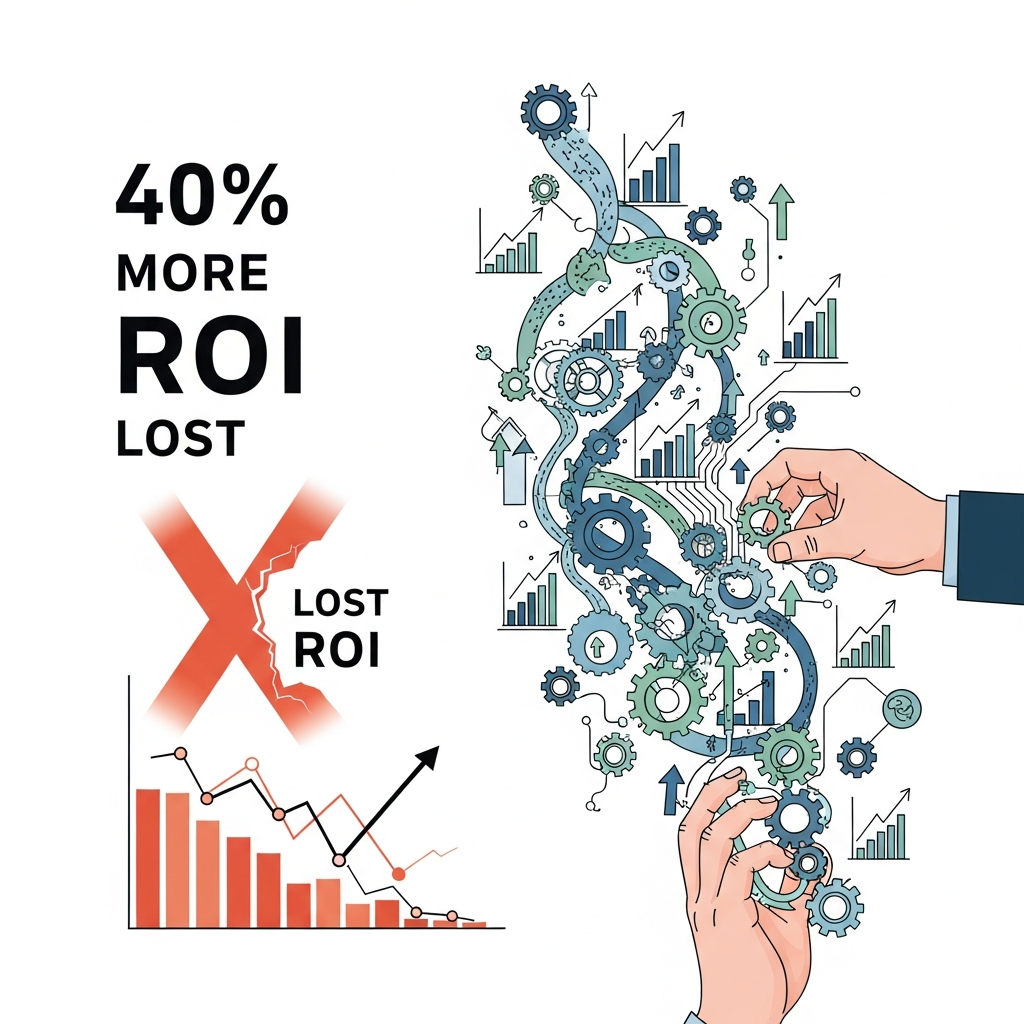
By bidding the “average” (say, $25), the manual bidder overpays for User B and loses the auction for User A. This inefficiency—multiplied by thousands of auctions—is where that 40% ROI leakage occurs. Machine Learning operates at the Request Level, while humans operate at the Aggregate Level. This is a fundamental structural disadvantage that no amount of human “gut feeling” can overcome.
The Architecture of an ML Bidder: Beyond Simple Automation
It is a common misconception that Machine Learning bidding (or “Smart Bidding”) is just a fancy set of “if-then” rules. It is significantly more sophisticated. Most modern ML bidding engines rely on a combination of Bayesian Inference and Deep Neural Networks to predict the likelihood of a conversion.
1. Predictive Modeling and Signal Synthesis
Unlike a human, an ML model doesn’t just look at what happened; it calculates the probability of what will happen. It uses a process called cross-signal analysis. For instance, it might discover that users on iOS devices in New York City have a 15% higher conversion rate on rainy Tuesdays between 5:00 PM and 7:00 PM. A human would never find that correlation, or if they did, they couldn’t possibly implement a bid adjustment for it in real-time. The ML model adjusts the bid for that specific micro-moment instantly.
2. The Epsilon-Greedy Strategy: Exploration vs. Exploitation
One of the most powerful aspects of ML in bidding is how it handles uncertainty. In the world of Reinforcement Learning, this is known as the Exploration vs. Exploitation trade-off. The algorithm “exploits” known winning segments to maximize current ROI, but it also “explores” new, untested segments (new times of day, new audiences) with a small portion of the budget. This ensures the account never stagnates—a feat manual buyers rarely achieve because they tend to be risk-averse with client capital.
“In the context of bid optimization, the algorithm is not just a calculator; it is a laboratory, constantly running thousands of micro-experiments to find the path of least resistance to a conversion.”
>The Mathematical Reality of the 40% ROI Gap
How do we arrive at the figure of 40%? It isn’t just a marketing hyperbole; it’s rooted in the concept of Diminishing Marginal Returns.
In manual bidding, the bidder often hits a “performance plateau.” To get more volume, they raise bids across the board. This increases the Cost Per Acquisition (CPA) because they are now paying more for the same low-quality traffic alongside the high-quality traffic.
ML-driven bid optimization flattens the efficiency curve. Because the algorithm can bid less for low-probability impressions and more for high-probability ones, it effectively reallocates “wasted” spend from the bottom 30% of your traffic and pushes it into the top 10% of high-intent auctions. The result? You often see a simultaneous increase in conversion volume and a decrease in CPA. That delta—the gap between the wasteful “flat” bidding and the surgical “dynamic” bidding—typically accounts for a 30% to 50% improvement in total return.
>Deconstructing the “Google Just Wants My Money” Myth
The most frequent objection to automated bidding is a cynical one: “Why would I trust the platform (Google/Meta) to set my bids? They just want to drain my budget.”
While a healthy dose of skepticism is required in any relationship with Big Tech, this logic falls apart under analytical scrutiny. The platforms are incentivized by long-term retention. If an advertiser spends $10,000 and sees $0 in return because the “automation” was predatory, they will stop spending. If the automation delivers a $50,000 return, they will increase their spend to $100,000.
Furthermore, the platforms possess First-Party Data that you will never have access to. They know the user’s recent search history across different sites, their app usage patterns, and their proximity to physical store locations. When you use manual bidding, you are intentionally blinding yourself to 90% of the data used to determine the auction’s winner. You are essentially playing poker while your opponent (the ML algorithm) can see half of your cards.
>The Hidden Cost of Human Intervention: Latency and Bias
Beyond the data processing limits, manual bidding suffers from two distinct human pathologies: Latency and Cognitive Bias.
The Latency Penalty
Digital markets change by the hour. A competitor might run out of budget at 3:00 PM, leaving a vacuum of cheap, high-quality traffic. A manual bidder might not check the account until the next morning. By then, the opportunity is gone. An ML algorithm detects the change in auction pressure in real-time and lowers the bids to capture that traffic at a discount. Manual bidding is inherently reactive; ML bidding is inherently proactive.
The Bias Trap
Humans are prone to the Recency Bias. If a keyword performed poorly yesterday, a manual bidder might slash the bid today, ignoring the fact that yesterday was a national holiday or a freak technical glitch on the website. Machine Learning models use decay functions and stochastic gradients to weight data appropriately, ensuring that a single outlier doesn’t derail the entire strategy.
>Strategizing for the Shift: How to Transition Without Breaking Your Account
If you are currently 100% manual, jumping headfirst into “Maximize Conversions” can feel like throwing your car into reverse while driving 60 mph. The transition requires a phased, academic approach.
- Step 1: Clean the Data Stream. ML is “Garbage In, Garbage Out.” Before turning on automated bidding, ensure your conversion tracking is flawless. If the algorithm thinks a “Newsletter Signup” is worth as much as a “$5,000 Purchase,” it will optimize for the wrong thing.
- Step 2: Use “Enhanced CPC” as a Training Wheel. ECPC allows the algorithm to adjust your manual bids by a small percentage based on conversion probability. It is a low-risk way to let the machine start learning your account’s nuances.
- Step 3: Run a Controlled Experiment. Use the “Experiments” feature in Google Ads to split your traffic 50/50. Run Manual Bidding on one half and Target ROAS (tROAS) on the other. Do not touch it for 30 days. The statistical significance of the results will usually end the manual bidding debate permanently.
- Step 4: Define Your Constraints. Automation works best when it has a clear North Star. Instead of telling the machine to “Get more sales,” tell it “Get more sales at a minimum 400% ROAS.” This provides the guardrails necessary to prevent budget runaway.
>The Evolution of the Media Buyer: From Pilot to Architect
Does the rise of Machine Learning bidding mean that the digital marketer is becoming obsolete? On the contrary. It means the boring parts of the job are becoming obsolete.
The role is shifting from Tactical Execution (changing bids) to Strategic Orchestration. In the ML era, the elite copywriter and strategist focus on:
- Creative Excellence: Since everyone will eventually use the same bidding algorithms, the only true competitive advantage left is the Ad Creative. The machine can’t write a compelling hook or understand the emotional pain points of your customer.
- Value-Based Optimization: Feeding the machine better data. This involves integrating your CRM so the algorithm optimizes for Lifetime Value (LTV) rather than just a one-time lead.
- Market Context: The algorithm doesn’t know your company is launching a new product next month or that a global supply chain issue has halved your inventory. Humans provide the context; machines provide the scale.
>Conclusion: The High Price of “Control”
The 40% loss in ROI associated with manual bidding is effectively a “Control Tax.” It is the price advertisers pay for the illusion of being in charge. In the hyper-competitive landscape of modern PPC, this is a tax that most businesses cannot afford to pay indefinitely.
Machine Learning in bid optimization is no longer a “luxury feature” for big spenders; it is the baseline requirement for survival. By relinquishing the granular, millisecond-level decisions to the algorithms, you free yourself to focus on the elements of marketing that truly move the needle: psychology, offer resonance, and long-term brand strategy.
The question is no longer whether you should automate your bidding—the question is how much more ROI you are willing to lose before you do.