Bid Optimization via Machine Learning: Why Manual Bidding is Costing You 40% More ROI.

In the nascent days of digital advertising, managing a Google Ads account was a tactile, almost artisanal pursuit. You would log in once a day, perhaps once a week, adjust a few CPC bids by a nickel or a dime, and feel the smug satisfaction of a job well done. It was the era of the “hand-cranked” auction—a world where human intuition could actually compete with the relatively slow-moving data streams of the early internet.

Fast forward to the present. The landscape has transitioned from a leisurely stroll through a data park to a high-frequency trading environment that would make a Wall Street quant sweat. Today, every single ad auction—which occurs in milliseconds—evaluates thousands of signals simultaneously. We are talking about device type, location intent, browser history, time of day, OS version, and even the atmospheric pressure of the user’s current city (well, perhaps not quite, but the granularity is staggering).

To suggest that a human media buyer can manually process these variables and assign a perfect bid for every individual impression is not just ambitious; it is statistically impossible. If you are still relying on manual bidding, you are essentially trying to win a Formula 1 race on a penny-farthing bicycle. Research and empirical data from high-scale accounts suggest that this stubborn adherence to “manual control” is costing advertisers, on average, 40% in potential ROI. Here is why the era of the manual bid is dead, and how Machine Learning (ML) is the only scalpel sharp enough for modern bid optimization.

>The Cognitive Ceiling: Why Humans Fail at High-Frequency Auctions

The human brain is an extraordinary piece of biological hardware, particularly skilled at pattern recognition and creative synthesis. However, it is fundamentally ill-equipped for the “Cold Calculus” of real-time bidding. When we bid manually, we are forced to aggregate. We look at the “average” performance of a keyword over the last 30 days and set a bid based on that average.

The problem? There is no such thing as an average user.

Consider two users searching for “enterprise CRM software” at 2:00 PM on a Tuesday. User A is a researcher at a Fortune 500 company who has visited your pricing page three times in the last 48 hours. User B is a college student writing a thesis who just happened to click an organic link earlier. To a manual bidder, these users are identical because they used the same keyword. To a Machine Learning algorithm, User A represents a high-probability conversion event worth a $50 bid, while User B represents a bounce worth $0.50.

By bidding the “average” (say, $25), the manual bidder overpays for User B and loses the auction for User A. This inefficiency—multiplied by thousands of auctions—is where that 40% ROI leakage occurs. Machine Learning operates at the Request Level, while humans operate at the Aggregate Level. This is a fundamental structural disadvantage that no amount of human “gut feeling” can overcome.
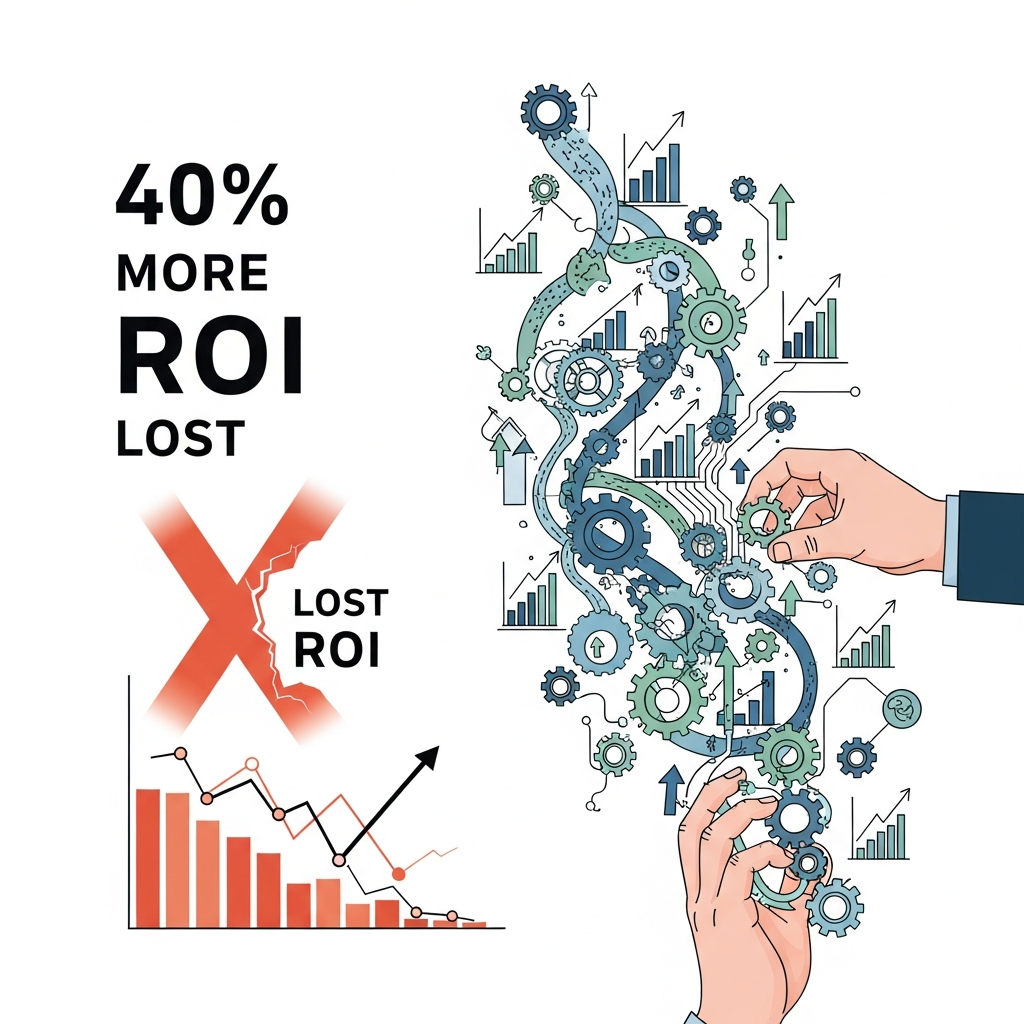
Visual for Bid Optimization via Machine Learning: Why Manual Bidding is Costing You 40% More ROI.

The Architecture of an ML Bidder: Beyond Simple Automation

It is a common misconception that Machine Learning bidding (or “Smart Bidding”) is just a fancy set of “if-then” rules. It is significantly more sophisticated. Most modern ML bidding engines rely on a combination of Bayesian Inference and Deep Neural Networks to predict the likelihood of a conversion.

1. Predictive Modeling and Signal Synthesis

Unlike a human, an ML model doesn’t just look at what happened; it calculates the probability of what will happen. It uses a process called cross-signal analysis. For instance, it might discover that users on iOS devices in New York City have a 15% higher conversion rate on rainy Tuesdays between 5:00 PM and 7:00 PM. A human would never find that correlation, or if they did, they couldn’t possibly implement a bid adjustment for it in real-time. The ML model adjusts the bid for that specific micro-moment instantly.

2. The Epsilon-Greedy Strategy: Exploration vs. Exploitation

One of the most powerful aspects of ML in bidding is how it handles uncertainty. In the world of Reinforcement Learning, this is known as the Exploration vs. Exploitation trade-off. The algorithm “exploits” known winning segments to maximize current ROI, but it also “explores” new, untested segments (new times of day, new audiences) with a small portion of the budget. This ensures the account never stagnates—a feat manual buyers rarely achieve because they tend to be risk-averse with client capital.

“In the context of bid optimization, the algorithm is not just a calculator; it is a laboratory, constantly running thousands of micro-experiments to find the path of least resistance to a conversion.”

>The Mathematical Reality of the 40% ROI Gap

How do we arrive at the figure of 40%? It isn’t just a marketing hyperbole; it’s rooted in the concept of Diminishing Marginal Returns.

In manual bidding, the bidder often hits a “performance plateau.” To get more volume, they raise bids across the board. This increases the Cost Per Acquisition (CPA) because they are now paying more for the same low-quality traffic alongside the high-quality traffic.

ML-driven bid optimization flattens the efficiency curve. Because the algorithm can bid less for low-probability impressions and more for high-probability ones, it effectively reallocates “wasted” spend from the bottom 30% of your traffic and pushes it into the top 10% of high-intent auctions. The result? You often see a simultaneous increase in conversion volume and a decrease in CPA. That delta—the gap between the wasteful “flat” bidding and the surgical “dynamic” bidding—typically accounts for a 30% to 50% improvement in total return.

>Deconstructing the “Google Just Wants My Money” Myth

The most frequent objection to automated bidding is a cynical one: “Why would I trust the platform (Google/Meta) to set my bids? They just want to drain my budget.”

While a healthy dose of skepticism is required in any relationship with Big Tech, this logic falls apart under analytical scrutiny. The platforms are incentivized by long-term retention. If an advertiser spends $10,000 and sees $0 in return because the “automation” was predatory, they will stop spending. If the automation delivers a $50,000 return, they will increase their spend to $100,000.

Furthermore, the platforms possess First-Party Data that you will never have access to. They know the user’s recent search history across different sites, their app usage patterns, and their proximity to physical store locations. When you use manual bidding, you are intentionally blinding yourself to 90% of the data used to determine the auction’s winner. You are essentially playing poker while your opponent (the ML algorithm) can see half of your cards.

>The Hidden Cost of Human Intervention: Latency and Bias

Beyond the data processing limits, manual bidding suffers from two distinct human pathologies: Latency and Cognitive Bias.

The Latency Penalty

Digital markets change by the hour. A competitor might run out of budget at 3:00 PM, leaving a vacuum of cheap, high-quality traffic. A manual bidder might not check the account until the next morning. By then, the opportunity is gone. An ML algorithm detects the change in auction pressure in real-time and lowers the bids to capture that traffic at a discount. Manual bidding is inherently reactive; ML bidding is inherently proactive.

The Bias Trap

Humans are prone to the Recency Bias. If a keyword performed poorly yesterday, a manual bidder might slash the bid today, ignoring the fact that yesterday was a national holiday or a freak technical glitch on the website. Machine Learning models use decay functions and stochastic gradients to weight data appropriately, ensuring that a single outlier doesn’t derail the entire strategy.

>Strategizing for the Shift: How to Transition Without Breaking Your Account

If you are currently 100% manual, jumping headfirst into “Maximize Conversions” can feel like throwing your car into reverse while driving 60 mph. The transition requires a phased, academic approach.

  • Step 1: Clean the Data Stream. ML is “Garbage In, Garbage Out.” Before turning on automated bidding, ensure your conversion tracking is flawless. If the algorithm thinks a “Newsletter Signup” is worth as much as a “$5,000 Purchase,” it will optimize for the wrong thing.
  • Step 2: Use “Enhanced CPC” as a Training Wheel. ECPC allows the algorithm to adjust your manual bids by a small percentage based on conversion probability. It is a low-risk way to let the machine start learning your account’s nuances.
  • Step 3: Run a Controlled Experiment. Use the “Experiments” feature in Google Ads to split your traffic 50/50. Run Manual Bidding on one half and Target ROAS (tROAS) on the other. Do not touch it for 30 days. The statistical significance of the results will usually end the manual bidding debate permanently.
  • Step 4: Define Your Constraints. Automation works best when it has a clear North Star. Instead of telling the machine to “Get more sales,” tell it “Get more sales at a minimum 400% ROAS.” This provides the guardrails necessary to prevent budget runaway.

>The Evolution of the Media Buyer: From Pilot to Architect

Does the rise of Machine Learning bidding mean that the digital marketer is becoming obsolete? On the contrary. It means the boring parts of the job are becoming obsolete.

The role is shifting from Tactical Execution (changing bids) to Strategic Orchestration. In the ML era, the elite copywriter and strategist focus on:

  • Creative Excellence: Since everyone will eventually use the same bidding algorithms, the only true competitive advantage left is the Ad Creative. The machine can’t write a compelling hook or understand the emotional pain points of your customer.
  • Value-Based Optimization: Feeding the machine better data. This involves integrating your CRM so the algorithm optimizes for Lifetime Value (LTV) rather than just a one-time lead.
  • Market Context: The algorithm doesn’t know your company is launching a new product next month or that a global supply chain issue has halved your inventory. Humans provide the context; machines provide the scale.

>Conclusion: The High Price of “Control”

The 40% loss in ROI associated with manual bidding is effectively a “Control Tax.” It is the price advertisers pay for the illusion of being in charge. In the hyper-competitive landscape of modern PPC, this is a tax that most businesses cannot afford to pay indefinitely.

Machine Learning in bid optimization is no longer a “luxury feature” for big spenders; it is the baseline requirement for survival. By relinquishing the granular, millisecond-level decisions to the algorithms, you free yourself to focus on the elements of marketing that truly move the needle: psychology, offer resonance, and long-term brand strategy.

The question is no longer whether you should automate your bidding—the question is how much more ROI you are willing to lose before you do.
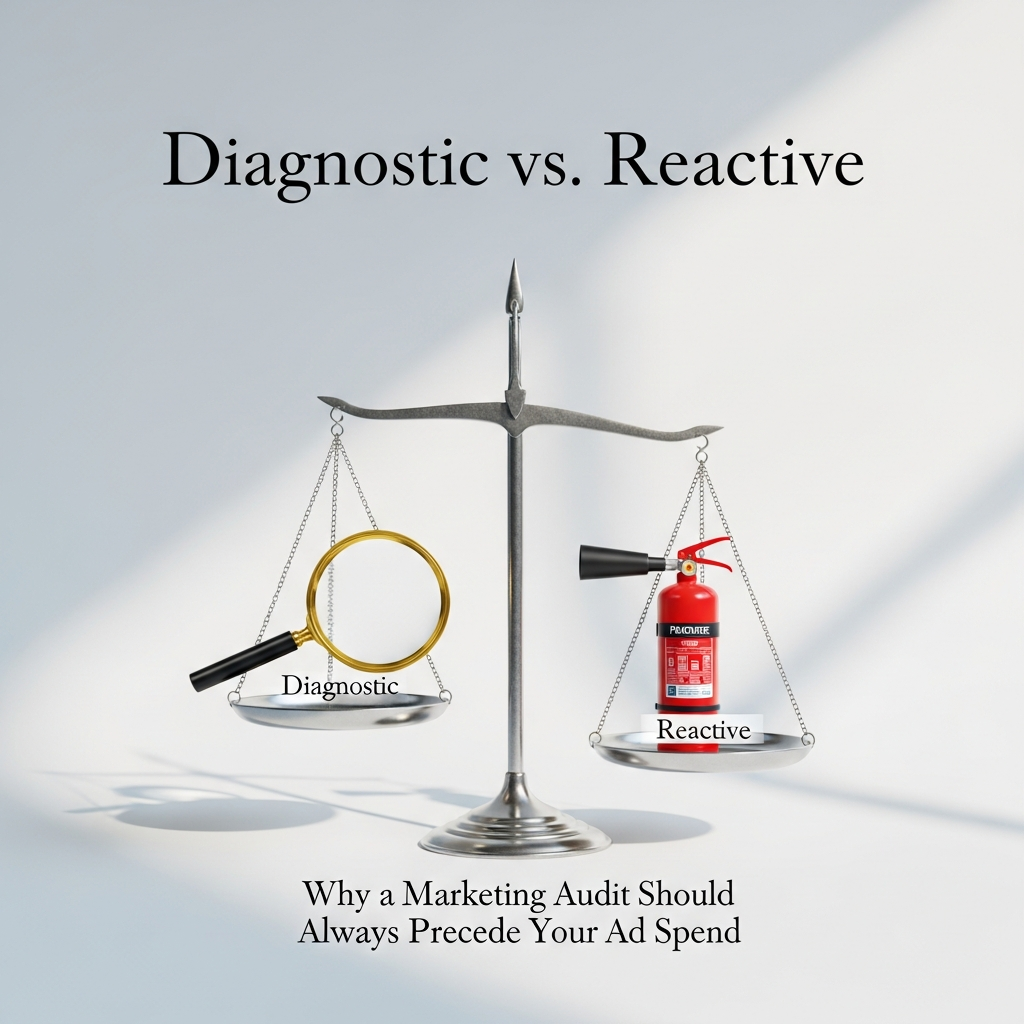
Diagnostic vs. Reactive: Why a Marketing Audit Should Always Precede Your Ad Spend

Imagine walking into a doctor’s office with a chronic cough, and before you even sit down, the physician hands you a prescription for high-dosage antibiotics and schedules you for a lung biopsy. No stethoscope. No blood tests. No questions about your history. You would walk out immediately, wouldn’t you? You would call it malpractice.

Yet, in the high-stakes world of digital growth, businesses commit the marketing equivalent of this every single day. They see a dip in sales or a plateau in growth and immediately “prescribe” more ad spend. They dump five, ten, or fifty thousand dollars into Meta, Google, or LinkedIn, hoping the sheer volume of traffic will drown their problems. It rarely does. Instead, they end up with a high-speed delivery system for a broken message, a leaky funnel, or a product-market mismatch.

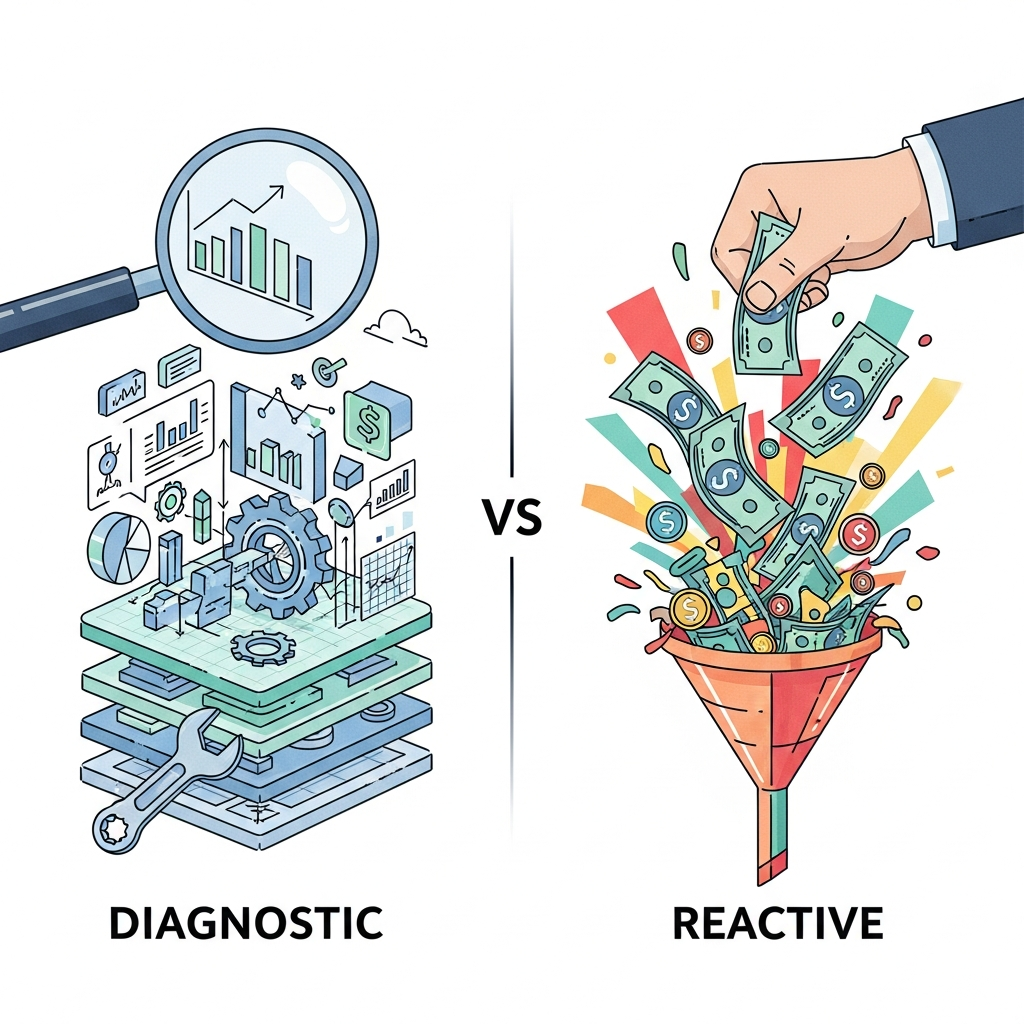
This is the difference between reactive marketing and diagnostic marketing. One is a desperate gamble; the other is a strategic blueprint. In this guide, we are going to tear apart the myth that “more ads” is the solution to stagnant growth and explain why a comprehensive marketing audit is the only logical step before touching your credit card.

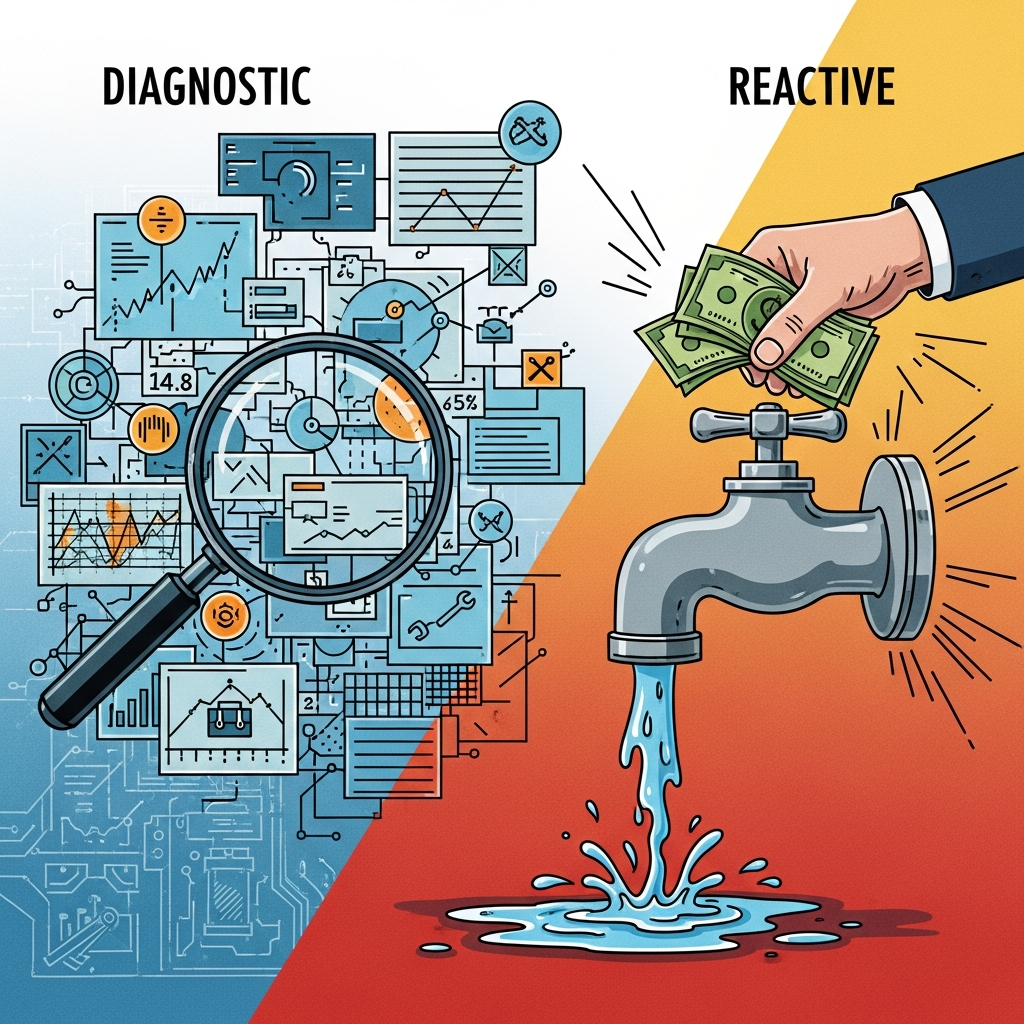
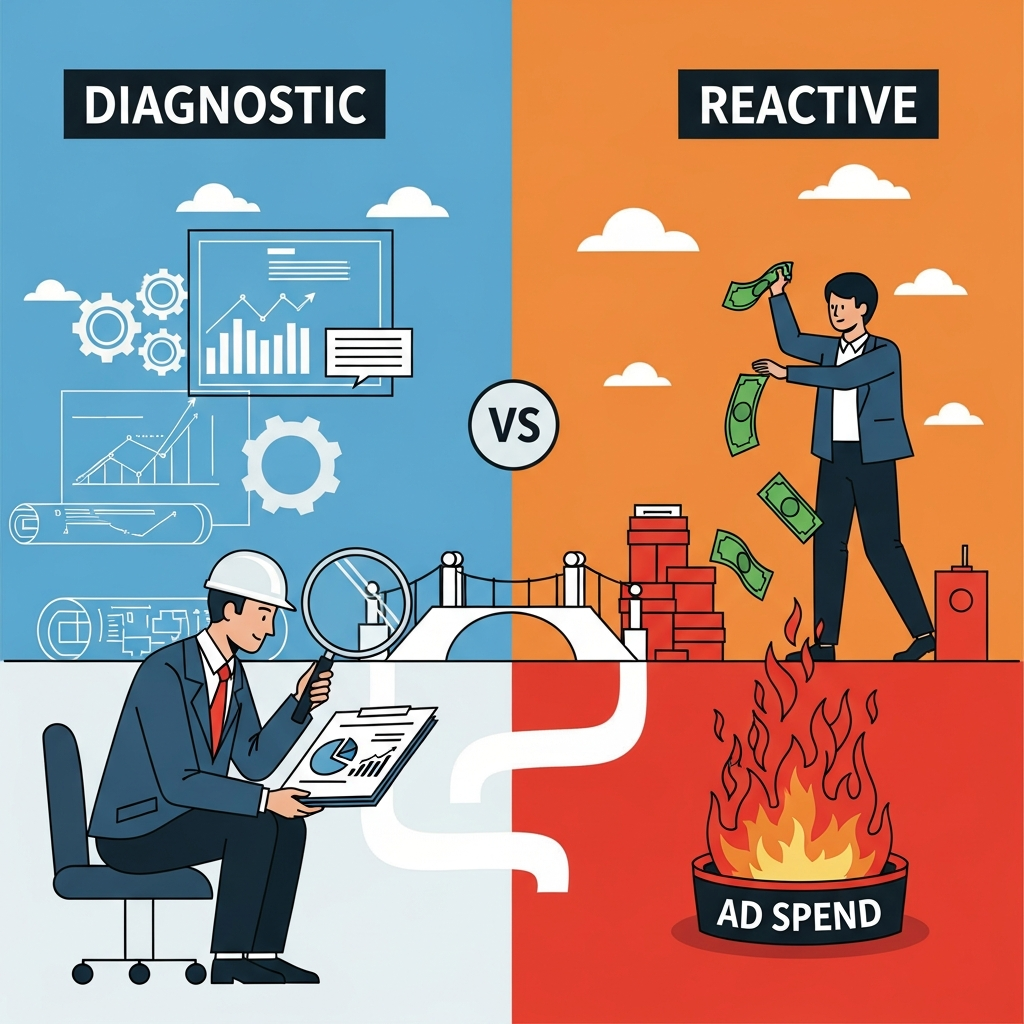
Visual for Diagnostic vs. Reactive: Why a Marketing Audit Should Always Precede Your Ad Spend

The Fatal Allure of Reactive Marketing

Reactive marketing is born out of anxiety. It’s the “we need leads yesterday” mentality. When a CEO looks at a dashboard and sees red, the first instinct is to turn the dials. “Double the daily budget on the retargeting campaign! Launch a new PMax campaign! Hire an agency that promises 10x ROI in 30 days!”

The problem with this approach is that it treats symptoms rather than causes. If your conversion rate is low, doubling your traffic just means you are paying twice as much to watch people leave your site. Reactive marketing is inherently expensive because it relies on brute force. It ignores the underlying “plumbing” of your brand’s digital presence.

“Pouring money into ads without an audit is like trying to fill a bucket with holes by using a larger hose. You might get more water in the bucket temporarily, but the waste is astronomical.”

When you react, you lose leverage. You are at the mercy of platform algorithms and rising CPMs. You haven’t earned the right to scale because you haven’t proven that your ecosystem can handle the pressure of increased volume.

Visual for Diagnostic vs. Reactive: Why a Marketing Audit Should Always Precede Your Ad Spend

The Diagnostic Approach: The Audit as a Foundation

Diagnostic marketing assumes that something is always broken—or at least, something can always be optimized. A marketing audit isn’t just a “check-up.” It is a deep-tissue scan of your entire go-to-market strategy. It looks at the technical, the psychological, and the financial aspects of your business.

Before you spend a single dollar on an ad, you must have answers to the following questions:

  • Is the tracking actually working? You’d be surprised how many Seven-figure brands have broken GA4 setups or misfiring pixels.
  • Does the landing page match the intent? If you’re bidding on “best accounting software” but your landing page talks about “enterprise financial transformation,” you’ve already lost.
  • What is the “true” CAC? Many companies calculate Customer Acquisition Cost (CAC) incorrectly, ignoring the overhead or the blended impact of organic traffic.
  • Who is the actual buyer? Not the “persona” you wrote three years ago, but the person actually clicking and buying today.

1. The Technical Audit: Fixing the Leaky Pipe

Most ad spend waste happens at the technical level. If your website takes four seconds to load on a mobile device, you are losing up to 50% of your paid traffic before they even see your headline. That is a 50% tax on your ad spend that no amount of “better creative” can fix.

A diagnostic audit starts with the “plumbing.” This includes Core Web Vitals, mobile responsiveness, and the checkout or lead-gen flow. If there is friction—if a button is hard to click or a form has twelve fields when it only needs three—your ad spend is being lit on fire. You must audit the user journey from the first click to the final confirmation page.

2. The Messaging Audit: Is Anyone Listening?

In a world of infinite scrolls and goldfish-level attention spans, your messaging is your only weapon. Most reactive marketing fails because the messaging is “me-centric.” It’s all about the features, the “we’ve been in business since 1994,” and the “award-winning service.”

A diagnostic audit peels back the layers of your copy. We look for Product-Market Fit resonance. Are you speaking to the customer’s pain, or are you just shouting about your solution? We analyze the “Hook-Value-Call to Action” framework across all touchpoints. If your ads are saying one thing and your website is saying another, the cognitive dissonance will kill your conversion rate.

Visual for Diagnostic vs. Reactive: Why a Marketing Audit Should Always Precede Your Ad Spend

Why Most Agencies Skip the Audit

If audits are so vital, why does every agency want to start running ads on day one? The answer is simple: Billable hours and immediate gratification.

Audits are hard work. They require high-level thinking, data science, and a willingness to tell the client their “baby is ugly.” It’s much easier for an agency to say, “Give us $10,000 for management and $50,000 for spend, and we’ll start testing.” Testing is often just a euphemism for “we don’t know what we’re doing, so we’re using your money to find out.”

An elite marketer will refuse to run ads without a diagnostic phase. They know that their reputation depends on ROI, and ROI is impossible to guarantee if the foundation is built on sand. When you pay for an audit, you are paying for a map. When you pay for reactive ads, you are paying for gas in a car with no steering wheel.

>The Pillars of a High-Impact Marketing Audit

If you are serious about scaling, your audit needs to cover four specific pillars. Skipping one is like trying to fly a plane with one wing missing.

Pillar 1: Data Integrity & Attribution

If you cannot measure it, you cannot manage it. In the post-iOS14 world, attribution is messy. A diagnostic audit looks at your “Source of Truth.” Are you relying solely on the Facebook Ads Manager dashboard (which often over-reports)? Or are you looking at Marketing Efficiency Ratio (MER) and First-Party Data?

We need to see where the drop-offs are. Is there a specific step in the funnel where 80% of users vanish? That is a data signal. A diagnostic audit turns “I think” into “I know.”

Pillar 2: Competitive Intelligence

You do not operate in a vacuum. Your competitors are bidding on the same keywords and targeting the same audiences. A reactive approach ignores the competition until they start stealing market share. A diagnostic approach analyzes their creative hooks, their pricing strategy, and their backlink profile.

Pro Tip: Use tools like the Meta Ad Library to see what your competitors have been running for more than 90 days. If an ad has been active for three months, it’s likely profitable. That is free data for your audit.

Pillar 3: Offer Architecture

Sometimes the ads aren’t the problem. Sometimes the offer is the problem. If you are offering a “Free Consultation” in a market where everyone else is offering a “Free Audit + 30-Day Roadmap,” you are going to lose. Your offer needs to be “Irresistible” in the sense that the value vastly outweighs the perceived cost or effort.

A marketing audit scrutinizes the offer. We look at the Value Ladder. Do you have an entry-point offer? Is there a logical upsell? Are you maximizing the Average Order Value (AOV)? If your AOV is too low, you’ll never be able to afford the rising costs of traffic.

Pillar 4: Creative Resonance

Creative is the new targeting. Since the algorithms are now better at finding your audience than you are, your “creative” (images, videos, headlines) does the heavy lifting. An audit looks at your historical creative performance. Which angles worked? Which ones flopped? We look for patterns in the “stop-rate” (the first 3 seconds of a video) and the “hold-rate” (how many people watched the whole thing).

>The Financial Impact: CAC vs. LTV

This is where the rubber meets the road. The ultimate goal of a marketing audit is to protect your Unit Economics. Reactive marketing often leads to a “Death Spiral” where the Cost Per Acquisition (CAC) exceeds the Lifetime Value (LTV) of a customer.

By conducting an audit first, you can identify ways to increase LTV through email marketing, SMS, and retention strategies before you pump the top of the funnel. If you can increase your LTV by 20% through a simple automated email sequence, you can suddenly afford to spend more on ads than your competitors. That is how you win markets.

“The business that can afford to spend the most to acquire a customer wins.” – Dan Kennedy

But you can only afford to spend the most if your backend is optimized. A diagnostic audit ensures that your backend is a profit-generating machine, not a black hole.

>Case Study: The $50,000 Lesson

I once consulted for an e-commerce brand spending $50,000 a month on Google Ads. They were barely breaking even and were convinced they needed a “better Google Ads expert.”

We paused the spend and did a 14-day diagnostic audit. We found two glaring issues:

  • The Mobile Checkout: The “Add to Cart” button was hidden below the fold on 80% of mobile devices.
  • The Message Gap: Their ads promised “Next Day Shipping,” but their product pages said “Ships in 3-5 business days.”

We fixed the button and aligned the shipping message. We didn’t change a single thing in the Google Ads account. Within 30 days, their conversion rate jumped by 40%. They were suddenly profitable without spending an extra dime on traffic. That is the power of a diagnostic mindset.

>How to Conduct Your Own Preliminary Audit

While a professional audit is irreplaceable, you can start the diagnostic process yourself. Follow this checklist before you approve your next ad budget increase:

Step 1: The “Ghost” Test

Open an incognito window and try to buy your own product or book your own service on a mobile device using a slow Wi-Fi connection. Every time you feel a moment of frustration or confusion, write it down. That is a conversion killer.

Step 2: The “So What?” Test

Read your ad copy and your landing page headlines out loud. After every sentence, ask yourself, “So what?” If your copy says “We have a patented technology,” and the answer is “So what?”, you haven’t explained the benefit. Keep digging until the “So what?” is answered with “This will save me time/money/stress.”

Step 3: The Data Reconciliation

Compare your Shopify/CRM sales to your Ad Manager sales. If there is a discrepancy of more than 20%, your tracking is broken. Do not scale until you know where your money is coming from.

>Stop Reacting. Start Diagnosing.

Ad spend is a multiplier. It multiplies what you already have. If you have a high-converting, psychologically resonant, technically sound sales process, ads will multiply your wealth. If you have a confusing, slow, “me-centric” website, ads will only multiply your losses.

The next time you feel the urge to “just try some ads,” stop. Take a breath. Invest in a marketing audit. It is the only way to ensure that your marketing budget is an investment in growth rather than a donation to Silicon Valley’s bottom line.

Marketing is a science of certainty, not a game of chance. You wouldn’t accept a medical diagnosis without a check-up; don’t accept a marketing strategy without an audit. Your balance sheet will thank you.

>Final Thoughts for the Decision Maker

If you are a CEO, a Founder, or a Marketing Director, your job is to be a steward of the company’s resources. Reactive spending is a failure of stewardship. A diagnostic audit is an act of leadership. It sets the tone for a culture of data-driven decisions and excellence. It forces your team to look at the hard truths and fix the foundational issues that are holding you back.

Are you ready to stop guessing and start growing? The audit is the first step. It’s time to look under the hood before you hit the gas.

How to Scale Your Small Business With Facebook Ads: a Step-by-step Blueprint

>The Quiet Anxiety of the Scaling Pivot

Most small business owners treat Facebook Ads like a sophisticated slot machine. You put a dollar in, you pull the lever of the “Publish” button, and you pray for a three-cherry ROAS (Return on Ad Spend). It works for a while. Then, suddenly, the machine jams. Your cost per acquisition (CPA) spikes. Your creative “fatigues.” You feel that familiar, cold knot in your stomach—the realization that what got you to six figures won’t drag you to seven. I’ve been there, staring at a red dashboard at 2:00 AM, wondering if the algorithm had a personal vendetta against my brand. It doesn’t. It just demands a different level of rigor once you decide to scale.

Scaling is not a linear function of budget. It is a complex reorganization of data, creative psychology, and technical infrastructure. If you simply double your budget tomorrow, you won’t double your revenue; you’ll likely just double your waste. This guide is the blueprint I wish I had when I was burning my own cash trying to figure out why my “winning” ads died the moment I touched the budget toggle.

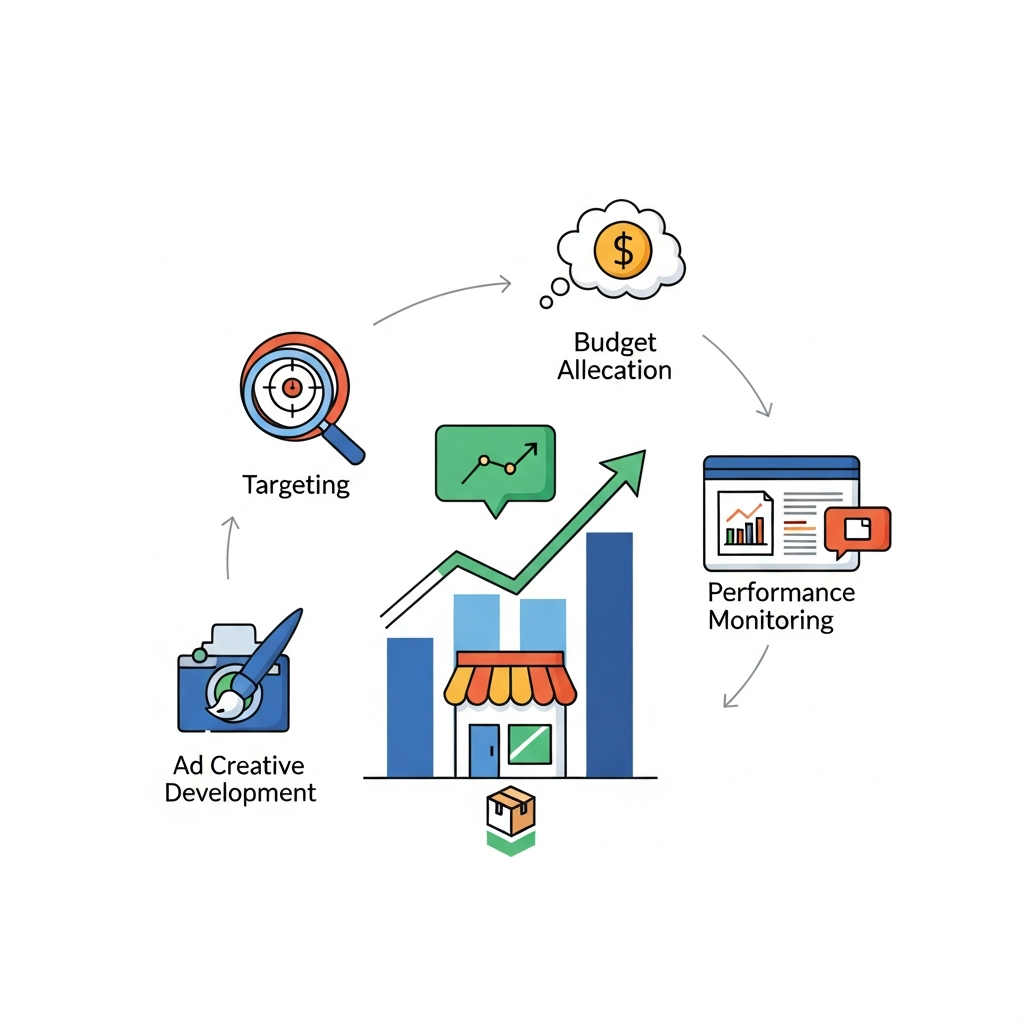
How to Scale Your Small Business With Facebook Ads: a Step-by-step Blueprint concept 2

Phase 1: The Technical Infrastructure (The “Truth” Layer)

Before you spend another dime, we need to talk about data integrity. Post-iOS 14.5, the “signal” Facebook receives from your website is degraded. If the algorithm is flying blind, your scaling efforts will crash. You cannot scale on a broken foundation.

The Conversion API (CAPI) and Server-Side Tracking

The standard browser-based Pixel is no longer enough. Ad blockers, cookie restrictions, and privacy settings “leak” data. You need Conversion API (CAPI). This creates a direct server-to-server connection between your website (Shopify, WooCommerce, etc.) and Meta. It ensures that when a purchase happens, Meta knows about it, even if the user’s browser tried to hide it. Without CAPI, your “Event Match Quality” will be poor, and the algorithm won’t know which users are actually worth bidding on.

Advanced Matching and Event Priority

Go into your Events Manager. Ensure “Advanced Matching” is turned on for all parameters (email, phone, city). Why? Because Meta needs to “stitch” a user’s identity across devices. If a customer clicks an ad on their iPhone but buys later on their MacBook, Advanced Matching is the thread that connects those two events. Without it, your attribution is a mess, and you’ll kill ads that are actually making you money because the dashboard says “0 sales.”

“In the world of algorithmic bidding, the person with the cleanest data wins. It’s not about who has the best product; it’s about who feeds the machine the highest quality signals.”

>Phase 2: The Creative-Led Growth Strategy

In the old days of Facebook Ads, we obsessed over “ninja” targeting. We’d layer interests like “People who like luxury watches AND organic kale AND live in a 5-mile radius of a Whole Foods.” Those days are dead. Creative is the new targeting.

The Algorithmic Bias of Creative

The Meta algorithm is now so sophisticated that it analyzes the visual elements and text of your ad to determine who to show it to. If your ad features a woman doing yoga, the algorithm will naturally find people interested in wellness. You don’t need to tell it to find “yoga lovers.” In fact, if you use tight interest targeting, you often increase your costs by limiting the algorithm’s ability to find cheaper pockets of the auction.

The “Big Three” Creative Archetypes for Scaling

  • The Social Proof Heavyweight: This isn’t just a testimonial. It’s a “mashup” video of five different customers saying the same thing. It builds immediate, unshakeable trust.
  • The Educational “How-To”: Scale often requires moving from “Warm” audiences to “Cold” ones. Cold audiences don’t know why they need you. A high-production (or intentionally lo-fi) video explaining the *mechanism* of your product solves the “Problem Awareness” gap.
  • The Aesthetic Lifestyle: High-quality static images or “cinematic” reels that sell the *identity* associated with your brand. This lowers the “friction of the scroll.”

The Concept of “Hook Rate” and “Hold Rate”

Stop looking at ROAS as your primary creative metric. It’s a “lagging” indicator. To scale, you need “leading” indicators.
Hook Rate (3-Second Video Views / Impressions): If this is below 25%, your creative is failing to stop the thumb. Change the first 2 seconds.
Hold Rate (ThruPlays / 3-Second Video Views): If this is low, your content is boring. You’re losing them before the pitch. Scale is only possible when your creative is “sticky” enough to keep people off the “Next” button.

>Phase 3: The “Simplified” Account Structure

Small businesses often suffer from “Campaign Bloat.” They have 15 campaigns, each with 10 ad sets, all with $5/day budgets. This is the fastest way to stay small. It traps your account in the “Learning Phase.”

Consolidation is Your Friend

To scale, you need to exit the Learning Phase as quickly as possible. Meta requires roughly 50 conversion events per ad set, per week, to optimize. If you spread your budget across too many ad sets, none of them will hit that 50-conversion threshold. They will perpetually underperform. Aim for a “Simplified Structure”:

  • One Prospecting Campaign (TOF): Use Broad targeting (Age, Gender, Location only) or very wide Lookalikes (3-5%). Let the creative do the heavy lifting.
  • One Retargeting Campaign (MOF/BOF): Only if your audience is large enough. Often, for small businesses, it’s better to use “Advantage+ Shopping Campaigns” (ASC) which handle prospecting and retargeting in one go.
  • The Testing Sandbox: A separate campaign where you test new creatives with small budgets before moving them into the “Scale” campaign.

>Phase 4: The Scientific Method of Scaling

Scaling is not just “increasing the budget.” It is the systematic reduction of uncertainty. There are two primary ways to scale: Vertical and Horizontal.

Vertical Scaling: The 20% Rule

If an ad set is performing well, the temptation is to double the budget. Don’t. Facebook’s auction is sensitive. A massive budget increase resets the learning phase and can cause your CPA to explode. Increase the budget by 20% every 48 to 72 hours. This allows the algorithm to adjust its bidding strategy without losing the “scent” of your ideal customer.

Horizontal Scaling: The Multi-Angle Approach

Vertical scaling eventually hits a ceiling where the “audience saturation” kicks in. To move past this, you scale horizontally. This means taking your winning product and finding a *new reason* for people to buy it.
Example: If you sell ergonomic chairs to “office workers,” horizontal scaling involves creating a new ad set targeting “gamers” with specific “gamer-focused” creative. You aren’t just spending more on the same people; you’re opening new doors to new rooms of people.

Using CBO (Campaign Budget Optimization)

When you are ready to scale, switch to CBO. You give the budget to the Campaign level, and Meta distributes it to the ad sets that are performing best in real-time. This is the “autopilot” of scaling. It prevents you from wasting money on an ad set that’s having a “bad day” and shifts those funds to the one that’s converting.

>Phase 5: The Math of the “Messy Middle”

You cannot scale what you cannot measure. Most small businesses look at the Facebook Ads Manager ROAS and think that’s the whole story. It’s not. As you scale, you must look at your MER (Marketing Efficiency Ratio).

MER = Total Revenue / Total Ad Spend.

Why does this matter? Because as you scale on Facebook, you will see “halo effects.” People will see your ad, not click, but search for you on Google three days later. Or they’ll see your ad, go to your Instagram, and buy through a link in your bio. If you only look at Facebook’s “Last Click” or “7-day Click” attribution, you’ll think the ads aren’t working as well as they are. You need to understand your Contribution Margin. If your MER is healthy, keep scaling, even if the individual ad ROAS looks slightly lower than it did at a $50/day spend.

>Phase 6: Avoiding the “Death Spirals”

Scaling creates friction. Things will break. Here is how to handle the most common failures.

Creative Fatigue: The Silent Killer

When you scale, you are showing your ads to more people, more often. Your “Frequency” will go up. When people see the same ad three or four times without clicking, they become “blind” to it. Your CTR (Click-Through Rate) will drop, and your CPMs will rise. To fight this, you must have a Creative Pipeline. You should be testing 2-3 new creatives every single week in your “Sandbox” so that when your “Scale” creative starts to die, you have a replacement ready to go.

The Post-Purchase Experience Gap

Scaling your ads scales your problems. If you double your orders, can your shipping department handle it? Can your customer service team answer the emails? I’ve seen businesses scale their ads beautifully only to be shut down by Facebook because their “Customer Feedback Score” tanked due to shipping delays. A low feedback score will increase your CPMs so high that your ads become unprofitable. Scaling is a holistic business effort, not just a marketing one.

“Your ads are only as good as your fulfillment. The algorithm prioritizes user experience; if your customers are unhappy, Meta will tax your greed with higher ad costs.”

>Conclusion: The Stoic Approach to Scaling

Scaling a small business via Facebook Ads is not a “set it and forget it” endeavor. It is a disciplined practice of hypothesis testing. You will have days where the data makes no sense. You will have weeks where you feel like you’re just donating money to Menlo Park. But the blueprint remains the same: Fix your data, lead with creative, simplify your account, and scale with mathematical patience.

Success in this arena belongs to the analytical and the empathetic. You must be analytical enough to read the spreadsheets, but empathetic enough to understand the human on the other side of the screen. They aren’t a “conversion event.” They are a person with a problem, looking for a solution. Solve their problem better than anyone else, and the algorithm will eventually reward you with the scale you’re looking for. Now, go back into your Ads Manager. Look at your Hook Rates. Check your CAPI status. Stop gambling and start scaling.

How to Scale Your Digital Business: the Ultimate Growth Strategy Roadmap

>The Great Scaling Delusion: Why Most Businesses Stagnate

Growth is a seductive siren. To the uninitiated digital founder, revenue and scaling are often conflated as synonymous twins. They are not. Growth is linear; it is the act of adding resources at the same rate you add revenue. If you hire one salesperson to close ten deals, and then hire ten more to close a hundred, you aren’t scaling. You are merely bloating. Scaling, in its purest, most academic sense, is the decoupling of the revenue curve from the cost curve. It is the pursuit of the exponential.

The digital landscape is littered with the corpses of companies that “grew” themselves into bankruptcy. They mistook a temporary spike in customer acquisition for a sustainable business model. To scale a digital business is to perform open-heart surgery on a marathon runner while they are mid-stride. It requires an analytical rigor that borders on the obsessive and a willingness to dismantle the very systems that brought you your initial success.

In this guide, we will dissect the anatomical requirements of a scalable digital enterprise. We will move beyond the “hustle-and-grind” platitudes of LinkedIn influencers and dive into the cold, hard mechanics of unit economics, operational infrastructure, and the psychological fortitude required to let go of the steering wheel without crashing into a ditch.

>Infrastructure: Moving Beyond “Bubble Tape and Prayer”

Most digital startups begin as a collection of frantic workarounds. You have a spreadsheet that talks to a CRM, which is manually updated by a founder who hasn’t slept since the Obama administration. This “scrappy” phase is necessary for survival, but it is the primary inhibitor of scale. You cannot build a skyscraper on a foundation of damp cardboard.

The Tech Debt Tax

In the early days, you make compromises. You choose the cheaper API. You write “quick and dirty” code. You ignore documentation. This is “tech debt,” and like any high-interest loan, the payments eventually become due. When you attempt to scale, this debt manifests as system crashes, data silos, and a development team that spends 90% of their time fixing bugs rather than building features. Scaling requires a ruthless audit of your stack. If your current architecture cannot handle 10x the traffic or 100x the data without a catastrophic failure, you aren’t ready to scale.

The Automation Paradox

Automation is the holy grail of scaling, yet it is frequently misunderstood. You cannot automate a broken process; you can only automate the speed at which it breaks. Before applying the “magic” of AI or automated workflows, you must map your business processes with such granularity that a reasonably intelligent golden retriever could follow them. Standard Operating Procedures (SOPs) are not bureaucratic busywork; they are the source code of your business. If a task requires “founder intuition” every time it’s performed, it is a bottleneck. Kill it or document it.

“The first rule of any technology used in a business is that automation applied to an efficient operation will magnify the efficiency. The second is that automation applied to an inefficient operation will magnify the inefficiency.” — Bill Gates

>The Mathematical Reality of the Leap

Scaling is a numbers game where the stakes are your sanity. To scale successfully, you must possess a visceral understanding of your unit economics. This isn’t just “revenue minus expenses.” It’s about the surgical isolation of what it costs to acquire a customer and what that customer is worth over their lifetime.

LTV/CAC: The Only Ratio That Truly Matters

If you don’t know your Customer Acquisition Cost (CAC) and your Lifetime Value (LTV), you aren’t running a business; you’re participating in an expensive hobby. In a scalable digital model, your LTV should ideally be at least 3x your CAC. But even that is a simplification. You must also consider the CAC Payback Period. If it takes you 18 months to recoup the cost of acquiring a customer, but your cash reserves only last for six months, you will scale yourself directly into a liquidity crisis. High-growth scaling requires a short payback window—ideally under six months—to ensure that your capital is constantly being recycled back into acquisition.

The Churn Silent Killer

Churn is the gravity of the digital world. It doesn’t matter how fast you pour water into the bucket if the bottom is missing. A 5% monthly churn rate might seem manageable at a small scale, but as you grow, that 5% represents an increasingly massive number of customers who must be replaced just to stay level. Scaling requires a shift in focus from Acquisition to Retention. Negative churn—where the expansion revenue from existing customers outweighs the loss from departing ones—is the true engine of the world’s most successful SaaS and digital platforms.

>The Product-Market Fit Fallacy

One of the most common mistakes in the digital space is assuming that Product-Market Fit (PMF) is a static achievement. It is not. PMF is a fleeting state of grace that must be constantly defended. As you scale, the “market” changes. You move from early adopters—who are forgiving of bugs and lack of features—to the early majority, who are demanding, impatient, and remarkably unenthusiastic about your “innovative” vision.

Horizontal vs. Vertical Expansion

When scaling, you face a fork in the road: do you go deeper into your current niche (vertical) or expand into adjacent markets (horizontal)? Most founders succumb to the “shiny object syndrome” and go horizontal too early. They launch new products before the flagship is stable. True scaling usually involves doubling down on the core “unit of value” until you have achieved near-total market saturation. Only then do you have the brand equity and cash reserves to colonize new territories.

The “Minimum Viable Bureaucracy”

As you scale, the product must evolve from a “tool” into a “platform.” This requires a shift in engineering philosophy. You move from building features to building systems. This is where many digital businesses lose their soul. The trick is to implement what I call “Minimum Viable Bureaucracy.” You need enough structure to prevent chaos, but not so much that you stifle the creativity that made you successful in the first place. If a developer needs three meetings and a signed permission slip to change a button color, your scaling efforts will grind to a halt.

>The Human Element: Scaling Without Losing the Soul

At some point, the scaling problem stops being a technical one and starts being a human one. Your role as a founder changes from the “Lead Doer” to the “Chief Architect.” This transition is psychologically painful. You will have to watch people do things 80% as well as you would have, and you will have to keep your mouth shut because that 20% gap is the price of growth.

Hiring for Trajectory, Not Just Pedigree

In the scaling phase, you don’t need “all-rounders” anymore. You need specialists. You need people who have seen this movie before. If you are scaling from $1M to $10M, you need to hire people who have worked at $50M companies. However, beware the “Big Company Refugee.” Someone who thrived at Google with 10,000 subordinates might crumble in a 50-person startup where they have to actually set up their own Slack integrations. Look for trajectory: people who are on their way up and possess the “scrappy” DNA combined with “big system” knowledge.

The Culture Debt

Just as tech debt accumulates, so does culture debt. When you are three people in a garage, culture is “whatever we feel like.” When you are 300 people across four time zones, culture is the only thing that ensures people are making the right decisions when you aren’t in the room. If you haven’t codified your values, your employees will invent their own. Usually, those invented values include “doing the bare minimum” and “avoiding accountability.”

>Marketing and the Red Queen Hypothesis

In Lewis Carroll’s Through the Looking-Glass, the Red Queen tells Alice, “Now, here, you see, it takes all the running you can do, to keep in the same place.” This is an apt metaphor for digital marketing during a scale-up. The algorithms of Google and Meta are constantly shifting. What worked yesterday at a $1,000/day spend will often break at $10,000/day. This is the law of diminishing returns.

Channel Diversification: The Antidote to Platform Risk

Scaling on a single channel is like building a mansion on a rented plot of land. If Zuck decides to change a line of code or Google decides your niche is “low quality,” your business can vanish overnight. A scalable marketing strategy is an omnichannel one. You need a mix of:

  • Paid Acquisition: For immediate, predictable (though expensive) feedback loops.
  • Organic Content/SEO: For long-term, compounding authority and “free” traffic.
  • Owned Media: Email and SMS lists that you control entirely.
  • Virality/Referral Loops: Where the product gets better as more people use it.

The Content Factory

To scale digitally, you must become a media company that happens to sell [insert your product here]. The modern consumer requires an average of 7 to 11 “touchpoints” before they trust a brand enough to purchase. Scaling your marketing means scaling your content production without diluting your brand’s voice. This is where many businesses fail—they outsource their content to low-cost agencies that churn out bland, AI-generated “slop” that attracts clicks but zero conversions. High-quality, authoritative content is the only thing that builds the “moat” around your business.

>The Founder’s Dilemma: Getting Out of the Way

The biggest bottleneck in any digital business is almost always the person who started it. Your “superpowers”—your attention to detail, your vision, your control-freak tendencies—become your greatest liabilities during scaling. You are the “single point of failure.” If you get hit by a bus (or just want to take a vacation without a laptop), does the business continue to grow? If the answer is no, you haven’t built a business; you’ve built a prison.

The Delegation Framework

Scaling requires a shift from Task Delegation to Outcome Delegation. Instead of telling someone *how* to do a task, you tell them what the successful *outcome* looks like and give them the resources to get there. This requires a level of trust that most founders find terrifying. It also requires a robust feedback loop. You need dashboards—not just for your finances, but for every department. You need to be able to see, at a glance, the health of your sales pipeline, your customer support response times, and your server uptime. If you have to ask for a report, you’ve already lost the battle for scale.

“Management is doing things right; leadership is doing the right things.” — Peter Drucker

>Operations: The Unsexy Engine of Growth

If marketing is the accelerator, operations is the transmission. Without it, you’re just redlining your engine while the wheels stay stationary. Scaling operations means moving from “heroic efforts” to “repeatable systems.” This involves everything from your financial modeling to your legal compliance.

Cash Flow Management: The Oxygen of Scale

Profit is a vanity metric; cash is reality. You can be profitable on paper while being stone-cold broke in the bank. Scaling consumes cash at a voracious rate. You are often paying for talent, marketing, and infrastructure months before they generate a return. This is the “J-Curve” of growth. To survive it, you need sophisticated cash flow forecasting. You need to know exactly how much “runway” you have under various growth scenarios. If you don’t have a CFO (or at least a very high-level fractional one) by the time you’re scaling, you’re flying blind through a thunderstorm.

Compliance and Global Complexity

When you scale a digital business, the world gets smaller, but the legal headaches get larger. GDPR, CCPA, NEXUS tax laws—these are not just acronyms; they are potential existential threats. Scaling internationally adds layers of complexity that can paralyze a small team. You must build your systems with compliance in mind from the start. Retrofitting privacy protocols or tax collection mechanisms after you’ve reached 50,000 customers is a nightmare that will consume your entire engineering team for months.

>The “Flywheel” Effect: Achieving Momentum

The ultimate goal of scaling is to reach the point where the “Flywheel Effect” takes over. This concept, popularized by Jim Collins, describes a massive, heavy flywheel that takes an enormous amount of effort to start moving. But once it gains momentum, the weight of the wheel itself starts to do the work for you. Each incremental push (a new customer, a new piece of content, a new feature) adds to that momentum.

Building the Moat

As you scale, you must ask: “What makes it harder for competitors to catch me the bigger I get?” This is your “moat.” In the digital world, moats usually consist of:

  • Network Effects: The product becomes more valuable as more people use it (e.g., Slack, LinkedIn).
  • Data Superiority: You have more data to train your algorithms or understand customer behavior than anyone else.
  • Brand Equity: Customers choose you because of trust and recognition, even if a cheaper alternative exists.
  • Switching Costs: Your product is so deeply integrated into the customer’s workflow that leaving would be a logistical disaster.

Scaling without a moat is just a race to the bottom. If your only advantage is a lower price or a slightly better UI, you will eventually be disrupted by someone with more VC funding or a more aggressive growth strategy. Scaling is the process of widening that moat every single day.

>Final Thoughts: The Horizon is Always Moving

Scaling a digital business is not a destination. There is no point at which you can sit back and say, “We have scaled.” The moment you stop optimizing, stop questioning your assumptions, and stop obsessing over your metrics is the moment you begin to decline. The digital landscape moves too fast for stagnation.

The roadmap provided here isn’t a simple checklist; it’s a fundamental shift in philosophy. It requires moving from the ego-driven “founder-centric” model to a “system-centric” model. It’s about building a machine that is smarter, faster, and more resilient than you are. It is an arduous, often thankless journey, but for those who get it right, the rewards are not just financial—they are the satisfaction of seeing a vision transformed into a self-sustaining, world-changing reality. Now, stop reading and go look at your LTV/CAC ratios. The flywheel won’t turn itself.