
>The Quiet Anxiety of the Scaling Pivot
Most small business owners treat Facebook Ads like a sophisticated slot machine. You put a dollar in, you pull the lever of the “Publish” button, and you pray for a three-cherry ROAS (Return on Ad Spend). It works for a while. Then, suddenly, the machine jams. Your cost per acquisition (CPA) spikes. Your creative “fatigues.” You feel that familiar, cold knot in your stomach—the realization that what got you to six figures won’t drag you to seven. I’ve been there, staring at a red dashboard at 2:00 AM, wondering if the algorithm had a personal vendetta against my brand. It doesn’t. It just demands a different level of rigor once you decide to scale.
Scaling is not a linear function of budget. It is a complex reorganization of data, creative psychology, and technical infrastructure. If you simply double your budget tomorrow, you won’t double your revenue; you’ll likely just double your waste. This guide is the blueprint I wish I had when I was burning my own cash trying to figure out why my “winning” ads died the moment I touched the budget toggle.
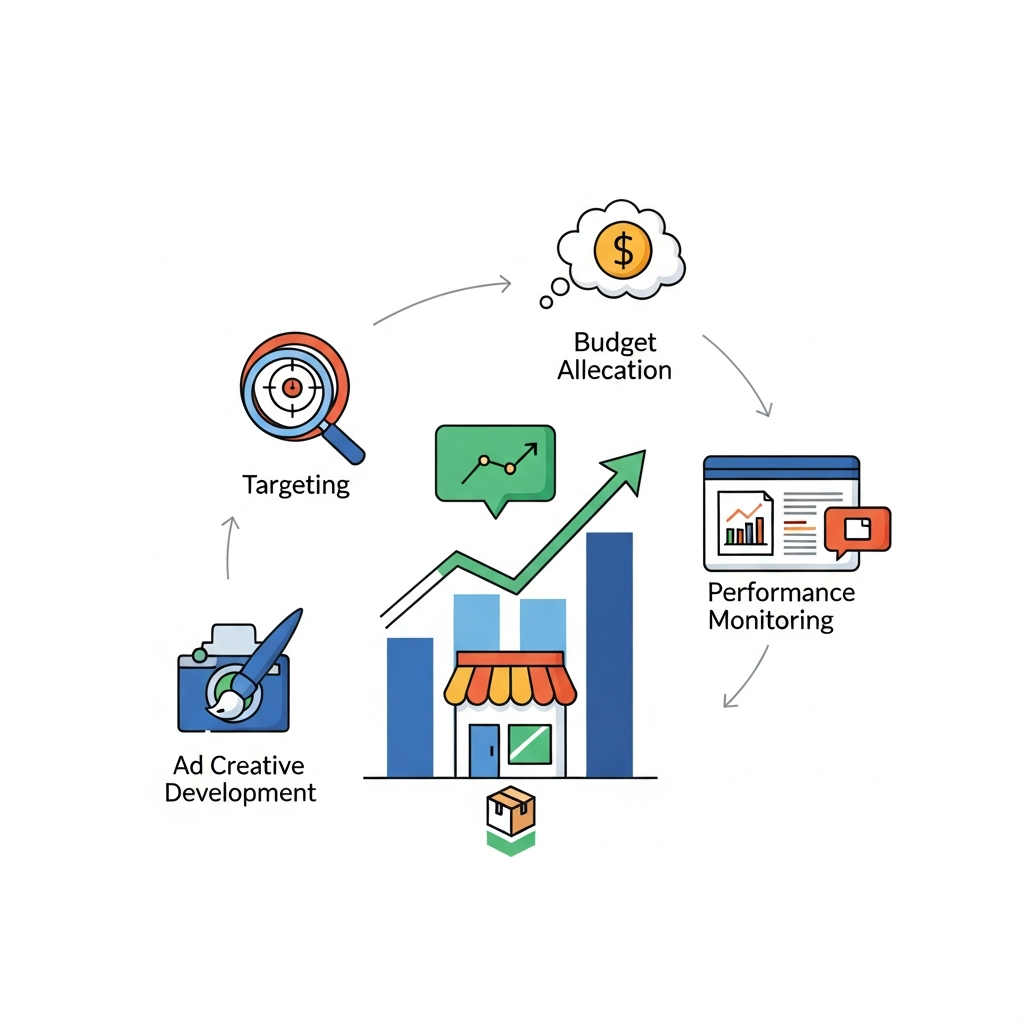
Phase 1: The Technical Infrastructure (The “Truth” Layer)
Before you spend another dime, we need to talk about data integrity. Post-iOS 14.5, the “signal” Facebook receives from your website is degraded. If the algorithm is flying blind, your scaling efforts will crash. You cannot scale on a broken foundation.
The Conversion API (CAPI) and Server-Side Tracking
The standard browser-based Pixel is no longer enough. Ad blockers, cookie restrictions, and privacy settings “leak” data. You need Conversion API (CAPI). This creates a direct server-to-server connection between your website (Shopify, WooCommerce, etc.) and Meta. It ensures that when a purchase happens, Meta knows about it, even if the user’s browser tried to hide it. Without CAPI, your “Event Match Quality” will be poor, and the algorithm won’t know which users are actually worth bidding on.
Advanced Matching and Event Priority
Go into your Events Manager. Ensure “Advanced Matching” is turned on for all parameters (email, phone, city). Why? Because Meta needs to “stitch” a user’s identity across devices. If a customer clicks an ad on their iPhone but buys later on their MacBook, Advanced Matching is the thread that connects those two events. Without it, your attribution is a mess, and you’ll kill ads that are actually making you money because the dashboard says “0 sales.”
“In the world of algorithmic bidding, the person with the cleanest data wins. It’s not about who has the best product; it’s about who feeds the machine the highest quality signals.”
>Phase 2: The Creative-Led Growth Strategy
In the old days of Facebook Ads, we obsessed over “ninja” targeting. We’d layer interests like “People who like luxury watches AND organic kale AND live in a 5-mile radius of a Whole Foods.” Those days are dead. Creative is the new targeting.
The Algorithmic Bias of Creative
The Meta algorithm is now so sophisticated that it analyzes the visual elements and text of your ad to determine who to show it to. If your ad features a woman doing yoga, the algorithm will naturally find people interested in wellness. You don’t need to tell it to find “yoga lovers.” In fact, if you use tight interest targeting, you often increase your costs by limiting the algorithm’s ability to find cheaper pockets of the auction.
The “Big Three” Creative Archetypes for Scaling
- The Social Proof Heavyweight: This isn’t just a testimonial. It’s a “mashup” video of five different customers saying the same thing. It builds immediate, unshakeable trust.
- The Educational “How-To”: Scale often requires moving from “Warm” audiences to “Cold” ones. Cold audiences don’t know why they need you. A high-production (or intentionally lo-fi) video explaining the *mechanism* of your product solves the “Problem Awareness” gap.
- The Aesthetic Lifestyle: High-quality static images or “cinematic” reels that sell the *identity* associated with your brand. This lowers the “friction of the scroll.”
The Concept of “Hook Rate” and “Hold Rate”
Stop looking at ROAS as your primary creative metric. It’s a “lagging” indicator. To scale, you need “leading” indicators.
Hook Rate (3-Second Video Views / Impressions): If this is below 25%, your creative is failing to stop the thumb. Change the first 2 seconds.
Hold Rate (ThruPlays / 3-Second Video Views): If this is low, your content is boring. You’re losing them before the pitch. Scale is only possible when your creative is “sticky” enough to keep people off the “Next” button.
>Phase 3: The “Simplified” Account Structure
Small businesses often suffer from “Campaign Bloat.” They have 15 campaigns, each with 10 ad sets, all with $5/day budgets. This is the fastest way to stay small. It traps your account in the “Learning Phase.”
Consolidation is Your Friend
To scale, you need to exit the Learning Phase as quickly as possible. Meta requires roughly 50 conversion events per ad set, per week, to optimize. If you spread your budget across too many ad sets, none of them will hit that 50-conversion threshold. They will perpetually underperform. Aim for a “Simplified Structure”:
- One Prospecting Campaign (TOF): Use Broad targeting (Age, Gender, Location only) or very wide Lookalikes (3-5%). Let the creative do the heavy lifting.
- One Retargeting Campaign (MOF/BOF): Only if your audience is large enough. Often, for small businesses, it’s better to use “Advantage+ Shopping Campaigns” (ASC) which handle prospecting and retargeting in one go.
- The Testing Sandbox: A separate campaign where you test new creatives with small budgets before moving them into the “Scale” campaign.
>Phase 4: The Scientific Method of Scaling
Scaling is not just “increasing the budget.” It is the systematic reduction of uncertainty. There are two primary ways to scale: Vertical and Horizontal.
Vertical Scaling: The 20% Rule
If an ad set is performing well, the temptation is to double the budget. Don’t. Facebook’s auction is sensitive. A massive budget increase resets the learning phase and can cause your CPA to explode. Increase the budget by 20% every 48 to 72 hours. This allows the algorithm to adjust its bidding strategy without losing the “scent” of your ideal customer.
Horizontal Scaling: The Multi-Angle Approach
Vertical scaling eventually hits a ceiling where the “audience saturation” kicks in. To move past this, you scale horizontally. This means taking your winning product and finding a *new reason* for people to buy it.
Example: If you sell ergonomic chairs to “office workers,” horizontal scaling involves creating a new ad set targeting “gamers” with specific “gamer-focused” creative. You aren’t just spending more on the same people; you’re opening new doors to new rooms of people.
Using CBO (Campaign Budget Optimization)
When you are ready to scale, switch to CBO. You give the budget to the Campaign level, and Meta distributes it to the ad sets that are performing best in real-time. This is the “autopilot” of scaling. It prevents you from wasting money on an ad set that’s having a “bad day” and shifts those funds to the one that’s converting.
>Phase 5: The Math of the “Messy Middle”
You cannot scale what you cannot measure. Most small businesses look at the Facebook Ads Manager ROAS and think that’s the whole story. It’s not. As you scale, you must look at your MER (Marketing Efficiency Ratio).
MER = Total Revenue / Total Ad Spend.
Why does this matter? Because as you scale on Facebook, you will see “halo effects.” People will see your ad, not click, but search for you on Google three days later. Or they’ll see your ad, go to your Instagram, and buy through a link in your bio. If you only look at Facebook’s “Last Click” or “7-day Click” attribution, you’ll think the ads aren’t working as well as they are. You need to understand your Contribution Margin. If your MER is healthy, keep scaling, even if the individual ad ROAS looks slightly lower than it did at a $50/day spend.
>Phase 6: Avoiding the “Death Spirals”
Scaling creates friction. Things will break. Here is how to handle the most common failures.
Creative Fatigue: The Silent Killer
When you scale, you are showing your ads to more people, more often. Your “Frequency” will go up. When people see the same ad three or four times without clicking, they become “blind” to it. Your CTR (Click-Through Rate) will drop, and your CPMs will rise. To fight this, you must have a Creative Pipeline. You should be testing 2-3 new creatives every single week in your “Sandbox” so that when your “Scale” creative starts to die, you have a replacement ready to go.
The Post-Purchase Experience Gap
Scaling your ads scales your problems. If you double your orders, can your shipping department handle it? Can your customer service team answer the emails? I’ve seen businesses scale their ads beautifully only to be shut down by Facebook because their “Customer Feedback Score” tanked due to shipping delays. A low feedback score will increase your CPMs so high that your ads become unprofitable. Scaling is a holistic business effort, not just a marketing one.
“Your ads are only as good as your fulfillment. The algorithm prioritizes user experience; if your customers are unhappy, Meta will tax your greed with higher ad costs.”
>Conclusion: The Stoic Approach to Scaling
Scaling a small business via Facebook Ads is not a “set it and forget it” endeavor. It is a disciplined practice of hypothesis testing. You will have days where the data makes no sense. You will have weeks where you feel like you’re just donating money to Menlo Park. But the blueprint remains the same: Fix your data, lead with creative, simplify your account, and scale with mathematical patience.
Success in this arena belongs to the analytical and the empathetic. You must be analytical enough to read the spreadsheets, but empathetic enough to understand the human on the other side of the screen. They aren’t a “conversion event.” They are a person with a problem, looking for a solution. Solve their problem better than anyone else, and the algorithm will eventually reward you with the scale you’re looking for. Now, go back into your Ads Manager. Look at your Hook Rates. Check your CAPI status. Stop gambling and start scaling.