
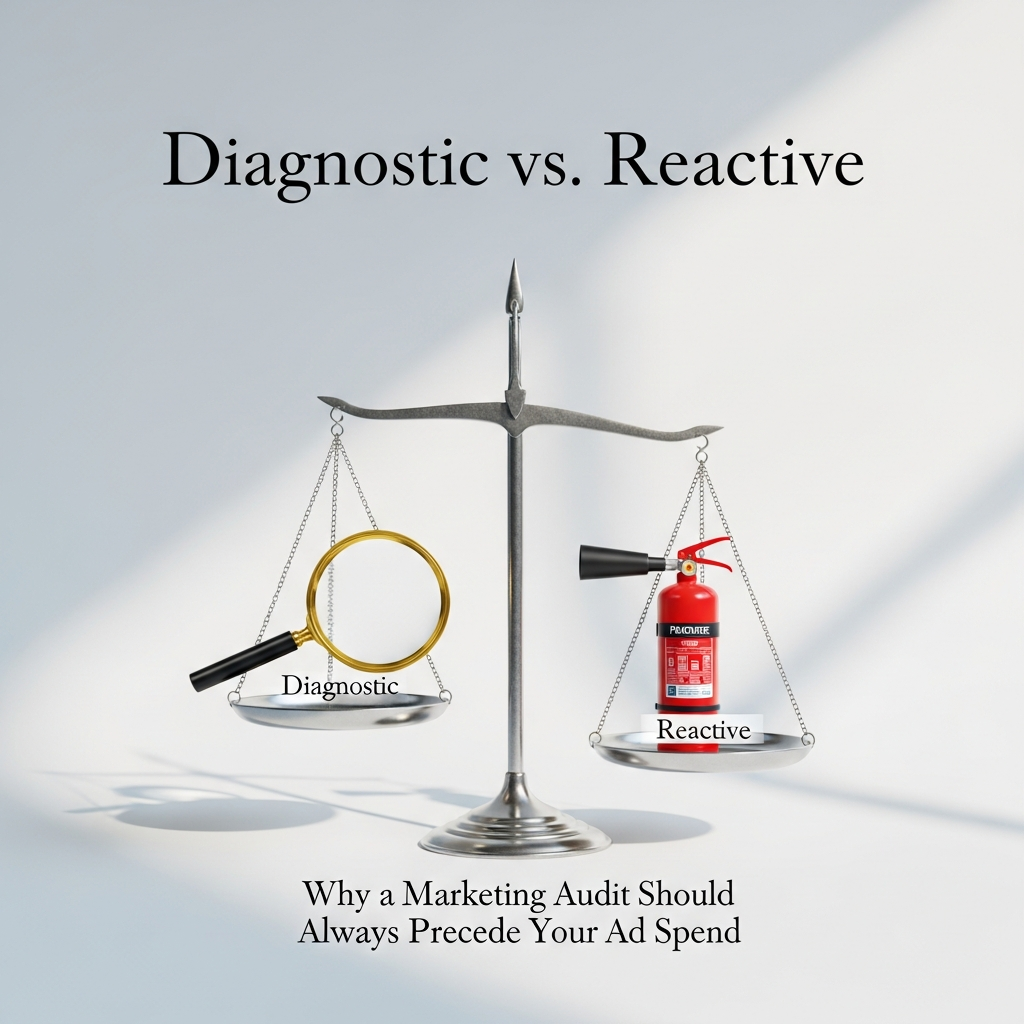
Imagine walking into a doctor’s office with a chronic cough, and before you even sit down, the physician hands you a prescription for high-dosage antibiotics and schedules you for a lung biopsy. No stethoscope. No blood tests. No questions about your history. You would walk out immediately, wouldn’t you? You would call it malpractice.
Yet, in the high-stakes world of digital growth, businesses commit the marketing equivalent of this every single day. They see a dip in sales or a plateau in growth and immediately “prescribe” more ad spend. They dump five, ten, or fifty thousand dollars into Meta, Google, or LinkedIn, hoping the sheer volume of traffic will drown their problems. It rarely does. Instead, they end up with a high-speed delivery system for a broken message, a leaky funnel, or a product-market mismatch.
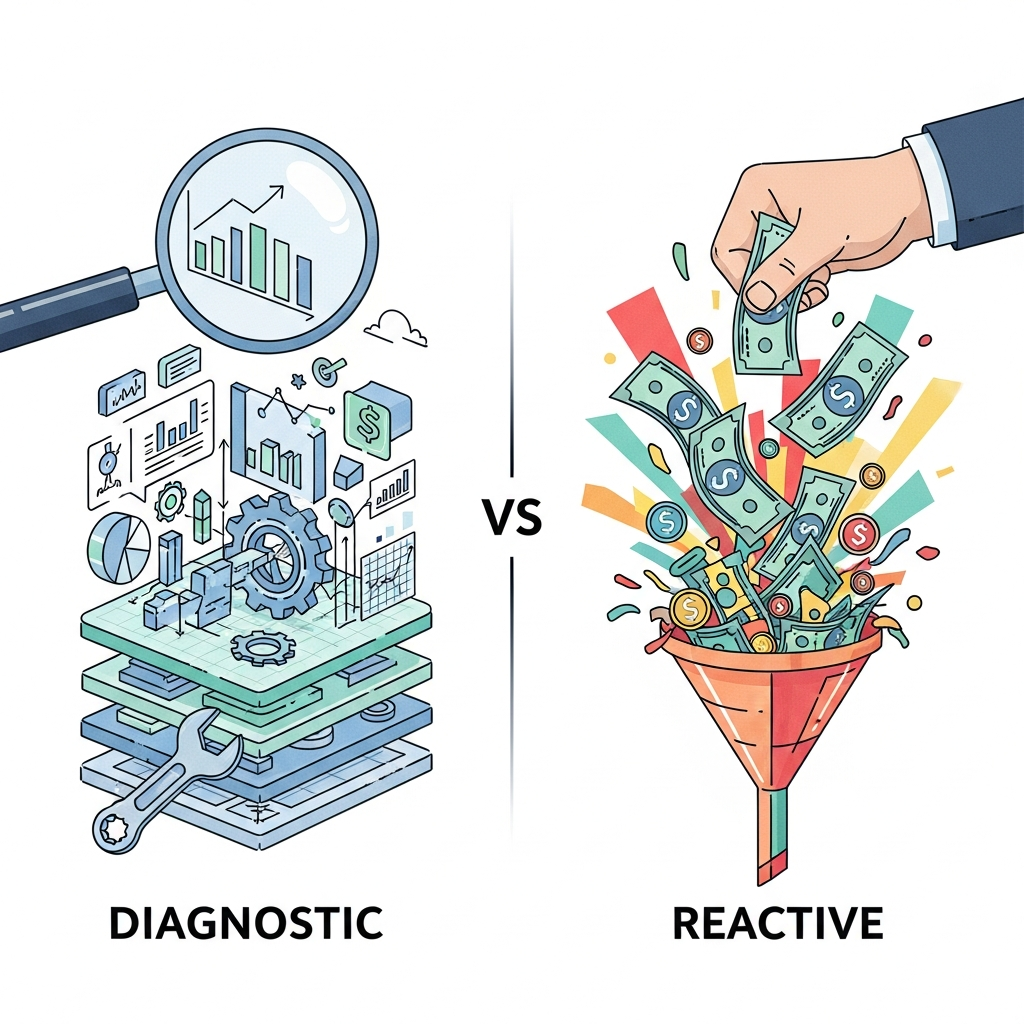
This is the difference between reactive marketing and diagnostic marketing. One is a desperate gamble; the other is a strategic blueprint. In this guide, we are going to tear apart the myth that “more ads” is the solution to stagnant growth and explain why a comprehensive marketing audit is the only logical step before touching your credit card.
The Fatal Allure of Reactive Marketing
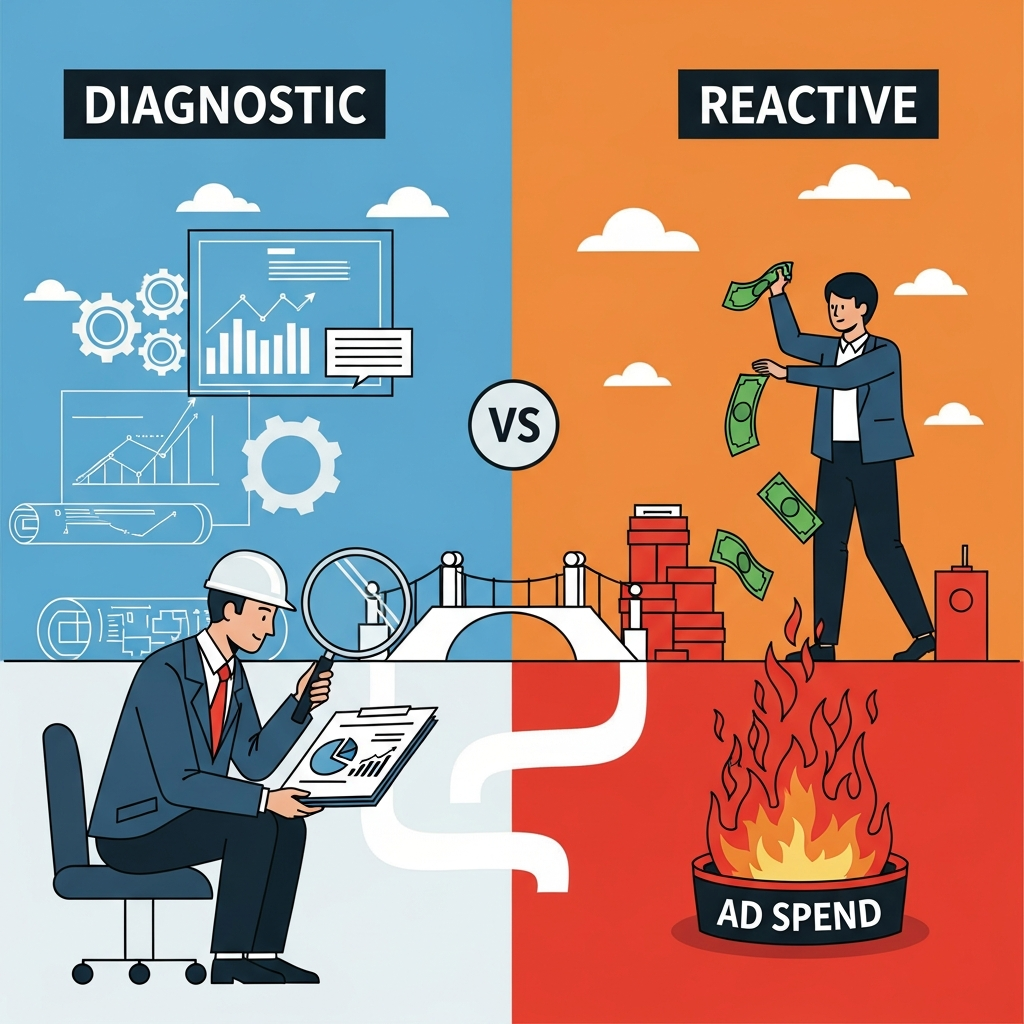
Reactive marketing is born out of anxiety. It’s the “we need leads yesterday” mentality. When a CEO looks at a dashboard and sees red, the first instinct is to turn the dials. “Double the daily budget on the retargeting campaign! Launch a new PMax campaign! Hire an agency that promises 10x ROI in 30 days!”
The problem with this approach is that it treats symptoms rather than causes. If your conversion rate is low, doubling your traffic just means you are paying twice as much to watch people leave your site. Reactive marketing is inherently expensive because it relies on brute force. It ignores the underlying “plumbing” of your brand’s digital presence.
“Pouring money into ads without an audit is like trying to fill a bucket with holes by using a larger hose. You might get more water in the bucket temporarily, but the waste is astronomical.”
When you react, you lose leverage. You are at the mercy of platform algorithms and rising CPMs. You haven’t earned the right to scale because you haven’t proven that your ecosystem can handle the pressure of increased volume.
The Diagnostic Approach: The Audit as a Foundation
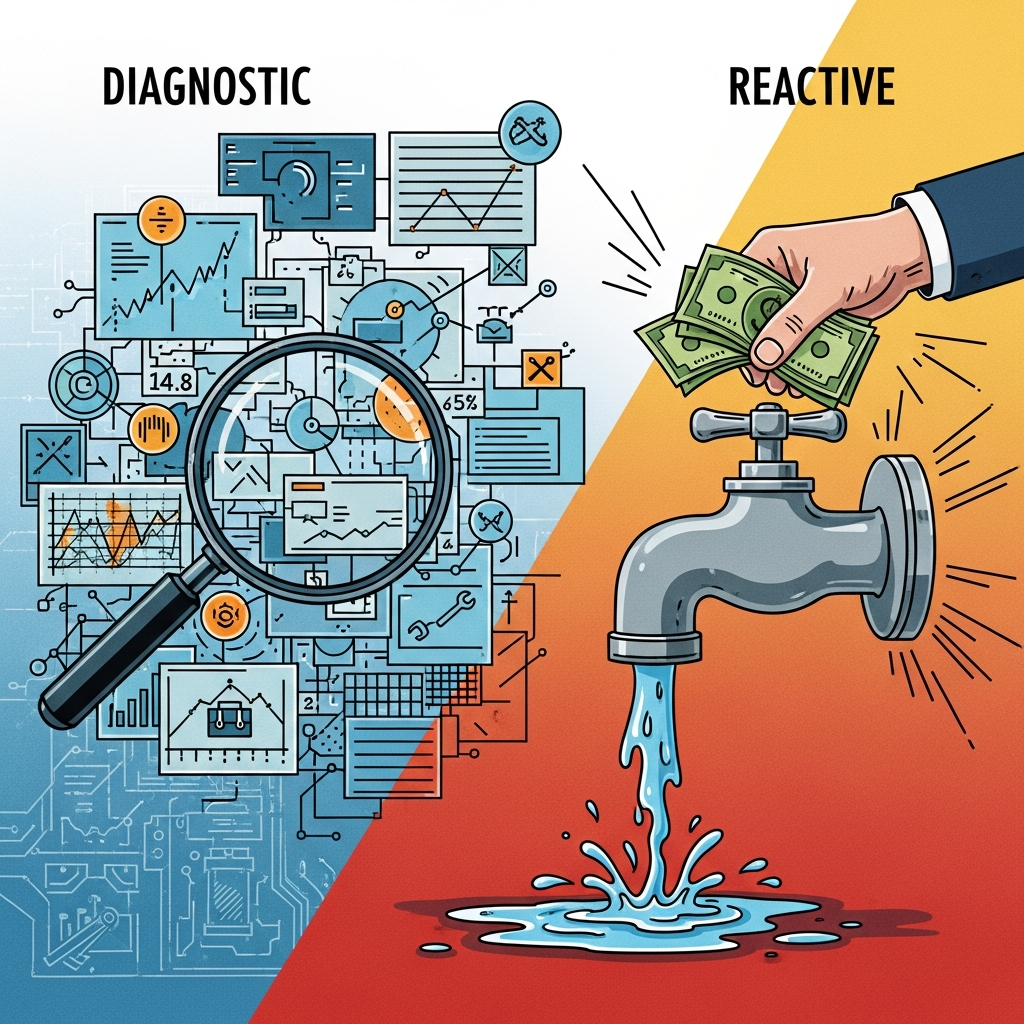
Diagnostic marketing assumes that something is always broken—or at least, something can always be optimized. A marketing audit isn’t just a “check-up.” It is a deep-tissue scan of your entire go-to-market strategy. It looks at the technical, the psychological, and the financial aspects of your business.
Before you spend a single dollar on an ad, you must have answers to the following questions:
- Is the tracking actually working? You’d be surprised how many Seven-figure brands have broken GA4 setups or misfiring pixels.
- Does the landing page match the intent? If you’re bidding on “best accounting software” but your landing page talks about “enterprise financial transformation,” you’ve already lost.
- What is the “true” CAC? Many companies calculate Customer Acquisition Cost (CAC) incorrectly, ignoring the overhead or the blended impact of organic traffic.
- Who is the actual buyer? Not the “persona” you wrote three years ago, but the person actually clicking and buying today.
1. The Technical Audit: Fixing the Leaky Pipe
Most ad spend waste happens at the technical level. If your website takes four seconds to load on a mobile device, you are losing up to 50% of your paid traffic before they even see your headline. That is a 50% tax on your ad spend that no amount of “better creative” can fix.
A diagnostic audit starts with the “plumbing.” This includes Core Web Vitals, mobile responsiveness, and the checkout or lead-gen flow. If there is friction—if a button is hard to click or a form has twelve fields when it only needs three—your ad spend is being lit on fire. You must audit the user journey from the first click to the final confirmation page.
2. The Messaging Audit: Is Anyone Listening?
In a world of infinite scrolls and goldfish-level attention spans, your messaging is your only weapon. Most reactive marketing fails because the messaging is “me-centric.” It’s all about the features, the “we’ve been in business since 1994,” and the “award-winning service.”
A diagnostic audit peels back the layers of your copy. We look for Product-Market Fit resonance. Are you speaking to the customer’s pain, or are you just shouting about your solution? We analyze the “Hook-Value-Call to Action” framework across all touchpoints. If your ads are saying one thing and your website is saying another, the cognitive dissonance will kill your conversion rate.
Why Most Agencies Skip the Audit
If audits are so vital, why does every agency want to start running ads on day one? The answer is simple: Billable hours and immediate gratification.
Audits are hard work. They require high-level thinking, data science, and a willingness to tell the client their “baby is ugly.” It’s much easier for an agency to say, “Give us $10,000 for management and $50,000 for spend, and we’ll start testing.” Testing is often just a euphemism for “we don’t know what we’re doing, so we’re using your money to find out.”
An elite marketer will refuse to run ads without a diagnostic phase. They know that their reputation depends on ROI, and ROI is impossible to guarantee if the foundation is built on sand. When you pay for an audit, you are paying for a map. When you pay for reactive ads, you are paying for gas in a car with no steering wheel.
>The Pillars of a High-Impact Marketing Audit
If you are serious about scaling, your audit needs to cover four specific pillars. Skipping one is like trying to fly a plane with one wing missing.
Pillar 1: Data Integrity & Attribution
If you cannot measure it, you cannot manage it. In the post-iOS14 world, attribution is messy. A diagnostic audit looks at your “Source of Truth.” Are you relying solely on the Facebook Ads Manager dashboard (which often over-reports)? Or are you looking at Marketing Efficiency Ratio (MER) and First-Party Data?
We need to see where the drop-offs are. Is there a specific step in the funnel where 80% of users vanish? That is a data signal. A diagnostic audit turns “I think” into “I know.”
Pillar 2: Competitive Intelligence
You do not operate in a vacuum. Your competitors are bidding on the same keywords and targeting the same audiences. A reactive approach ignores the competition until they start stealing market share. A diagnostic approach analyzes their creative hooks, their pricing strategy, and their backlink profile.
Pro Tip: Use tools like the Meta Ad Library to see what your competitors have been running for more than 90 days. If an ad has been active for three months, it’s likely profitable. That is free data for your audit.
Pillar 3: Offer Architecture
Sometimes the ads aren’t the problem. Sometimes the offer is the problem. If you are offering a “Free Consultation” in a market where everyone else is offering a “Free Audit + 30-Day Roadmap,” you are going to lose. Your offer needs to be “Irresistible” in the sense that the value vastly outweighs the perceived cost or effort.
A marketing audit scrutinizes the offer. We look at the Value Ladder. Do you have an entry-point offer? Is there a logical upsell? Are you maximizing the Average Order Value (AOV)? If your AOV is too low, you’ll never be able to afford the rising costs of traffic.
Pillar 4: Creative Resonance
Creative is the new targeting. Since the algorithms are now better at finding your audience than you are, your “creative” (images, videos, headlines) does the heavy lifting. An audit looks at your historical creative performance. Which angles worked? Which ones flopped? We look for patterns in the “stop-rate” (the first 3 seconds of a video) and the “hold-rate” (how many people watched the whole thing).
>The Financial Impact: CAC vs. LTV
This is where the rubber meets the road. The ultimate goal of a marketing audit is to protect your Unit Economics. Reactive marketing often leads to a “Death Spiral” where the Cost Per Acquisition (CAC) exceeds the Lifetime Value (LTV) of a customer.
By conducting an audit first, you can identify ways to increase LTV through email marketing, SMS, and retention strategies before you pump the top of the funnel. If you can increase your LTV by 20% through a simple automated email sequence, you can suddenly afford to spend more on ads than your competitors. That is how you win markets.
“The business that can afford to spend the most to acquire a customer wins.” – Dan Kennedy
But you can only afford to spend the most if your backend is optimized. A diagnostic audit ensures that your backend is a profit-generating machine, not a black hole.
>Case Study: The $50,000 Lesson
I once consulted for an e-commerce brand spending $50,000 a month on Google Ads. They were barely breaking even and were convinced they needed a “better Google Ads expert.”
We paused the spend and did a 14-day diagnostic audit. We found two glaring issues:
- The Mobile Checkout: The “Add to Cart” button was hidden below the fold on 80% of mobile devices.
- The Message Gap: Their ads promised “Next Day Shipping,” but their product pages said “Ships in 3-5 business days.”
We fixed the button and aligned the shipping message. We didn’t change a single thing in the Google Ads account. Within 30 days, their conversion rate jumped by 40%. They were suddenly profitable without spending an extra dime on traffic. That is the power of a diagnostic mindset.
>How to Conduct Your Own Preliminary Audit
While a professional audit is irreplaceable, you can start the diagnostic process yourself. Follow this checklist before you approve your next ad budget increase:
Step 1: The “Ghost” Test
Open an incognito window and try to buy your own product or book your own service on a mobile device using a slow Wi-Fi connection. Every time you feel a moment of frustration or confusion, write it down. That is a conversion killer.
Step 2: The “So What?” Test
Read your ad copy and your landing page headlines out loud. After every sentence, ask yourself, “So what?” If your copy says “We have a patented technology,” and the answer is “So what?”, you haven’t explained the benefit. Keep digging until the “So what?” is answered with “This will save me time/money/stress.”
Step 3: The Data Reconciliation
Compare your Shopify/CRM sales to your Ad Manager sales. If there is a discrepancy of more than 20%, your tracking is broken. Do not scale until you know where your money is coming from.
>Stop Reacting. Start Diagnosing.
Ad spend is a multiplier. It multiplies what you already have. If you have a high-converting, psychologically resonant, technically sound sales process, ads will multiply your wealth. If you have a confusing, slow, “me-centric” website, ads will only multiply your losses.
The next time you feel the urge to “just try some ads,” stop. Take a breath. Invest in a marketing audit. It is the only way to ensure that your marketing budget is an investment in growth rather than a donation to Silicon Valley’s bottom line.
Marketing is a science of certainty, not a game of chance. You wouldn’t accept a medical diagnosis without a check-up; don’t accept a marketing strategy without an audit. Your balance sheet will thank you.
>Final Thoughts for the Decision Maker
If you are a CEO, a Founder, or a Marketing Director, your job is to be a steward of the company’s resources. Reactive spending is a failure of stewardship. A diagnostic audit is an act of leadership. It sets the tone for a culture of data-driven decisions and excellence. It forces your team to look at the hard truths and fix the foundational issues that are holding you back.
Are you ready to stop guessing and start growing? The audit is the first step. It’s time to look under the hood before you hit the gas.