
The Morning the Sledgehammer Broke
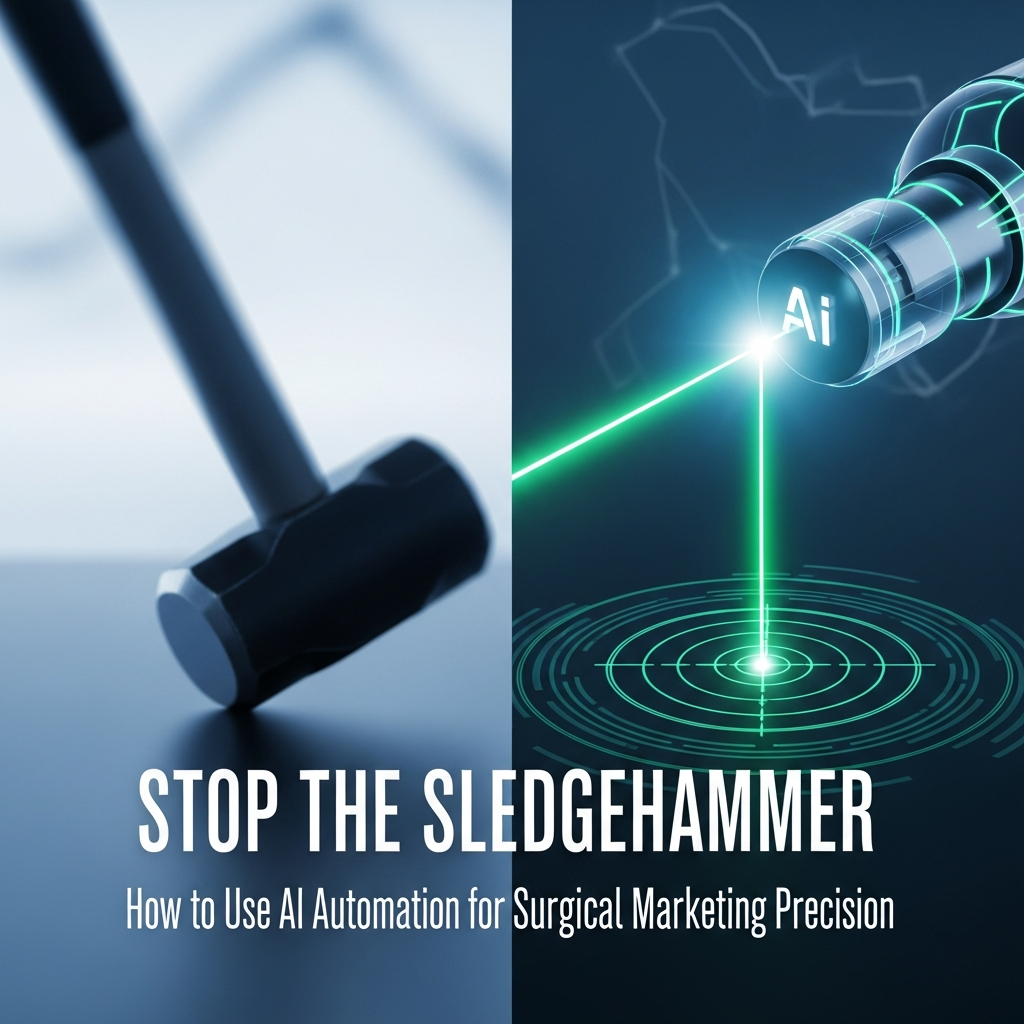
It was 3:00 AM on a Tuesday when I finally hit “delete” on a sixty-page marketing strategy I’d spent three months building. Why? Because I realized I was just designing a more expensive sledgehammer. We’ve all been there—staring at a dashboard, watching conversion rates flatline despite having “state-of-the-art” automation tools screaming at us that everything is optimized. It wasn’t optimized. It was just loud. In our desperate rush to adopt AI, we’ve collectively traded our scalpels for blunt instruments, battering our audiences with generic, high-frequency “content” that has the nutritional value of wet cardboard.
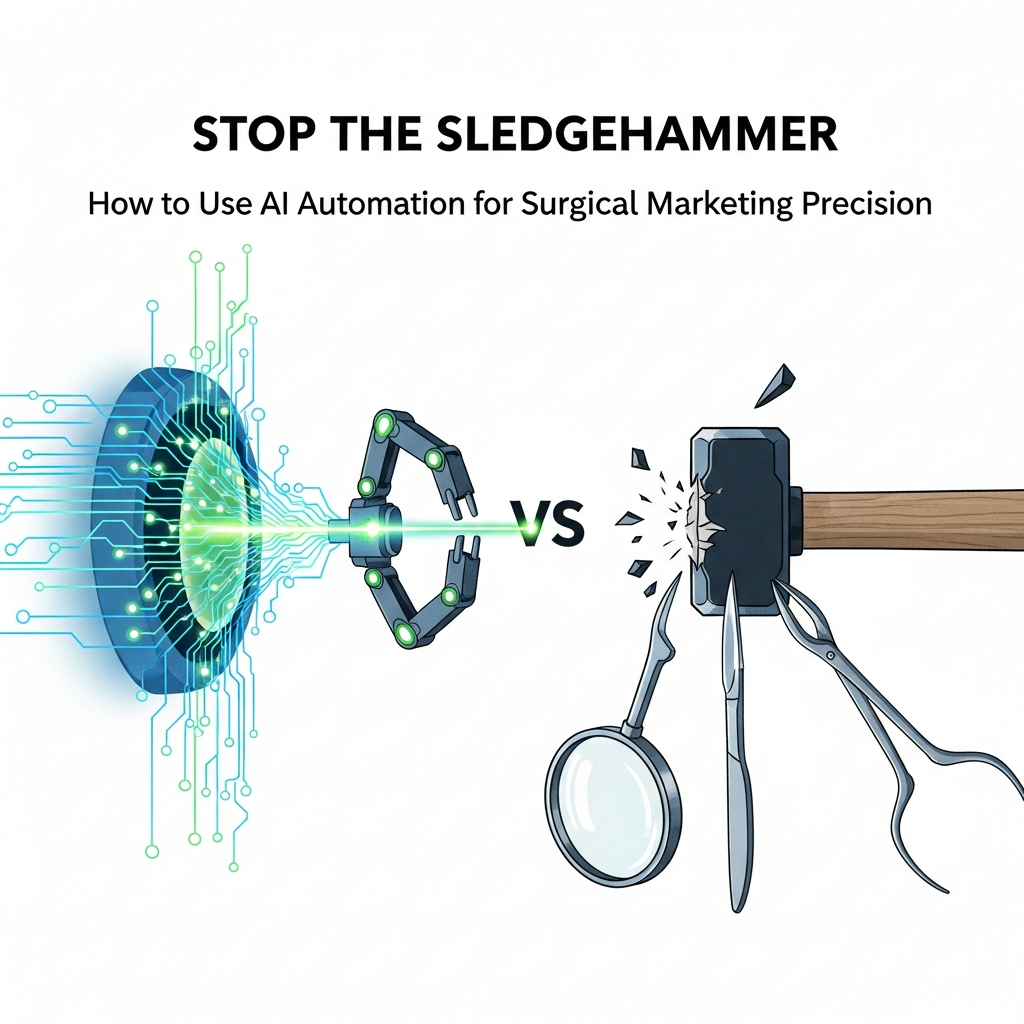
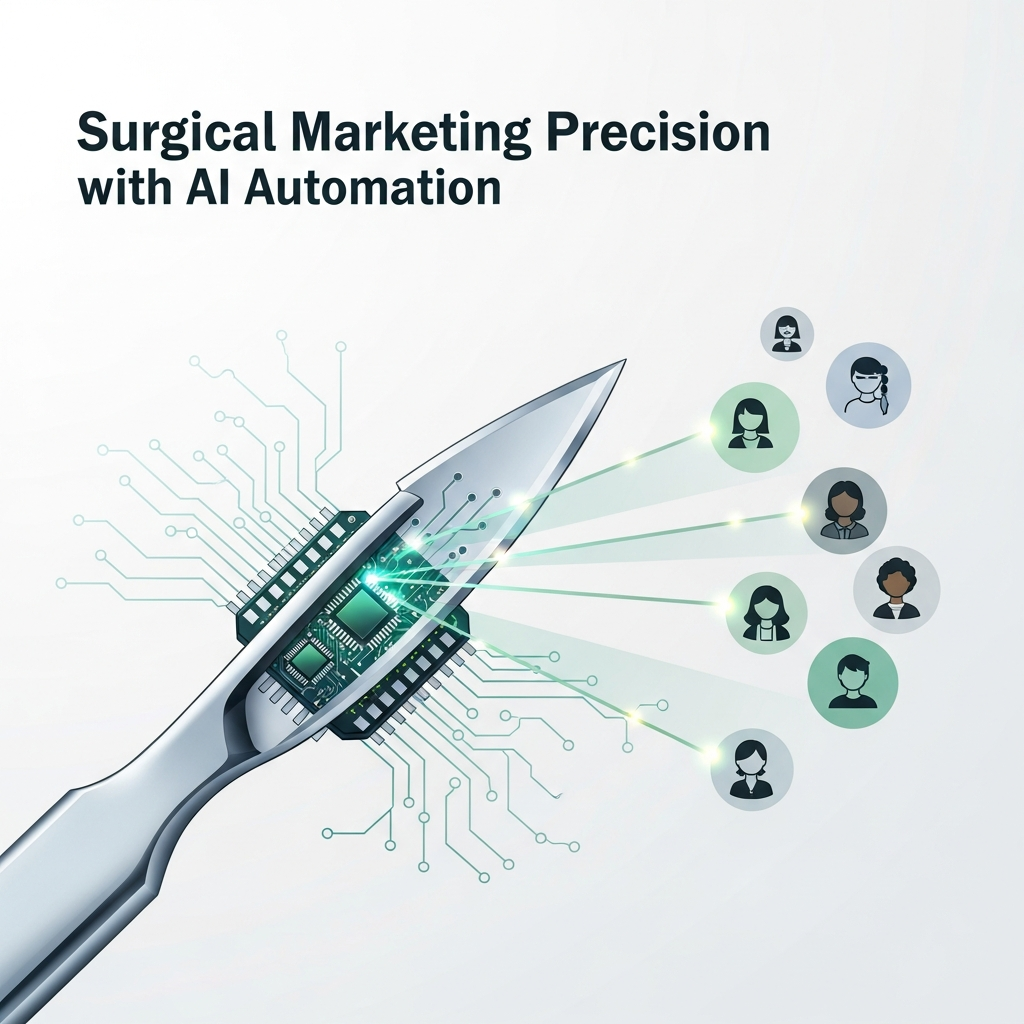
I’ve spent fifteen years in the trenches of digital strategy, and I’ve seen the pendulum swing from manual labor to mindless automation. Right now, we’re in the “mindless” phase. We use AI to generate 5,000 blog posts a month, hoping the sheer volume will crack the algorithm. We use it to blast “personalized” emails that feel about as personal as a court summons. This is the Sledgehammer Approach, and frankly, your customers are tired of the noise. They don’t want more; they want better. They want surgical precision.
Precision marketing isn’t about doing things faster. It’s about doing fewer things, but with such calculated accuracy that the impact is undeniable. It’s the difference between carpet bombing a city and a laser-guided delivery. If you’re ready to put down the heavy tools and start operating with a surgeon’s steady hand, let’s talk about how AI actually works when you stop treating it like a glorified intern.
The Cognitive Dissonance of Modern Automation
We’re living in a strange paradox. We have access to the most sophisticated Large Language Models (LLMs) and predictive engines in human history, yet marketing has never felt more robotic. This happens because most teams use AI as a generative crutch rather than an analytical engine. They use it to fill space. If you’re using ChatGPT to “write a LinkedIn post about synergy,” you’re using a sledgehammer. You’re contributing to the entropy of the internet.
The “Mid-Wit” Trap in AI Adoption
There’s a specific curve to AI adoption. At the bottom, you have people who fear it. In the middle—where most “growth hackers” live—you have the sledgehammer users. They automate everything, create massive “top-of-funnel” noise, and wonder why their Brand Equity is bleeding out. At the top of the curve? That’s where the surgeons live. These are the practitioners who use AI to identify micro-segments of 50 people who are exactly 72 hours away from making a purchase decision based on a specific pain point they haven’t even articulated yet.
To move from the middle to the top, you have to embrace Perplexity. In linguistics, perplexity is a measure of how well a probability model predicts a sample. In marketing, it’s your ability to surprise and delight a customer with something so relevant it feels like you’re reading their mind. Sledgehammers have zero perplexity. They are predictable. And in a world of infinite scrolls, predictable is invisible.
Step 1: Diagnostic Data—Sharpening the Blade
Before you can operate, you need a clear view of the patient. Most companies sit on mountains of “dark data”—customer interactions, support tickets, abandoned carts, and social sentiment that never gets analyzed. They look at Google Analytics and see “Users” and “Sessions.” That’s a sledgehammer metric. It’s too broad to be useful.
Surgical marketing requires Vectorized Intent. Instead of seeing a user who visited your pricing page, a surgical AI system analyzes the *sequence* and *velocity* of their actions. Did they come from a technical whitepaper? Did they spend four minutes on the “Integrations” section but only ten seconds on “Pricing”? This isn’t just data; it’s a narrative.
- Natural Language Processing (NLP) on Support Tickets: Use AI to categorize the *emotional state* of your customers. Are they frustrated with a feature or confused by the UI? Stop sending them “feature update” emails if they’re currently angry about a bug.
- Predictive Churn Modeling: Instead of reacting when someone cancels, use machine learning to identify the “quiet withdrawal”—the moment a user’s engagement frequency drops by 15% over a three-day rolling average. That’s when the surgeon steps in with a targeted intervention.
- Zero-Party Data Enrichment: Stop guessing. Use AI-driven micro-surveys that adapt in real-time based on the user’s previous answer. This isn’t a static form; it’s a conversation.
The Myth of the “Ideal Customer Persona”
I’m going to say something controversial: The ICP is dead. Or at least, the way we use it is dead. “Marketing Mary, 35, lives in the suburbs” is a sledgehammer. People are too complex for that now. Surgical marketing replaces static personas with Dynamic Cohorts. These are clusters of individuals who share a specific behavior or problem at a specific moment in time. AI allows us to manage 500 micro-cohorts simultaneously, something no human marketing team could ever do manually.
>Step 2: Predictive Content Architectures
Once you have the data, what do you do with it? Most people just make more content. “We need more top-of-funnel!” they scream. No. You need more High-Context Content. This is where the surgical precision of AI automation really starts to shine. We’re moving away from “The Big Campaign” and toward “The Continuous Stream of Relevance.”
Think about the last time you received an automated email that actually made you stop. It probably didn’t just have your name in the subject line. It probably referenced a specific problem you were having or a goal you were chasing. That’s Retrieval-Augmented Generation (RAG) in action. By connecting your AI to your proprietary data (your blog, your case studies, your product docs), the AI can generate responses that are deeply rooted in your specific expertise, not just generic web-scraped noise.
Building the “Context Engine”
To do this, you need a tech stack that talks to itself. It’s not just about having an ESP (Email Service Provider) and a CRM. It’s about an Orchestration Layer. Here is how a surgical content workflow looks:
- Trigger: A prospect downloads a technical guide on “Scalable Infrastructure.”
- Analysis: The AI cross-references this with their LinkedIn profile (via API) and realizes they are a Lead Engineer at a Series B startup.
- Syntheses: Instead of a generic “Thanks for downloading” email, the AI pulls a specific paragraph from a case study involving another Series B company in the same industry.
- Execution: It generates a personalized video script for the sales rep, highlighting exactly why this lead engineer should care about Section 4 of that guide.
This is surgical. It’s quiet. It’s hyper-relevant. It doesn’t feel like marketing; it feels like service.
>Step 3: The Human-in-the-Loop (HITL) Imperative
Here is the “imperfect” truth: AI is a brilliant idiot. It can process a billion data points in a second, but it doesn’t know what it feels like to be afraid of losing a job. It doesn’t understand the subtle political nuances of a boardroom. This is where most automation strategies fail—they remove the human entirely because they want “efficiency.”
True surgical precision requires a Human-AI Symbiosis. The AI provides the data, the scale, and the initial draft; the human provides the empathy, the ethics, and the “soul.” If your marketing feels robotic, it’s because you’ve outsourced your taste to an algorithm. Never outsource your taste.
In my own workflow, I use AI to “stress test” my ideas. I’ll feed it my pitch and say, “Act as a cynical CFO who hates spending money on marketing. Rip this apart.” The AI gives me the analytical pushback, which allows me to refine my human-centric message. That’s using the tool for precision, not just production.
The “Cringe” Filter
We need to talk about the “Uncanny Valley” of marketing. You know that feeling when you get an AI-generated message that *almost* sounds human, but something is just… off? It’s too polished. It’s too “LinkedIn-fluencer.” It’s cringey. Surgical marketing avoids this by intentionally leaning into Human Imperfection. Sometimes, a short, plain-text email with a typo is more effective than a perfectly formatted, AI-optimized newsletter because the typo proves a human was there.
>Step 4: Real-Time Optimization (The “Closing” Phase)
A surgeon doesn’t just cut and walk away; they monitor vitals throughout the entire procedure. Most marketers “set and forget” their automations. They build a drip sequence and let it run for six months. That’s a sledgehammer move. The market moves too fast for that.
Surgical automation uses Feedback Loops. If an AI-generated subject line isn’t performing with a specific micro-segment after 100 sends, the system should automatically pivot, test a new hypothesis, and alert the human strategist. This is “Continuous Discovery.”
- Multi-Armed Bandit Testing: Instead of traditional A/B testing (which is slow and often inconclusive), use Multi-Armed Bandit algorithms. These dynamically shift traffic toward the winning variant in real-time, minimizing the “regret” of showing low-performing content to potential leads.
- Sentiment Drift Monitoring: Use AI to monitor how the conversation around your brand is changing. If a competitor launches a new feature, your automation should be able to detect the shift in customer inquiries and adjust the “surgical” focus of your outbound messaging within hours, not weeks.
- Micro-Conversion Tracking: Stop obsessing over the “Final Sale.” Track the small wins—did they click the ‘technical docs’? Did they watch more than 30 seconds of the demo? These micro-conversions are the “vitals” that tell you if the surgery is succeeding.
>The Ethical Scalpel: Privacy as a Feature
We cannot talk about precision without talking about privacy. The more surgical you get, the closer you get to the “creepy” line. There is a very fine line between “Wow, this is exactly what I needed” and “How did they know I was talking about that in my kitchen?”
Surgical precision requires Radical Transparency. Use AI to be better at respecting boundaries, not finding ways around them. Use it to scrub your lists of people who haven’t engaged. Use it to ensure you aren’t over-targeting the same individual across seven different channels. Precision is as much about restraint as it is about action. A surgeon doesn’t cut more than they have to. A precision marketer doesn’t send more emails than necessary.
In an era of GDPR and CCPA, your AI should be your first line of defense in compliance, automatically flagging data that shouldn’t be there and ensuring that “Personalization” never turns into “Surveillance.”
>Implementing the Precision Stack: A No-Fluff Guide
I promised no fluff, so here is the actual architectural logic you need. You don’t need a million-dollar budget; you need a cohesive logic. You need to move from a “Linear Funnel” to a “Circular Ecosystem.”
The Foundation: The Vector Database. If you’re serious about surgical AI, you need to move beyond relational databases. A vector database (like Pinecone or Weaviate) allows your AI to understand the “semantic meaning” of your data. It allows the AI to find connections between a customer’s LinkedIn comment and their behavior on your pricing page that a standard CRM would miss.
The Logic Layer: Low-Code Automation. Tools like Make.com or Zapier are the “connective tissue.” They allow you to build complex, conditional logic. If the AI detects “High Intent” + “High Technical Knowledge,” then send them to the “Expert Workflow.” If it detects “Confusion” + “Low Engagement,” then send them to the “Education Workflow.”
The Execution Layer: Modular Content. Stop writing “Emails.” Start writing “Content Modules.” These are small snippets of value—a testimonial, a technical tip, a discount code—that the AI can assemble in real-time like Lego bricks based on the recipient’s specific needs. This is how you achieve “Surgical Personalization” at scale without losing your mind.
>The Final Reckoning: Putting Down the Sledgehammer
Transitioning to surgical marketing is painful. It requires you to admit that much of what you’ve been doing—the mass blasts, the generic social calendars, the “volume-first” mindset—isn’t working. It requires you to slow down so you can eventually move much, much faster. It requires an empathetic understanding that there is a human being on the other side of that data point.
I’ve seen companies double their revenue by cutting their email volume in half. I’ve seen brands go from “ignored” to “essential” by simply using AI to listen better than they talk. The sledgehammer is easy. It’s heavy, it’s loud, and it feels like work. But the surgery? That’s where the healing happens. That’s where the growth is.
Stop trying to break down the door. The door isn’t even locked; you just need to find the right key. Use your AI to find that key. Use it to understand the nuance, the timing, and the quiet signals that everyone else is ignoring. Be the surgeon in a world of demolition crews. Your customers will thank you for it, and your bottom line will reflect the difference between a mess and a masterpiece.
The era of the sledgehammer is over. It’s time to pick up the scalpel. Are you ready to operate?