

The Invisible Gravity of the First Number
I’ve sat in enough midtown Manhattan boardrooms to know the exact moment the oxygen leaves the room. It’s not when the legal team starts nitpicking the indemnity clauses, nor is it when the CTO asks about SOC2 compliance for the third time. It’s the moment the first number hits the mahogany table. That number—the anchor—creates a psychological gravity so dense that every subsequent minute of the negotiation is spent trying to escape its pull. If you aren’t the one setting that anchor, you’re already losing the war for margin.
The anchoring effect isn’t just some dusty heuristic from a Kahneman and Tversky paper; it is the visceral, often irrational way our brains latch onto the first piece of information offered when making decisions. In Enterprise SaaS, where value is often amorphous and “ROI” is a projection of a future that hasn’t happened yet, the anchor is the only objective reality the buyer has. It’s the north star, even if that star is a total fabrication. We’re going to dissect how to build that anchor, how to defend it, and why your $200k-a-year platform is actually being judged against a number you probably haven’t even thought of yet.
The Neurobiology of Why We Get Stuck
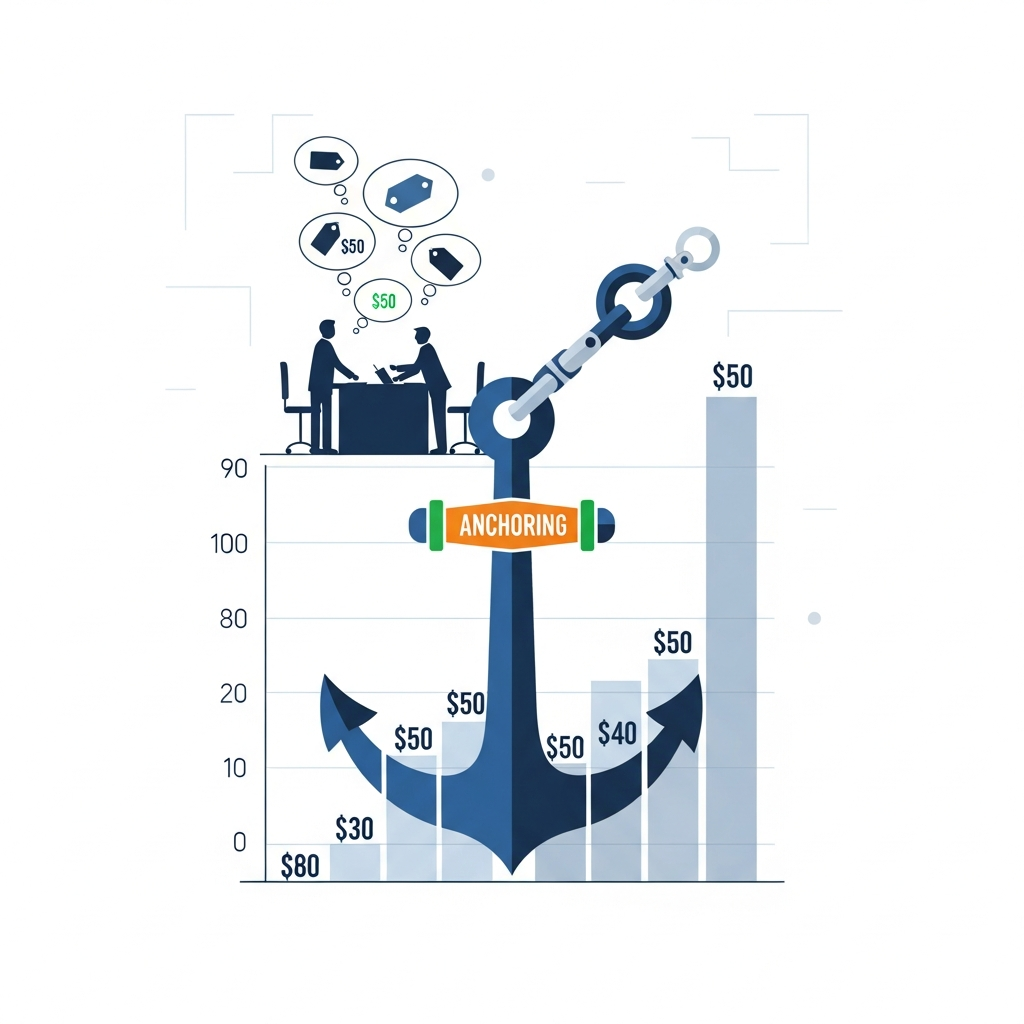
Our brains are remarkably efficient at being lazy. We use a process called “Anchor and Adjustment.” When we see a price, our brain accepts it as a baseline and then adjusts away from it based on new information. The problem? We never adjust far enough. The initial stimulus leaves a residue. In a high-stakes SaaS deal, if I pitch an enterprise license at $500,000, and your budget was $200,000, your brain doesn’t just stay at $200k. It subconsciously drifts toward $350k. You feel like you’ve won a massive discount, while I’ve secured a deal 75% higher than your internal ceiling. It’s a dance of cognitive dissonance where the loser often leaves the room smiling.
The Architecture of the Enterprise Anchor
You don’t just shout a number and hope it sticks. That’s amateur hour. An effective anchor in the enterprise space is built through a sequence of value signals that precede the actual quote. It’s about “priming” the environment. If I spend three months talking about the $10 million in technical debt your current legacy system creates, a $1 million implementation fee feels like a bargain. I’ve anchored the problem before I’ve anchored the price.
Consider the “Decoy” strategy. I often advise SaaS founders to present a three-tier pricing model even when they know the prospect only wants the middle tier. The “Titanium” or “Global Enterprise” tier shouldn’t just be expensive; it should be painfully expensive. It exists solely to make the “Professional” tier look like a rounding error. When a CIO sees a $2M option and a $450k option, the $450k option stops being “expensive” and starts being “the sensible choice.” You aren’t selling the $2M tier. You’re selling the relief of not paying it.
The Precision Paradox: Why $147,550 Beats $150,000
There is a peculiar bit of psychological magic in the “precise number.” Round numbers—like $100k or $50k—are perceived as placeholders. They look like guesses. They invite a counter-offer that is equally round and usually 20% lower. However, when you present a quote of $147,550, you signal to the procurement team that this number is the result of a rigorous, data-driven calculation. It suggests you’ve crunched the numbers on server load, implementation hours, and seat-based utility. It is much harder for a buyer to look at a precise number and say, “Can you do $120k?” It feels disrespectful to the “math” you’ve clearly done. Precision commands a higher level of deference.

Tactical Execution: The First-Mover Advantage
There’s a classic debate in negotiation circles: do you go first, or do you wait for the buyer to show their hand? In SaaS, if you have a solid grasp of the value you’re delivering, you always go first. Waiting allows the buyer to anchor you with their budget. “We only have $80k allocated for this” is a hard anchor to break. If you hit them with $250k before they can say a word, you’ve reframed their entire budget conversation. Now, they aren’t thinking about their $80k limit; they’re wondering why their budget is so misaligned with the market reality you’ve just established.
- The “Flanking” Move: If you know the budget is low, anchor with a massive TCV (Total Contract Value) over three years rather than an annual fee. A $900,000 three-year deal sounds more serious and “anchors” the long-term commitment better than a $300k annual recurring revenue (ARR) quote.
- The “Flinch”: When the buyer eventually counters, you must flinch. Not physically (though sometimes that helps), but through your terms. If you drop the price without changing the scope, you’ve just admitted your anchor was a lie. You’ve destroyed your credibility.
- The Scope-Price Linkage: Every dollar move downward must be “paid for” by a feature or service removal. “We can get to $120k, but we’ll have to move from 24/7 support to a 12-hour ticket response time.” This reinforces the validity of the original anchor.
The “Total Cost of Ownership” (TCO) Re-Anchor
In enterprise sales, you aren’t just competing against other SaaS vendors. You are competing against the “Status Quo.” The Status Quo has its own anchor: $0 (or so the buyer thinks). Your job is to prove that the Status Quo actually costs $2M a year in inefficiency. By anchoring the cost of doing nothing, your subscription fee becomes a cost-saving measure rather than an expense. I’ve seen deals close at double the expected price because the salesperson spent the first three meetings documenting the hidden costs of the client’s current manual processes. Shift the anchor from “What this costs” to “What you’re losing.”

Navigating the Procurement Gauntlet
Procurement officers are professional “de-anchorers.” They are trained to ignore your first offer and treat it as a theatrical performance. To beat them, you need to understand “The Threshold of Plausibility.” If your anchor is too high—say, 10x the market rate—it loses its gravitational pull and becomes a joke. You lose trust. The ideal anchor is just at the edge of what they find believable but high enough to leave you room for meaningful concessions.
When procurement says, “We have a strictly defined budget of $X,” they are attempting to counter-anchor. I’ve found success by acknowledging the budget and then immediately pivoting to “Value Adjustments.” “I understand the budget is $100k. Most of our clients with that budget find that they have to sacrifice [Key Critical Feature], which usually ends up costing them more in the long run. Would you like to see how we can bridge that gap?” You aren’t fighting their anchor; you’re making it look dangerous.
The “Silence” Anchor: Let the Number Breathe
One of the most common mistakes I see from even seasoned AEs is the “nervous chatter” immediately following the price reveal. You say, “The annual investment is $215,000…” and then, because the silence feels like a heavy blanket, you add, “…but we have some flexibility there depending on the seat count.” You just sabotaged your own anchor. You gave away the farm before they even asked for a cow.
State the price. Then stop. Don’t sip your water. Don’t look at your phone. Look them in the eye and wait. The first person to speak after a price is revealed is usually the one who makes a concession. Let them be the one to break. Even if they react with shock, let that reaction hang in the air. Their shock is just a negotiation tactic; your silence is a statement of value.
>The Psychology of Concessions: Giving Without Losing
If you start at $200k and eventually settle at $150k, the way you get there matters more than the final number. This is the “Decreasing Concessions” rule. If your first drop is $20k, your second should be $10k, and your third should be $2,500. This creates a psychological “asymptote”—it signals to the buyer that you are reaching your absolute floor. If you drop $10k every time they ask, they’ll keep asking until you’re at zero. You’re training them that your price is a suggestion, not a fact.
We also need to talk about “The Non-Monetary Anchor.” Sometimes, the best way to hold your price is to anchor on terms. “The price is $150k, but I can’t move on the Net-30 payment terms” or “I need a case study and a press release signed off within 90 days.” Often, procurement will fight you on these terms, and then you can “concede” on the terms to keep your price anchor intact. It’s a shell game, but one where everyone leaves with what they actually need.
The “Endowment Effect” Integration
How do you make an anchor even stronger? You let the prospect “own” the solution before they pay for it. This is why Proof of Concepts (PoCs) are so dangerous/effective. Once a team has integrated your software into their workflow, the psychological cost of “losing” that efficiency (the endowment effect) makes them less likely to fight your price anchor. They aren’t buying a new tool; they’re paying to keep a tool they already feel they own. At that point, the anchor isn’t just a number on a page—it’s the price of maintaining their new, better reality.
>The Ethics of Psychological Pricing
I’d be remiss if I didn’t touch on the morality of this. Is anchoring manipulative? Perhaps. But in the world of Enterprise SaaS, where a single bad deal can sink a startup and a single good one can lead to a Series B, you have a responsibility to your team and your product to capture the value you create. If you don’t anchor correctly, you aren’t being “fair”—you’re being undervalued. The goal of psychological pricing isn’t to trick people into paying more than something is worth; it’s to prevent them from underpaying for the immense value your engineers and product teams have spent years building. Value is subjective. The anchor is simply your way of defining that subjectivity.
Final Strategic Checklist for Your Next Negotiation
- Research the “Shadow Anchor”: What did they pay for their last solution? That is their hidden baseline. You must break that before you set yours.
- Prime the Value: Spend the discovery phase talking about the millions they are losing, not the thousands you are charging.
- Be Specific: Use a non-round number to imply rigorous calculation.
- Wait for the Silence: Give your anchor room to sink in.
- Control the Concession Curve: Smaller and smaller drops to signal the floor.
The next time you’re preparing a quote, don’t just think about what you *need* to get. Think about what you need to *say* first. The first number isn’t just a price; it’s the boundary of the possible. If you don’t set the boundary, your customer will—and they’ll always set it in their own favor. Mastering the anchoring effect is about having the courage to claim your space in the market and the tactical discipline to hold it under pressure. Go big. Go precise. And for heaven’s sake, stop talking once you’ve said the number.