
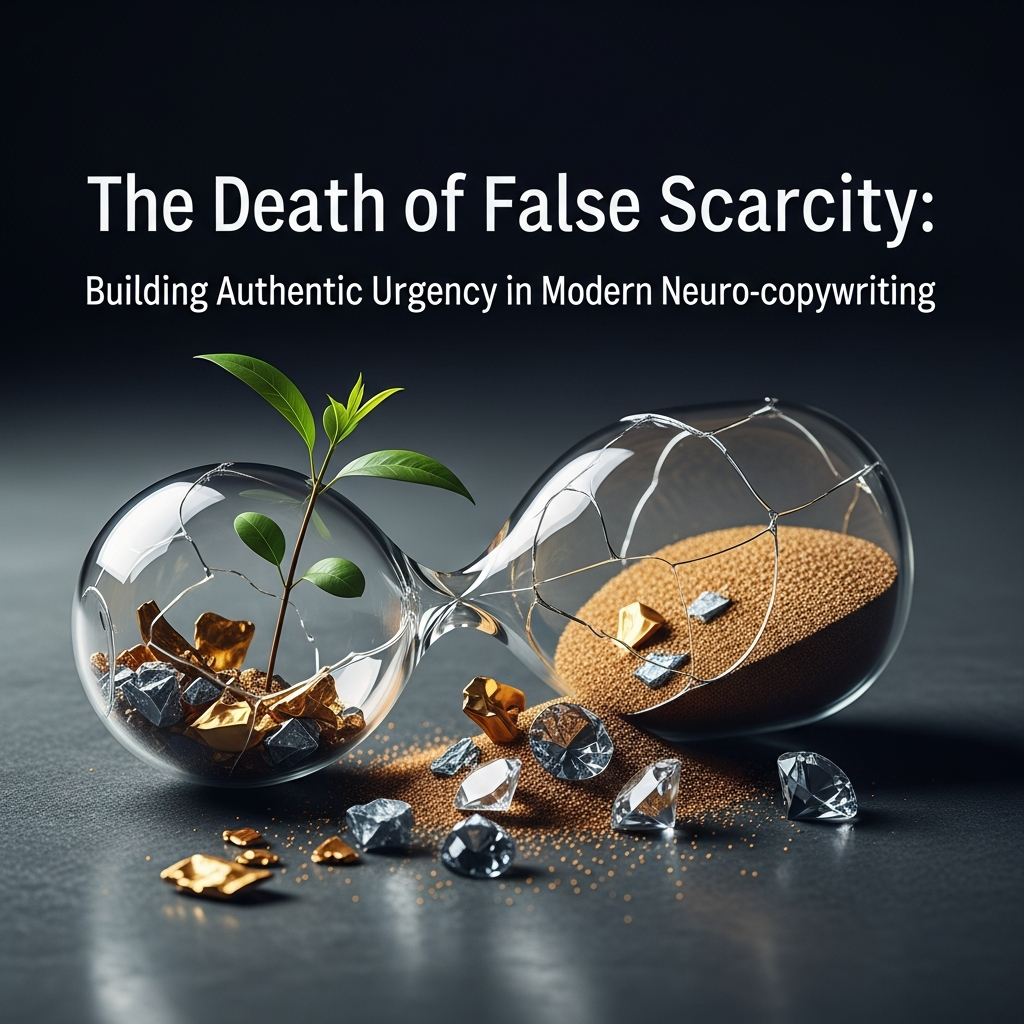
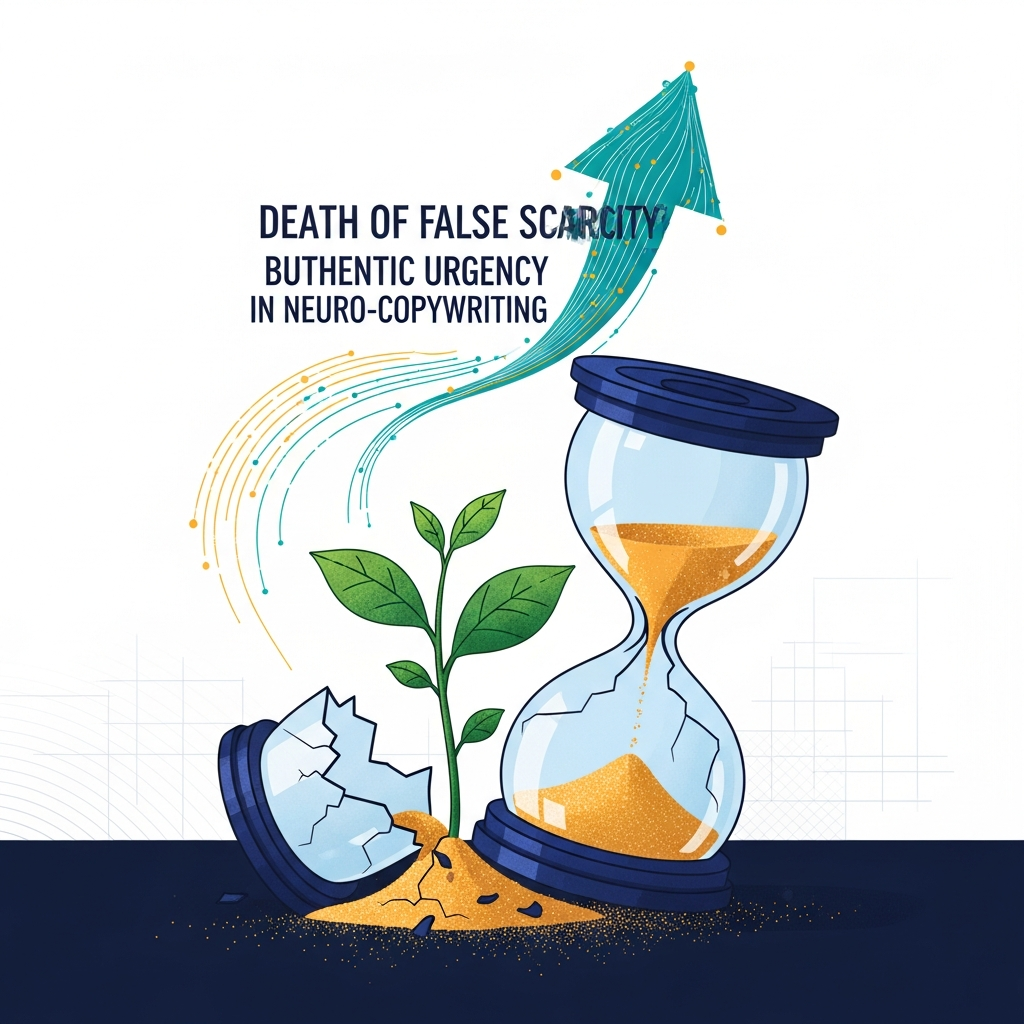
The Great Desensitization: Why Your Countdown Timer is Killing Your Conversion Rate
I remember sitting in a windowless boardroom in 2014, watching a “guru” demonstrate how a simple JavaScript countdown timer could double sales overnight. Back then, it worked. The reptilian brain, or more accurately, the amygdala-driven survival circuit, wasn’t yet conditioned to the digital “boy who cried wolf.” If a timer hit zero, we assumed the offer vanished. We felt that visceral prickle of FOMO—Fear Of Missing Out—and we reached for our wallets. But something shifted around 2019. The “evergreen” countdown timer, which magically resets every time you clear your cookies, became the hallmark of the digital snake oil salesman.
Modern consumers aren’t just skeptical; they are biologically habituated to manipulation. When a user sees a “Only 3 seats left!” banner on a webinar that they know is pre-recorded, a phenomenon known as Psychological Reactance kicks in. This is the brain’s defensive response to a perceived threat to its autonomy. Instead of clicking “Buy,” the prospect feels a surge of cortisol—not the “good” kind that drives action, but the “bad” kind that triggers avoidance. They feel hunted. And nobody likes being hunted. The death of false scarcity isn’t just an ethical shift; it’s a neurological necessity for any brand that plans to exist three years from now.
The Neurobiology of the “Bait and Switch”
To understand why authentic urgency works, we have to look at the Ventral Tegmental Area (VTA) and the Prefrontal Cortex (PFC). When we encounter a genuine limited-time opportunity, our dopamine pathways light up. We anticipate a reward. However, if the brain detects a lie—a fake deadline or a manufactured shortage—the PFC immediately flags it as a “deceptive signal.” This creates Cognitive Dissonance. The prospect wants the solution but despises the messenger. In neuro-copywriting, this is the kiss of death. You might get the one-time sale, but you’ve effectively incinerated the Lifetime Value (LTV) of that customer by damaging the trust-processing centers of their brain.

Beyond the Timer: Defining Authentic Urgency
Authentic urgency isn’t about telling people to “Hurry!” It’s about illustrating the intrinsic cost of delay. If you are selling a weight loss program, the urgency isn’t that the price goes up in ten minutes; it’s that every day the prospect waits, their systemic inflammation persists. If you’re selling B2B software, the urgency is the $4,000 in lost productivity they bleed every month they stick with their legacy system.
We need to move from Extrinsic Pressure (timers, red text, screaming banners) to Intrinsic Motivation (logic, empathy, and consequence). Authentic urgency is a service to the customer. It helps them overcome the Status Quo Bias—that paralyzing neurological tendency to do nothing even when change is beneficial. You aren’t “forcing” a sale; you are facilitating a breakthrough.
The “Capacity Constraint” Framework
One of the most powerful ways to build authentic urgency is through Radical Transparency regarding your constraints. Every business has them. You have limited server bandwidth, limited coaching hours, limited physical inventory, or a limited window before a specific seasonal event.
- Human Bandwidth: “I only take on three new consulting clients per month because my process requires 15 hours of deep-dive research for each.” (This is verifiable and logical).
- Logistical Windows: “To get your garden seeds in the ground by the first frost, you need to order by Friday.” (This is an external reality the seller doesn’t control).
- Curated Exclusivity: “We only printed 500 copies of this leather-bound edition because the artisanal bindery we use can’t handle more.” (This attaches value to the scarcity).
When you explain why something is scarce, the brain accepts the limitation as a fact rather than a tactic. This lowers the guard of the PFC and allows the emotional brain to engage with the benefits of the product.
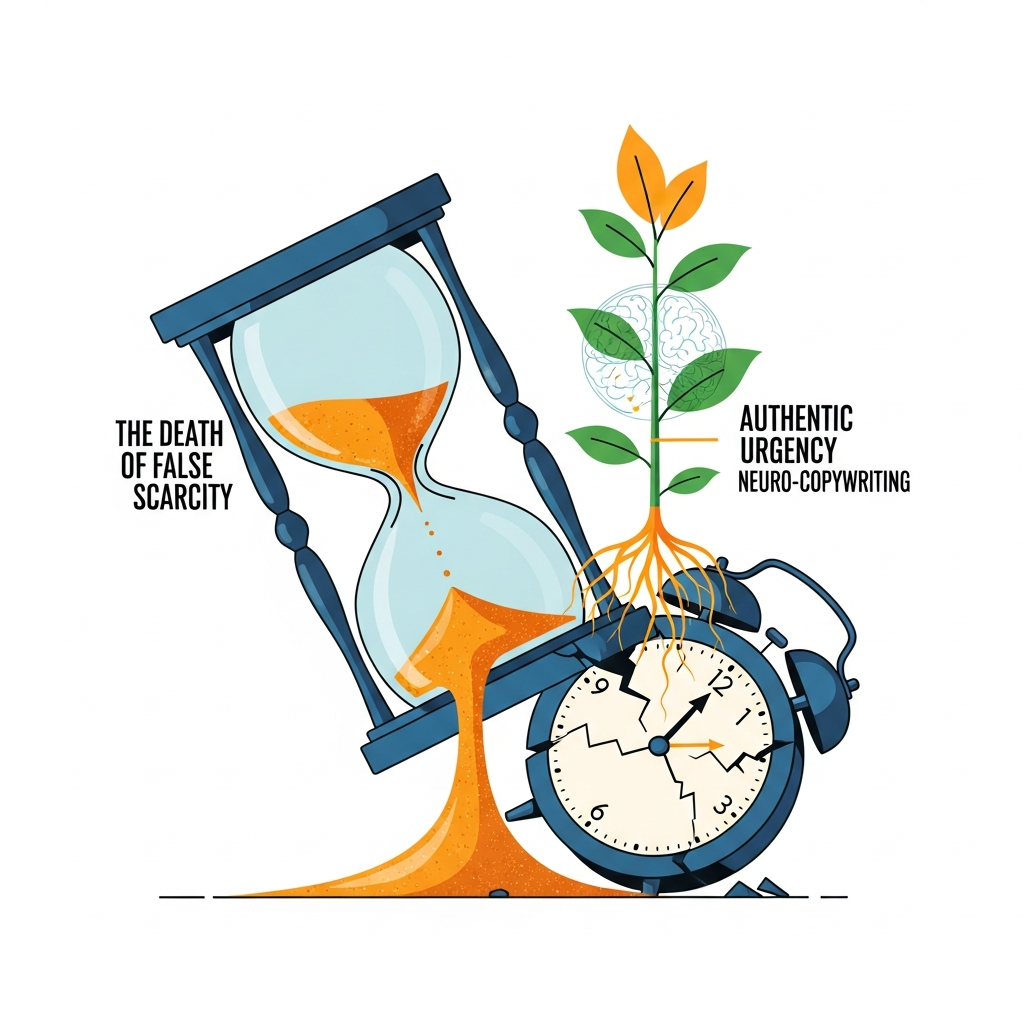
The Cognitive Psychology of “The Cost of Inaction” (COI)
Standard copywriting focuses heavily on ROI (Return on Investment). But the human brain is Loss Averse. As Daniel Kahneman famously noted, the pain of losing is twice as potent as the joy of gaining. Therefore, elite neuro-copywriting pivots from “Look what you’ll get” to “Look what you’re losing by waiting.”
This is where we employ Temporal Discounting. Most people value a small reward now more than a large reward later. By waiting, they are choosing the “small reward” of staying comfortable/lazy over the “large reward” of their desired future. Your copy must bridge this gap.
Writing the “Gap” Analysis
To do this effectively, you must paint a vivid, sensory-rich picture of the “Middle Ground.” That purgatory where they currently live. Let’s say you’re writing for a sleep aid supplement.
False Scarcity: “Buy now! Sale ends in 2 hours!” (Weak. Ignorable.)
Authentic Urgency (COI): “Another night of staring at the ceiling at 3:00 AM isn’t just frustrating; it’s physically taxing. Every hour of lost REM sleep increases your cortisol levels the next morning, making you more likely to snap at your kids or miss a crucial detail at work. You can keep hoping tomorrow will be different, or you can address the neural pathways keeping you awake. Which version of yourself do you want to be at 9:00 AM tomorrow?”
This approach uses affective forecasting—forcing the brain to simulate a future emotional state. It creates a sense of urgency that is internal, not external.

Neuro-Copywriting Tactics for the Skeptical Era
If we are abandoning the “fake” tactics, what do we replace them with? How do we nudge the prospect toward the “Add to Cart” button without feeling like a used car salesman? We use Micro-Nudges and Social Validation that feel organic.
1. Real-Time Activity Feeds (Done Ethically)
Instead of “300 people are looking at this right now” (which is usually a lie), use “12 people joined the community in the last 24 hours.” This leverages Social Proof without the frantic energy. It suggests a moving train that the prospect might want to board, but it doesn’t scream in their ear. It taps into our tribal instincts—the need to belong to a successful group.
2. The “Threshold” Close
This is where you reveal how close you are to a meaningful milestone. “We’re about to ship our 10,000th order. To celebrate, we’re including a gift for the next 14 customers.” This is grounded in a specific, celebratory event. It feels like an invitation to a party rather than a countdown to an execution.
3. Micro-Copy: The Power of “Yet”
Urgency can be subtle. Using the word “yet” triggers a sense of incompleteness in the brain. “You haven’t mastered your morning routine yet.” This creates a Zeigarnik Effect—the psychological phenomenon where people remember uncompleted or interrupted tasks better than completed ones. The brain wants to close the loop. Your product becomes the “loop closer.”
>The Empathy-First Conversion Architecture
I’ve spent fifteen years analyzing heatmaps and click-through rates, and if there’s one thing I’ve learned, it’s that empathy outperforms ego every single time. False scarcity is an ego-driven tactic. It assumes the seller is in control. Authentic urgency is empathy-driven. It recognizes the customer’s struggle and offers a timely hand up.
When you write with empathy, you use Mirror Neurons. You describe the problem so accurately that the reader feels you are inside their head. “I know that feeling of looking at a blank screen while the cursor blinks, mocking your lack of ideas.” When the reader feels understood, their Oxytocin levels rise. Oxytocin is the “bonding hormone.” It mutes the amygdala’s fear response. In this state, the reader is much more likely to accept your “limitations” as honest and your “deadlines” as helpful.
Case Study: The “Waitlist” Strategy
I once worked with a SaaS founder who insisted on an “Open/Closed” enrollment model. We didn’t use a countdown timer. Instead, we used a Conditional Waitlist. We told the truth: “Our support team is small. To ensure every new user gets a 1-on-1 onboarding call, we only admit 50 people a week. Join the waitlist, and we’ll email you when your slot opens.”
The result? A 40% increase in conversion over the “Always Open” model. Why? Because the scarcity was logical. It was rooted in a commitment to quality. The “urgency” was the desire to be one of the 50, but it wasn’t manufactured—it was a byproduct of operational integrity. The prospects didn’t feel pressured; they felt chosen.
>Advanced Neuro-Linguistic Programming (NLP) in Urgency
We can further enhance authentic urgency by using specific linguistic structures that bypass the “analytical” filter. One such structure is the “If/Then” Proposition coupled with a Future Pace.
“If you decide to start today, then by this time next month, you’ll have your first three chapters drafted. If you wait, next month will look exactly like this one—more ideas, zero pages.”
This uses Linear Time Mapping. It forces the brain to plot two different trajectories. The urgency arises from the visible divergence of those two paths. One leads to growth; the other leads to stagnation. Stagnation is a form of biological death, and the brain is hardwired to avoid it at all costs.
The “Precision Pricing” Nudge
Oddly enough, urgency can be built into your pricing. Avoid “rounded” numbers. $497 feels like a marketing number. $482 feels like a calculated, cost-plus-margin number. When things feel calculated and precise, they feel more “real.” People don’t question the “scarcity” of a precisely priced item as much as they do a “Special $99 Sale!” which feels like it was pulled from a hat.
>Why “Slow” is the New “Fast” in High-Ticket Copy
If you are selling something for $5,000, a countdown timer is an insult to the buyer’s intelligence. High-ticket sales require Cognitive Ease. You want the buyer to feel calm, certain, and focused. The urgency here must be Philosophical.
You aren’t asking them to buy before the clock hits zero; you are asking them to commit before their current problem becomes an irreversible disaster. This is “High-Stakes Urgency.” It’s the difference between a “Flash Sale” on a sweater and a doctor telling you that you need surgery before the nerve damage becomes permanent. Which one gets your attention? Which one do you respect?
The “Inverted” Deadline
Try this: Instead of saying “Offer ends Friday,” say “We start on Monday.” Shift the focus from the end of the opportunity to the beginning of the transformation. This reframes the deadline as a “Launch Point.” It’s positive, forward-looking, and creates a natural, undeniable reason for the cut-off date. If the class starts Monday, you obviously can’t join on Tuesday. The scarcity is a natural law of the universe, not a line of code on a sales page.
>Reclaiming the Narrative: An Ethical Manifesto
We are entering the “Post-Truth” era of marketing, where consumers are increasingly insulated by “Ad-Blockers” of the mind. The only way through these defenses is through a radical commitment to the truth. Does that mean we stop being persuasive? Absolutely not. It means we become more persuasive by being more human.
Stop looking for the latest “hack” or “plugin.” Instead, look at your business. Where are the real bottlenecks? Where are the genuine limits? What is the actual, painful consequence of your customer waiting another six months to solve their problem? Write those things down. Use them. That is where the power lies.
The “Death of False Scarcity” is actually the birth of Sustainable Influence. It’s the move from being a “closer” to being a “guide.” Guides don’t need to lie about how much oxygen is left in the tank; they just need to point out that the sun is setting and the summit is still three miles away. That’s enough to get anyone moving.
The brain remembers how you made it feel. If you make it feel tricked, it will remember that every time your name pops up in an inbox. If you make it feel empowered—even if that empowerment came with a firm “Now is the time”—you’ve built a bridge that no competitor can burn down.
Focus on the Dopaminergic Reward of progress. Focus on the Amgydala’s healthy fear of a life wasted. But leave the JavaScript timers in 2014 where they belong. The modern world is too fast, too loud, and too smart for anything less than the truth. Build your urgency on the bedrock of reality, and you’ll never have to worry about a “declining conversion rate” again. You’ll be too busy serving the people who finally, actually, trust you.