

The Invisible Friction: Why Your Copy is Repelling the Wealthy
I remember sitting in a mahogany-clad boardroom in Zurich about a decade ago, watching a brilliant CMO wither under the gaze of a private equity titan. The CMO was pitching a revolutionary wealth management platform. He kept using words like “cheap,” “efficient,” and “savings.” To a middle-market consumer, those words are honey. To the man across the table, they were grit in a finely tuned engine. He didn’t want “cheap.” He wanted exclusive. He didn’t care about “savings”—he cared about yield optimization and capital preservation.
That was the day I realized that words aren’t just carriers of meaning; they are emotional triggers that either align with a prospect’s identity or violently clash with it. If you are targeting high-value leads but using the vocabulary of a discount retailer, you aren’t just losing sales; you are invisible. You are broadcasting on a frequency they’ve long since tuned out. This isn’t about snobbery. It’s about the semantics of value.
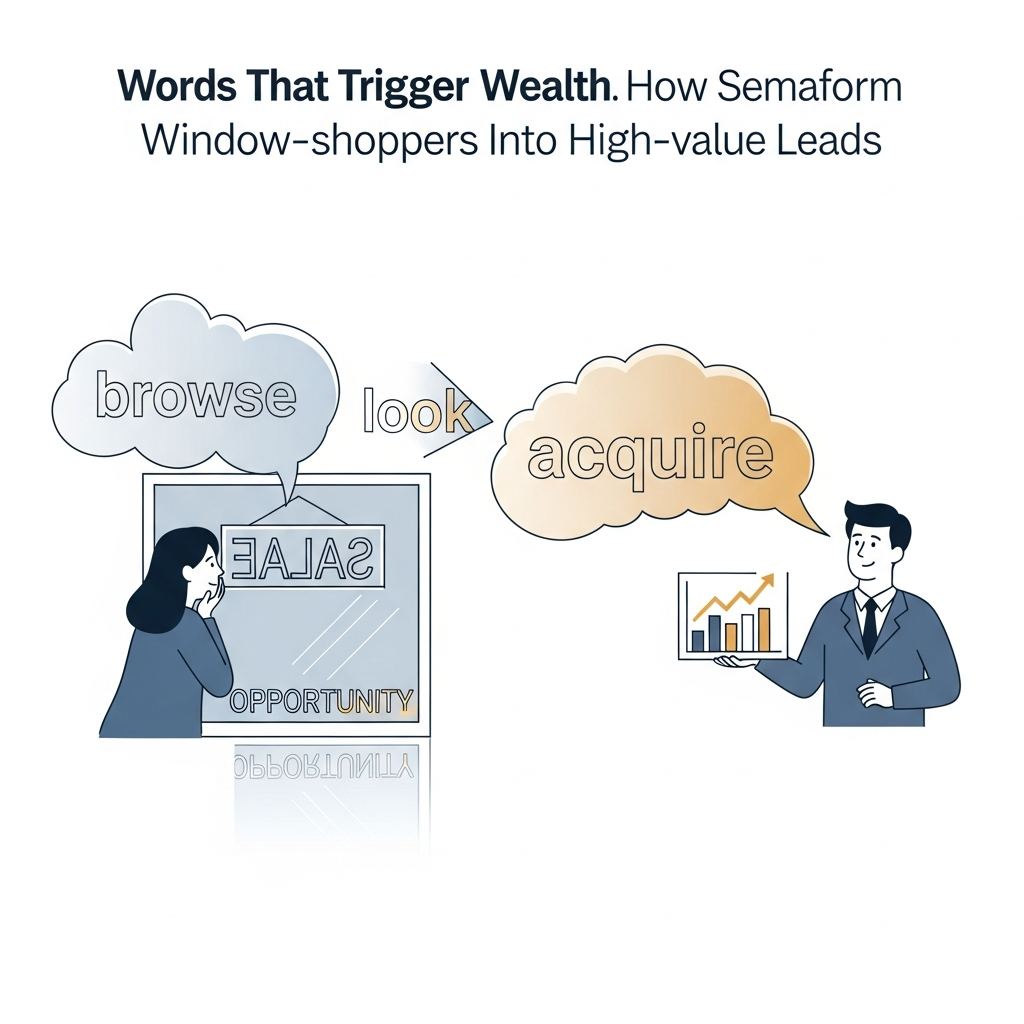
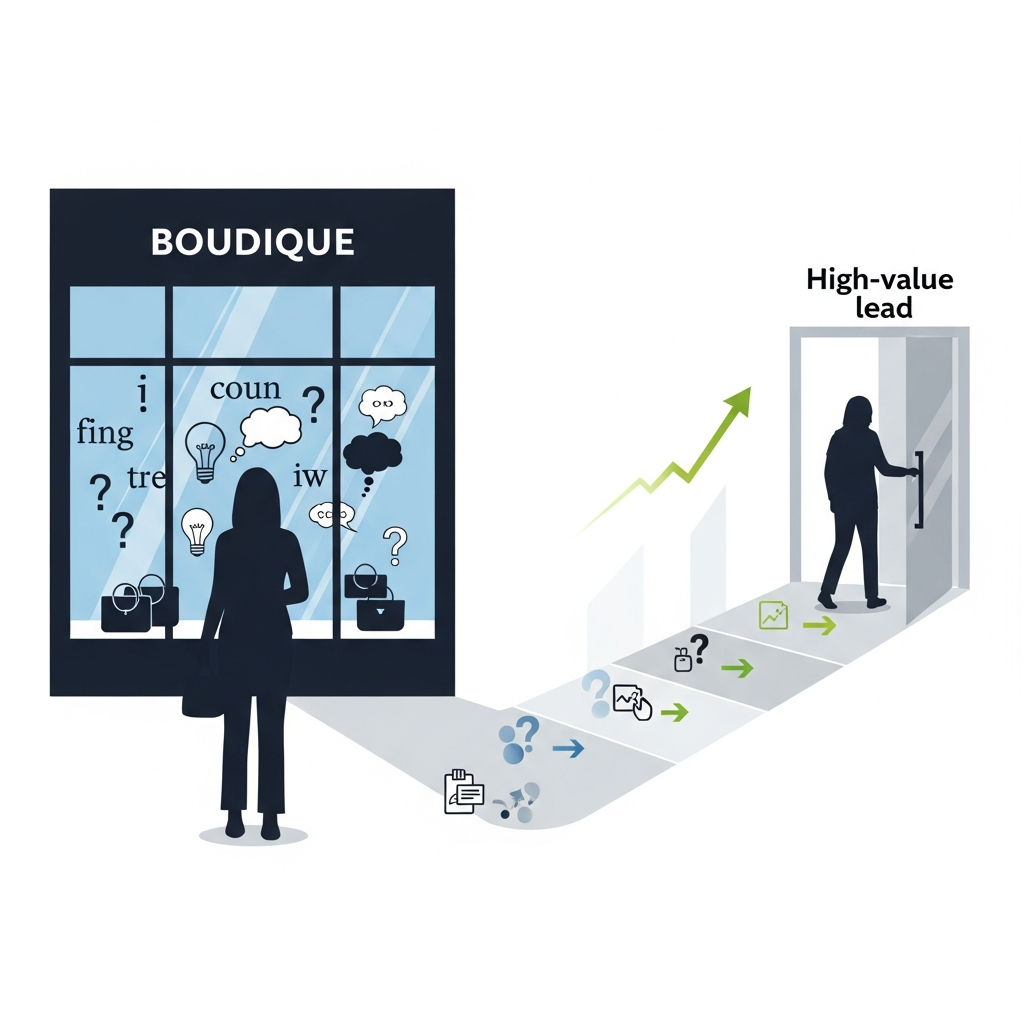
When we talk about “Semantic Shifts,” we’re looking at the subtle, often unconscious psychological recalibration that happens when a lead encounters a specific set of vocabulary. It’s the difference between a “problem” and a “complexity.” It’s the gap between “buying a product” and “acquiring an asset.” If you want to transform window-shoppers into high-value leads, you have to stop selling features and start linguistic world-building.
The Sapir-Whorf Hypothesis of High-Ticket Sales
In linguistics, there’s a concept called linguistic relativity—the idea that the language we speak shapes how we perceive the world. In the world of high-ticket sales, this is our North Star. If your copy uses “transactional” language, your prospect perceives a “transactional” relationship. They look for the lowest price. They haggle. They treat you like a vendor. But if your copy utilizes “transformational” or “stewardship” language, the relationship shifts. You become a partner, an advisor, a gatekeeper.
Think about the word “cost.” It implies loss. It’s a subtraction from one’s wealth. Now, consider “investment” or, even better, “capital allocation.” These terms imply a future-facing movement of resources with the expectation of a return. A window-shopper asks what something costs. A high-value lead asks what the allocation requires and what the projected delta is. By shifting your semantics, you filter out the “price-sensitive” and attract the “value-obsessed.”
The Psychological Weight of Syllables
It sounds academic, almost pedantic, but the “weight” of your words matters. In English, we have a fascinating split between Germanic roots (short, punchy, visceral) and Latinate roots (longer, abstract, intellectual).
- Germanic: Help, Buy, Get, Fix, Cheap.
- Latinate: Facilitate, Acquire, Obtain, Resolve, Economical.
While “human” copy often favors the Germanic for its clarity, high-value leads often respond better to a strategic infusion of Latinate vocabulary. Why? Because it signals authority and distance. It suggests that the solution is sophisticated, not just a quick fix. You aren’t “helping them get more leads.” You are “facilitating the expansion of their proprietary pipeline.” See the difference? One sounds like a freelancer; the other sounds like a consultant.
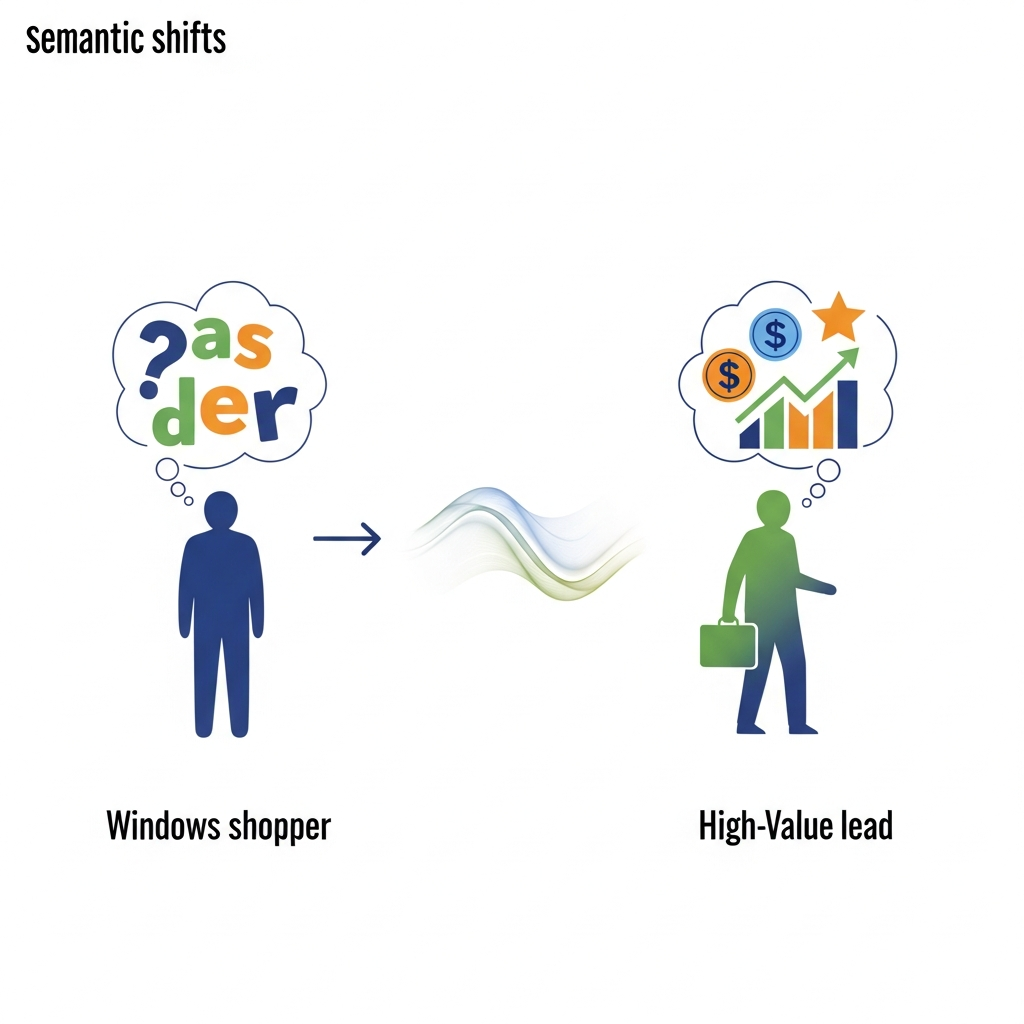
The Semantic Pivot: From “Need” to “Aspiration”
High-value leads rarely “need” anything in the survivalist sense. They have their basics covered. They are operating at the top of Maslow’s hierarchy. Therefore, using “pain point” language—the bread and butter of traditional copywriting—can actually be offensive to them. If you tell a CEO who manages a $500M portfolio that he has a “problem,” his ego might reflexively reject it. He doesn’t have “problems”; he has “strategic bottlenecks.”
We need to shift the semantic focus from the deficiency (what they lack) to the aspiration (what they are becoming). This is the “Identity Shift.” Window-shoppers look for things to fill a hole. High-value leads look for things that polish their armor.
Reframing the “Solution”
Stop using the word “solution.” It’s become a corporate cliché that means absolutely nothing. Instead, use words that imply a structural change.
- Instead of “Solution,” try “Architecture.” (e.g., “The architecture of your wealth.”)
- Instead of “Fix,” try “Equilibrium.” (e.g., “Restoring equilibrium to your operations.”)
- Instead of “Easy,” try “Seamless” or “Fluid.” (High-value leads know nothing is easy, but they pay for fluidity.)
This isn’t just about being “fancy.” It’s about matching the internal monologue of a person who deals with complexity every day. They want to know you understand the nuances of their world.

The Syntax of Certainty: How Sentence Structure Commands Wealth
It’s not just the words; it’s the architecture of the sentence. Most “window-shopper” copy is frantic. It uses lots of exclamation points! It asks too many questions? It feels desperate for attention. High-value copy, conversely, is marked by declarative certainty.
Consider the “if/then” structure.
“If you want to grow your business, then you should click here.” This is weak. It puts the power in the prospect’s hands and suggests uncertainty.
Now, consider the Presuppositional Statement:
“As your portfolio scales, the requirement for sophisticated risk mitigation becomes a matter of legacy, not just profit.”
This sentence doesn’t ask. It states a fact. It assumes the lead is already successful (“As your portfolio scales”) and positions the service as an inevitable next step. It’s authoritative. It’s calm. It smells like old money.
The Power of the Passive Voice (Used Sparingly)
We’re always told to “use the active voice.” In 90% of cases, that’s right. But in luxury and high-ticket environments, the passive voice can create a sense of inevitability and timelessness.
“We hand-stitch every bag” is active and focuses on the “we” (the vendor).
“Every bag is hand-stitched” is passive and focuses on the object and the standard.
It removes the “salesman” from the room and leaves only the craftsmanship. High-value leads don’t want to be “sold to” by a person; they want to “interact with” an excellence that exists independently of the salesperson.
>Case Study: The “Fee” vs. “Retainer” Transformation
I worked with a boutique legal firm that was struggling to attract high-net-worth individuals for their estate planning. Their website was filled with “affordable fees” and “simple pricing.” They were getting “shoppers”—people who wanted a $200 will. We did a total semantic overhaul.
We stripped out “fees” and replaced it with “capital commitment.” We replaced “pricing” with “retainer structure.” We changed “simple” to “streamlined for complexity.” Within three months, their lead volume actually decreased, but their lead value quadrupled. They stopped talking to people who wanted a bargain and started talking to people who wanted their children’s inheritance secured. The “word” was the filter.
The takeaway? You cannot attract a $100,000 client using $10 vocabulary. The cognitive dissonance is too loud. They will feel that “something is off,” and they will leave without even knowing why.
>Interrogating Your Current Lexicon: A Diagnostic
Take a look at your current landing page or sales deck. Be ruthless. Look for what I call “Cheapened Adjectives.” These are words that have been eroded by late-stage capitalism until they mean nothing.
- Revolutionary: Unless you’ve invented cold fusion, it’s not revolutionary. Use “Pioneering” or “Primary.”
- Ultimate: It sounds like a monster truck rally. Use “Definitive” or “Comprehensive.”
- World-class: Everyone says this. Use “Peerless” or “Recognized by [Specific Authority].”
- Hustle: This is for people trying to make their first $1,000. For high-value leads, use “Efficacy” or “Strategic Momentum.”
Your goal is to purge the “noise” of the common marketplace. You want your copy to feel like a quiet, expensive room. There is a reason luxury car commercials often have long silences and deep, resonant voiceovers. The silence is where the value lives.
>The Neurobiology of Precision: Why Specificity Triggers Trust
High-value leads are often high-information leads. They didn’t get where they are by being vague. When you use “fuzzy” words—”lots of,” “many,” “fast,” “better”—you trigger their skepticism. Their brains are wired to look for the “catch.”
Precision, however, bypasses this skepticism. Instead of “fast results,” use “a 22% reduction in operational latency within the first fiscal quarter.” The more specific the language, the more the lead’s brain perceives you as an expert who has actually done the work. This is the Semantic Shift from Generalization to Specification.
The “Artifact” Technique
One way to trigger wealth-perception is to treat your service or product as an “artifact” rather than a commodity. Use words that imply history, provenance, and curation.
- Curation: Not “choosing,” but “curating.”
- Provenance: Not “where it’s from,” but “its provenance.”
- Legacy: Not “future,” but “legacy.”
These words carry a “phantom weight.” They suggest that what you are offering has value that transcends the immediate moment. For a high-value lead, who is often thinking in decades rather than days, this is the ultimate hook.
>Empathy in High-Ticket Copy: The “burden of Success”
Here is where many copywriters fail. They think “empathy” means “I know you’re struggling to pay the bills.” For a high-value lead, empathy means: “I know you’re struggling with the weight of responsibility, the lack of time, and the difficulty of finding people you can actually trust.”
Your copy should acknowledge the loneliness of the high-achiever. Use phrases like:
“For those who are tired of being the smartest person in the room.”
“We understand the nuances of managing high-stakes volatility.”
“You don’t need another vendor; you need a confidant for your strategic vision.”
This isn’t about being “nice.” It’s about signaling that you are part of their “tribe.” You understand the specific pressures that come with having a high net worth or a high-level position. You aren’t looking up at them; you are looking across at them.
>The Semantic Bridge: From Curiosity to Commitment
How do we move them from just reading to actually signing? We use “Committal Semantics.” We shift the language from the “potential” to the “actual.”
In your Call to Action (CTA), avoid “Submit” or “Buy Now.” Those are commands for subordinates. Instead, use language that implies an invitation to a higher tier of engagement.
- “Request a Consultation” (Implies you might say no).
- “Apply for Membership” (Exclusivity).
- “Initiate the Onboarding Protocol” (Professionalism and process).
- “Secure Your Position” (Scarcity).
Notice how these phrases feel more significant. They don’t feel like clicking a button; they feel like opening a door. That is the essence of the semantic shift.
>The Final Word: Consistency is the Real Conversion Hook
You can’t just sprinkle these words into your copy like salt and expect it to work. Semantic shifts require a holistic commitment. If your headline is “Bespoke Wealth Architecture” but your footer says “Cheap Deals Here,” the spell is broken. The high-value lead will smell the incongruity immediately.
This linguistic transformation is a commitment to a higher standard of communication. It’s about respecting your prospect’s intelligence and their time. It’s about speaking their language so fluently that they don’t even realize you’re selling to them—they just realize that they’ve finally found someone who understands exactly what they need.
Stop being a window-shopper in the world of high-ticket sales. Stop using the language of the masses and start using the lexicon of the elite. It’s not about changing what you do; it’s about changing how you name it. Because in the end, the person who defines the terms of the conversation is the person who wins the contract.