
Beyond the Persona: Why Your “Average Customer” Is a Myth
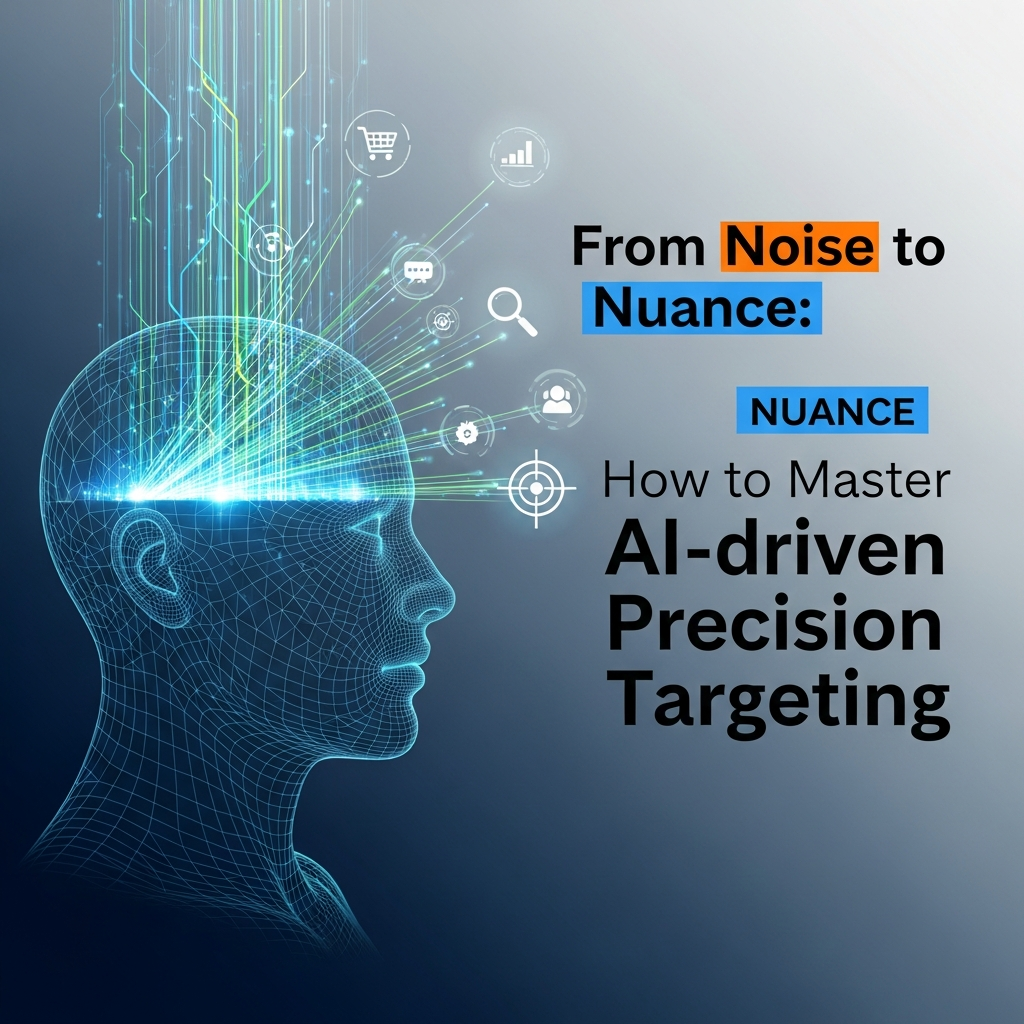
I remember sitting in a boardroom circa 2014, staring at a PowerPoint slide that featured “Marketing Mary.” Mary was 32, lived in a suburban zip code, liked yoga, and supposedly represented our entire targetable universe. It felt wrong then; it looks like a prehistoric relic now. The fundamental problem with traditional targeting—the kind we all cut our teeth on—is that it relies on categorical averages. But here is the cold, analytical truth: nobody is average. When we aggregate data into broad buckets, we don’t find clarity; we find noise. We lose the individual in the spreadsheet.
AI-driven precision targeting isn’t just a faster way to find Mary. It’s the tool that finally allows us to kill her off. In the modern landscape, we are moving from demographic proxies (who someone is on paper) to behavioral intent (what someone is actually doing in the moment). This shift requires a radical empathetic leap. We have to stop thinking of our audience as data points and start seeing them as a series of high-intent signals. It’s about recognizing that a 60-year-old grandfather in rural Nebraska might have more in common—behaviorally—with a 22-year-old coder in Berlin than with his own neighbor. AI sees the commonality in the chaos. It finds the nuance.
To master this, we have to embrace the messy reality of human digital behavior. People don’t follow linear paths. They bounce from TikTok to a white paper, from a podcast to an abandoned cart. Managing this “noise” requires a level of computational heavy lifting that the human brain simply isn’t wired for. We need the machines to do the sorting, but we need the human heart to provide the context.
The Architecture of Intent: Moving from Static to Dynamic Modeling
Static models are the death of ROI. If your targeting criteria are updated monthly, you’re already behind the curve. AI allows for dynamic propensity modeling. This means the system is constantly recalculating the likelihood of a conversion based on real-time inputs. It’s the difference between a paper map and a live GPS that reroutes you the second there’s an accident ahead.
- Temporal Relevance: Understanding that a “high-intent” signal has a shelf life. A search for “best strollers” is a high-value signal for about three months, then it drops to zero. AI tracks this decay.
- Cross-Channel Synthesizing: Your customer isn’t a different person on Instagram than they are on LinkedIn. AI bridges the identity gap, stitching together fragmented sessions into a cohesive “identity graph.”
- Lookalike Evolution: Traditional lookalike audiences are often “garbage in, garbage out.” Precision targeting uses seed audiences based on lifetime value (LTV), not just one-off conversions.
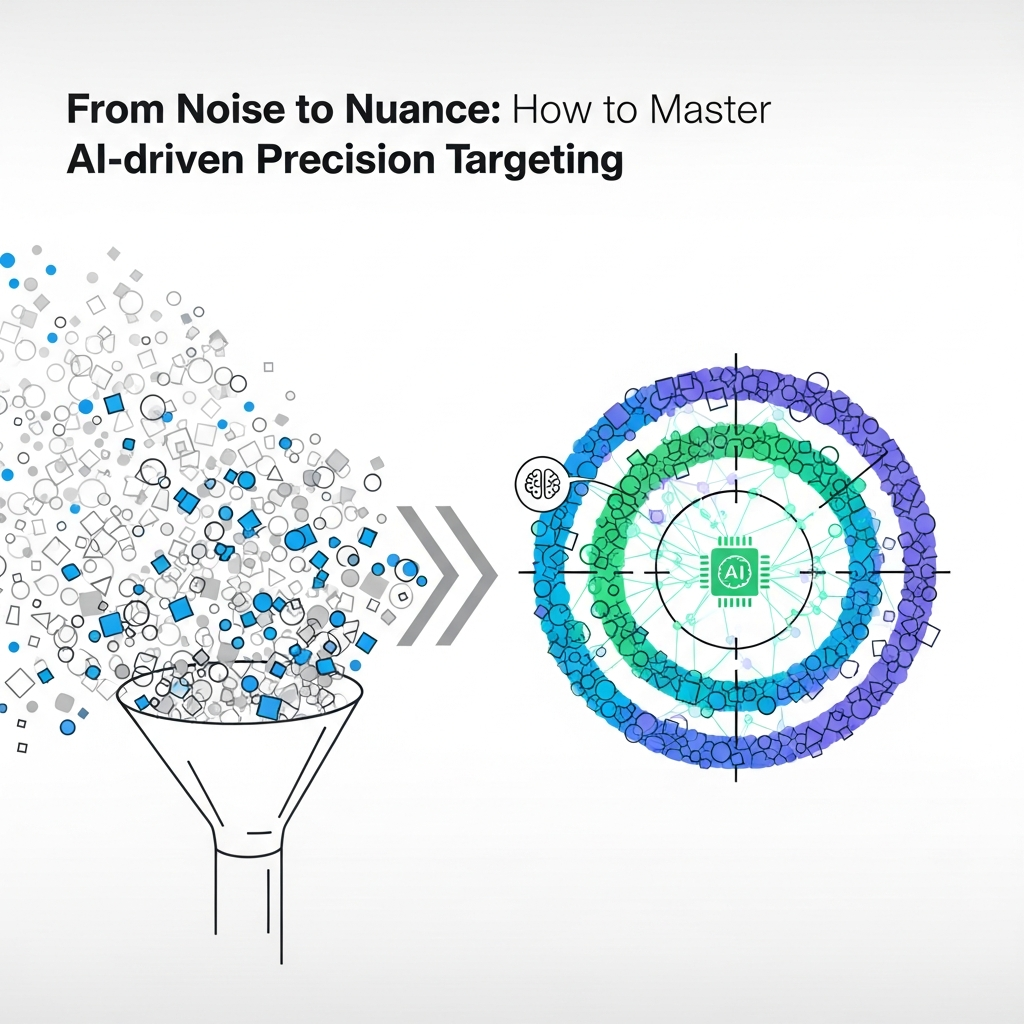
The Mechanics of Precision: Vector Space and Latent Intent
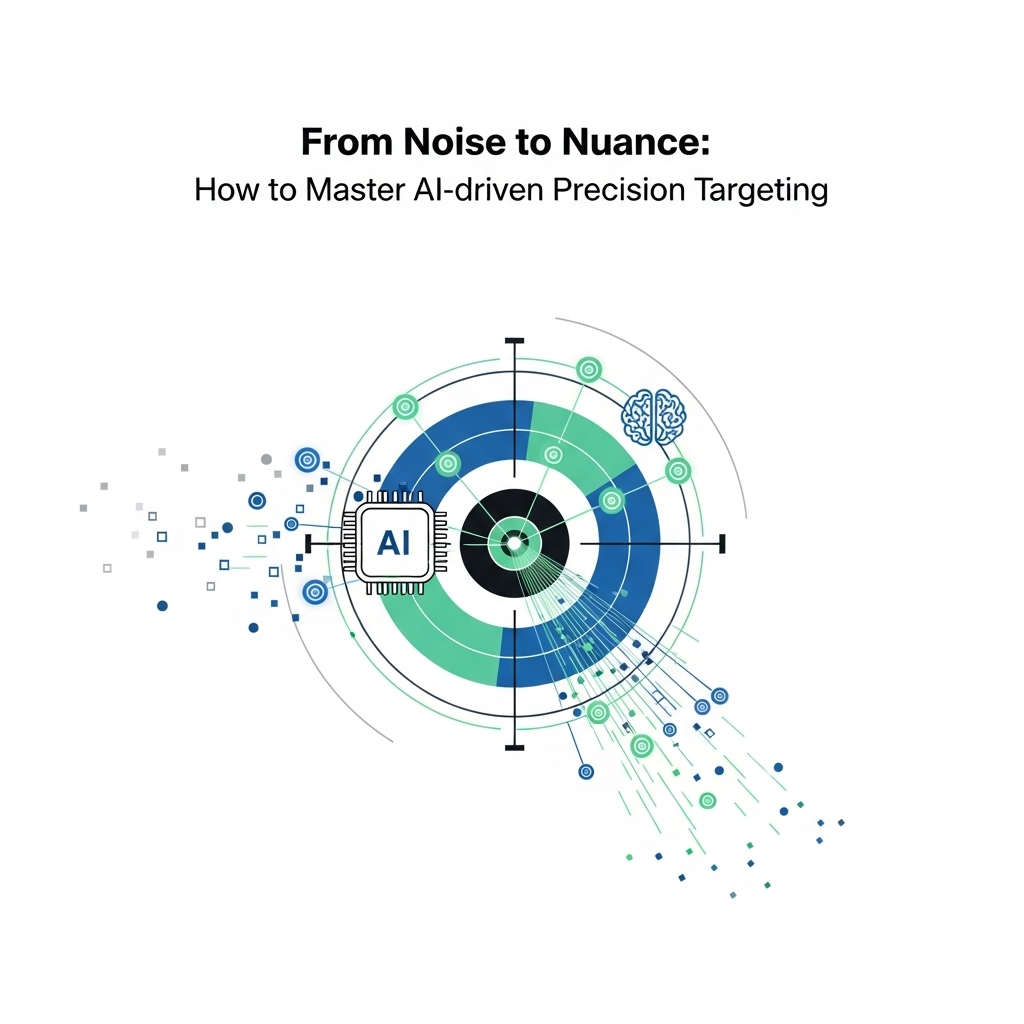
Let’s get technical for a moment, because “AI” is often used as a nebulous buzzword by people trying to sell you something you don’t need. When we talk about precision targeting, we’re often talking about vector embeddings. Imagine every customer interaction exists as a point in a multi-dimensional space. In a traditional database, you might have ten columns of data. In a vector space, you might have thousands.
This is where the “nuance” happens. AI doesn’t just see “Customer bought a shirt.” It sees the speed of the scroll, the time of day, the semantic relationship between the product description and the customer’s previous search history, and the subtle “clumping” of similar behaviors across millions of other users. It identifies latent intent—desires the customer hasn’t even articulated to themselves yet. It’s eerie, yes, but from a marketing perspective, it is the holy grail of efficiency.
I’ve seen campaigns where we ignored demographics entirely and targeted solely based on behavioral clusters. The results? A 40% reduction in CPA (Cost Per Acquisition). Why? Because the machine found customers that our human biases told us to ignore. We thought our audience was “professionals”; the AI found that our most engaged users were actually hobbyists with high disposable income who happened to browse at 11 PM on Tuesdays. That is the power of letting go of your assumptions.
The Signal-to-Noise Ratio: Filtering the Digital Exhaust
The world is drowning in data, most of it useless “digital exhaust.” Every click, like, and hover creates a data point, but not all data points are created equal. A “like” on a Facebook post is a weak signal. A three-minute dwell time on a pricing page is a strong signal. Precision targeting is, at its core, the art of signal amplification.
To master this, you need to implement rigorous data hygiene. AI is an incredible force multiplier, but it multiplies whatever you feed it. If you feed it messy, biased, or incomplete data, you will simply arrive at the wrong conclusion faster. You must define your “north star” metrics with clinical precision. Are you optimizing for clicks? Sales? Retention? The machine doesn’t know what “success” looks like unless you define it with absolute clarity.

The “Creepiness” Threshold: Navigating the Ethics of Precision
We need to talk about the elephant in the room: the “uncanny valley” of targeting. We’ve all had that moment where we mention a product in conversation and an ad for it appears ten minutes later. It feels like surveillance. As practitioners, we have a responsibility to balance precision with privacy. If you cross the line into “creepy,” you don’t just lose a sale; you lose brand equity that might take years to rebuild.
Empathy is the antidote to intrusion. When we use AI, we should use it to be helpful, not just ubiquitous. Precision targeting should feel like a well-timed recommendation from a knowledgeable friend, not a stalker following you through the mall. This means being transparent about data usage and giving users control. It also means using “soft” targeting—showing related content rather than the exact product they just looked at—to ease the psychological tension of being “watched.”
Building a Trust-First Data Strategy
The regulatory landscape is shifting. GDPR, CCPA, and the death of the third-party cookie are not obstacles; they are guardrails. They force us to move toward Zero-Party Data (data the user intentionally shares) and First-Party Data (data you collect directly). This is where the real nuance lies. AI can help you predict what a user wants based on the limited, high-quality data they’ve actually given you permission to use. It’s about doing more with less.
- Contextual Targeting 2.0: Using AI to analyze the content of a page and placing ads that match the mood and intent of that content, rather than following the user.
- Federated Learning: Training models on decentralized data so you never actually “own” the raw personal information, keeping privacy intact while maintaining predictive power.
- The Value Exchange: Always ask: “Is this ad providing enough value to justify the data used to serve it?” If the answer is no, rethink your strategy.

The Infrastructure of Nuance: What Your Stack Actually Needs
You cannot achieve precision targeting with a fragmented tech stack. If your CRM doesn’t talk to your ad platform, and your email tool is in its own silo, your AI is essentially blind in one eye. Mastering this requires an integrated Customer Data Platform (CDP). This serves as the single source of truth, the “brain” that feeds the various execution arms of your marketing department.
But having the tools isn’t enough. I’ve seen companies spend seven figures on Salesforce or Adobe suites and still fail because they didn’t have the analytical talent to ask the right questions. You need people who understand both the “why” and the “how.” You need “translators”—people who can bridge the gap between a data scientist’s Python script and a creative director’s vision.
The Role of Algorithmic Auditing
Algorithms drift. Over time, an AI model can become biased or lose its edge as market conditions change. A model built in 2019 would have been disastrous in 2020. Mastering precision targeting requires constant algorithmic auditing. You need to pull the curtain back and ask: Why is the AI making these decisions? Is it ignoring a profitable sub-segment? Is it over-weighting a specific channel because it’s “cheap” even if the quality is low?
Think of your AI as a high-performance engine. It needs tuning. It needs the right fuel. And occasionally, it needs a mechanic to take it apart and make sure everything is still running as intended. This isn’t a “set it and forget it” situation. It’s a “supervise and iterate” situation.
>The Human-in-the-Loop: Why Machines Can’t Do It Alone
There is a dangerous tendency in our industry to outsource our thinking to the machine. We assume that because an algorithm is “smart,” it understands human culture. It doesn’t. AI is brilliant at identifying patterns, but it is blind to cultural context. It doesn’t know why a specific meme is funny, or why a certain phrase might be offensive in a specific political climate. It lacks the “gut feeling” that has driven great marketing for a century.
The most successful precision targeting happens when we use AI to handle the scale and humans to handle the strategy. The machine finds the “who” and the “when,” but the human must define the “what” and the “why.” This is the “Human-in-the-Loop” (HITL) model. It’s about creating a feedback loop where human insights refine the machine’s parameters, and the machine’s data challenges the human’s assumptions.
The Anatomy of a Precision Campaign
To move from noise to nuance, follow this framework for every campaign you launch:
- Hypothesis Generation: Start with a human insight. “I think people who buy our product are also interested in sustainable gardening.”
- Data Seeding: Feed the AI high-quality data related to that hypothesis.
- Algorithmic Expansion: Let the AI find the “lookalike” patterns you missed. Maybe it’s not gardening; maybe it’s “minimalist home design.”
- Creative Variance: Use AI to generate hundreds of micro-variations of your creative to match the specific nuances of each sub-segment.
- Human Review: Stop. Look at what the AI is doing. Does it make sense? Is it on-brand? Is it empathetic?
- Optimization: Scale the winners, kill the losers, and feed the results back into the model.
>Future-Proofing Your Targeting: The Post-Cookie Paradigm
We are entering the “Great Reset” of digital marketing. The old ways of tracking—those sticky little cookies that followed you across the web—are crumbling. This is actually a good thing. It’s forcing us to be smarter. It’s forcing us to move toward predictive modeling based on aggregated signals rather than individual tracking.
The future of precision targeting belongs to those who can build first-party ecosystems. This means creating content, tools, and experiences so valuable that users want to give you their data. Think of it as a “loyalty loop.” Once you have that data, AI becomes your secret weapon for maximizing its value. You can predict churn before it happens, recommend products before the customer knows they need them, and personalize every touchpoint of the journey.
It’s a shift from “stalking” to “service.” And in a world filled with digital noise, service is the only thing that actually cuts through. It’s the ultimate nuance.
A Final Thought for the Weary Marketer
If this feels overwhelming, that’s because it is. We are asking you to be a data scientist, a psychologist, an ethicist, and a creative all at once. But remember: you don’t have to master it all overnight. Start by questioning your “Personas.” Start by looking at your data hygiene. Start by asking your AI provider better questions. Precision isn’t a destination; it’s a discipline. It’s a commitment to seeing your customers as the complex, nuanced individuals they actually are. The machines are just here to help us see them more clearly.
The noise is loud, but the nuance is where the growth is. Go find it.