
The Great Digital Noise: Why Your Inbox Feels Like a War Zone
I’ll be honest with you. Last Tuesday, I went through my “Promotions” tab and deleted 442 emails without opening a single one. It wasn’t because I was busy. It was because I felt invaded. My digital space has become a dumping ground for the “spray and pray” methodology—a relic of 2010 marketing that refuses to die. We’ve all been there, haven’t we? The generic “Hi [First_Name],” the follow-up that “just wants to bubble this to the top of your inbox,” and the desperate LinkedIn pitches that read like they were written by a blender.
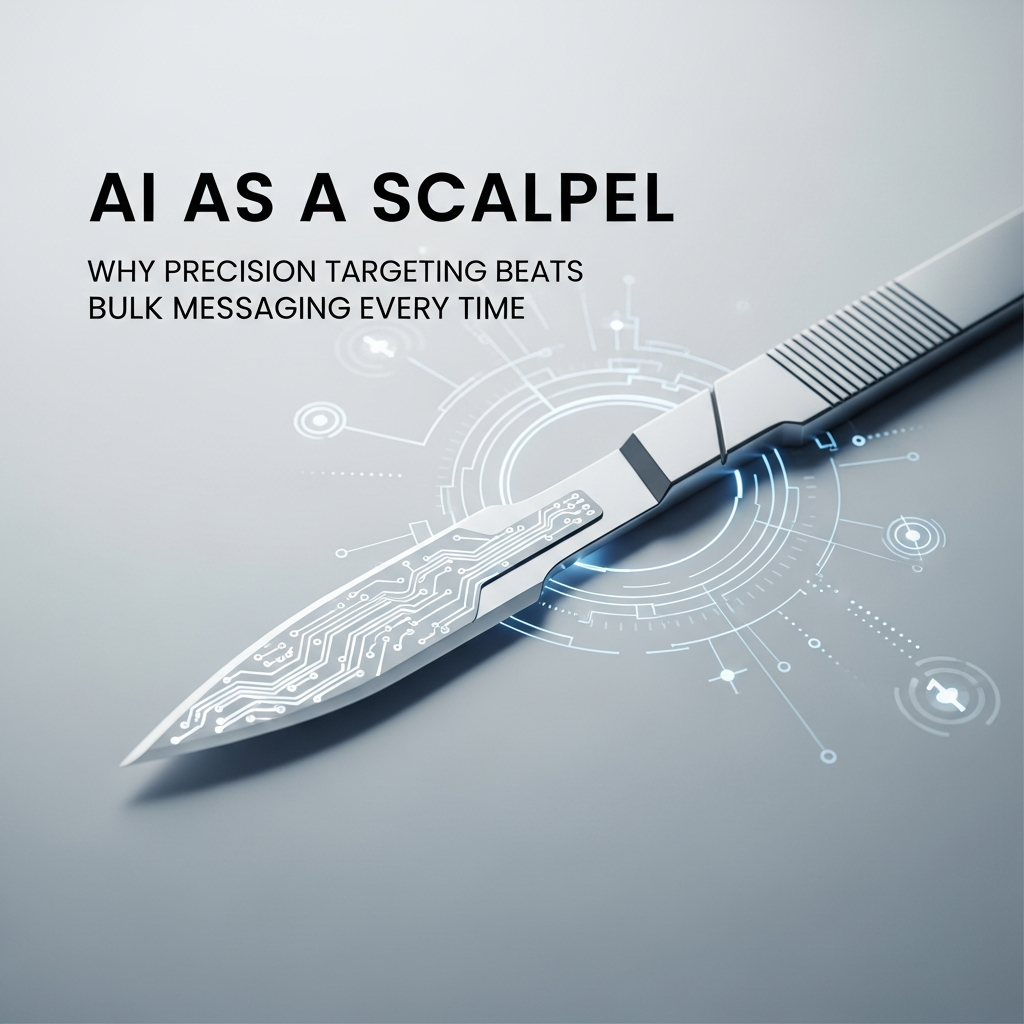
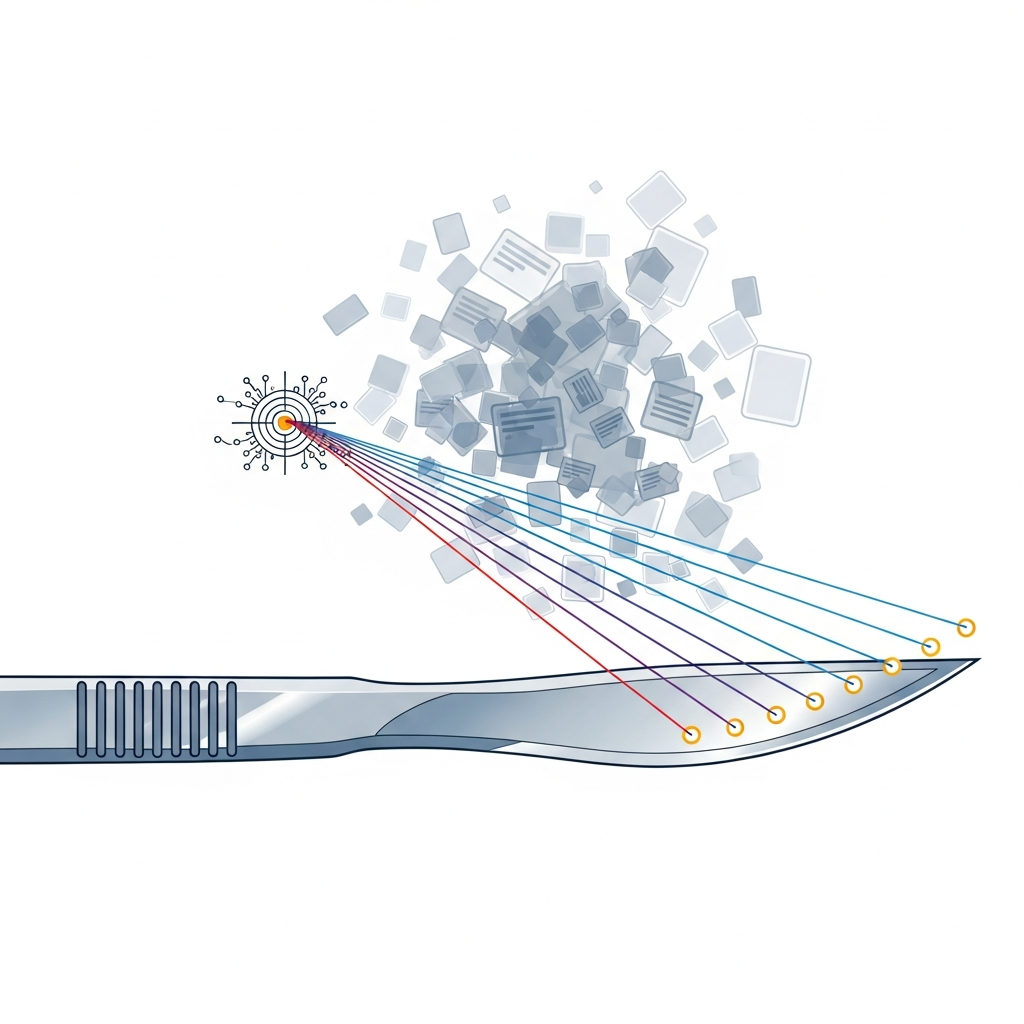
The problem isn’t just that these messages are annoying; it’s that they represent a fundamental misunderstanding of human psychology and modern technology. We are currently living through the “Tragedy of the Digital Commons.” Marketers have overgrazed the fields of our attention, leaving behind a barren landscape of cynicism. This is where the AI Scalpel comes in. It’s not just a tool; it’s a philosophical shift. It is the transition from being a loud, clumsy giant with a megaphone to being a precision surgeon who knows exactly where to make the incision to save the patient’s time—and your ROI.
In this guide, we’re going to dissect why bulk messaging is a fast track to brand irrelevance and how you can leverage AI to perform “surgical” strikes that actually resonate. This isn’t about “hacks.” It’s about the brutal, beautiful efficiency of relevance.
The Blunt Trauma of Bulk Messaging: A Post-Mortem
Let’s get analytical for a moment. Why does bulk messaging fail so spectacularly in the current era? It comes down to Cognitive Load. Every time a person interacts with a piece of content that is irrelevant to them, they experience a micro-friction. They have to expend energy to categorize it as “trash.” Do this enough times, and the brain builds a permanent firewall against your brand.
The Math of Diminishing Returns
Old-school marketers love the “numbers game.” They argue that if you send 100,000 emails and get a 0.01% conversion rate, you’ve still made 10 sales. But they ignore the Brand Erosion Cost. You didn’t just get 10 sales; you also alienated 99,990 potential future customers who now associate your logo with a mild sense of irritation. That is a massive, unquantified liability on your balance sheet.
The Algorithmic Penalty
It’s not just humans who hate bulk. The gatekeepers—Google, Outlook, Apple Mail—have evolved. Their spam filters are no longer just looking for keywords like “Viagra” or “Free Money.” They are looking at engagement signals. If your bulk messages have low open rates and high “delete-without-reading” rates, the algorithms learn that you are a nuisance. You aren’t just missing an inbox; you’re being buried in a digital shallow grave.

The Scalpel Philosophy: AI as a Tool for Radical Relevance
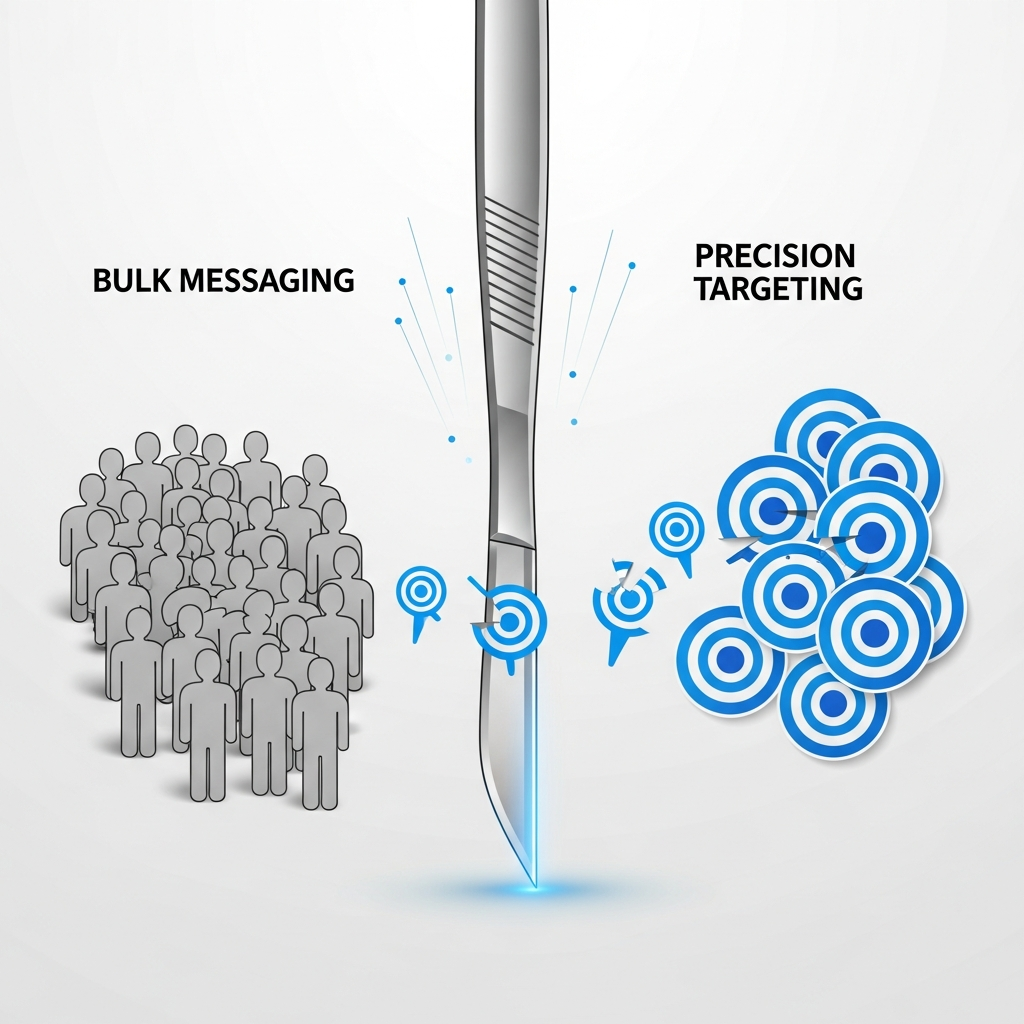
When we talk about AI as a scalpel, we’re talking about intent-based targeting. It’s the ability to move beyond demographics (Age, Gender, Location) and into the realm of psychographics and behavioral triggers. Bulk is “Who are they?” Precision is “What do they need *right now*, and how do they feel about it?”
Semantic Understanding vs. Keyword Matching
Most traditional targeting is based on keywords. If a user searches for “running shoes,” they get bombarded with ads for running shoes for three weeks. But what if they already bought the shoes? What if they were actually searching for “how to fix a running shoe injury”? AI allows us to understand the semantics—the meaning behind the action. A precision AI model looks at the context. It realizes the user is in “problem-solving mode,” not “buying mode.” Instead of a discount code, the “scalpel” delivers an article on injury prevention. That is how you build trust.
The End of the Funnel, The Rise of the Labyrinth
We’ve been taught to think of marketing as a funnel. You pour a lot in the top, and a little comes out the bottom. That’s a blunt-force metaphor. Modern customer journeys are more like a labyrinth. People move sideways, they double back, they pause. AI allows us to track these movements in real-time, providing the exact piece of information needed at that specific turn in the maze. It’s supportive, not pushy.
>Deconstructing the “Surgical” AI Stack
To move from bulk to precision, you need a different kind of infrastructure. It’s not about having more data; it’s about having refined data. Here is how the “scalpel” is actually built in a modern enterprise environment.
1. Vector Databases and Latent Intent
Forget standard SQL tables for a second. Precision targeting often utilizes vector databases. These allow us to map “embeddings”—mathematical representations of concepts. If a customer is looking at “sustainable leather,” the AI understands the proximity to concepts like “ethical sourcing,” “durability,” and “minimalism.” It doesn’t just look for the word “leather.” It understands the values of the consumer. This allows you to message them with content that aligns with their worldview, which is a far more powerful hook than a 10% off coupon.
2. Predictive Lead Scoring (The “Why” Behind the Score)
Traditional lead scoring is often arbitrary. “Oh, they clicked a link? Give them 5 points.” AI lead scoring is nuanced. It uses machine learning to identify patterns that a human would never see. For example, it might find that users who visit your pricing page on a mobile device on a Saturday afternoon but have previously watched a 3-minute video on your “About” page are 80% more likely to convert if they receive a case study, not a sales call. The AI finds the “invisible” correlations.
3. Hyper-Personalized Synthetic Content
This is where it gets interesting—and where you have to be careful. Large Language Models (LLMs) allow us to generate unique messages for every single recipient. I’m not talking about swapping out a name tag. I’m talking about changing the tone, the examples used, and the narrative structure based on the recipient’s past interactions. If I know a lead is an analytical engineer, my AI-generated reach out will be data-heavy and concise. If they are a creative director, it will be visual and narrative-driven. One message, ten thousand variations, zero human fatigue.
>The Anatomy of a Precision Campaign: A Hypothetical Case Study
Let’s look at two companies. Company A uses the “Blunt Hammer.” Company B uses the “AI Scalpel.”
The Scenario: A B2B SaaS company selling project management software.
Company A (Bulk): They buy a list of 50,000 “CTOs and Project Managers.” They send a sequence of 5 emails. “Struggling with deadlines? Our tool helps you stay organized. Click here for a demo.”
Result: 0.2% open rate. 5 demos booked. 400 “Unsubscribe” requests. Brand reputation: “Just another spammer.”
Company B (Precision): They use AI to monitor LinkedIn job postings and GitHub activity. They identify 200 companies that have recently hired 5+ new developers—a sign of scaling friction. They then use an LLM to analyze the specific tech stack mentioned in those job posts.
The Message: “Hey [Name], I saw you’re scaling the engineering team at [Company] and moving toward [Specific Tech Stack]. Usually, that transition creates a bottleneck in sprint planning. Here’s a 2-minute breakdown of how we handled that specific friction point for [Similar Competitor].”
Result: 35% open rate. 12 demos booked. 0 unsubscribes. Brand reputation: “These people actually understand my job.”
Company B spent more time on the “cut,” but they didn’t waste any “blood.” They didn’t need 50,000 people to listen. They needed 200 of the right people to feel understood.
>The Cognitive Cost of Being Wrong: Why “Close Enough” Isn’t Good Enough
There is a dangerous middle ground in marketing: the “Uncanny Valley” of personalization. This happens when you try to use AI but do it poorly. You’ve seen it—the email that says, “I saw you’re a fan of [Niche Hobby]!” when you just clicked a link by accident once. This feels creepy and manipulative.
As a copywriter, I advocate for the Supportive Tone. When you use a scalpel, you must do so with the intent to heal (or help), not just to extract. If your AI targeting feels like a “gotcha,” you’ve failed. It should feel like a “finally.” As in, “Finally, someone sent me something I actually needed to read.”
The “Is This Helpful?” Litmus Test
Before deploying any AI-driven precision campaign, ask yourself: If this person were standing in front of me, would I feel comfortable saying this to them based on what I know? If the answer is no, your AI is being a stalker, not a strategist. Precision requires empathy. You are using data to better understand a human being’s frustrations, not to exploit their weaknesses.
>Overcoming the Infrastructure Inertia
I know what you’re thinking. “This sounds expensive and complicated.” It’s actually less expensive than wasting $50,000 a month on bulk ads that get ignored. The shift to precision is an investment in efficiency.
Clean Your Room (Data Hygiene)
You cannot perform surgery with a dirty scalpel. Most companies have “dirty” data—duplicate entries, outdated titles, and fragmented touchpoints. The first step to AI precision isn’t buying a fancy LLM; it’s data orchestration. You need a single source of truth where all customer interactions are logged. If your CRM doesn’t talk to your website analytics, your scalpel is blunt.
Start with Micro-Segments
Don’t try to hyper-personalize for your whole audience on Day 1. Pick your top 5%—your “Whales” or your most loyal advocates. Use AI to analyze their patterns. Why do they stay? What was the “Aha!” moment for them? Once you understand the precision needed for your best customers, you can start to model that for the rest of your leads.
>The Ethical Scalpel: Privacy in the Age of Precision
We have to address the elephant in the room: Privacy. In an era of GDPR and CCPA, the “Scalpel” approach might seem like it’s skirting the line of surveillance. However, I’d argue that precision is actually more ethical than bulk. Bulk messaging is “Attention Theft.” You are stealing seconds of life from thousands of people for something they didn’t ask for.
Precision targeting, when done correctly, relies on Zero-Party and First-Party Data. This is data the user has willingly given you or generated through their direct interaction with your brand. By using AI to make that experience better, you are fulfilling the “Implicit Contract” of digital commerce: I give you my data, and in return, you don’t waste my time.
Transparency as a Feature
One of the best ways to humanize your AI is to be transparent about it. I’ve seen incredible results from companies that literally say: “Our system noticed you’ve been struggling with [Topic], so we generated this specific report for you.” It turns the “creepiness” into utility. It shows the recipient that you are using your technology to serve them, not just to track them.
>The Future: From Precision to Prediction
Where does the scalpel go from here? We are moving into the era of Predictive Empathy. This isn’t just reacting to what a user did; it’s anticipating what they will need before they even realize it. Imagine an AI that notices a change in a user’s typing rhythm or interaction frequency—indicators of stress or frustration—and automatically simplifies the interface or offers a direct human support line.
That is the ultimate expression of the scalpel. It’s not just about “Targeting.” It’s about care. In a world that is increasingly automated and cold, the brands that use AI to become more “human”—by being more relevant, more timely, and more thoughtful—are the ones that will survive the Great Noise.
>Your Next Step: Laying Down the Megaphone
If you take nothing else from this, let it be this: Scale is a vanity metric; resonance is a sanity metric. Stop looking at how many people you reached. Start looking at how many people you touched. Turn off the bulk sequences for a week. Take a small segment of your audience, use every AI tool at your disposal to understand their specific, current pain points, and send them something so relevant it feels like a gift.
The scalpel is in your hand. The question is: are you ready to stop swinging and start cutting?
Precision isn’t just a strategy. It’s a sign of respect for your audience. And in the modern economy, respect is the only currency that doesn’t depreciate.