
Let’s be brutally honest for a second. You’ve spent weeks, maybe months, obsessing over HEX codes. You’ve argued with developers about the exact curvature of your “Buy Now” buttons. You’ve likely sacrificed several nights of sleep and an alarming amount of caffeine to birth this digital masterpiece into the world. And yet, when you look at your Google Search Console, the graph looks like a flatline on a hospital monitor.
Zero clicks. Five impressions—four of which were probably your mom. It’s a gut-punch. In the industry, we call this the “Digital Sahara” effect. You built the oasis, but nobody’s coming because you forgot to put up the signs, or worse, you put them up in a language only a hallucinating camel could understand. SEO isn’t a dark art practiced by hooded figures in basement apartments, but it isn’t a “set it and forget it” checkbox on your Squarespace dashboard either.
Google’s algorithm is a moody librarian with billions of books to sort and a very short temper. If you aren’t following the rules—or if you’re following the rules from 2014—you’re basically invisible. Here is exactly why your website is currently pulling a disappearing act and the high-octane fixes you need to implement before your competitors eat your lunch.

1. The “Keywords Are Everything” Delusion
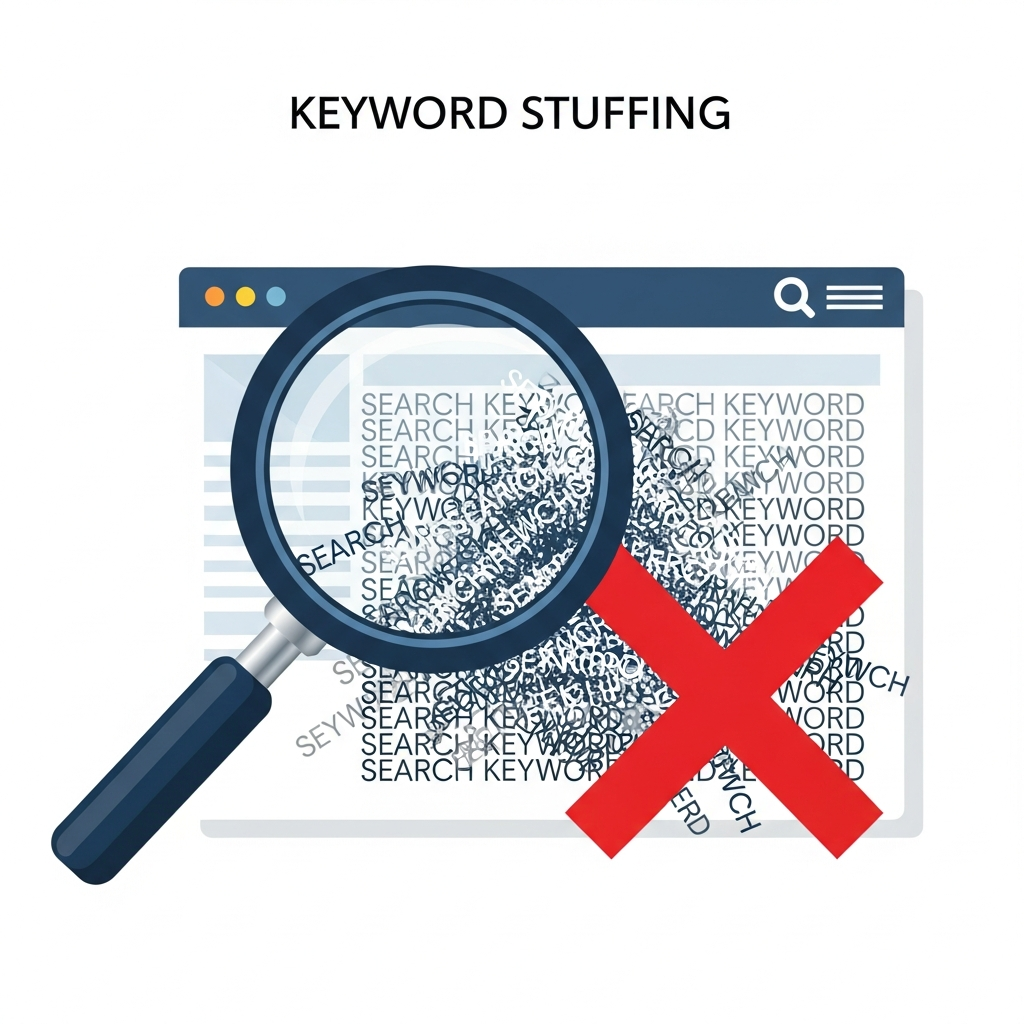
Back in the day, you could rank for “best pizza in New York” by writing “best pizza in New York” fifty times in white text on a white background. Those were the Wild West days. If you try that now, Google will treat your site like a spammy flyer under a windshield wiper. The mistake isn’t just “keyword stuffing”—it’s a fundamental misunderstanding of Semantic Search and Entity-based SEO.
Modern search engines don’t just look for strings of characters. They look for meaning. They want to know if you actually understand the topic. If you’re writing about “Organic Gardening,” and you don’t mention “compost,” “soil pH,” “mulching,” or “pollinators,” Google realizes you’re a fraud. You’re missing the “entities” that define the neighborhood of that topic.
The Fix: Latent Semantic Indexing (LSI) and Topic Clusters
Stop obsessing over a single “magic” keyword. Instead, build a topical fortress. If you want to rank for “Home Insurance,” you need to cover “premiums,” “deductibles,” “liability coverage,” and “natural disaster riders.” Use tools like Ahrefs or Clearscope to identify these related terms. Don’t just sprinkle them in; weave them into a narrative that actually helps the human reading it. If a human finds it useful, the algorithm eventually will too. It’s becoming scarily good at detecting “thin” content that’s just a keyword wrapper.
>2. The Spinning Wheel of Death (Technical Debt)
You have approximately 2.5 seconds. That’s it. If your website takes longer than that to load, the average user is gone. They’ve bounced back to the search results faster than a rubber ball on a concrete floor. This isn’t just a “user experience” issue; it’s a massive ranking factor. Google introduced Core Web Vitals (CWV) because they realized that slow sites make users miserable.
Many business owners suffer from “Plugin Bloat.” You wanted a fancy slider? Plugin. You wanted a pop-up that begs for emails? Plugin. You wanted a floating social media bar that follows the user like a needy ghost? Plugin. Every one of those is a heavy backpack your website has to carry while trying to win a sprint.
The Fix: A Technical Exorcism
Go to Google PageSpeed Insights right now. If your mobile score is in the red, you are actively bleeding money. Start by optimizing your images—don’t upload a 5MB JPEG when a 100KB WebP file will do. Next, look at your “Largest Contentful Paint” (LCP). If your server is slow, consider upgrading your hosting. Cheap $5-a-month shared hosting is the equivalent of trying to run a Ferrari on lawnmower fuel. It won’t work, and you’ll end up on page 10 of the SERPs (Search Engine Results Pages) where even the FBI won’t find you.
“The best place to hide a dead body is the second page of Google search results.” — Anonymous (but painfully accurate) SEO Pro.
3. The “AI Slop” Content Trap
We need to talk about the elephant in the room: ChatGPT. Since the explosion of LLMs, the internet has been flooded with “beige” content. It’s grammatically correct, it’s structured, and it’s utterly, painfully boring. It has no soul. It has no “Information Gain.”
If your blog post says the exact same thing as the top ten results, why should Google rank you? You aren’t adding anything new to the collective human knowledge. Google’s recent Helpful Content Updates (HCU) are designed to nuking sites that produce mass-scale AI content without human oversight. If you are just hitting “generate” and “publish,” you are building your house on a sinkhole.
The Fix: Experience, Expertise, Authoritativeness, and Trustworthiness (E-E-A-T)
To rank now, you need the “double E.” Show Experience. Use phrases like “In my ten years of doing this…” or “When I tried this strategy, here is what went wrong.” Give people data they can’t get elsewhere. Conduct a survey. Run an experiment. Share a controversial opinion that you can back up with logic. The goal is to create content that an AI couldn’t write because the AI hasn’t lived your life or run your business.
>4. Your Backlink Profile Looks Like a Toxic Waste Dump
Backlinks (links from other websites to yours) are essentially “votes of confidence.” However, not all votes are equal. A link from the New York Times is a glowing endorsement from a world-class scholar. A link from “Cheap-Medication-4-U.xyz” is a recommendation from a guy selling “Rolexes” out of a trench coat in a dark alley.
If you hired a “SEO expert” on Fiverr who promised 5,000 backlinks for $50, you haven’t bought a shortcut; you’ve bought a death sentence. Google’s Penguin algorithm (now part of the core algo) identifies these “link farms” and ignores them, or worse, penalizes the recipient. If your site is drowning in “toxic” links, your rankings will stay at the bottom of the ocean.
The Fix: Digital PR and “Earned” Media
Stop “building” links and start “earning” them. This sounds harder because it is. Reach out to journalists in your niche. Use platforms like Connectively (formerly HARO) to provide expert quotes. Create “link bait”—infographics, original research, or tools that people want to link to because it makes their own content better. One high-quality link from a reputable site in your industry is worth more than 10,000 bot-generated links from Russia or India.
>5. The Labyrinth: Poor Site Architecture and Orphan Pages
Imagine walking into a supermarket where the milk is in the ceiling, the cereal is in the basement, and there are no signs. You’d leave. Google’s “crawlers” (the bots that index your site) feel the same way about messy site architecture. If your most important pages are more than three clicks away from the homepage, the bots might never find them. Or, they might decide those pages aren’t important enough to rank.
Then there are Orphan Pages. These are pages on your site that have zero internal links pointing to them. They are digital islands. If you don’t link to your own content, why should anyone else?
The Fix: The “Pyramid” Structure
Your site should have a logical flow. Homepage links to main category pages. Category pages link to individual posts or products. Use Breadcrumbs to help both users and bots navigate. More importantly, implement a robust internal linking strategy. When you write a new blog post, go back to three old posts and add a link to the new one. This passes “link juice” (authority) around your site and tells Google, “Hey, this page is relevant!”
>6. Ignoring Search Intent (The “Steak vs. Salad” Problem)
This is the most common mistake made by smart people. They rank for a keyword, but it’s the wrong keyword for what they are offering. There are four main types of search intent:
- Informational: “How do I fix a leaky faucet?”
- Navigational: “Delta Airlines login.”
- Commercial: “Best plumbing tools 2024.”
- Transactional: “Buy 12-inch pipe wrench online.”
If you are trying to sell a pipe wrench (Transactional) using a page that only gives a history of plumbing (Informational), you will fail. Even if you rank #1, people will click, realize they can’t buy what they need, and immediately leave. Google sees this “pogo-sticking” and realizes your page isn’t satisfying the user’s intent. Down the rankings you go.
The Fix: Audit Your SERPs
Before you write a single word, type your target keyword into Google. Look at what is already ranking. Are they long-form guides? Are they product pages? Are they lists of “Top 10” items? If the top 10 results are all listicles, and you try to rank with a 5,000-word philosophical essay, you are fighting an uphill battle against the collective psychology of the internet. Give the people what they are looking for, in the format they expect.
>7. The “Mobile-First” Afterthought
We live in a world where people browse the web while waiting for coffee, sitting on the bus, or—let’s be real—on the toilet. Over 60% of global search traffic is mobile. Google has moved to Mobile-First Indexing. This means Google looks at the mobile version of your site first to decide where you should rank, even for desktop searches.
If your desktop site is beautiful but your mobile site has tiny text, overlapping buttons, or images that don’t scale, you are being downgraded. It doesn’t matter how “aesthetic” your site looks on a 27-inch iMac if it’s a dumpster fire on an iPhone 13.
The Fix: Thumb-Friendly Design
Test your site on your own phone. Can you click every button without accidentally hitting three others? Is the font size at least 16px? Does the “hamburger menu” actually work, or does it just flicker and die? Use Google’s Search Console to check for “Mobile Usability” errors. If it says your “clickable elements are too close together,” fix it. It’s not just about design; it’s about accessibility and ranking power.
>Bringing it All Together (The Roadmap)
SEO isn’t a one-time project you finish and put on a shelf. It’s a garden. If you don’t water it, pull the weeds, and occasionally talk to the plants, it will wither. But if you fix these seven critical mistakes, you aren’t just “optimizing”—you’re building a digital asset that works for you 24/7.
Start with the technical stuff. Clean up the code, speed up the loading times, and make sure your mobile experience is flawless. Then, move to the content. Inject your personality, your data, and your “hot takes” into everything you publish. Stop trying to trick the algorithm and start trying to be the most helpful resource on the internet for your specific niche.
It takes time. You won’t see results tomorrow. You might not even see them next month. But six months from now, when your phone starts ringing and your inbox is full of leads because you’re sitting pretty at the top of page one, you’ll realize it was the best investment you ever made. Now, stop reading this and go check your PageSpeed score. You’ve got work to do.