
Scaling a business, a technical infrastructure, or a high-performance team is often viewed through a lens of chaotic growth. We celebrate the “hustle,” the late nights, and the “move fast and break things” mantra. But let’s be brutally honest: breaking things is expensive. In the world of high-stakes operations, unplanned breakage is a symptom of structural failure, not a badge of honor. To achieve true, sustainable scale—the kind that doesn’t collapse under its own weight—you need more than ambition. You need a protocol.
I’ve spent the better part of two decades dissecting why some organizations explode into market dominance while others plateau and wither. The differentiator is never just “better marketing” or “more funding.” It is methodological rigor. It is the transition from intuitive management to systemic execution. This is where the 5-Phase Protocol comes into play.
This isn’t a collection of “productivity hacks.” This is a foundational framework for engineering growth. If you are looking for shortcuts, you won’t find them here. If you are looking for a roadmap to building a machine that produces predictable, scalable results, let’s dive in.
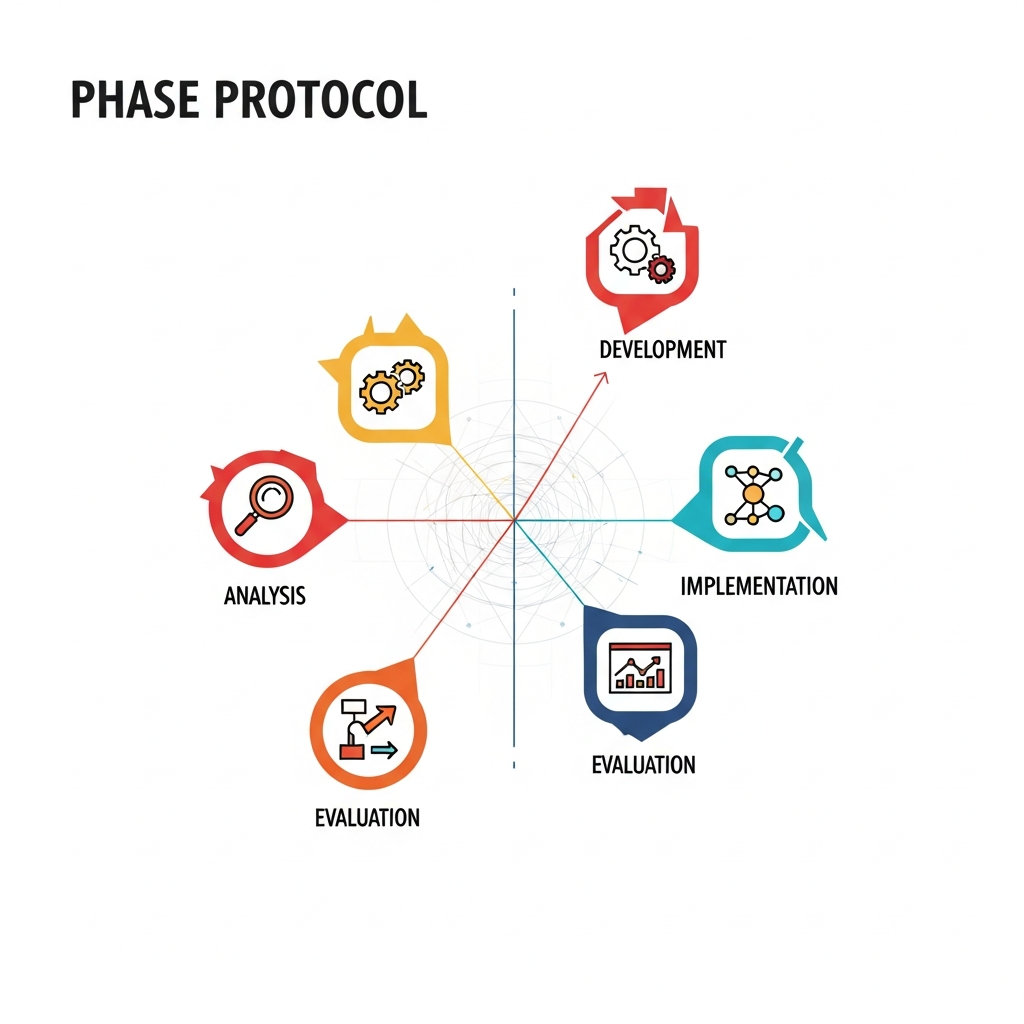
Phase 1: Deep Discovery and the Environmental Audit
Most leaders suffer from the “Solution First” bias. They see a problem and immediately reach for a tool or a tactic. Phase 1 of the protocol demands that you stop. Before a single line of code is written or a new hire is onboarded, you must perform a comprehensive environmental audit.
Discovery is the process of uncovering the Ground Truth. This isn’t the truth as presented in your quarterly reports or what your middle managers tell you during a synchronized slide deck presentation. Ground Truth is the granular, often ugly reality of your current operations. It involves identifying the “ghost in the machine”—those informal processes that employees use to bypass broken official systems.
The Anatomy of a Rigorous Audit
- Data Integrity Check: Are the metrics you’re tracking actually reflective of health? If you’re scaling a sales team, are you looking at raw lead count, or are you tracking the velocity of qualified pipeline?
- Dependency Mapping: Every system has bottlenecks. You need to map out every single dependency. If Person A leaves, does Process B collapse? If a third-party API goes down, does your entire service layer fail?
- Cultural Resistance Assessment: Scaling requires change. You must identify who will be your champions and who will be your anchors. Ignoring the human element at this stage is a recipe for internal sabotage later.
The goal of Phase 1 is to eliminate “Assumed Knowledge.” When you assume you know why a process is failing, you build a solution for a phantom problem. Methodological rigor starts with the humility to admit you might be wrong about your own business.
“The greatest obstacle to discovery is not ignorance—it is the illusion of knowledge.” — Daniel J. Boorstin
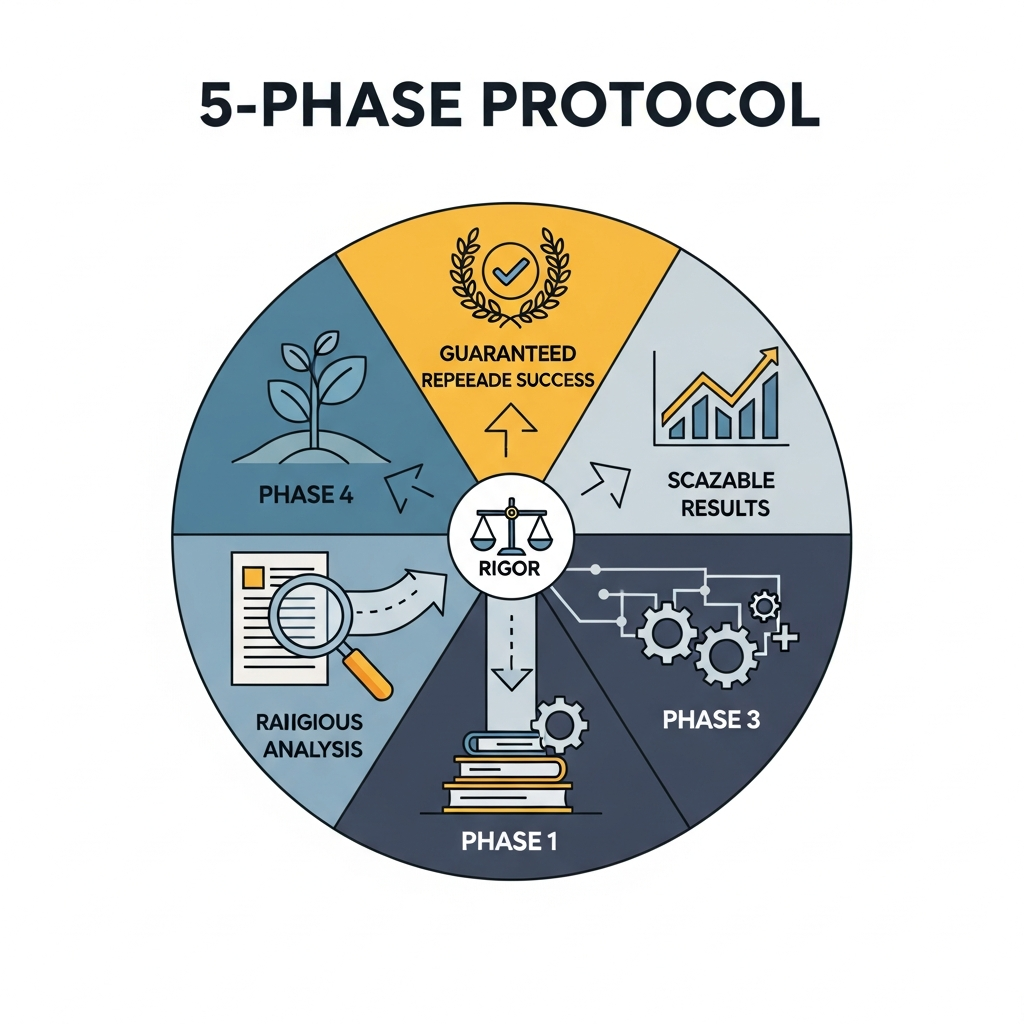
Phase 2: Architectural Modeling and Logic Frameworks
Once the audit is complete, we move into the blueprinting phase. In the 5-Phase Protocol, this is where we design the Scalable Architecture. Think of this as the difference between building a shed and building a skyscraper. You can’t just “add floors” to a shed; the foundation isn’t built for it. You have to design the skyscraper to be a skyscraper from day one.
Architectural modeling involves defining the logic that will govern your growth. This means moving away from “How do we do this?” and toward “How do we build a system that does this automatically?”
The Principle of Modular Design
A scalable system must be modular. Whether you are building software or a customer success team, the components should be able to function independently and interface through clearly defined protocols. In software, we call these APIs. In business, we call them Standard Operating Procedures (SOPs) and Key Performance Indicators (KPIs).
If your growth relies on one “genius” in the room making every decision, you haven’t built a scalable model; you’ve built a bottleneck. Phase 2 focuses on de-risking the individual. We build frameworks where the process is the star, not the person. This allows you to plug in talent and see immediate results because the “logic” of the role is already established.
Designing for Failure (The Pre-Mortem)
Rigorous architecture includes a “Pre-Mortem.” We ask: “It is one year from now and this project has failed. Why did it happen?” By imagining failure in the modeling phase, we can build safeguards directly into the architecture. We don’t just plan for success; we engineer against failure.
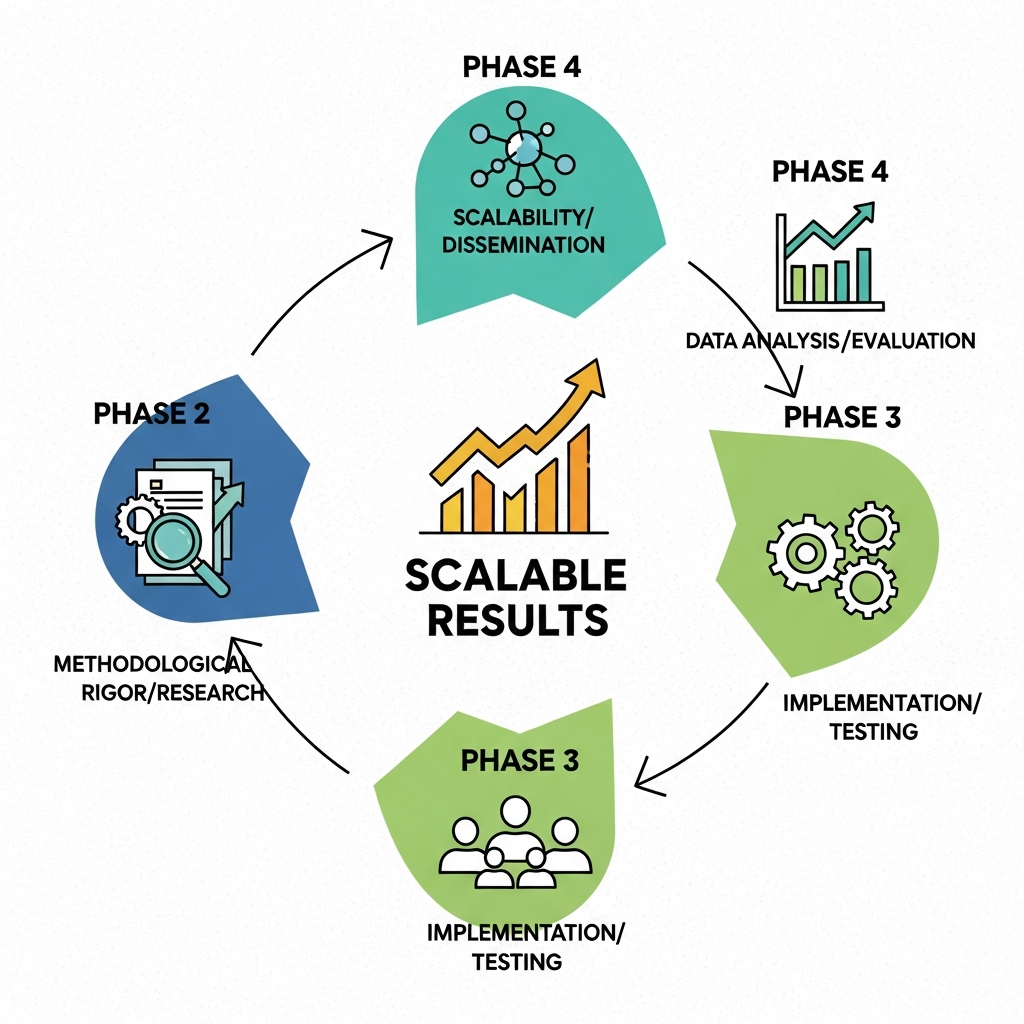
Phase 3: Controlled Execution (The Beta Loop)
Now we reach the stage where most people get impatient. They have the plan, they have the data, and they want to flip the switch for the entire company. Do not do this.
Phase 3 is about Controlled Execution. In the tech world, we call this a Beta test or a Canary release. In the broader business world, it’s a pilot program. The objective here isn’t to achieve massive results; it’s to validate the logic frameworks you built in Phase 2 under real-world conditions.
The “Sandbox” Methodology
You need a “sandbox”—a small, isolated segment of your market or operation where you can deploy the new protocol without risking the entire enterprise. This allows you to observe how the system handles stress, variance, and the “human factor.”
During Phase 3, your primary job is to find the friction. Where did the SOPs fail? Where did the data flow break? Controlled execution is about failing small to learn big. Every error caught in the Beta Loop is an error that doesn’t cost you $10 million when you move to Phase 5.
- Short Feedback Cycles: In this phase, feedback should be daily, not monthly.
- Iterative Refinement: If a process isn’t working, you don’t scrap the protocol; you refine the module. This is the essence of agility.
- Documenting Variance: Keep a rigorous log of everything that didn’t go according to the blueprint. These are your “Optimization Nodes.”
>Phase 4: Optimization and Performance Tuning
If Phase 3 was about “Does it work?”, Phase 4 is about “How do we make it perfect?” This is where the 5-Phase Protocol transitions from a functional system to a high-performance engine. Optimization is the stage where you squeeze every ounce of efficiency out of your processes.
Many organizations skip this step. They see that the pilot program worked, and they immediately scale it. This is a massive mistake. Scaling an unoptimized process is simply scaling waste. If your customer acquisition cost is slightly too high in the pilot, it will become a hemorrhaging wound when you scale 100x.
The 80/20 of Optimization
In this phase, we apply the Pareto Principle. We identify the 20% of actions that are driving 80% of the results and we double down on them. Conversely, we look for the “Tail”—the activities that consume resources but provide marginal utility. We prune the tail ruthlessly.
Technical Debt and Process Debt: This is the time to pay it down. If you cut corners in Phase 3 to get the pilot live, you must fix those shortcuts now. In Phase 5, those shortcuts become structural cracks. Performance tuning involves upgrading your tools, training your people to a higher level of mastery, and automating repetitive tasks that were previously done manually for the sake of speed.
Zero-Based Budgeting for Growth
In Phase 4, we also look at resource allocation. We don’t just add 10% to last year’s budget. we look at every resource—time, money, and talent—and ask: “If we started from scratch today, would we invest this here?” If the answer is no, those resources are redirected to the high-leverage areas identified during the audit.
>Phase 5: Radical Scaling and Institutionalization
Finally, we reach the endgame. You have a validated, optimized, and stress-tested system. Now, and only now, do you pour the fuel on the fire. Phase 5 is about Radical Scaling.
Scaling isn’t just about doing more of the same; it’s about maintaining the integrity of the results while increasing volume. This is achieved through Institutionalization—the process of turning your protocol into the “cultural DNA” of the organization.
The Flywheel Effect
When you reach Phase 5, the protocol should start to generate its own momentum. Jim Collins famously called this the “Flywheel Effect.” In the beginning, it takes massive effort to get the wheel to turn. But because you followed the methodological rigor of the first four phases, the wheel is perfectly balanced and lubricated. Eventually, the weight of the system itself starts to drive the growth.
- Automation of Governance: Use technology to monitor compliance with the protocol. Dashboards should alert you the moment a KPI deviates from the expected range.
- Hyper-Documentation: Your SOPs should be so robust that a new hire can be onboarded and become productive within days, not months.
- Continuous Evolution: Even in the scaling phase, the protocol is not static. It is a living framework that incorporates feedback from the front lines to stay ahead of market shifts.
The Danger of “Ego-Scaling”
The biggest threat in Phase 5 is ego. Leaders often get confident and start ignoring the protocol that got them there. They start making “gut instinct” bets again. Methodological rigor requires a level of discipline that many find uncomfortable. You must remain a student of your own system. Don’t scale because your ego wants to see a bigger number; scale because the data shows the system can handle the load.
>Why Methodological Rigor is the Only Real Security
We live in an era of volatility. Markets shift, technologies disrupt, and global events can upend an industry overnight. In this environment, “talent” is not enough. “Luck” is not a strategy. The only real security you have is the rigor of your methods.
A rigorous protocol allows you to pivot with precision. When you have a modular, well-documented system, you can swap out a failing component without crashing the whole machine. You can identify exactly where a problem is occurring because you have the data and the visibility to see it. That is the power of the 5-Phase Protocol.
It’s not the easiest way to grow. It requires more upfront work, more discipline, and a willingness to confront uncomfortable truths. But it is the guaranteed way to scale. If you want results that are predictable, repeatable, and scalable, you have to stop playing and start engineering.
Success is a byproduct of the system. Build a better system, and the success will take care of itself.
>The Human Factor: Why Most Fail the Protocol
If this protocol is so effective, why isn’t everyone using it? Because it requires a psychological shift that many are unwilling to make. It requires moving from the “Hero” archetype to the “Architect” archetype.
The “Hero” leader loves to swoop in and save the day. They thrive on the adrenaline of a crisis. But in a truly scalable, rigorous system, there are no crises to save. Everything is handled by the protocol. For some, this feels boring. They miss the “firefighting.”
To succeed with the 5-Phase Protocol, you must find your satisfaction in the elegance of the machine rather than the drama of the rescue. You must value consistency over intensity. Rigor is a quiet virtue, but in the world of high-performance scaling, it is the loudest differentiator there is.
Are you ready to stop hustling and start building? The protocol is waiting.