
Let’s be brutally honest for a moment: Most marketing departments are running on a treadmill of “busy-work” while hallucinating progress. You’ve seen it. I’ve seen it. The Monday morning meetings where someone says, “We need to increase brand awareness,” or “Let’s focus on engagement this quarter.”
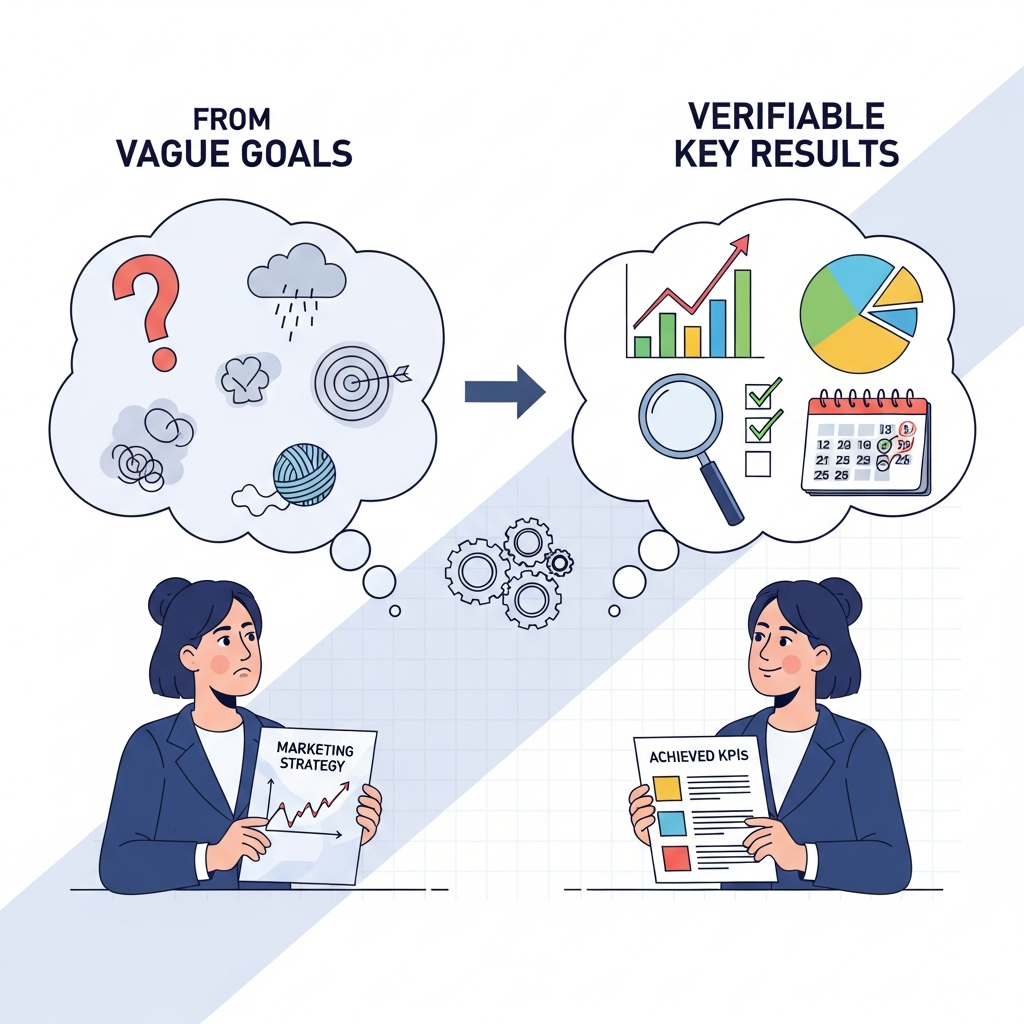
Those aren’t goals. Those are wishes. They are soft, pillowy cushions designed to protect marketing teams from the cold, hard reality of accountability. If you can’t measure it with a definitive ‘yes’ or ‘no’ at the end of the quarter, it’s not a result—it’s a hobby.
This is where the OKR (Objectives and Key Results) framework enters the room like a cold splash of water. Born at Intel and perfected at Google, OKRs are the antidote to the “vague-goal syndrome” that plagues modern marketing. Transitioning from fuzzy aspirations to verifiable key results isn’t just a management tweak; it’s a fundamental rewiring of how your team thinks, breathes, and executes.

The Fundamental Anatomy of a Marketing OKR
Before we dive into the weeds of implementation, we need to clarify what we’re actually building. An OKR consists of two distinct components that work in tandem to create both inspiration and execution.
The Objective (The “Where”): This is your North Star. It is qualitative, inspirational, and designed to get the team out of bed in the morning. An objective doesn’t have a number in it. It describes a desired future state. Example: “Become the most trusted educational resource for first-time home buyers.”
The Key Results (The “How”): These are the yardsticks. They are quantitative, time-bound, and—this is the non-negotiable part—verifiable. If an Objective is the destination, the Key Results are the GPS coordinates that prove you’ve arrived. Example: “Achieve 50,000 monthly organic visits to the ‘Home Buying 101’ hub.”
In marketing, we often confuse these two. We treat “getting more leads” as an objective when it’s actually a key result. We treat “launching a new campaign” as a result, when it’s actually just a task. To win with OKRs, you must separate the impact from the activity.
Why Marketing Teams Struggle with “Vague Goals”
Marketing is inherently creative, and creative people often recoil at the thought of rigid metrics. There is a prevailing fear that if we track everything, we lose the “magic.” This is a fallacy. In reality, metrics provide the guardrails that allow creativity to be effective rather than just decorative.
The “Vague Goal” trap usually stems from three specific failures in leadership:
- Fear of Failure: If a goal is vague (e.g., “Improve social media presence”), it is impossible to fail. You can always find a metric that went up. OKRs remove this safety net.
- The Activity Trap: Many marketers believe that being busy equals being productive. They mistake “sending 10 emails” for “generating revenue.”
- Lack of Strategic Alignment: When the marketing team doesn’t know how their work impacts the bottom line, they default to vanity metrics like “likes” and “impressions.”
To transition to verifiable results, you must first foster a culture where failure is seen as data, and where “getting it done” is secondary to “making it matter.”
The Shift from Outputs to Outcomes
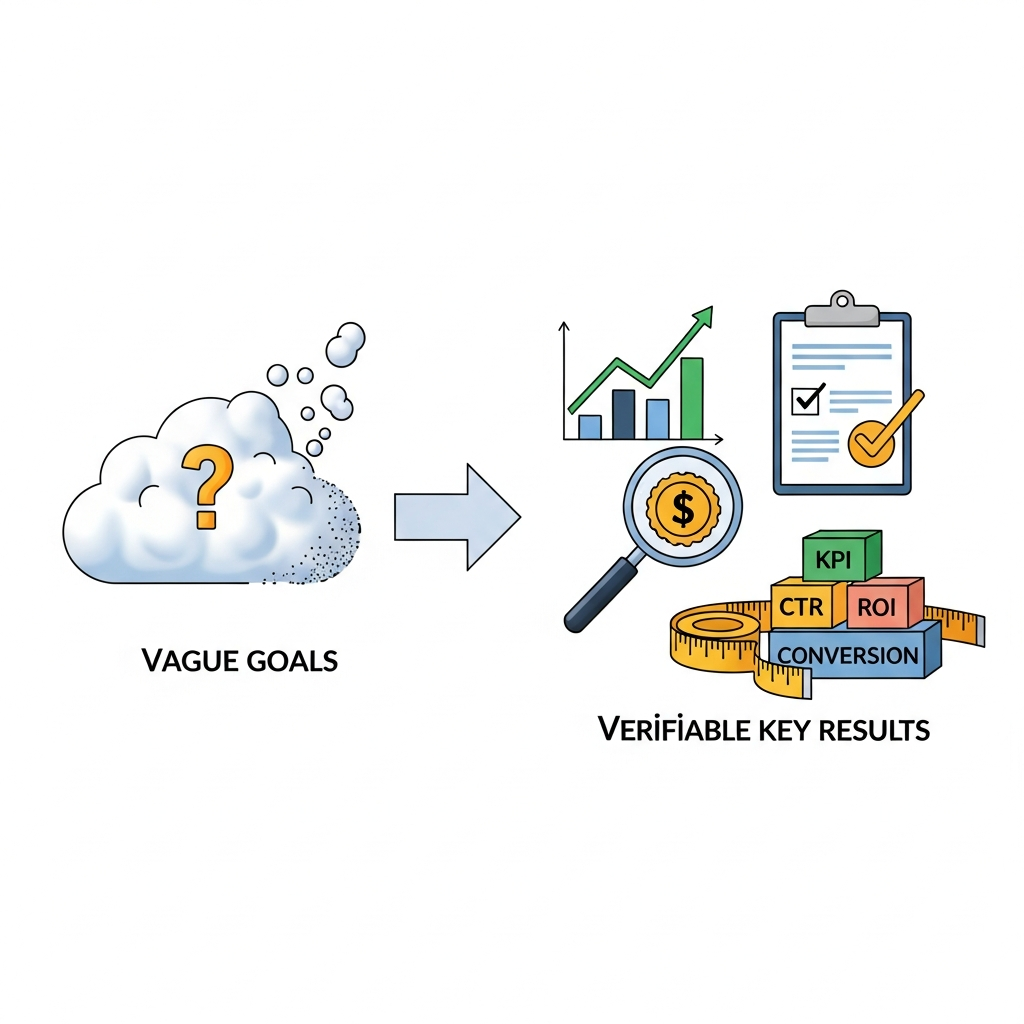
If you take nothing else away from this guide, remember this: Key Results are about outcomes, not outputs.
An output is something you do (e.g., write a whitepaper). An outcome is the result of that action (e.g., 500 qualified leads from that whitepaper). Marketing teams that are new to OKRs almost always fill their “Key Results” section with a to-do list. They write things like:
- “Launch the new website.”
- “Run a LinkedIn ad campaign.”
- “Publish 12 blog posts per month.”
These are not Key Results. These are Initiatives. You could launch a beautiful website that converts at 0% and does nothing for the business. Did you “hit” your goal? Technically, yes. Did you help the company? Absolutely not.
A verifiable Key Result for a website launch would look like this: “Increase website conversion rate from lead-to-MQL from 2.1% to 3.5% by Q3.” Now, you aren’t just launching a site; you’re optimizing for performance. The “launch” is just the tool you use to hit the number.
>Crafting Verifiable Key Results: The “So What?” Test
How do you know if your Key Result is actually verifiable and valuable? You put it through the “So What?” test. Imagine you tell your CEO you hit your KR. If they say “So what?” and you don’t have an answer that involves money, market share, or growth, your KR is weak.
Let’s look at a typical transition from a vague goal to a verifiable KR:
Vague Goal: “Improve our SEO and get more traffic.”
Refined KR (Output-based): “Publish 20 SEO-optimized articles.”
The “So What?” Reality (Outcome-based): “Increase organic search traffic to the pricing page from 500 to 2,000 sessions per month.”
The third option is verifiable. At the end of the quarter, the analytics dashboard will show a number. It is binary. You either hit 2,000 or you didn’t. There is no room for “we felt like the traffic was better.”
>OKRs for Different Marketing Verticals
Marketing is a broad church. The OKRs for a Brand Manager will look vastly different from those of a Performance Marketer. Let’s break down how to apply this rigor across different specialties.
1. Content Marketing & SEO
Content is the king of “vague goals.” We often hide behind the idea that content is a “long-term play” to avoid immediate accountability. While true, we still need verifiable milestones.
Objective: Establish our brand as the undisputed thought leader in the AI-automation space.
- KR 1: Achieve 3 top-3 rankings for high-intent keywords with a total search volume of 10k+.
- KR 2: Secure 5 placements in Tier-1 industry publications (e.g., TechCrunch, Wired).
- KR 3: Increase average time-on-page across the blog from 1:20 to 2:45.
2. Demand Generation & Paid Media
Paid media is already data-heavy, but it often focuses on the wrong data (CPC instead of CAC). OKRs help align paid spend with business health.
Objective: Hyper-scale our lead generation engine without sacrificing lead quality.
- KR 1: Increase monthly Sales Qualified Leads (SQLs) from 150 to 300.
- KR 2: Maintain a Customer Acquisition Cost (CAC) of under $450.
- KR 3: Increase the “Lead-to-Opportunity” conversion rate from 12% to 18%.
3. Brand & Communications
This is the hardest area to quantify, which makes OKRs even more vital here. Don’t let “brand” be a black hole for budget.
Objective: Create a “fanatical” following that differentiates us from commoditized competitors.
- KR 1: Increase Net Promoter Score (NPS) from 45 to 60.
- KR 2: Grow branded search volume from 5,000 to 8,500 monthly queries.
- KR 3: Achieve a 15% share of voice in the “Enterprise Security” category.
>The Rule of Three: Avoid OKR Bloat
One of the most common mistakes I see in high-growth marketing teams is “OKR Bloat.” They try to track 15 different Key Results for a single objective. This is a recipe for mediocrity. When everything is a priority, nothing is a priority.
The Golden Rule: 1 Objective, 3 to 5 Key Results. Maximum.
If you have more than five KRs, you aren’t focused. You’re just listing your department’s entire dashboard. OKRs are meant to highlight the *most* important levers for growth this quarter. Everything else is just “business as usual” (BAU). Don’t mix your daily tasks with your OKRs.
>The Cultural Shift: High-Trust Accountability
Transitioning to verifiable results requires a psychological shift. In a traditional marketing setup, failing to hit a goal is often seen as a performance issue. In an OKR setup, failing to hit a “stretch goal” is often expected.
Google famously aims for a 60-70% success rate on their OKRs. If you hit 100% of your Key Results, you didn’t win—you “sandbagged.” You set the bar too low. You played it safe.
For a marketing team to embrace this, leadership must reward transparency. If a team realizes halfway through the quarter that their Key Result of “2,000 leads” was wildly optimistic because the market shifted, they should be able to pivot or discuss it openly without fear of retribution. The goal is alignment, not punishment.
>Implementing the OKR Cycle in Marketing
You can’t just set OKRs in January and check them in December. That’s how goals go to die. The OKR framework requires a rhythm—a heartbeat.
Phase 1: The Planning (Week 0)
The CMO or Marketing Director sets the top-level Objective based on the company’s annual goals. The individual teams (Content, Paid, Product Marketing) then draft their own OKRs that support that top-level objective. This is “bidirectional” goal setting. It’s not just top-down; it’s collaborative.
Phase 2: The Weekly Check-in
Every week, spend 15 minutes reviewing the numbers. Are we “On Track,” “At Risk,” or “Off Track”? This prevents “End-of-Quarter Panic,” where teams realize on week 11 that they haven’t moved the needle at all.
Phase 3: The Scoring & Retrospective
At the end of the quarter, score your KRs on a scale of 0.0 to 1.0. A 0.7 is a “green” (great success). A 1.0 is a “miracle” (you sandbagged). A 0.3 is a “red” (total failure). The most important part is the Retrospective: Why did we miss? Was it the strategy, the execution, or the goal itself?
>Common Marketing OKR Pitfalls to Avoid
Even the best marketing minds fall into these traps. Keep an eye out for these red flags:
- The “And” KR: “Increase traffic and decrease bounce rate and improve conversions.” This is three KRs disguised as one. Break them apart.
- Lagging-only Metrics: Revenue is a lagging indicator. It takes time to show up. Balance your OKRs with “leading indicators”—metrics that predict future success (e.g., “Demo requests” is a leading indicator for “Revenue”).
- The “Vanish” KR: Setting a KR that you have no way of tracking today. If you don’t have the tooling to measure “Brand Sentiment” accurately, don’t make it a KR until you’ve built the measurement system.
>Tools for Tracking: Don’t Overcomplicate It
I’ve seen companies spend $50,000 on OKR software only to have the team hate using it. If you’re just starting, a shared Google Sheet or a simple Notion database is more than enough. The magic is in the conversations the framework triggers, not the software used to record it.
As you scale, tools like GTMHub or Lattice can help align thousands of employees, but for a 20-person marketing team? Keep it lean. Focus on the data, not the interface.
>The Competitive Advantage of Verifiable Marketing
In a world of tightening budgets and AI-driven competition, “vague” marketers are the first to be replaced. CEOs and CFOs are tired of hearing about “engagement” when the pipeline is dry. By moving to verifiable Key Results, you change the perception of marketing from a cost center to a profit center.
You stop being the department that “makes things pretty” and start being the department that “drives predictable growth.”
Is it harder? Yes. Does it require more math? Definitely. But it also provides a level of clarity and confidence that vague goals never can. When you hit a 0.7 on a truly ambitious, verifiable Key Result, you don’t just feel like you did a good job—you have the data to prove it.
>Conclusion: Start Small, but Start Now
Don’t try to overhaul your entire marketing philosophy by next Monday. Start by taking your biggest “Vague Goal” for this quarter and putting it through the grinder. Strip away the fluff. Ask “So what?” until you find the number that actually matters.
Transitioning to OKRs is a muscle. The first quarter will be clunky. Your goals will be poorly written. You will miss your targets. But by the third quarter, you’ll look back at your old way of working and wonder how you ever got anything done in the fog.
Marketing isn’t a guessing game. It’s a series of hypotheses tested against reality. OKRs are simply the way we record the results. Stop wishing for growth and start verifying it.