

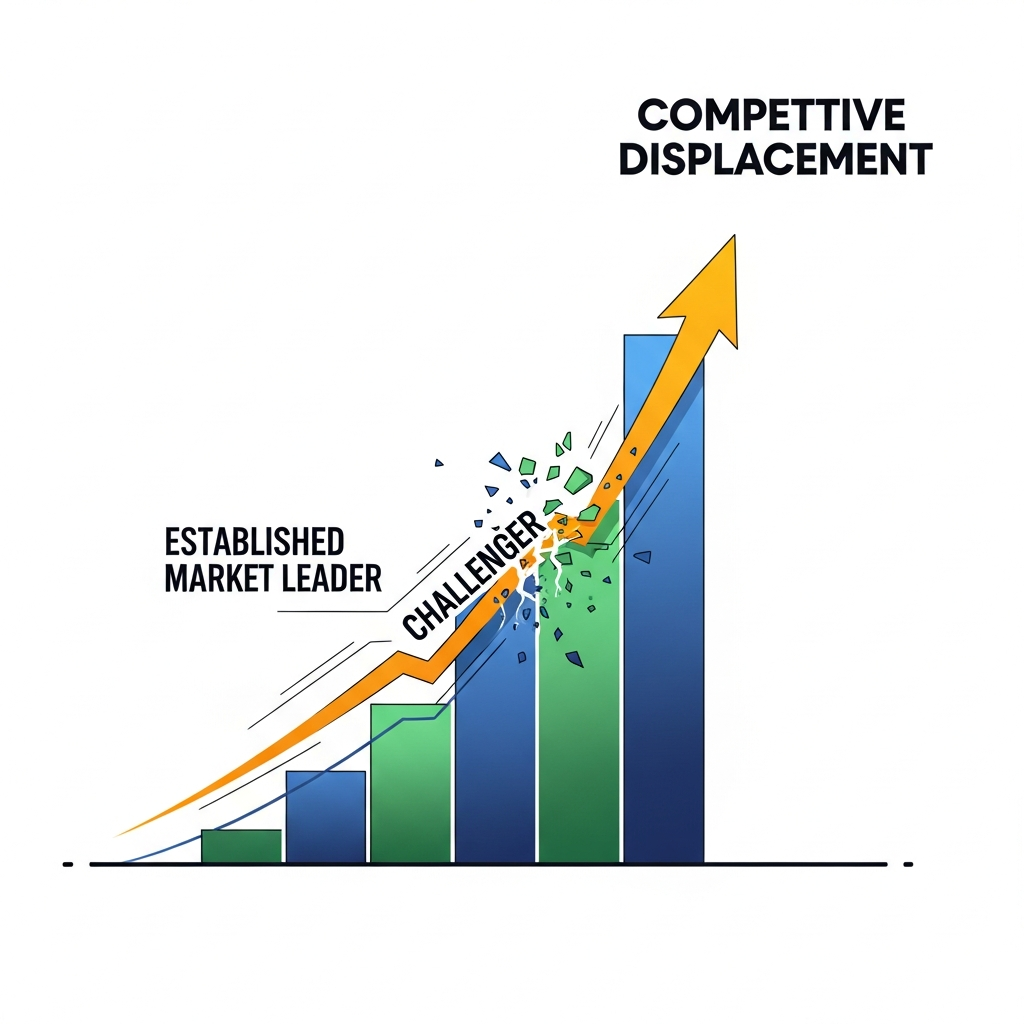
In the high-stakes theater of modern commerce, the “incumbent” is often viewed as an immovable geological formation. They possess the brand equity, the sprawling distribution networks, and the war chests that make venture capitalists salivate. Yet, if the history of industry teaches us anything, it is that the largest trees in the forest often create the very shadows that nurture their eventual replacements. Competitive displacement is not a matter of sheer force; it is a clinical, almost surgical application of strategic asymmetry. It is the science of finding the precise point where an established leader’s greatest strength becomes their most catastrophic liability.
To the uninitiated, unseating a market leader looks like a chaotic brawl. To the elite strategist, it is a study in Gause’s Principle of Competitive Exclusion: two species competing for the exact same resource cannot coexist at constant population values. One will eventually gain even the slightest advantage over the other, leading to the extinction or displacement of the second. In business, this “slight advantage” is rarely a cheaper price point—it is a superior alignment with the evolving reality of the user.

The Entropy of Giants: Why Market Leaders Are Structurally Vulnerable
Before we discuss the “how” of displacement, we must understand the “why” of incumbent decay. Large organizations suffer from what I call Organizational Ossification. As a company scales, its primary objective shifts from “solving a problem” to “preserving the solution.” This subtle transition is the beginning of the end. Their processes become rigid, their risk tolerance evaporates, and their product roadmap begins to resemble a Frankenstein’s monster of legacy features and technical debt.
Consider the incumbent’s dilemma: they cannot innovate too radically because they risk alienating their existing, high-paying enterprise base. They are trapped in a golden cage of their own making. This creates a “Product-Market Gap” where the actual needs of the market have moved forward, but the incumbent’s product remains tethered to a previous era’s requirements. This gap is your entry point.
The Psychology of the Status Quo Bias
Displacement is as much a psychological battle as a technological one. Humans are biologically wired to prefer the “devil they know.” This is the Status Quo Bias, a cognitive preference for the current state of affairs. To displace a leader, your offering cannot merely be “better.” It must be so significantly superior that it overcomes the neurological friction of change. Research suggests that for a user to switch, the perceived value of the new solution must be at least 2.5 to 3 times greater than the current one to offset the perceived risk of abandonment.
“The incumbent’s greatest defense is not their feature set, but the collective exhaustion of their users. Your job is to provide the adrenaline shot.”
Phase I: Diagnostic Intelligence and Sentiment Mining
A scientific approach to displacement begins with data, not intuition. You must perform a heuristic evaluation of the incumbent’s ecosystem. Where are they failing? The answer is rarely in their marketing copy; it is buried in the “one-star” reviews, the Reddit threads of disgruntled power users, and the support tickets that remain open for months.
Sentiment Mining involves using Natural Language Processing (NLP) to categorize the specific “pain clusters” of an incumbent’s audience. Are they complaining about the UI? The lack of integration? The predatory pricing? By mapping these clusters, you aren’t just building a product; you are building an antidote. You are looking for Negative Network Effects—points where the incumbent’s size actually makes the product worse for the individual user (e.g., slow load times, bureaucratic support, bloated interfaces).
The Feature Parity Trap
One of the most common mistakes in competitive displacement is the pursuit of feature parity. Startups often think, “If we have everything they have plus one more thing, we win.” This is a fallacy. Feature parity leads to “me-too” products that lack a distinct identity. Instead, focus on Feature Salience. Identify the 20% of features that drive 80% of the value and make them flawlessly intuitive. Then, aggressively ignore the legacy bloat that the incumbent is forced to maintain.
>Phase II: Strategic Asymmetry and the 10x Value Proposition
Once the diagnosis is complete, you must apply the principle of Strategic Asymmetry. This is the art of competing in a way that the incumbent cannot easily replicate without destroying their own business model. If the incumbent relies on high-touch sales and annual contracts, your asymmetry might be a friction-less, product-led growth (PLG) model with monthly billing. If they are a “closed garden,” you become the open, “API-first” alternative.
The “Point of Entry” Strategy
Do not attack the incumbent’s entire kingdom at once. Instead, identify a High-Value Wedge. This is a specific niche or use case that the incumbent has neglected or over-served. By dominating this specific sub-segment, you establish a beachhead. From there, you can expand your footprint through Adjacent Market Penetration. This was the strategy used by Zoom. They didn’t try to be “the enterprise communication suite” like Cisco Webex; they simply tried to be the “video call that actually works.” Once they owned the call, they owned the meeting room, and eventually, the entire communication stack.
- Identifying the Wedge: Look for the “Over-served” customer who is paying for 100 features but only needs 5.
- Optimizing the Friction: Reduce the “Time to Value” (TTV) to under five minutes.
- Radical Transparency: Use the incumbent’s lack of transparency (hidden pricing, complex SLAs) as a marketing weapon.
>Phase III: Reducing the Friction Coefficient (The Migration Engine)
The greatest barrier to displacement is the “Switching Cost.” This includes the financial cost, the time cost of retraining staff, and the emotional cost of potential failure. To displace an established leader, you must engineer a Frictionless Migration Engine.
This is where the “Science” part of the approach becomes literal. You need to treat the migration as a technical hurdle to be automated. Build one-click importers. Create “Shadow Mode” environments where the user can see your product working with their real data before they ever cancel their old subscription. If you can make the transition invisible, you’ve won the battle of inertia.
The “Aha! Moment” vs. The “Oh, No” Moment
In the first 30 days of displacement, you are in a race against buyer’s remorse. Every minor bug in your software will be magnified because the user is looking for a reason to go back to the “safety” of the incumbent. You must engineer multiple Micro-Wins—small, high-visibility successes that validate the user’s decision to switch. This is the “Aha! Moment” on steroids.
>SEO and Digital Dominance: Outranking the Goliath
In the digital realm, displacement is reflected in the Search Engine Results Pages (SERPs). An incumbent usually dominates high-volume, “Category” keywords. Trying to outrank them for “CRM Software” or “Project Management” is a war of attrition you likely cannot afford. Instead, you must use Semantic Encirclement.
Focus on “Comparison” and “Alternative” keywords. These are high-intent searches. When someone searches “[Incumbent Name] Alternatives,” they are literally telling the world they are ready to leave. Your content strategy should not be a “hit piece,” but a clinical comparison that acknowledges the incumbent’s strengths while highlighting the specific “Modern Use Cases” where they fail. This builds authority and trust.
The Power of Semantic Clusters
Google’s algorithms have evolved from simple keyword matching to understanding Topic Authority. To outrank a leader, you must build a deeper, more specialized knowledge graph around the “problems” the leader solves, rather than the “product” itself. If you are displacing a legacy accounting software, don’t just write about accounting; write about “Automating R&D Tax Credit Compliance for SaaS Companies.” The specificity of your expertise is your competitive advantage.
>Phase IV: The Cultural Coup
Every long-standing market leader has a “Brand Mythos.” To displace them, you must provide a new, more compelling narrative. This is the transition from a “Tool” to a “Movement.” People don’t just buy Slack because it’s a chat app; they bought it because they were “Done with Email.” They didn’t buy Tesla because it was a car; they bought it because it was “The Future.”
Your marketing must position the incumbent as anachronistic. They aren’t “bad”; they are simply from a different era. Use language that emphasizes agility, modern workflows, and “the way people work now.” This creates a “Fear of Being Left Behind” (FOMO) among the incumbent’s user base. If staying with the leader makes the user feel like they are using a rotary phone in an iPhone world, the displacement is already complete.
The Feedback Loop: Staying the Disruptor
The most tragic part of the displacement cycle is when the disruptor becomes the disrupted. To avoid this, you must institutionalize the Disruptor’s Mindset. This means intentionally Cannibalizing your own features before someone else does. It means maintaining a “Day 1” culture (as Jeff Bezos famously advocated) where the customer’s evolving dissatisfaction is the primary driver of innovation, not the competitor’s roadmap.
>Summary of the Displacement Framework
To summarize the scientific approach to competitive displacement, one must follow a rigorous sequence of analytical and tactical steps:
- Structural Analysis: Identify the incumbent’s “Legacy Weight”—technical debt, rigid pricing, and organizational inertia.
- Sentiment Mining: Use NLP and deep social listening to find the specific “Pain Clusters” that the incumbent is ignoring.
- Strategic Asymmetry: Build a business model that the incumbent cannot copy without harming their existing revenue streams.
- Wedge Entry: Dominate a high-value niche rather than attacking the broad market.
- Migration Automation: Reduce the “Friction Coefficient” to near-zero through automated importers and “Shadow Mode” trials.
- Semantic SEO: Encircle the incumbent by owning high-intent “Alternative” and “Problem-Solution” keywords.
- Narrative Shift: Frame the incumbent as anachronistic and your solution as the “Modern Standard.”
>Conclusion: The Relentless Pursuit of Entropy
Market leadership is not a permanent state; it is a temporary equilibrium. The very qualities that allow a company to achieve dominance—standardization, scale, and predictability—eventually become the anchors that prevent them from adapting to the next shift in the environment. Competitive displacement is not about “winning” a market; it is about recognizing that the market has already moved and being the first to build a home in the new reality.
Success in this arena requires a paradoxical blend of academic rigor and street-fighter aggression. You must analyze the data with the cold eye of a scientist, then execute your strategy with the wit and speed of a disruptor. The giants are not as stable as they appear. They are merely waiting for a competitor who understands the physics of their downfall better than they do. Go forth and be the catalyst of their entropy.