
The business world has a fetish for the “grind.” If you spend ten minutes on LinkedIn or Twitter, you are bombarded with the same tired tropes: wake up at 4:00 AM, outwork your competition, “embrace the suck,” and wear your burnout like a badge of honor. We have romanticized the “hustle” to the point where we value movement over direction and effort over outcome. But here is the cold, hard truth that most gurus won’t tell you: the hustle is a lottery ticket, not a strategy.
I have spent years in the trenches of growth marketing and organizational design. I have seen founders work themselves into a hospital bed only to watch their companies fold in eighteen months. I have also seen “lazy” founders build empires by doing about four hours of high-leverage work a day. The difference isn’t grit. It isn’t even “passion.” The difference is the adherence to empirical evidence. If you are building a business based on gut feelings, caffeine, and motivational quotes, you aren’t an entrepreneur; you are a gambler who is running out of chips.

The Fatal Flaw of the Hustle Culture
The problem with hustle culture is that it confuses activity with achievement. In the early stages of a startup, yes, effort is required. But effort without an empirical feedback loop is just noise. When we operate in “hustle mode,” we are often operating in a state of high cortisol and low cognitive flexibility. We make decisions based on what feels productive rather than what the data proves is effective.
Hustle culture relies heavily on survivorship bias. We look at the one billionaire who slept on his office floor and assume that the floor-sleeping was the cause of his success. We ignore the 10,000 others who slept on their office floors and ended up bankrupt. Empirical evidence demands that we look at the denominator, not just the numerator. It forces us to ask: What are the repeatable, predictable variables that lead to growth?
The Psychological Cost of Ignoring Evidence
When you ignore evidence in favor of raw effort, you eventually hit a wall called Decision Fatigue. Your brain can only make a finite number of high-quality decisions per day. If you are “hustling” through 16-hour days, by hour ten, your ability to discern a good lead from a bad one or a sound investment from a sinkhole is compromised. Evidence-based growth acts as a cognitive externalization; the data makes the hard choices for you, preserving your mental energy for execution.
Defining Empirical Growth: Beyond the Buzzwords
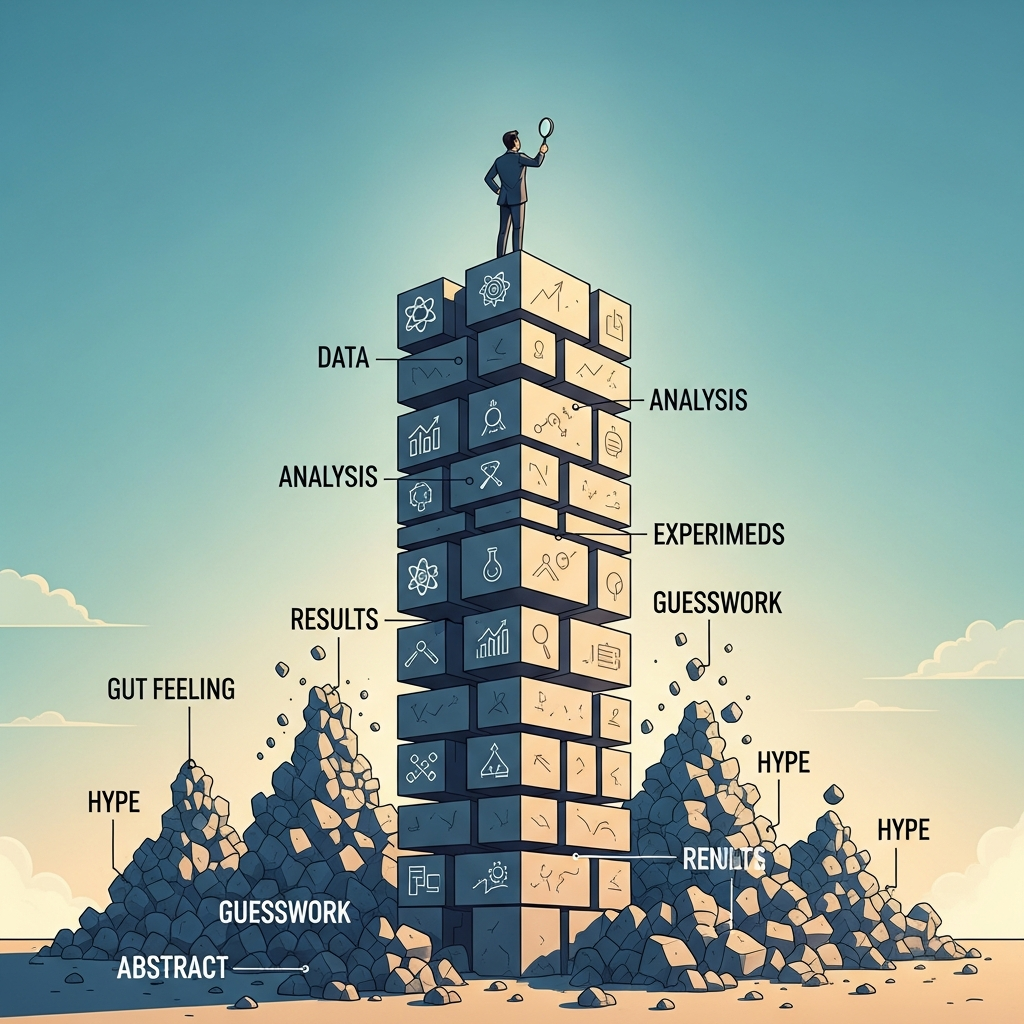
To move beyond the hustle, we must first define what we mean by empirical evidence. In a business context, this is the application of the scientific method to your growth strategy. It is the transition from “I think our customers like X” to “We have observed a 22% higher conversion rate when we present X instead of Y, with a 95% confidence interval.”
Empirical growth is built on three pillars:
- Observable Data: Real-world interactions, not hypothetical market research or “expert” opinions.
- Falsifiability: Every strategy you deploy must be capable of being proven wrong. If you cannot define what failure looks like, you cannot recognize success.
- Reproducibility: If you can’t make the growth happen twice using the same variables, you haven’t found a strategy; you’ve found a fluke.
The Difference Between Vanity Metrics and Empirical Signals
One of the biggest mistakes “hustlers” make is chasing vanity metrics. These are numbers that look great on a slide deck but have zero correlation with sustainable revenue. High social media engagement, “raw” website traffic, and the number of employees you have are classic vanity metrics. They feed the ego, but they don’t feed the bottom line.
Empirical signals, on the other hand, focus on unit economics and retention. If your Customer Acquisition Cost (CAC) is higher than your Lifetime Value (LTV), no amount of “hustle” will save you. In fact, the harder you hustle in that scenario, the faster you will go broke. Empirical evidence forces you to stop and fix the leaky bucket before you try to pour more water into it.

The Survivorship Bias Trap: Why Your Heroes Are Lying to You
Every biography of a successful tech mogul follows the same narrative arc: they had a “vision,” they worked harder than everyone else, they took massive risks, and they won. But if you dig into the actual mechanics of their growth, you find something different. You find that they were obsessively data-driven.
The “vision” is usually just a hypothesis. The “risk” was usually a calculated experiment where the downside was capped. The “hard work” was focused on optimizing systems, not just performing tasks. When we try to emulate the “hustle” without the “evidence,” we are essentially trying to fly a plane by flapping our arms really fast because we saw a bird do it. It’s the wrong mechanism for the desired outcome.
The Danger of “Founder Intuition”
Founder intuition is a dangerous drug. It feels like a superpower, but it’s often just a collection of personal biases disguised as insight. Intuition is great for generating hypotheses, but it is a terrible tool for validating them. A sustainable growth model requires the humility to let the data tell you that your “brilliant” idea is actually a dud.
>Building the Infrastructure for Sustainable Growth
If you want to move away from the frantic energy of the hustle and toward the steady, compounding growth of an empirical system, you need the right infrastructure. This isn’t about buying expensive software; it’s about a shift in your operational philosophy.
1. The Feedback Loop: The Heartbeat of Growth
Every action your company takes should be part of a loop. You launch a campaign, you measure the result, you analyze the variance between your expectation and reality, and you iterate. Most “hustle” companies skip the analysis and iteration phases. They just launch, launch, launch. By the time they realize they are heading in the wrong direction, they are 50 miles off course.
2. Cohort Analysis: Seeing the Truth Behind the Averages
Averages lie. If you look at your average retention rate, you might think you’re doing fine. But if you perform a cohort analysis—breaking down users by the month they joined—you might find that your newest users are leaving at twice the rate of your early adopters. This is an empirical “fire alarm” that the hustle-mindset would miss while focusing on total user growth.
3. The North Star Metric
A sustainable business needs one single metric that represents the value delivered to the customer. For Airbnb, it’s nights booked. For Slack, it’s messages sent. If your North Star metric is growing, your business is likely healthy. If you are “hustling” but your North Star metric is flat, you are wasting your life. Empirical evidence keeps you focused on the one thing that actually matters.
The “20-Mile March”: Why Pacing Beats Sprinting
In his book Great by Choice, Jim Collins introduces the concept of the “20-Mile March.” He tells the story of two explorers racing to the South Pole. One explorer pushed his team to the limit on good weather days and hunker down on bad days. The other explorer committed to walking 20 miles every single day, regardless of the weather. The one who paced himself—the one who adhered to a strict, evidence-based regimen—was the one who survived and won.
Growth is a marathon, not a sprint. Hustle culture is a series of frantic sprints that lead to exhaustion and injury. Sustainable growth is the 20-mile march. It requires the discipline to not overextend yourself when things are going well, so that you have the reserves to maintain your pace when things get difficult.
The Compounding Power of Small Gains
If you improve your conversion rate by just 1% every week, you don’t just grow by 52% in a year. Because of compounding, you actually grow by nearly 68%. This is the “boring” path to success. It doesn’t make for a great Instagram story, but it makes for a very large bank account. Hustle culture looks for 100% gains overnight; empirical growth looks for 1% gains that last forever.
>Case Study: The Pivot from Hype to Evidence
Consider the story of a well-known D2C mattress brand (we’ll keep it nameless to be polite). In their early years, they were the darlings of the “hustle” world. They raised hundreds of millions, spent aggressively on billboards and podcasts, and grew their top-line revenue at a staggering pace. They were “winning” the hustle game.
However, their unit economics were a disaster. They were losing money on every mattress sold once you factored in returns and marketing costs. They ignored the empirical evidence that their business model was unsustainable because they were addicted to the “growth at all costs” narrative. When the venture capital dried up, the hustle couldn’t save them. They had to drastically downsize and restructure. Meanwhile, smaller, quieter competitors who focused on profitable unit economics from day one are now the ones dominating the market.
>Step-by-Step: How to Transition to an Empirical Framework
If you’re currently caught in the hustle trap, how do you get out? You can’t just stop working, but you can change how you work. Follow this framework to transition your business into an evidence-led organization.
Step 1: The Data Audit
Sit down and list every metric you currently track. Now, go through that list and delete anything that you cannot directly link to revenue or customer retention. If a number goes up and you don’t know exactly what action caused it, it’s not data—it’s noise. You need to identify your levers.
Step 2: Establish Your Baselines
You cannot measure growth if you don’t know where you are starting. Establish firm baselines for your CAC, LTV, Churn Rate, and Conversion Rate. These are your “vital signs.” If any of these numbers move in the wrong direction, you stop the hustle and find out why. You don’t “grind” through a declining LTV.
Step 3: Run Weekly Sprints (The Real Kind)
In Agile methodology, a “sprint” isn’t about working harder; it’s about time-boxing an experiment. Every week, pick one variable to test. Maybe it’s a headline on a landing page, or a different lead magnet, or a pricing tweak. At the end of the week, look at the evidence. Did it work? If yes, keep it. If no, discard it. This is how you build a “Growth Machine.”
Step 4: Institutionalize the Learning
The greatest asset of an empirical company isn’t its product; it’s its knowledge base. Every time an experiment fails, document it. Why did it fail? What did we learn about our customers? This ensures that you never make the same mistake twice. In a hustle-based company, mistakes are repeated constantly because everyone is too busy to document the “why.”
>The Myth of “Not Enough Time”
The most common pushback I hear from founders is: “I don’t have time for all this data stuff. I just need to get things done!”
This is the ultimate irony. You have time to work 80 hours a week on things that might not work, but you don’t have three hours a week to ensure that your work is actually effective? The “not enough time” excuse is a psychological defense mechanism. Analyzing data is hard. It forces us to confront the possibility that we are wrong. Hustling is easy. It allows us to feel productive even when we are failing.
Sustainable growth requires the courage to be slow. It requires the maturity to admit that your effort is not a substitute for a viable strategy. If you don’t have time for evidence, you are effectively saying you have time for failure.
>The Biological Imperative of Sustainability
We often talk about business sustainability in terms of finances, but what about human sustainability? Your brain is a biological organ. It requires glucose, rest, and low-stress environments to function at peak capacity. When you operate in a state of perpetual hustle, you are essentially “overclocking” your brain. Eventually, the hardware fries.
Empirical evidence provides the “guardrails” for your mental health. When you know that your systems are working—because the data tells you so—your baseline stress level drops. You no longer feel the need to check your email at 2:00 AM because you trust the feedback loops you’ve built. This isn’t just better for your business; it’s better for your life. You can’t enjoy the fruits of your labor if you’ve burned out your capacity for joy before you reach the finish line.
>Conclusion: The New Standard of Excellence
The era of the “uninformed hustle” is coming to an end. In an age of AI-driven optimization and hyper-competitive global markets, raw effort is no longer a competitive advantage. Anyone can work hard. Anyone can pull an all-nighter. The new “moat”—the thing that will separate the titans from the also-rans—is the ability to process information and pivot based on empirical evidence faster than anyone else.
Stop looking at the clock and start looking at the spreadsheet. Stop valuing the “grind” and start valuing the truth. Growth is not a result of how much you suffer; it is a result of how much you learn. If you want to build something that lasts—something that grows while you sleep and sustains you for decades—you must move beyond the hustle. You must build your foundation on the only thing that doesn’t lie: evidence.
Are you ready to stop guessing and start growing?