
The business landscape has shifted. If you are still relying on a “build it and they will come” philosophy or clinging to the expensive, untraceable methods of 1990s traditional advertising, you aren’t just falling behind—you are effectively invisible. We live in an era where the consumer’s attention is the most valuable currency on earth, and that attention is focused squarely on the five-inch screen in their pockets.
Transformation isn’t about just adding a “digital” layer to what you already do. It is about rethinking your entire growth trajectory through the lens of data, connectivity, and psychological triggers. As someone who has watched brands scale from zero to eight figures using these exact levers, I can tell you that digital marketing is the only engine capable of providing both surgical precision and massive, unbridled scale simultaneously. Here are 10 proven ways digital marketing will completely transform your business growth.
1. Hyper-Precision Targeting: Moving from “Spray and Pray” to “Sniper” Precision
In the old world of marketing, you bought a billboard and hoped that someone in your target demographic drove past it. It was inefficient, expensive, and largely unmeasurable. Digital marketing has flipped the script. Today, we don’t just target demographics; we target intent and behavior.
Through platforms like Meta and Google, you can reach a 34-year-old mother who lives in a specific zip code, has shown interest in organic gardening, and has recently visited a competitor’s website. This level of granularity ensures that your marketing spend isn’t being wasted on people who have zero interest in your offer.
The Power of Lookalike Audiences
One of the most transformative tools in modern marketing is the Lookalike Audience (LAL). By feeding your existing customer data into an AI-driven algorithm, platforms can find millions of other people who “look” exactly like your best buyers. This eliminates the guesswork of expansion. You aren’t guessing who might buy; you are targeting people who share the same digital DNA as your current revenue-generators.
“Targeting is no longer about finding a needle in a haystack; it’s about using a magnet so powerful the needle finds you.”
2. Search Engine Optimization (SEO) as Your Digital Real Estate
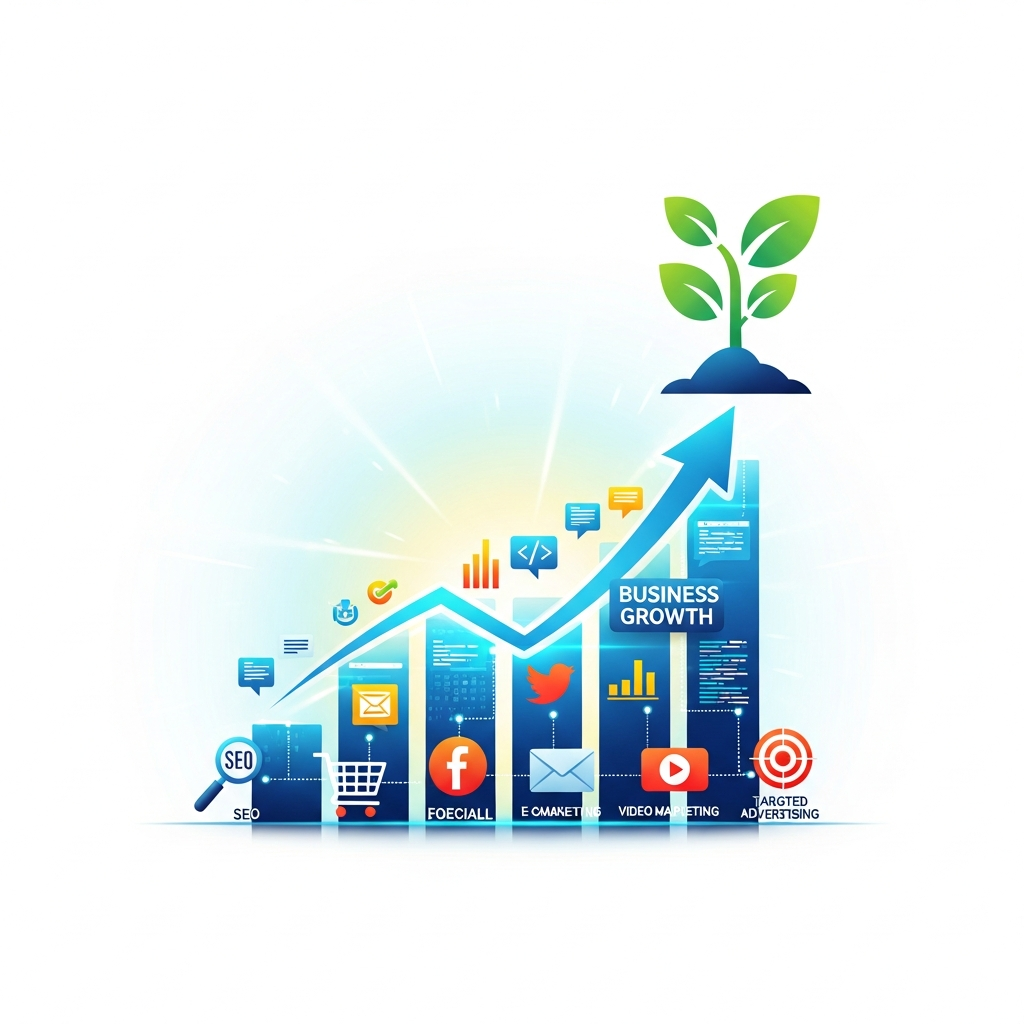
Think of your website as a physical storefront. If it’s located on a dark alleyway where no one walks, it doesn’t matter how great your products are. SEO is the process of moving that storefront to the busiest intersection in the digital world. But modern SEO is no longer about “keyword stuffing.” It’s about Topical Authority and User Experience.
When you consistently rank at the top of search results for high-intent keywords, you aren’t just getting traffic; you are capturing trust. Users subconsciously associate high search rankings with industry leadership. If Google trusts you enough to put you at the top, the customer trusts you enough to click.
The Long-Tail Keyword Strategy
Growth-oriented businesses focus on long-tail keywords—specific phrases that indicate a high readiness to buy. For example, while “shoes” is too broad, “handmade men’s leather dress shoes for wide feet” is a goldmine. Transforming your growth means identifying these specific pain points and owning the conversation around them before your competitor even realizes the niche exists.
3. Content Marketing as an Authority Engine
Content is the bridge between a stranger and a customer. In a world where consumers are bombarded with “Buy Now” ads, the brand that provides the most value wins. Content marketing transforms your business from a “vendor” into a “trusted advisor.”
By producing high-quality blogs, whitepapers, videos, and podcasts, you are essentially building a library of assets that work for you 24/7. This is the Hub and Spoke model: your core expertise (the Hub) is broken down into various formats (the Spokes) and distributed across the web.
- Educational Content: Solves a problem for the user, building immediate rapport.
- Entertaining Content: Humanizes the brand and increases shareability.
- Transactional Content: Provides the final nudge needed to convert a warm lead into a sale.
When you stop selling and start solving, your growth becomes a natural byproduct of the value you provide to the market.
>4. Data-Driven Decision Making: The Death of Guesswork
Perhaps the most profound transformation digital marketing brings is the ability to see exactly what is happening in real-time. In traditional marketing, if a campaign failed, you often didn’t know why. Was it the creative? The message? The placement?
With digital marketing, every click, scroll, and conversion is a data point. Using tools like Google Analytics 4 (GA4), heatmaps, and CRM data, you can see where users are dropping off in your sales funnel. This allows for rapid iteration. If you see that 70% of users leave your site on the checkout page, you don’t need to guess that there’s a problem with your shipping costs or payment gateway—you know it.
Understanding Attribution Models
Digital marketing allows you to understand the “customer journey.” Rarely does someone buy the first time they see you. They might see an Instagram ad, later search for you on Google, and finally convert after receiving an email. Transformation occurs when you stop looking at single channels and start optimizing the entire ecosystem based on hard data.
>5. Social Media as a Community and Retention Hub
Most businesses treat social media as a megaphone for their announcements. That’s a mistake. The true power of social media for business growth lies in community building. It is a two-way street that allows for direct feedback and customer advocacy.
When you engage with your audience, answer their questions, and highlight their stories, you create brand evangelists. These are customers who don’t just buy once—they tell their friends. In the digital age, Word of Mouth (WOM) is amplified by a factor of ten thousand.
The “Social Proof” Multiplier
User-generated content (UGC) is the ultimate growth hack. When a customer posts a video of your product on TikTok or Instagram, it carries more weight than any high-budget commercial ever could. Leveraging this social proof transforms your brand from something you claim to be into something the community confirms you are.
>6. Paid Advertising (PPC) for Instant Scalability
While SEO and content marketing are long-term plays, Pay-Per-Click (PPC) is the “gasoline on the fire.” If you have a product that converts, PPC allows you to scale your revenue almost instantly. The beauty of digital ads (Google Ads, Meta Ads, LinkedIn Ads) is the control over the tap.
If you need more leads this week, you increase the budget. If your fulfillment center is overwhelmed, you dial it back. This flexibility is impossible with traditional media. Furthermore, digital advertising allows for Retargeting—the practice of showing ads only to people who have already interacted with your brand. This is often the highest-ROI activity in a digital marketer’s toolkit.
“The goal of PPC isn’t to spend money; it’s to buy customers at a profit. If you spend $1 to make $3, you have a money machine, not an expense.”
>7. Email Marketing & Lifecycle Automation
Your email list is the only digital asset you truly own. Algorithms change, and social platforms can disappear or throttle your reach, but your direct line to your customers’ inboxes is permanent. Email marketing, when done right, is the highest-ROI channel in existence.
Transformation happens through Automation. Instead of sending one-off blasts, you build automated “flows” that trigger based on user behavior:
- The Welcome Series: Introduces your brand and sets expectations.
- Abandoned Cart Recovery: Reminds users to finish their purchase (this alone can recover 10-20% of lost sales).
- Post-Purchase Upsell: Encourages customers to buy again, increasing Customer Lifetime Value (CLV).
- Win-Back Campaigns: Re-engages customers who haven’t purchased in a while.
A business with an automated email system is a business that makes money while the owners sleep.
>8. Conversion Rate Optimization (CRO): The “Silent” Growth Lever
Growth isn’t just about getting more traffic; it’s about making better use of the traffic you already have. This is where Conversion Rate Optimization (CRO) comes in. If you have 10,000 visitors and a 1% conversion rate, you have 100 sales. If you can use CRO to bump that to 2%, you have doubled your revenue without spending an extra dime on advertising.
CRO involves A/B testing different elements of your website:
- Headline variations.
- Button colors and placements.
- Shortened forms vs. long forms.
- Video vs. static images.
By constantly testing and refining, you create a frictionless path to purchase. This obsession with the “micro-moments” of the user experience is what separates the billion-dollar tech giants from the struggling local shops.
>9. Video Marketing and Human-Centric Storytelling
We are currently in the middle of a video revolution. From YouTube’s educational dominance to the viral nature of TikTok and Reels, video is how the modern world consumes information. Video allows you to convey emotion, nuance, and personality in a way that text simply cannot.
Transformation occurs when you use video to pull back the curtain. Show the “making of” your product. Interview your founders. Share a customer success story with raw emotion. When people can see the faces behind the brand, the “know, like, and trust” factor skyrockets. In a digital world that can often feel cold and robotic, humanity is a competitive advantage.
The Rise of Short-Form Content
Short-form video is the best discovery engine available today. It’s the top of the funnel where you catch the eye of the casual scroller. By mastering the 3-second hook, you can drive massive awareness for a fraction of the cost of traditional PR.
>10. Building an Omnichannel Experience
The final way digital marketing transforms your growth is by weaving all these threads into a single, seamless Omnichannel Experience. Your customer shouldn’t feel like they are interacting with a different company when they move from your Instagram to your website to your physical store.
Consistency is key. An omnichannel strategy ensures that the data from an offline purchase informs the next email the customer receives, or that a customer who abandoned a cart on their laptop sees a reminder on their mobile phone while browsing Facebook. This creates a “surround sound” effect that makes your business feel much larger and more established than it may actually be.
Omnichannel is about being wherever your customer is, at the exact moment they need you.
>The Road to Transformation: Where Do You Start?
Digital marketing can feel overwhelming because of the sheer volume of options. However, you don’t need to do everything at once to see growth. The transformation begins with a single step toward digital maturity.
Start by identifying your biggest bottleneck. Is it a lack of traffic? Start with SEO or PPC. Is it a lack of conversion? Focus on CRO. Is it low customer retention? Dive into Email Automation and Social Media Community building.
The businesses that thrive in the next decade will be the ones that view digital marketing not as a “cost center,” but as the primary driver of business intelligence and customer connection. The tools are available, the data is waiting, and the audience is already online. The only question is: are you ready to transform?
Stop playing small with outdated tactics. Embrace the digital revolution, lean into the data, and watch as your business growth moves from linear to exponential. The market doesn’t wait for the slow; it rewards the agile. It’s time to take your place at the top of the search results—and the top of your industry.