
In the digital epoch, the quest for the summit of Google’s search results is often portrayed as a modern-day crusade—a blend of arcane sorcery, rigorous data science, and an unhealthy obsession with the whims of an enigmatic algorithm. To “rank #1” is the ultimate meritocracy of the internet, yet the path to this zenith is littered with the corpses of websites that tried to “game” the system. To master Search Engine Optimization (SEO) is not merely to optimize for a bot, but to curate an experience that satisfies the insatiable curiosity of the human psyche while adhering to the stringent logical frameworks of Mountain View’s silicon giants.
This guide serves as a comprehensive manual for the discerning marketer and the meticulous technologist. We shall deconstruct the multifaceted architecture of SEO, moving beyond the pedestrian advice of “writing good content” into the granular, analytical, and often counter-intuitive strategies that separate the apex predators of the SERPs (Search Engine Results Pages) from the also-rans.
I. The Ontological Shift: From Keywords to Entities
For decades, SEO was a game of lexical matching. If a user searched for “bespoke leather shoes,” the site with that exact phrase repeated the most frequently—and perhaps bolded for good measure—would win. That era is dead. Google has evolved from a directory of strings into a repository of things. This transition to Semantic Search means the algorithm now understands the relationship between entities.
An entity, in SEO parlance, is a well-defined object or concept. When you write about SEO, Google recognizes its relationship to “digital marketing,” “backlinks,” “RankBrain,” and “John Mueller.” Ranking #1 requires you to establish your content within this web of relationships. You are no longer just targeting keywords; you are building a knowledge graph.
“The goal of search is to understand exactly what you mean and give you back exactly what you want.” – Larry Page
To master this, one must employ LSI (Latent Semantic Indexing) keywords—though the term is technically archaic, the principle of topical depth remains. Your content must demonstrate “topical authority.” If you want to rank for a competitive term, you cannot simply write one stellar post. You must build a “Topic Cluster” consisting of a pillar page and multiple supporting sub-topics, all interconnected via a sophisticated internal linking structure.

II. Technical SEO: The Infrastructure of Invisibility
If content is the sovereign, technical SEO is the castle. Without a robust foundation, your brilliant prose will languish in the dark corners of the deep web, unindexed and unloved. Technical SEO is an exercise in reducing friction for Google’s crawlers.
1. Crawl Budget and Efficiency
Google does not have infinite resources to spend on your website. Each site is allocated a “crawl budget.” If your site is bloated with 404 errors, unnecessary redirects (301 chains), and low-quality “zombie” pages, the Googlebot will exhaust its budget before it finds your high-value content. Use tools like Screaming Frog to conduct a forensic audit of your site’s health.
2. The Schema Markup: Speaking Google’s Native Tongue
While Google is adept at parsing natural language, it prefers structured data. Schema Markup (JSON-LD) allows you to explicitly tell the search engine what your content represents. Is it a recipe? A product? A FAQ? By implementing Schema, you increase your chances of appearing in “Rich Snippets,” which dramatically improves Click-Through Rate (CTR), a known secondary ranking signal.
3. HTTPS and Security
In an era of rampant data breaches, security is not optional. Since 2014, HTTPS has been a confirmed ranking signal. A site without an SSL certificate is effectively shouting to the world—and to Google—that it is untrustworthy. In the eyes of the algorithm, trust is a prerequisite for authority.
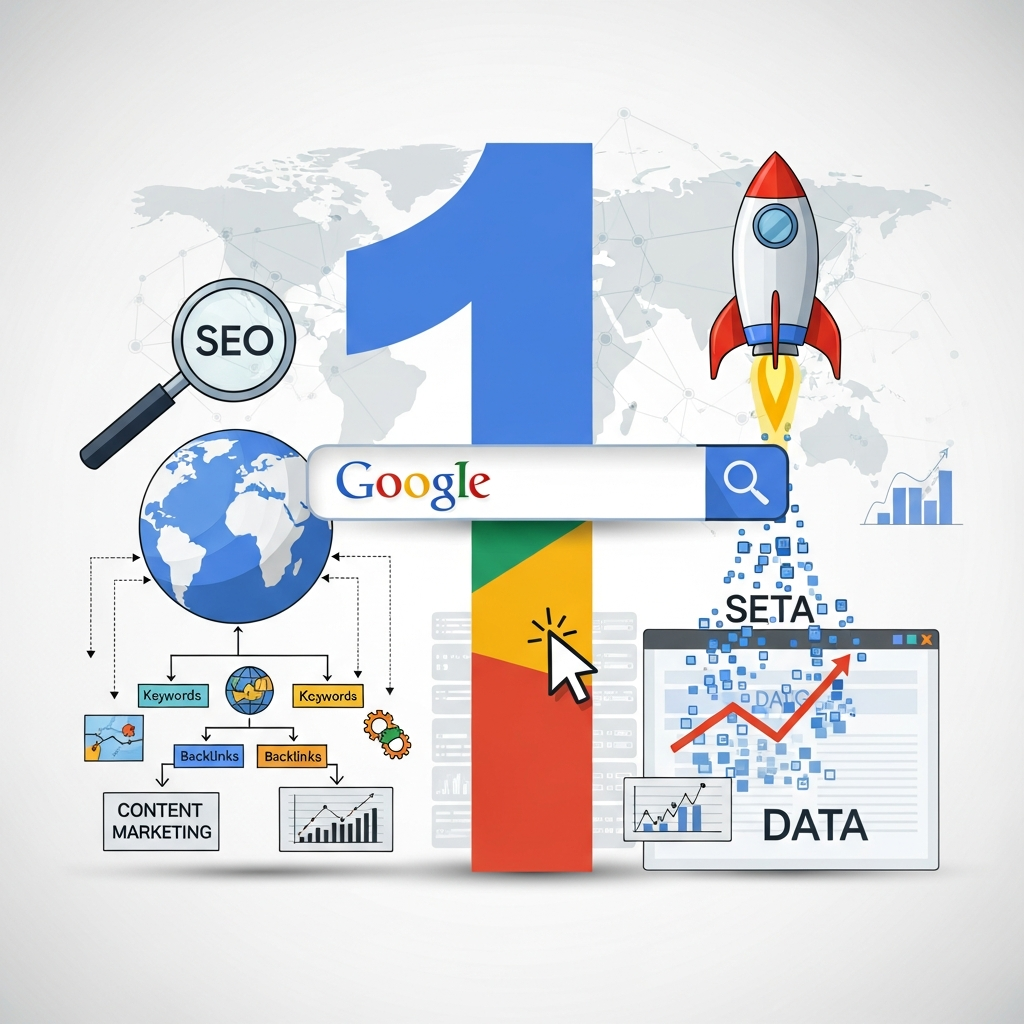
III. The E-E-A-T Framework: The Currency of Credibility
Google’s Quality Rater Guidelines introduce us to E-E-A-T: Experience, Expertise, Authoritativeness, and Trustworthiness. This is not a direct “ranking factor” in the way a backlink is, but it is the lens through which Google evaluates the quality of its index.
- Experience: Does the author have first-hand, “boots-on-the-ground” experience with the subject?
- Expertise: Is the author a recognized professional or an academic in the field?
- Authoritativeness: Does the domain itself carry weight? Is it the “go-to” source for this niche?
- Trustworthiness: Is the information accurate, cited, and transparent?
To rank #1, especially in “Your Money Your Life” (YMYL) niches like finance or health, you must cultivate these signals. This involves creating detailed author bios, citing reputable sources, and ensuring your “About Us” page reflects a legitimate organization rather than a faceless content farm.
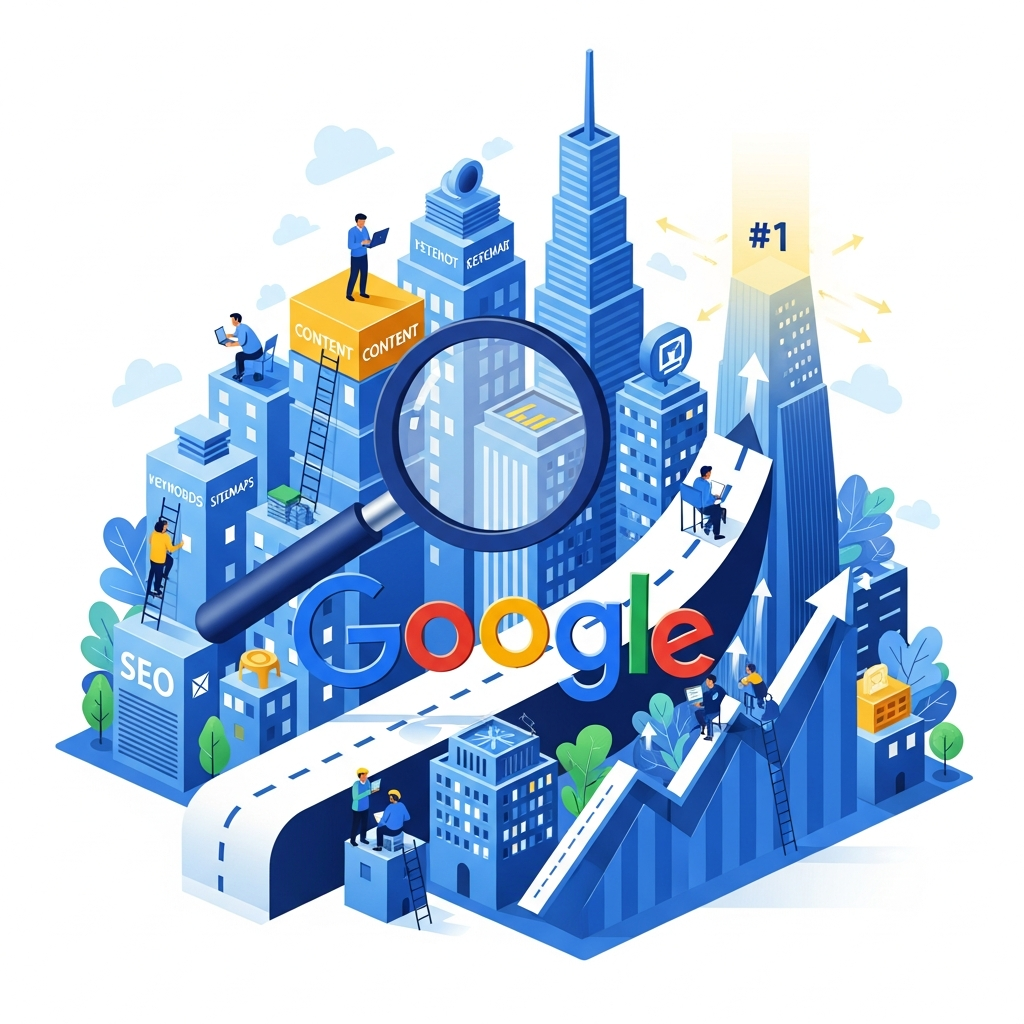
IV. Content Orchestration: Beyond the “High-Quality” Cliché
The advice to “write high-quality content” is as ubiquitous as it is useless. What constitutes quality in the eyes of an algorithm? It is a combination of Search Intent and Comprehensive Utility.
Decoding Search Intent
There are four primary types of search intent. If your content does not align with the user’s intent, you will never rank, regardless of how “good” the writing is.
- Informational: The user wants to learn (e.g., “What is SEO?”).
- Navigational: The user is looking for a specific site (e.g., “Google Search Console login”).
- Commercial: The user is researching before a purchase (e.g., “Best SEO tools 2024”).
- Transactional: The user is ready to buy (e.g., “Ahrefs subscription discount”).
Ranking #1 requires a forensic analysis of the current top 10 results. If the SERP for your target keyword is filled with listicles, do not try to rank with a long-form white paper. The algorithm has already decided what the user wants; your job is to provide the most refined version of that format.
The “Skyscraper” Technique 2.0
The Skyscraper technique—finding the best content and making something better—is still viable, but it requires more nuance today. “Better” no longer means “longer.” It means more readable, more visually engaging, and more updated. Use original data, bespoke infographics, and expert interviews to add unique value that cannot be replicated by generative AI.
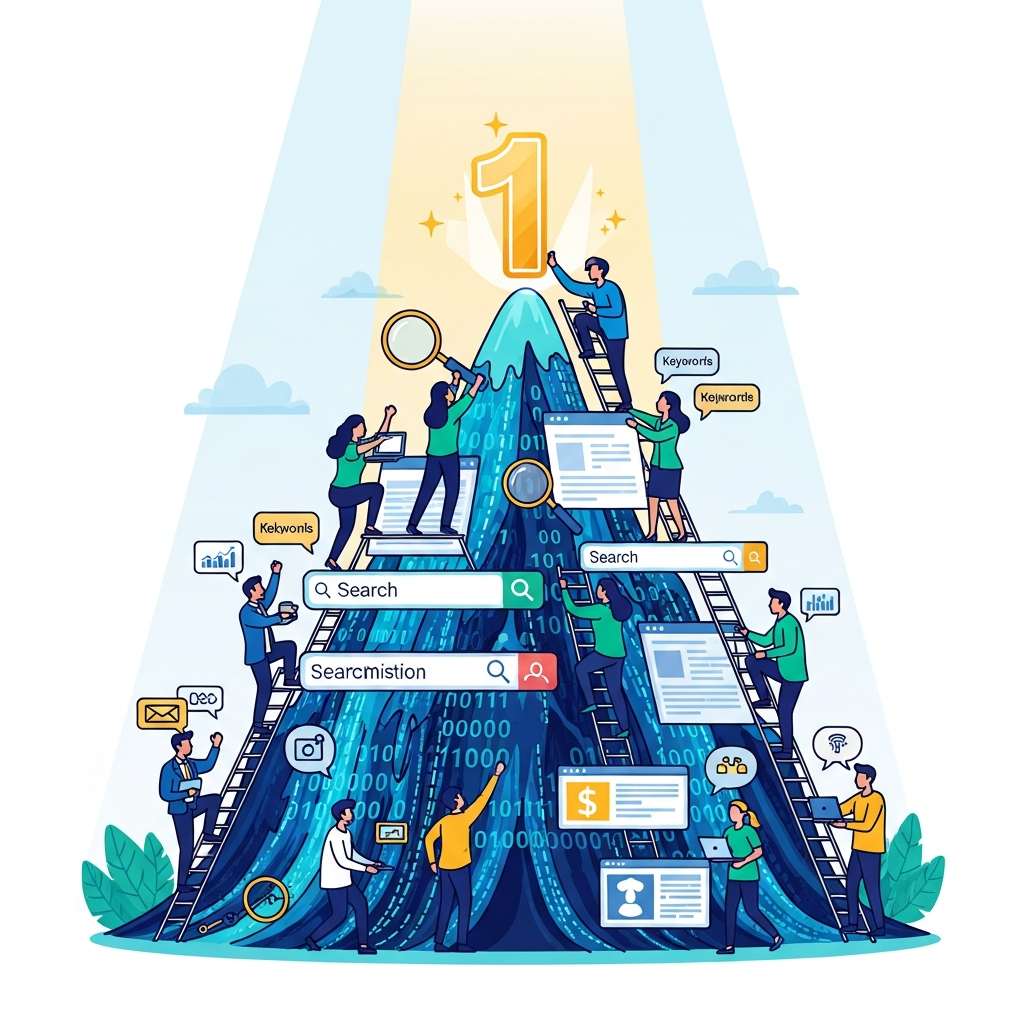
V. On-Page Optimization: The Art of the Nuance
On-page SEO is the process of optimizing individual web pages. While the basics are well-known, the mastery lies in the execution of the Title Tag and Meta Description as psychological triggers.
Your Title Tag is your first—and often only—chance to capture a user’s attention. It should be a blend of your primary keyword and a “power word” that increases CTR. For example, instead of “SEO Guide,” use “Mastering SEO: The Definitive 2024 Blueprint for Ranking #1.”
Furthermore, internal linking is perhaps the most undervalued lever in SEO. By strategically linking from high-authority pages (like your homepage) to “deep” content pages, you distribute Link Equity (or “Link Juice”) throughout your site, signaling to Google which pages are the most important.
>VI. Off-Page SEO: The Machiavellian World of Link Building
If on-page SEO is what you say about yourself, off-page SEO is what the world says about you. Backlinks remain the most significant ranking factor in Google’s algorithm. However, the days of quantity-over-quality are long gone. Ten links from high-authority, relevant domains are worth more than ten thousand links from disparate, low-quality blogs.
The Power of Relevance
A backlink from a niche-specific site (e.g., a tech blog linking to a software site) carries exponentially more weight than a link from a generic news site. Link building should be approached as Digital PR. This includes guest posting on reputable sites, the “Broken Link Building” strategy, and—most effectively—creating “Link Magnets” (original research, calculators, or controversial opinion pieces that demand citation).
“The best way to get links is to create something that is actually worth linking to.” – A sentiment often echoed by Matt Cutts.
Beware the “Black Hat” temptation. Purchasing link packages from Fiverr or participating in link farms will eventually lead to a manual penalty. Google’s Penguin algorithm and its subsequent AI-driven updates are incredibly adept at sniffing out unnatural link patterns. Slow, organic growth is the only sustainable path to the #1 spot.
>VII. User Experience (UX) and the Core Web Vitals
In 2021, Google officially integrated Core Web Vitals as ranking signals. This move codified what we already knew: Google prioritizes the user. If your site is slow, unresponsive, or suffers from “layout shift” (where elements jump around as they load), your rankings will suffer.
- Largest Contentful Paint (LCP): Measures loading performance. Aim for 2.5 seconds or faster.
- First Input Delay (FID): Measures interactivity. Aim for less than 100 milliseconds.
- Cumulative Layout Shift (CLS): Measures visual stability. Aim for a score of less than 0.1.
Mobile-first indexing is also the standard. Your site must be perfectly responsive. If your mobile experience is a secondary thought, you are effectively invisible to the majority of searchers. SEO and UX are no longer separate disciplines; they are a symbiotic whole.
>VIII. The Artificial Intelligence Frontier: SGE and Beyond
As we navigate the mid-2020s, the elephant in the room is SGE (Search Generative Experience). Google is increasingly using AI to provide direct answers on the SERP, potentially leading to “zero-click” searches. To rank #1 in this environment, you must optimize for AI Overviews.
This involves being extremely concise in your definitions, using clear heading structures, and providing “nuggets” of information that an AI can easily scrape and attribute to you. Ironically, the rise of AI makes the human element—your unique perspective and “Experience” (the first ‘E’ in E-E-A-T)—more valuable than ever. AI can summarize facts, but it cannot (yet) provide a nuanced, human critique of a complex industry.
>IX. Measuring Success: The Analytics of Victory
Ranking #1 is a vanity metric if it doesn’t lead to conversions. To truly master SEO, one must be proficient in Google Analytics 4 (GA4) and Google Search Console. You must track not just your position, but your “Share of Voice,” your “Engagement Rate,” and your “Conversion Rate Optimization” (CRO).
SEO is not a one-time project; it is a cycle of hypothesis, execution, measurement, and refinement. The algorithm changes thousands of times a year. What works today might be relegated to the dustbin of history by the next Core Update. Vigilance is the price of dominance.
>X. Conclusion: The Long Game
Achieving the #1 spot on Google is not about “tricking” the algorithm. It is about becoming the most authoritative, trustworthy, and useful resource on the internet for your chosen topic. It requires a Herculean effort across technical, creative, and analytical domains. It is a game of marginal gains—optimizing a title here, speeding up a server there, and earning a high-authority link tomorrow.
Those who view SEO as a “hack” will always be at the mercy of the next update. But those who view it as a commitment to excellence—a way to ensure that the best information reaches the people who need it most—will find themselves not just at the top of the search results, but at the forefront of their industry. The view from the top is spectacular, but the climb is where the true mastery is forged.