
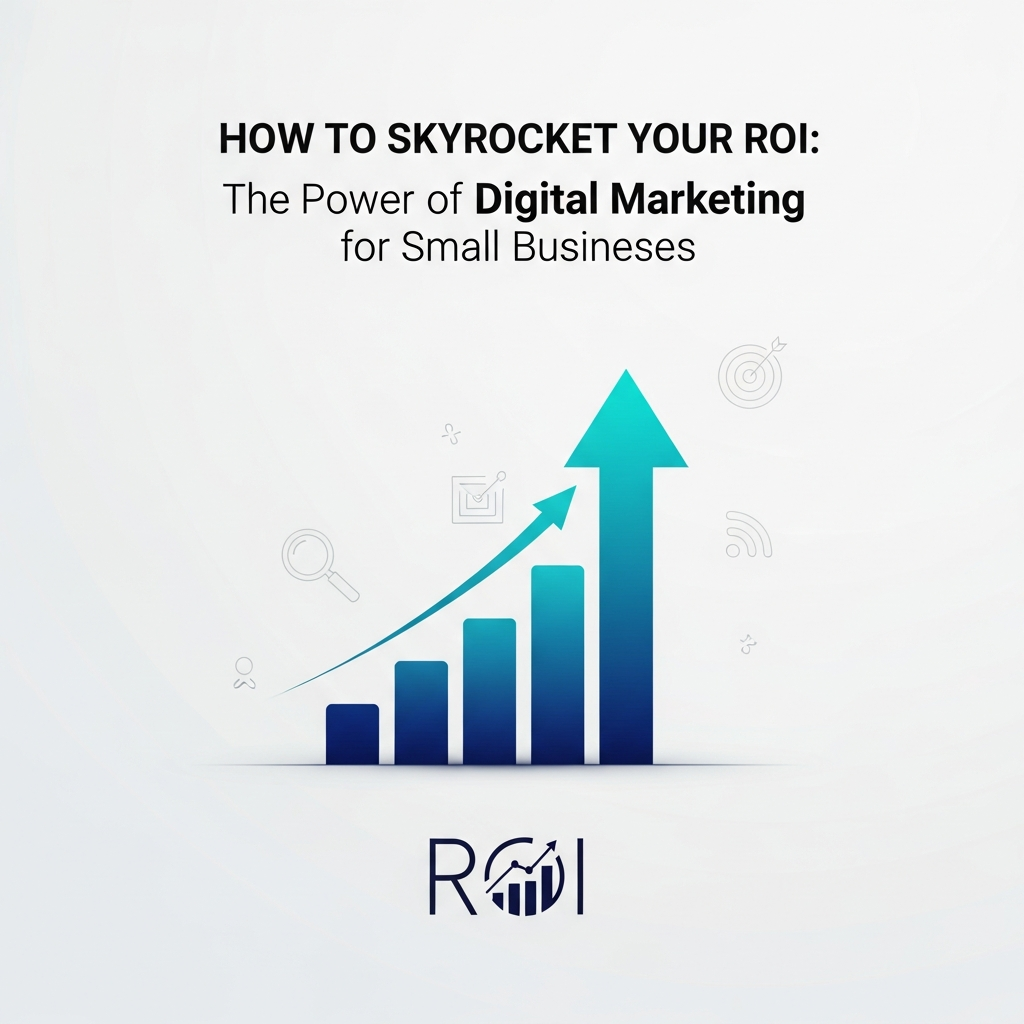
Let’s be brutally honest for a moment. If you are running a small business today and you aren’t obsessed with your digital presence, you aren’t just leaving money on the table—you are effectively handing your market share to the competitor down the street who finally figured out how to use a Meta pixel. We live in an era where the barrier to entry has never been lower, yet the noise has never been louder. To “skyrocket” your Return on Investment (ROI), you cannot simply throw spaghetti at the digital wall and hope something sticks. You need a surgical, data-driven approach that prioritizes high-impact moves over vanity metrics.
I have spent years in the trenches of digital strategy, and if there is one thing I’ve learned, it’s that small businesses have a unique superpower: agility. You don’t have the red tape of a Fortune 500 company. You can pivot, experiment, and double down on what works in real-time. This guide is your roadmap to doing exactly that.
The ROI Mindset: Why Most Small Businesses Fail at Digital Marketing
Before we dive into the “how-to,” we must address the “why-not.” Most small business owners approach digital marketing as an expense rather than an investment. They see a monthly bill for SEO or a daily spend on Google Ads and they cringe. This is the first hurdle. To see a massive ROI, you must shift your perspective to focus on Customer Acquisition Cost (CAC) versus Lifetime Value (LTV).
If you spend $50 to acquire a customer who spends $500 over their lifetime with you, you haven’t “lost” $50; you’ve bought a $450 profit margin. Digital marketing is the machine that facilitates this transaction at scale. The failure usually happens because businesses track the wrong things. Likes, follows, and “brand awareness” are great, but they don’t pay the rent. Conversion, retention, and referral do.
Success in digital marketing isn’t about being everywhere; it’s about being exactly where your highest-value customers are, at the precise moment they realize they have a problem you can solve.
The Foundation: Search Engine Optimization (SEO) as a Wealth Generator
SEO is often described as “free” traffic. Let’s clear that up: it isn’t free. It costs time, intellectual capital, and often, professional management. However, unlike paid ads, which stop the moment you stop paying, SEO is an appreciating asset. It is the “real estate” of the internet.
Mastering Local SEO: The Small Business Edge
If you have a physical location or serve a specific geographic area, Local SEO is your bread and butter. When someone searches for “best plumber near me” or “boutique coffee shop in [City],” you need to be in the “Map Pack” (the top three results next to the map).
How do you win here? It starts with your Google Business Profile (GBP). Most businesses half-fill this out. To skyrocket ROI, you must optimize it aggressively. This means high-resolution photos, responding to every single review (yes, even the bad ones), and using the “Posts” feature to share updates. Proximity, relevance, and prominence are Google’s key signals. You can’t change your proximity, but you can absolutely dominate relevance through keyword optimization and prominence through consistent, high-quality reviews.
Technical SEO and the User Experience
Google has become increasingly obsessed with how users feel when they land on your site. This is where Core Web Vitals come in. If your site takes five seconds to load on a mobile device, your ROI is already dead. Users will bounce, and Google will bury you. Ensure your site is mobile-responsive, uses HTTPS for security, and has a clean, intuitive navigation structure. A fast site doesn’t just help SEO; it directly increases conversion rates.
Content Marketing: Moving from “Selling” to “Solving”
Content marketing is the fuel for your digital engine. But here is the secret: nobody cares about your “anniversary sale” or your “company picnic.” They care about their own problems. To skyrocket ROI, your content must bridge the gap between a customer’s pain point and your solution.
The “Helpful Content” Framework
Google’s recent algorithm updates have doubled down on E-E-A-T (Experience, Expertise, Authoritativeness, and Trustworthiness). As a small business owner, you have a wealth of “Experience” and “Expertise.” Leverage it. Instead of writing a generic post about “The Benefits of Landscaping,” write a deep dive into “How to Save Your Lawn During a Texas Heatwave Without Breaking the Bank.”
- Identify the FAQ: What are the top 10 questions your customers ask? Write a dedicated, 1,000-word blog post for each.
- Use Video: A 60-second video explaining a complex topic can build more trust than a 5,000-word whitepaper.
- Repurpose Everything: One long-form blog post can become five Instagram reels, three LinkedIn articles, and a month’s worth of tweets.
The Buyer’s Journey: Awareness to Decision
Not every visitor is ready to buy. A high-ROI strategy accounts for the entire funnel. Top of Funnel (TOFU) content educates the user. Middle of Funnel (MOFU) content compares solutions. Bottom of Funnel (BOFU) content—like case studies, testimonials, and product demos—closes the deal. If you only focus on the “Buy Now” stage, you are ignoring 90% of your potential market.
>Paid Advertising: The Fast Track to Scalability
If SEO is a marathon, Paid Media (PPC) is a sprint. When done correctly, it is the fastest way to see an immediate jump in ROI. However, it is also the easiest way to burn through a budget. The key is granularity.
Google Ads: Capturing Intent
Google Ads are powerful because they capture intent. When someone searches for “emergency roof repair,” they are ready to spend money. Your goal is to be the first option they see. To maximize ROI here, stop using broad match keywords. They are a vacuum for your budget. Use “phrase match” or “exact match” to ensure your ads only show up for highly relevant queries.
Furthermore, your ad copy must match your landing page. If your ad promises a “20% Discount for New Customers,” and the landing page doesn’t mention that discount, the user will leave, and you will have paid for a useless click. This is called Message Match, and it is the difference between a 1% conversion rate and a 10% conversion rate.
Social Media Ads: Creating Desire
While Google captures intent, Meta (Facebook/Instagram) and TikTok create desire. You are interrupting a user’s scroll, so your creative must be thumb-stopping. For small businesses, User-Generated Content (UGC) often outperforms high-end production. A video of a real customer using your product feels authentic and trustworthy. Use Meta’s powerful “Lookalike Audiences” to find people who share characteristics with your best existing customers.
>Social Media: Community Over Reach
Organic social media reach has plummeted over the years. You can no longer rely on just “posting” and expecting people to see it. Today, social media for small businesses is about community management and social selling.
Don’t try to be on every platform. If you are a B2B consultancy, TikTok might be a waste of time, but LinkedIn is a goldmine. If you are a boutique clothing brand, Instagram and Pinterest are non-negotiable. Choose one or two platforms and dominate them. Engage with your followers. Reply to comments within the hour. Use Stories to show the “behind the scenes” of your business. People buy from people, not faceless corporations.
>Email Marketing: The Undisputed ROI King
If you were to ask any elite marketer which channel has the highest ROI, the answer is almost always email. For every $1 spent, email marketing generates an average return of $36 to $42. Why? Because you own the list. You aren’t at the mercy of an algorithm change.
Automating the Customer Journey
Small business owners are busy. You don’t have time to send individual emails to every lead. This is where automation comes in. You need three core “flows”:
- The Welcome Series: Triggered when someone signs up for your list. Introduce your brand, deliver value, and offer a first-time incentive.
- The Abandoned Cart/Inquiry: If someone was looking at a service or product but didn’t pull the trigger, send a gentle nudge 24 hours later.
- The Post-Purchase Follow-up: Ask for a review, provide tips on how to use their new purchase, and suggest a complementary product.
Segmentation is the secret sauce. Stop sending the same email to your entire list. Segment by past purchase behavior, geographic location, or engagement level. A highly targeted email to 100 people will always outperform a generic blast to 10,000.
>Data and Analytics: The North Star of ROI
You cannot improve what you do not measure. Most small businesses have Google Analytics 4 (GA4) installed but never look at it. To skyrocket ROI, you must become a student of your own data.
Key Metrics to Watch
Ignore the “hits” (How Idiots Track Success). Instead, focus on:
- Conversion Rate: What percentage of visitors actually take the desired action?
- Cost Per Lead (CPL): How much are you paying to get someone into your funnel?
- Customer Lifetime Value (LTV): How much is a customer worth over 1, 2, or 5 years?
- Attribution: Which channel actually closed the sale? (Hint: It’s usually a combination of multiple touchpoints).
Use this data to kill what isn’t working. If your Pinterest ads aren’t converting after three months, pull the plug and move that budget into your high-performing Google Ads. Be ruthless with your capital.
>The Multiplier Effect: Integrating Your Strategy
The real magic happens when these channels work together. SEO brings them in, Content builds the trust, Social Media keeps them engaged, and Email closes the deal—while Paid Ads act as the accelerant. This is the Omnichannel Approach.
Imagine a potential customer sees your helpful blog post (SEO). They leave without buying, but because you have a tracking pixel, they see an ad for your service on Instagram (Retargeting). They click the ad, sign up for your newsletter to get a guide (Lead Magnet), and eventually, they receive an automated email that offers a consultation (Email Marketing). This is how small businesses beat larger competitors with deeper pockets: by being smarter, faster, and more integrated.
>Actionable Steps to Get Started Today
If you feel overwhelmed, don’t try to do everything at once. Focus on these three steps over the next 30 days:
- Claim and Optimize Your Google Business Profile: This is the lowest-hanging fruit for local ROI. Fill it out completely and get 5 new reviews this week.
- Install a Lead Magnet on Your Site: Stop letting 98% of your traffic leave without leaving a name and email. Offer a checklist, a discount, or a free guide in exchange for their contact info.
- Audit Your Current Spend: Look at where your money is going. If you’re paying a “marketing agency” that hasn’t shown you a conversion report in three months, it’s time for a difficult conversation.
Digital marketing is not a “set it and forget it” project. It is a living, breathing part of your business. By focusing on the fundamentals—SEO, high-value content, targeted paid media, and aggressive email follow-up—you won’t just see a marginal increase in sales. You will create a predictable, scalable machine that generates ROI while you sleep.
Small businesses are the backbone of the economy. In the digital age, you have more power than ever before to reach your audience directly. The only question is: are you going to seize it, or let your competition do it first?