
In the halcyon days of search engine optimization, we were all essentially digital cartographers, mapping out the landscape of keywords that had already been settled. We looked at historical data, sighed over the monthly search volumes provided by tools that were—let’s be honest—little more than educated guesses, and optimized for the past. But the map is not the territory. Today, the landscape is shifting in real-time. If you are waiting for a keyword to show up in a SEMrush or Ahrefs dashboard with a “high volume” badge, you are already three months too late to the feast. The scraps that remain are hard-fought and expensive.
Welcome to the era of Predictive Algorithm Modeling. This isn’t just about anticipating the next trend; it’s about using stochastic modeling, time-series analysis, and deep learning to identify the latent intent of users before they even know they have it. It is the transition from being a reactive content creator to a proactive architect of digital demand. In this comprehensive guide, we will dissect the mechanics of predictive SEO, exploring how you can out-maneuver both the algorithm and your competition by living in the future.
The Epistemology of Search: Moving Beyond the Keyword
To understand predictive modeling, one must first undergo a bit of an intellectual ego-death regarding keywords. Keywords are merely the linguistic residue of an underlying psychological state. When a user types a query, they are attempting to bridge the gap between a state of lack and a state of resolution. Traditional SEO focuses on the bridge; predictive modeling focuses on the tectonic shifts that create the gap in the first place.
Search engines like Google have moved from being lexical (matching words) to semantic (matching meaning) and are now becoming predictive (anticipating needs). Through the implementation of BERT, MUM (Multitask Unified Model), and subsequent iterations, Google’s neural networks are increasingly capable of understanding the “trajectories” of search behavior. If a user searches for “early signs of pregnancy,” the algorithm already knows the statistical likelihood of them searching for “best prenatal vitamins” in three days and “stroller reviews” in five months. Predictive modeling allows us to occupy those future spaces before the competitive noise becomes deafening.
“The best way to predict the future is to create it, but in the absence of omnipotence, the second-best way is to model the recurring patterns of human desire using high-velocity data streams.”
The Anatomy of a Predictive Search Model
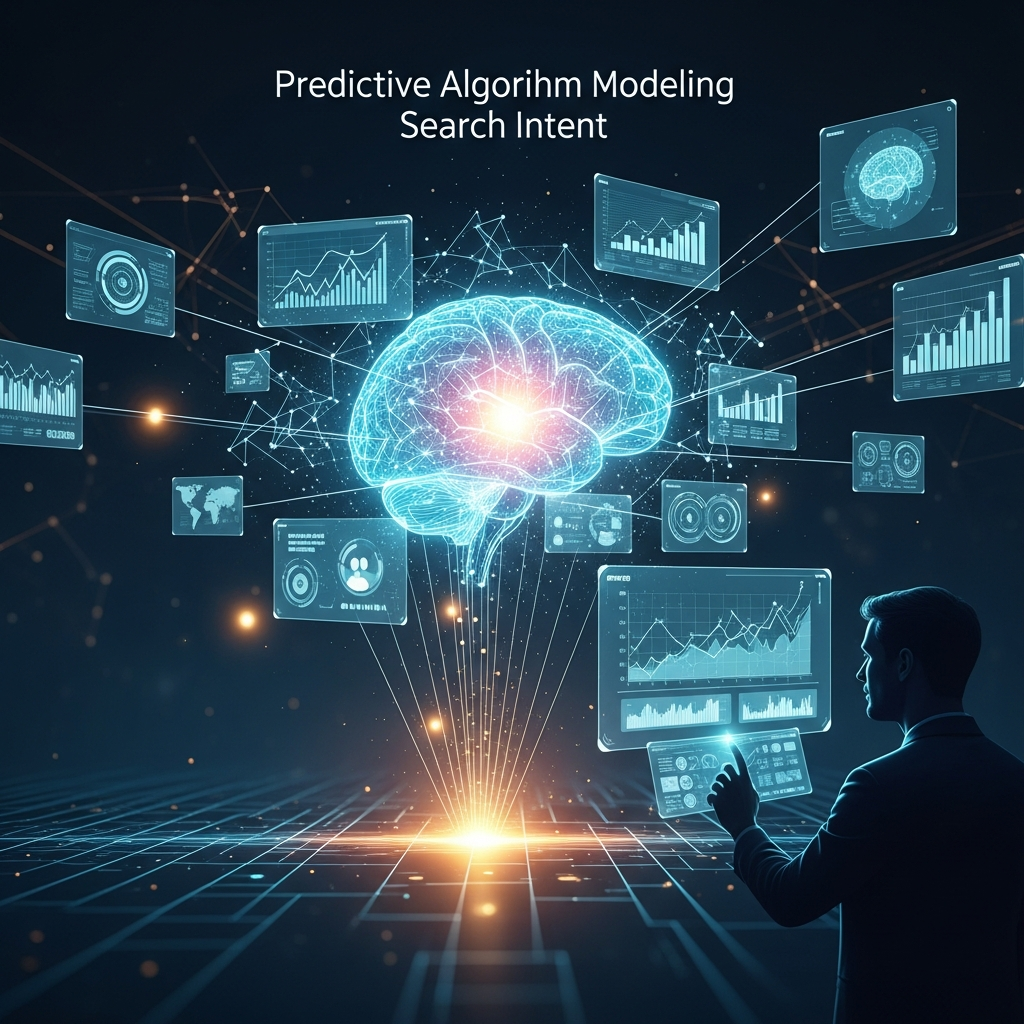
Building a predictive model isn’t about gazing into a crystal ball; it’s about crunching the right variables. An elite predictive SEO framework typically involves three core layers:
- Historical Seasonality: Not just “Christmas is in December,” but the micro-fluctuations of intent that occur in specific fiscal quarters or even weather patterns.
- Correlative External Signals: Monitoring social sentiment, venture capital flow, and legislative shifts that act as leading indicators for search demand.
- User Pathing Latency: Analyzing the time-to-conversion between informational queries and transactional queries within a specific niche.

Data Ingestion: The Fuel for the Machine
A model is only as robust as the data that feeds it. Relying solely on Google Search Console is like trying to navigate the Atlantic with a bathtub toy. To anticipate intent, we need a “Data Lake” approach. This involves aggregating disparate data sources into a unified repository for analysis.
For an elite practitioner, this means using Python or R to scrape and integrate several streams. Consider the Google Trends API. While the web interface is rudimentary, the API allows for granular “interest over time” data that can be correlated with internal CRM data. If you notice that interest in “remote work infrastructure” peaks exactly 14 days after a specific type of economic report is released, you have a predictive window. You don’t wait for the peak; you publish 10 days after the report.
Furthermore, we must look at Social Listening and Sentiment Analysis. Platforms like Reddit and X (formerly Twitter) are the “canaries in the coal mine” for search intent. A spike in discussions regarding “AI-driven supply chain disruptions” on specialized subreddits will almost inevitably precede a surge in search queries for related B2B solutions. By using Natural Language Processing (NLP) to cluster these discussions, we can identify “emergent entities” before they enter the mainstream lexicon.
Feature Engineering for Intent Forecasting
In machine learning, feature engineering is the process of using domain knowledge to extract features from raw data. In our context, we are looking for “Intent Signals.” For example, if we are in the SaaS space, our features might include:
- Rate of change in competitor mentions on G2 or Capterra.
- The velocity of new GitHub repositories being created in a specific technology stack.
- Macroeconomic indicators like interest rate hikes (which might trigger searches for “cost-saving software”).

Algorithmic Architectures: Choosing Your Weapon
Once the data is cleaned and the features are engineered, we must choose a modeling approach. While many SEOs are content with a simple linear regression, the complexities of human search behavior often require more sophisticated “Non-linear” approaches.
1. Time-Series Analysis (Prophet and ARIMA)
For predicting seasonal peaks and cyclical trends, Facebook’s Prophet or the ARIMA (AutoRegressive Integrated Moving Average) model are industry standards. These models are particularly adept at handling outliers—such as the massive search anomalies caused by the 2020 pandemic—and smoothing them out to reveal the underlying trend. They allow you to say, with a high degree of confidence, “By June 15th, search intent for ‘sustainable swimwear’ will increase by 42% regardless of current weather patterns.”
2. Random Forests and XGBoost
If you are trying to predict categorical intent (i.e., whether a searcher will want “How-to” content vs. “Pricing” content), gradient-boosted decision trees like XGBoost are remarkably powerful. By feeding the model historical user journey data, you can predict the “Next Best Content” to serve a user. This is how high-level publishers dominate the SERPs; they don’t just rank for one query; they have modeled the entire decision-making tree and have content ready for every branch.
3. Recurrent Neural Networks (RNNs) and LSTMs
Human behavior is sequential. What I searched for yesterday influences what I search for today. Long Short-Term Memory (LSTM) networks are a type of RNN designed to recognize patterns in sequences. In the context of predictive SEO, LSTMs can be used to model the “decay” of interest. It can tell you when a topic is not just “down for the week” but is officially entering a state of permanent obsolescence, allowing you to reallocate your crawl budget and editorial resources to more fertile ground.
>The Psychology of the “Pre-Search” Phase
Before a user types a query into Google, they exist in a “Pre-Search” state of ambiguity. They have a problem, but they haven’t yet formulated the language to solve it. Predictive algorithm modeling seeks to own this state of ambiguity. If you can provide the answer before the user has even finished articulating the question, you don’t just win a click; you win authority.
This requires a deep dive into Psychographic Layering. Let’s say you are in the fintech space. A reactive SEO focuses on “how to invest in stocks.” A predictive SEO realizes that a certain segment of the population is currently worried about “inflationary pressure on mid-cap assets.” By the time those users start searching for specific investment vehicles, they should already be familiar with your brand because you predicted their anxiety and addressed it through “top-of-funnel” predictive content pieces weeks earlier.
“The most sophisticated algorithms don’t just follow the user; they anticipate the collision between necessity and curiosity.”
>Operationalizing Predictive SEO: A Practical Framework
Theory is fine for academic journals, but for the elite copywriter and strategist, we need a roadmap. How do we turn these complex data models into actual ranking content?
Step 1: The Inventory of Intent
Map your current content against the Standard Buyer’s Journey. However, add a “T-Minus” column. This column represents the predicted time before the user enters that stage. For a luxury travel brand, the “T-Minus 90 days” intent might be “dreaming/escapism,” while “T-Minus 30 days” is “logistical planning.” Your goal is to create a content bridge that leads them through these phases automatically.
Step 2: The “Shadow” Keyword Strategy
Identify keywords that do not yet have significant volume but are “semantically adjacent” to growing trends. Use Latent Dirichlet Allocation (LDA) to find topics that frequently co-occur in academic papers or patent filings in your industry. If you see a specific term being used in white papers, it is only a matter of time before it trickles down into consumer search intent. Build the pillar pages for these terms now. When the volume arrives, you will have the oldest, most authoritative URL on the subject.
Step 3: Real-Time Content Injection
Use a “Headless CMS” paired with your predictive model to dynamically update content. If your model predicts a sudden surge in interest for “remote work security” due to a news break, your homepage and sidebar “recommended reading” should update programmatically to surface that content. This isn’t just SEO; it’s User Experience Optimization powered by predictive analytics.
>The Risks: Overfitting and the Echo Chamber
As with any high-level strategy, there are pitfalls. The most common in predictive modeling is overfitting. This happens when your model is so finely tuned to historical data that it fails to account for “Black Swan” events. If your model only looks at last year’s trends, it will be blindsided by a sudden cultural shift or a new technological breakthrough (like the sudden explosion of Generative AI).
There is also the “Echo Chamber” effect. If every major player is using the same predictive models, we all end up producing the same “future-proof” content at the same time, leading to a new kind of competitive saturation. The solution is to inject human eccentricity into the model. Use your predictive data as the skeleton, but use human intuition, wit, and unique brand voice as the skin. An algorithm can predict what people will search for, but it cannot yet predict what will truly resonate with their souls.
>The Future: Autonomous SEO Agents
We are rapidly approaching a point where the “human-in-the-loop” will become the bottleneck. We are seeing the rise of Autonomous SEO Agents—AI systems that not only predict intent but automatically generate, publish, and iterate on content to meet that intent in real-time. This sounds like science fiction, but for those of us working with Large Language Models (LLMs) and Vector Databases, it is the current frontier.
In this future, the role of the elite copywriter evolves. We become the “Prompt Architects” and the “Strategic Overseers.” We manage the models, ensuring they don’t hallucinate or veer off-brand, while the predictive algorithms do the heavy lifting of trend spotting and intent mapping. The competitive advantage will go to those who can master the interplay between data science and narrative craft.
>Conclusion: The Proactive Advantage
Predictive algorithm modeling is more than a technical upgrade; it’s a fundamental shift in mindset. It’s moving from the “Ask and Receive” model of search to the “Anticipate and Provide” model. By the time your competitor is looking at a keyword report, you should already be ranking for those terms, with a backlink profile that is months in the making and content that has been refined through early user feedback.
The digital world doesn’t wait for the slow. It rewards those who can read the ripples in the water before the wave arrives. Stop optimizing for what was. Start modeling for what will be. The competition is looking at the scoreboard; you should be looking at the trajectory of the ball.
Key Takeaways for Your Strategy:
- Shift focus from keywords to “Intent Trajectories.” Understand where the user is going, not just where they are.
- Integrate non-traditional data streams. Use social listening, API data, and macroeconomic signals to find leading indicators.
- Adopt sophisticated modeling. Move beyond spreadsheets and into Python-based time-series and classification models.
- Build “Shadow” content. Occupy the semantic space of emergent trends before they hit the mainstream.
- Balance data with humanity. Use the algorithm to find the “what,” but use human creativity to master the “how.”