
In the halcyon days of the early 2010s, SEO was a playground for the technically proficient and the ethically flexible. If you could optimize your crawl budget, sprinkle keywords like fairy dust, and secure a few dozen PBN links from a Russian server farm, you were essentially the king of the SERPs. But the digital landscape has undergone a tectonic shift. Today, the algorithm is no longer a simple pattern-matching machine; it has evolved into a sophisticated arbiter of human credibility. While the technical foundation of a website—its Schema markup, Core Web Vitals, and XML sitemaps—remains the “cost of entry,” the real battle for dominance is won or lost in the murky, qualitative waters of E-E-A-T.
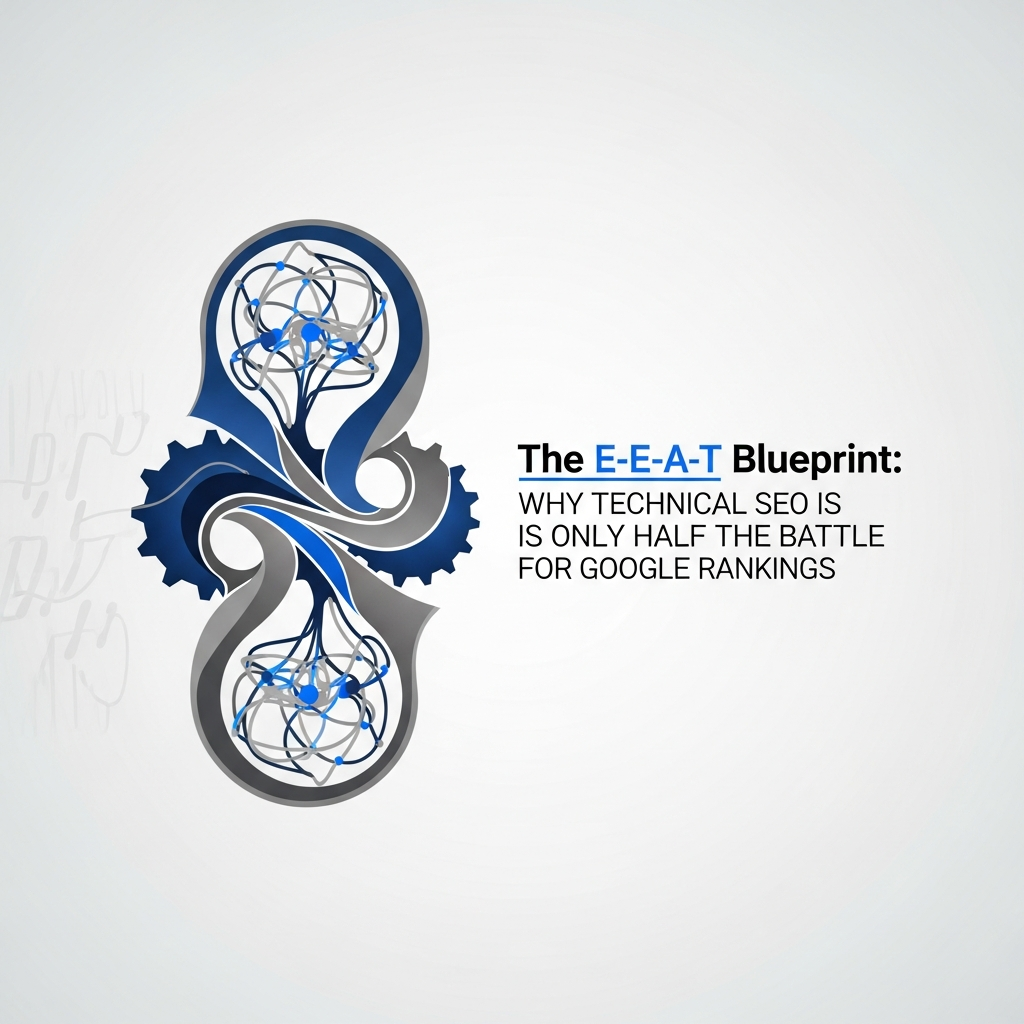
Standing for Experience, Expertise, Authoritativeness, and Trustworthiness, E-E-A-T is not a direct ranking factor in the way a backlink is, but rather a framework used by Google’s Quality Raters to evaluate the efficacy of the algorithm itself. It is the invisible hand that guides which pages rise to the top of the search results and which ones are relegated to the digital graveyard of page two. If you treat SEO as a purely technical endeavor, you are essentially building a state-of-the-art library filled with plagiarized, unverified pamphlets. It might look good on paper, but no one is going to cite it as a source of truth.
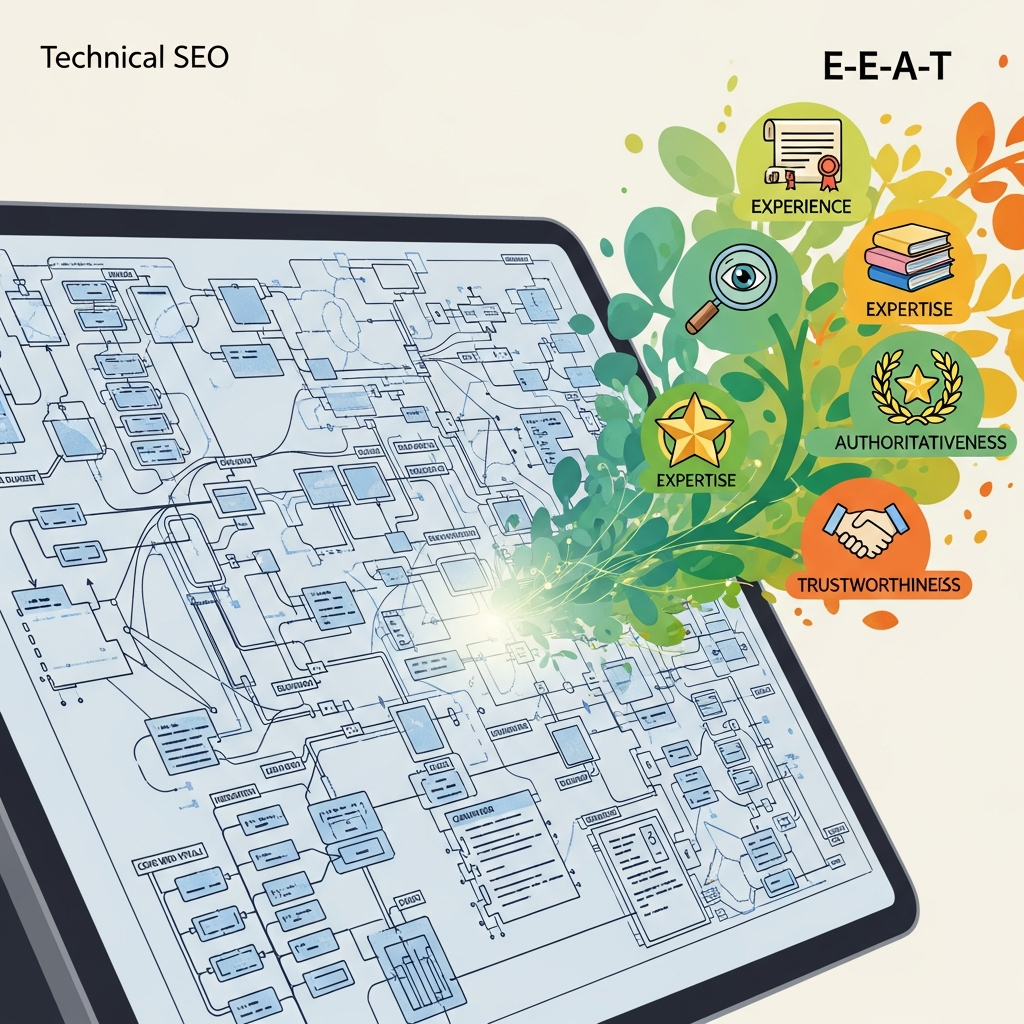
The Genesis of the E-E-A-T Framework
To understand why E-E-A-T matters, we must look back at the Quality Rater Guidelines (QRG). Google employs thousands of human evaluators whose sole job is to manually check search results and rate their quality. These ratings provide a feedback loop for the engineers to tweak the ranking algorithms. For years, we dealt with E-A-T. Then, in December 2022, Google added an extra “E” for Experience. This wasn’t just a linguistic flourish; it was a fundamental acknowledgment that in an age of generative AI, the “who” and the “how” behind the content are becoming more valuable than the content itself.
Consider the distinction. If you are searching for advice on how to treat a rare cardiac condition, do you want an article written by a “content strategist” who synthesized WebMD articles (Expertise), or do you want the insights of a board-certified cardiologist who has performed three thousand surgeries (Experience + Expertise)? Google’s evolution toward E-E-A-T is an attempt to codify that human preference into a machine-readable format.
The “Experience” Paradox: Why First-Person Narrative Wins
The introduction of Experience was a direct response to the surge of “thin” content. With the advent of Large Language Models (LLMs), any high-schooler can generate a 2,000-word guide on “The Best Hiking Boots for Beginners.” However, that AI cannot tell you how those boots felt on the descent of the Appalachian Trail during a thunderstorm. It cannot describe the specific way the heel friction felt after six miles of damp terrain.
Experience is about the “I.” It is about first-hand involvement. Google is increasingly prioritizing content where the creator has actually utilized the product, visited the location, or lived the experience. This is why Reddit and Quora have seen a massive resurgence in search visibility. Users are hungry for the messy, unpolished reality of human experience, which serves as a powerful antidote to the sanitized, SEO-optimized fluff that has dominated the web for the last decade.
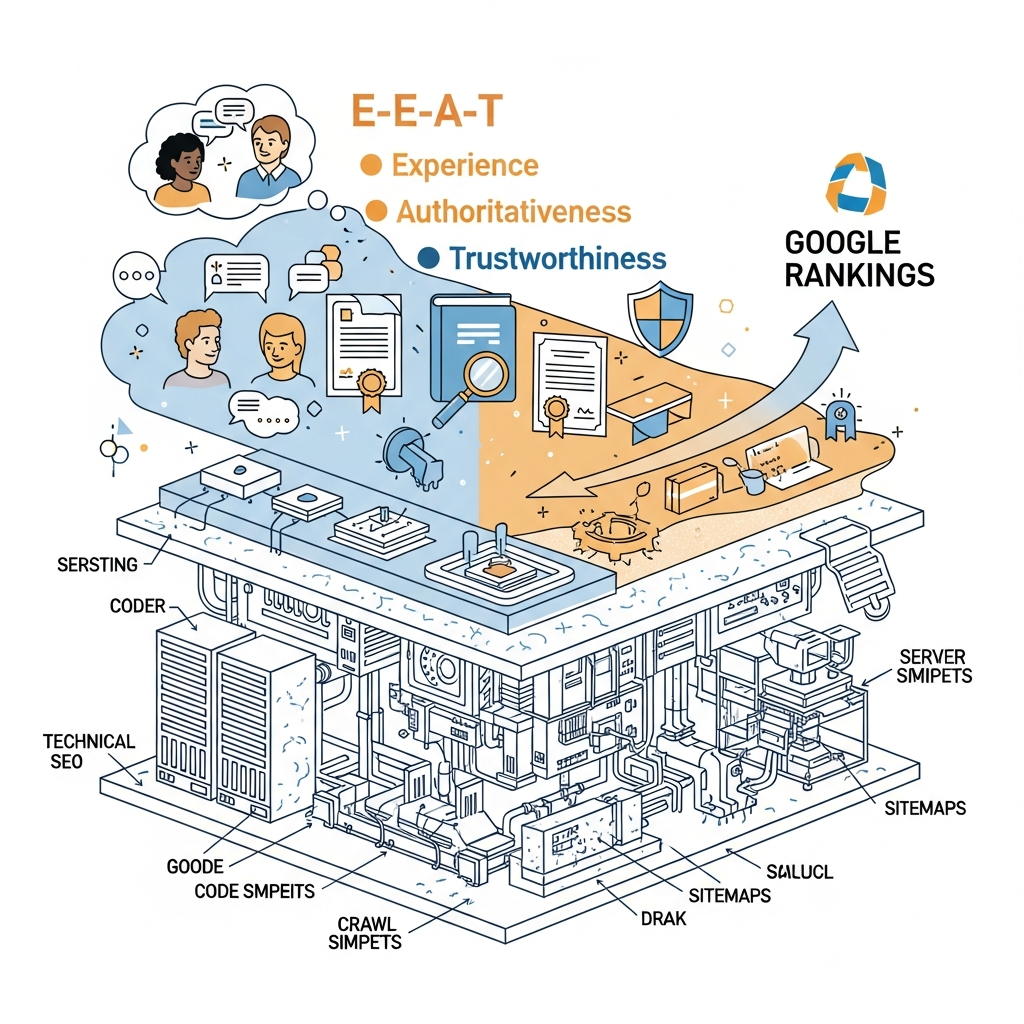
Deconstructing the Pillars: Expertise, Authority, and the Core of Trust
While Experience is the newcomer, the original pillars remain the bedrock of a successful organic strategy. Let’s dissect them with the clinical precision of a surgeon.
Expertise: The Depth of Knowledge
Expertise refers to the creator of the main content. It is less about the website as a whole and more about the individual behind the keyboard. In the world of YMYL (Your Money Your Life) topics—such as finance, health, and legal advice—expertise is non-negotiable. Google looks for signals that the author is a subject matter expert. This is communicated through:
- Formal Credentials: Degrees, certifications, and professional licenses.
- External Validation: Being cited in academic journals or major news outlets.
- Author Entities: A consistent digital footprint that proves the author exists and is recognized in their niche.
Authoritativeness: The Reputation of the Source
Authoritativeness scales the concept of expertise up to the level of the domain. When other experts or websites in your niche point to you as a source of truth, you gain authority. This is where the old-school concept of “Backlinks” meets the new-school concept of “Digital PR.”
If you write a brilliant piece on astrophysics and NASA links to it, your authoritativeness skyrockets. Why? Because an established authority has effectively vouched for your credibility. It is the digital equivalent of a peer-reviewed endorsement. However, authority is not just about links; it’s about topical relevance. A website that is an authority on gardening will not carry the same weight when it tries to rank for cryptocurrency advice.
Trustworthiness: The Most Important Pillar
In the updated QRG, Google explicitly states that Trustworthiness is the most important member of the E-E-A-T family. It is the central hub. A site can have experience, expertise, and authority, but if it is untrustworthy—perhaps it hides its refund policy, has a history of data breaches, or fails to cite its sources—it will be penalized.
Trust is built through transparency. Does your site have an “About Us” page that features real people? Do you have clear contact information? Are your sources cited with outbound links? If you are an e-commerce site, do you have a plethora of genuine customer reviews? Trust is the filter through which all other E-E-A-T signals are viewed.

Why Technical SEO is Only the Foundation
Lest we forget our roots, technical SEO is absolutely vital. If Google’s bots cannot crawl your site, or if your JavaScript rendering is a chaotic mess, your E-E-A-T signals won’t even be seen. However, technical SEO has a diminishing marginal return. Once your site is fast, mobile-friendly, and properly indexed, further technical optimizations yield smaller and smaller gains.
“Technical SEO makes a site readable for machines; E-E-A-T makes a site valuable for humans. Google’s algorithm is increasingly bridging the gap between the two.”
Think of technical SEO as the plumbing and electricity in a restaurant. You cannot run a Michelin-star establishment without them. But no one goes to a restaurant because the pipes are 3/4-inch copper or because the wiring is up to code. They go for the food (Experience) and the reputation of the chef (Expertise/Authority). If your SEO strategy is 90% technical and 10% content quality, you are essentially inviting people to dine in a beautifully wired, empty basement.
>The YMYL Nexus: Where E-E-A-T Becomes Life or Death
The stakes of E-E-A-T are not uniform across the web. If you are writing a blog post about the “Best 1980s Synth-Pop Albums,” Google’s standards for E-E-A-T are relatively relaxed. You don’t need a PhD in Musicology to have a valid opinion on Depeche Mode. However, for YMYL categories, the standards are draconian—and rightfully so.
YMYL categories include:
- Finance: Investment advice, taxes, retirement planning, or loans.
- Health: Medical conditions, drugs, mental health, or nutrition.
- Safety: Information on dangerous activities or emergency preparedness.
- Civics/Law: Voting, legal proceedings, and government information.
In these sectors, Google employs a “disruption of life” metric. If inaccurate information on your page could lead to someone losing their savings or suffering a medical emergency, your E-E-A-T signals must be impeccable. This is where many affiliate marketers hit a brick wall. You cannot rank for “Best Heart Medication” using an AI-written article on a generic domain. Google demands a level of verifiable expertise that most generic content sites simply cannot provide.
>Practical Implementation: Building Your E-E-A-T Blueprint
Moving from the theoretical to the practical, how do we actually “do” E-E-A-T? Since it isn’t a checkbox in a plugin, it requires a holistic approach to brand building. Here is a blueprint for the modern SEO professional.
1. Cultivate and Display Individual Authorship
Stop publishing content under the name of “Admin” or “Editorial Staff.” This is an immediate red flag. Create detailed author bios for every contributor. Link to their LinkedIn profiles, their previous work on other reputable sites, and any professional awards. Use Person Schema to help search engines connect the dots between the author and their digital footprint.
2. The “Information Gain” Strategy
Google recently filed a patent for “Information Gain.” In layman’s terms, this means the algorithm looks for whether your page provides *new* information that wasn’t present in the pages it already crawled. If you are merely summarizing the top 10 results, your information gain is zero. To improve E-E-A-T, add unique data, original photography, or a contrarian viewpoint backed by evidence. This is the essence of “Experience.”
3. Aggressive Fact-Checking and Sourcing
Treat your blog like a journalistic publication. If you make a claim, back it up with a link to a primary source—preferably a .gov, .edu, or high-authority news site. This doesn’t “drain your Link Juice” (a concept that is largely archaic); it reinforces your Trustworthiness. It shows Google that your content is rooted in established fact.
4. Audit Your Digital Footprint (Off-Page E-E-A-T)
E-E-A-T happens mostly off-site. What are people saying about your brand on Reddit? What are your Glassdoor reviews like? Is your business mentioned in Wikipedia? While you can’t always control these factors, you can influence them through Digital PR and community engagement. Mentions on authoritative sites, even without a “dofollow” link, are powerful signals of authority.
>The Role of Schema Markup in the E-E-A-T Framework
While we argued that technical SEO is only half the battle, it is the bridge that communicates E-E-A-T to the bots. Structured Data (Schema) is the language Google uses to understand entities. By using Article, Author, Organization, and ReviewedBy Schema, you are explicitly telling Google who wrote the content, who vetted it, and what their credentials are.
For example, using the reviewedBy property allows you to show that even if a staff writer wrote a medical article, it was checked for accuracy by a licensed doctor. This is a powerful way to leverage the expertise of others to bolster your site’s trustworthiness.
>The AI Elephant in the Room: Can Machines Have E-E-A-T?
The rise of Generative AI has created a crisis of authenticity. AI can mimic Expertise (by synthesizing data) and it can sound Authoritative (by its confident tone), but it fundamentally lacks Experience and Trustworthiness. It cannot “experience” anything. It cannot be held accountable for its mistakes, which is the cornerstone of trust.
Google’s stance on AI content has shifted. They no longer penalize it simply for being AI-generated, but they do penalize it if it lacks E-E-A-T. The irony is that as AI becomes more prevalent, the human elements of content—personal anecdotes, nuanced opinions, and original research—become exponentially more valuable. To future-proof your SEO, don’t just use AI to write content; use it to research, then overlay it with the “human experience” that an LLM cannot replicate.
>Conclusion: The Shift from Optimization to Reputation
In the final analysis, E-E-A-T represents the “humanization” of search. Google is trying to mimic the way a rational, skeptical human being evaluates information. When we look for a lawyer, we don’t just look for who has the fastest-loading website; we look for who has the most experience, the best reputation, and the most transparent fees.
Technical SEO will always be necessary. It ensures that your “digital store” is open, the lights are on, and the aisles are organized. But E-E-A-T is why people choose to shop there instead of at the competitor down the street. It is the cumulative effect of your brand’s reputation, your authors’ expertise, and the genuine value you provide to your audience.
Stop asking, “How can I rank for this keyword?” and start asking, “Do I deserve to rank for this keyword?” If the answer is “no,” then no amount of Schema or site speed optimization will save you from the eventual algorithmic correction. The blueprint for success in modern SEO is simple, yet incredibly difficult to execute: Be the authority you claim to be.
As we move deeper into this decade, the gap between “good content” and “trustworthy content” will continue to widen. Those who invest in building a brand rooted in E-E-A-T will find themselves insulated from the volatility of algorithm updates, while those who rely on technical hacks will be forever chasing a moving target. SEO is no longer just a technical department; it is a reputation management department. Treat it accordingly.