
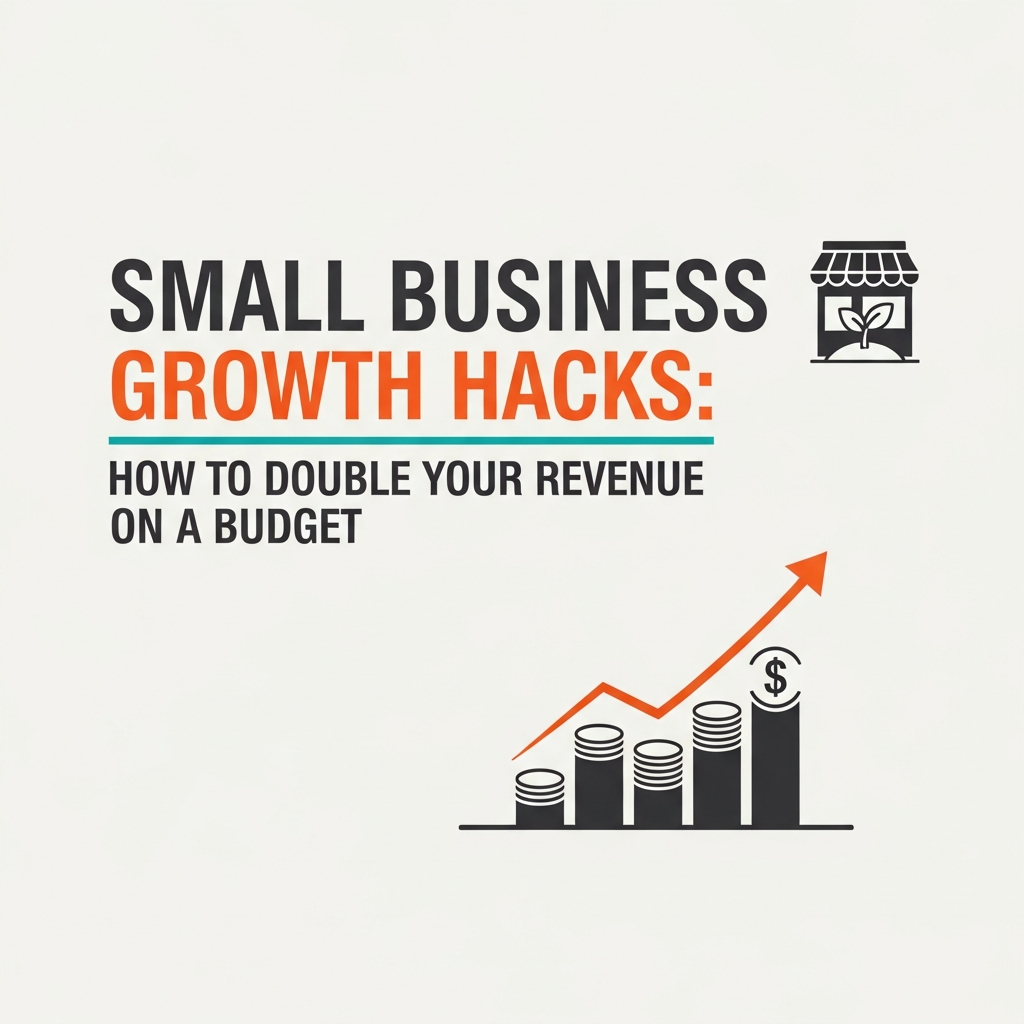
The entrepreneurial dream is often sold as a series of high-gloss snapshots: the Series A funding round, the sleek glass office, and the “hockey stick” growth curve. But for the vast majority of small business owners, the reality is far more grounded in the grit of bootstrapping. When you are operating without a venture capital war chest, “growth” isn’t just a metric—it is a survival imperative. Doubling your revenue on a shoe-string budget requires more than just hard work; it demands a radical reimagining of your leverage points.
Most businesses fail not because they lack a good product, but because they succumb to the “Leaky Bucket” syndrome. They spend agonizing amounts of time and money pouring new leads into the top of the funnel while their existing value evaporates through poor retention, stagnant pricing, and inefficient conversion. To double your revenue without doubling your expenses, you must pivot from a mindset of acquisition at all costs to one of maximum yield per touchpoint.
The Geometric Growth Formula: Moving Beyond Linear Thinking
Most business owners think of growth as a linear equation: if I want 2x the revenue, I need 2x the customers. This is the most expensive way to grow. Instead, elite strategists use the Jay Abraham model of geometric growth. There are only three ways to grow any business: increase the number of total clients, increase the average transaction value, and increase the frequency of repurchase.
If you increase each of these three variables by just 25%, the cumulative effect isn’t a 25% increase in revenue—it is nearly a 100% increase. This is the “growth hack” that requires zero additional ad spend. It requires optimization of the systems you already have in place. By focusing on these incremental gains across the board, you bypass the need for a massive marketing budget and instead build a compounding revenue machine.
1. Conversion Rate Optimization (CRO): Plugging the Leaks
Before you spend a single dollar on increasing traffic, you must ensure your current traffic is actually converting. If your website has a 1% conversion rate and you double your traffic, you have doubled your revenue—but you have also doubled your acquisition costs. If, however, you improve your conversion rate from 1% to 2%, you have doubled your revenue without spending an extra dime on ads.
The Psychology of Frictionless UX
Conversion is often a battle against friction. Friction is anything that causes a potential customer to hesitate. To identify friction, you don’t need expensive consultants; you need data. Tools like Hotjar or Microsoft Clarity (which has a robust free tier) allow you to watch session recordings. Are users clicking on images that aren’t links? Are they abandoning their carts at the shipping calculator? Reducing the number of fields in your contact form from five to three can often result in a 20% lift in submissions overnight.
High-Velocity A/B Testing
In the journalistic world of copywriting, we know that the headline is 80% of the value. The same applies to your landing pages. Use a simple tool like Google Optimize to test two different headlines. One should focus on the benefit (“Get More Leads Today”) and the other on loss aversion (“Stop Losing Leads to Your Competitors”). You will often find that one resonates significantly better, effectively lowering your cost per acquisition through sheer linguistic efficiency.
2. Leveraging Micro-Influencer Arbitrage
The era of the celebrity influencer is waning for small businesses. Their rates are astronomical, and their audiences are too broad. The real growth hack in 2024 and beyond lies in micro-influencer arbitrage. These are creators with 5,000 to 50,000 followers who command hyper-niche, high-trust communities.
“Trust is the new currency of the digital economy. A recommendation from a niche expert is worth a thousand banner ads.”
Instead of paying for a post, offer these creators an affiliate model or “product-for-post” arrangement. Because these creators are often looking to build their own portfolios, they are more willing to work on performance-based incentives. This aligns your costs directly with your revenue. If they don’t sell, you don’t pay. When they do sell, the cost is a percentage of a sale you wouldn’t have otherwise had. This is infinitely scalable and carries almost zero financial risk.
3. The “Invisible” Revenue: Maximizing Customer Lifetime Value (LTV)
The most expensive sale you will ever make is the first one. The profit in any business is found in the second, third, and tenth transaction. If you want to double your revenue, you must stop treating your customers like a one-off transaction and start treating them like a long-term asset.
The Art of the Upsell and Cross-Sell
Analyze your customer journey. At what point are they most excited? Usually, it is immediately after the purchase. This is the “Golden Window.” Implementing a one-click upsell—a complementary product offered immediately after the initial checkout—can increase your average order value (AOV) by 15-30% instantly. Amazon didn’t become a titan through innovation alone; they did it through the “Customers who bought this also bought…” algorithm.
Predictive Re-engagement
If you sell a consumable product or a service that needs renewal, don’t wait for the customer to remember you. Use your CRM data to predict when they are running low or when their interest might be waning. An automated email sent at day 45 of a 60-day supply, offering a “loyalty discount” if they reorder now, creates a predictable revenue stream that requires no manual intervention.
4. Strategic Partnerships: Borrowing Other People’s Audiences (OPA)
One of the fastest ways to double your revenue is to find a business that has already spent years building a relationship with your ideal customer—and then find a way to provide value to them. This is the concept of Other People’s Audiences.
Identify non-competing businesses that share your target demographic. If you are a high-end pet groomer, partner with a local boutique veterinarian or an organic pet food supplier. Create a “Welcome Package” for their new clients that includes a significant discount for your services. In return, you offer their customers exclusive value that makes the partner look like a hero. You gain access to a pre-vetted, high-trust list of leads for the cost of a few printed vouchers or a co-branded email.
>5. Content Marketing as a Compending Asset
Paid ads are like a faucet: when you stop paying, the water stops flowing. Content marketing is like planting an orchard: it takes time to grow, but once it does, it yields fruit for years with minimal maintenance. To double revenue on a budget, you must stop “blogging” and start creating Programmatic SEO assets.
Solving for Intent
Don’t write about what you do; write about the problems your customers are desperately trying to solve at 2:00 AM. Use tools like AnswerThePublic to find the exact questions people are asking. If you are a plumber, don’t just write “Best Plumber in Chicago.” Write “How to fix a leaking PVC pipe under a kitchen sink.” By solving their problem for free, you build the ultimate authority. When they eventually have a problem they can’t fix themselves, you are the only person they will call.
The Power of Video Repurposing
Creating content is time-consuming. Maximize your ROI by using the “Pillar and Post” method. Record one long-form, high-value video (10 minutes) addressing a core industry pain point. Use AI tools to chop that video into ten TikToks/Reels, three LinkedIn posts, and one comprehensive blog post. You have now populated your entire marketing ecosystem for a week from a single hour of effort. This is how small teams project the presence of a global corporation.
>6. Psychological Pricing and Tiered Options
Pricing is the most powerful lever in your business, yet it is often the one most neglected. Most small business owners price based on their costs or their competitors. Elite copywriters price based on perceived value.
The Decoy Effect
If you offer two options—a basic service for $500 and a premium service for $1,500—most people will choose the $500 option because the jump feels significant. However, if you introduce a “Decoy” option at $1,400 that has significantly fewer features than the $1,500 premium tier, the $1,500 option suddenly looks like an incredible bargain. You aren’t “selling” the premium tier; you are allowing the customer to “choose” the best value. This simple shift in pricing architecture can move your median transaction value up by 40%.
>7. Referral Loops: Turning Customers into a Sales Force
A referral is the highest-converting lead you will ever receive. Yet, most businesses leave referrals to chance. To double your revenue, you must systematize your referral process. This is often called a Viral Coefficient.
Create an “Irresistible Referral Loop.” Instead of just asking for a referral, give your current customers a “Gift Credit” they can give to a friend. For every friend who redeems the credit, the original customer gets a credit for themselves. This creates a win-win-win scenario. Dropbox grew to a multi-billion dollar valuation using this exact hack: “Give space, get space.” It works just as well for a local landscaping business or a boutique SaaS platform.
>8. High-Perplexity Email Marketing: The Anti-Newsletter
The traditional “monthly newsletter” is dead. Nobody wants a PDF of your company updates. What they want is curated, high-value insight. To drive revenue through email, you must move toward behavior-based automation.
If a user visits your pricing page three times but doesn’t buy, that should trigger an automated “Is everything okay?” email from the founder. These emails should be plain-text, appearing as if they were typed manually. This “human-centric” automation has a much higher response rate than glossy, HTML-heavy marketing emails. It initiates a conversation, and in small business, conversations lead to conversions.
>9. Operational Efficiency: Scaling Without Hiring
Doubling revenue often breaks businesses because they try to scale their manual labor. To keep your budget intact, you must scale your systems. This is where the modern SME can outcompete larger incumbents.
The No-Code Revolution
Use tools like Zapier or Make to connect your disparate apps. If a lead fills out a form, Zapier should automatically add them to your CRM, send them a personalized introductory text message, and notify your sales team in Slack. By automating the administrative “drudge work,” you free up your time—or your staff’s time—to focus on high-value revenue-generating activities like closing deals or innovating products.
>10. The Power of “No”: Niche Down to Scale Up
It sounds counterintuitive, but the fastest way to double your revenue is often to fire half of your clients. Small businesses often get trapped in the “Generalist Trap,” taking any client who can pay. This leads to specialized workflows for every project, which destroys your margins.
By narrowing your focus to a specific niche—for example, instead of “Digital Marketing,” you do “SEO for Pediatric Dentists”—you can productize your service. Productization allows you to create a “factory line” for your delivery. You become faster, your results become more predictable, and you can charge a premium because you are a specialist rather than a generalist. Efficiency is the silent partner of revenue growth.
>Conclusion: The Path to 2x
Doubling your revenue on a budget isn’t about finding a single “silver bullet.” It is about the relentless pursuit of marginal gains. It is the result of tightening your conversion funnels, leveraging the trust of micro-influencers, and turning your existing customers into your most vocal advocates. It requires the discipline to look at your data and the courage to stop doing what isn’t working.
Growth is not a mystery; it is a mechanical process. When you optimize the math of your business—AOV, LTV, and Conversion—the revenue increase becomes an inevitability rather than a hope. Start with one of these hacks today, master it, and move to the next. The compounding effect will take care of the rest.