
The entrepreneurial dream often begins in a garage, a spare bedroom, or a corner of a local coffee shop. It starts with a spark—an idea that solves a problem or fills a gap. But then, reality hits. You have a product. You have a few customers. Now what? The transition from “surviving” to “thriving” is where most small businesses stall out. They hit the invisible ceiling of the founder’s personal bandwidth.
Growth isn’t just about doing more of what you’re currently doing; it’s about doing things fundamentally differently. It is the shift from being a technician who owns a job to becoming a CEO who owns a system. If you want to scale without losing your mind—or your profit margins—you need a roadmap that balances aggressive marketing with operational discipline. This guide is that roadmap.
The Pre-Growth Checklist: Are You Actually Ready?
Before you pour gasoline on the fire, you need to make sure the fire is actually burning hot enough to sustain itself. Growing a broken business model only accelerates its demise. Before looking at outward expansion, we must look inward at three critical pillars: Product-Market Fit, Unit Economics, and Scalability.
1. Validating Product-Market Fit (Again)
You might have had product-market fit for your first 50 customers, but does that fit hold up for the next 5,000? Growth often requires moving from early adopters (who are forgiving) to the “early majority” (who are demanding). Listen to your current churn rate. If people are leaving as fast as they are arriving, you don’t have a growth problem; you have a product problem. Fix the bucket before you pump more water into it.
2. The Math of Growth: CAC vs. LTV
If you don’t know these two acronyms, stop everything. Customer Acquisition Cost (CAC) is how much it costs you in marketing and sales to get one new customer. Lifetime Value (LTV) is how much total profit that customer brings in before they stop buying from you. A healthy growing business typically aims for an LTV that is at least 3x its CAC. If it costs you $100 to get a customer who only spends $80, you aren’t growing—you’re subsidizing your customers’ lives with your own bankruptcy.
“Growth for the sake of growth is the ideology of the cancer cell.” — Edward Abbey
Abbey’s words ring true in the boardroom. Growth must be profitable, or at the very least, have a clear path to profitability. Chasing “vanity metrics” like total users or Instagram followers while your bank account bleeds dry is a recipe for a very public failure.
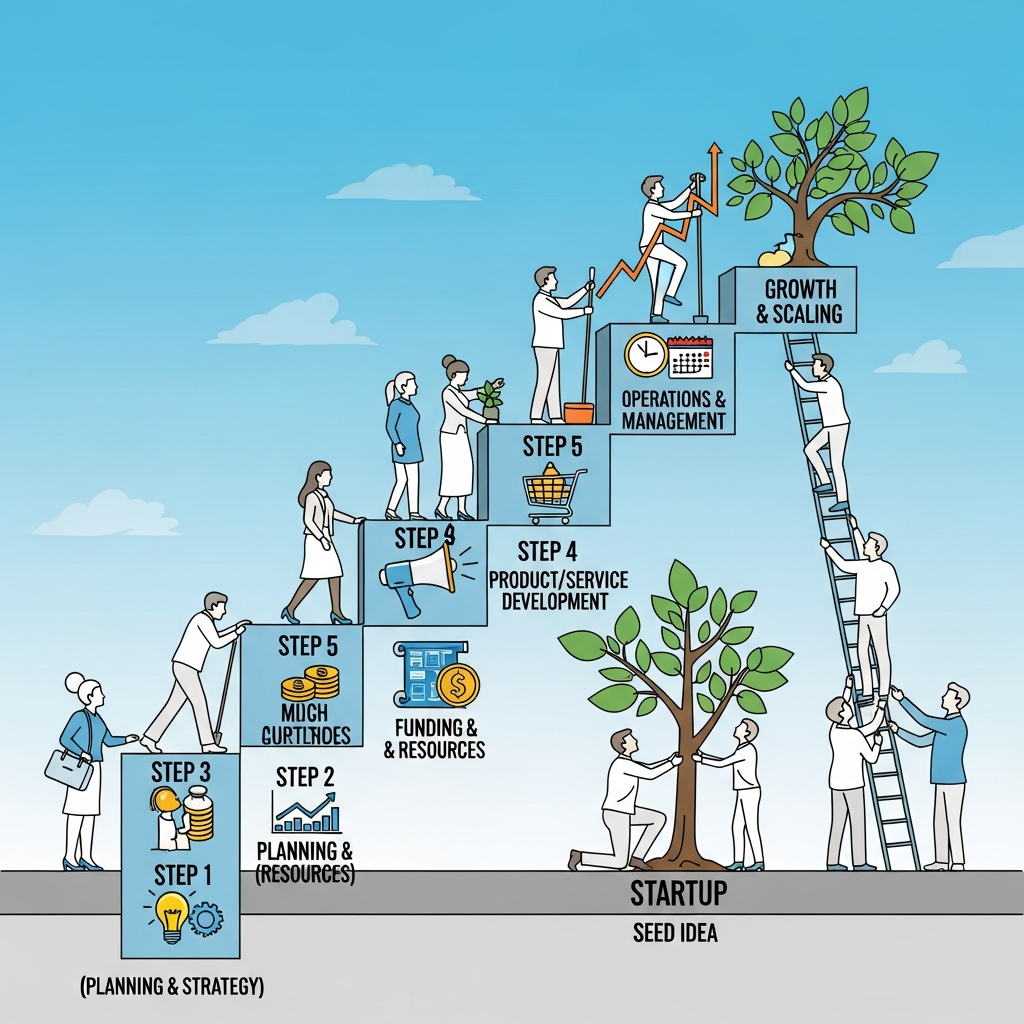
Step 1: Deepen Your Existing Market Share
The easiest person to sell to is someone who has already bought from you. The second easiest is someone exactly like them. Before you try to conquer new territories or launch entirely new product lines, you must exhaust your current niche.
The Art of the Upsell and Cross-Sell
Growth doesn’t always mean new faces. It can mean deeper pockets. Look at your current offerings. Is there a “Premium” version for your power users? Is there a “Maintenance Plan” for your service clients? Increasing your Average Order Value (AOV) is the most efficient way to grow because your acquisition cost is zero.
Building a Referral Engine
Word of mouth is the “Holy Grail” of marketing, but most small businesses leave it to chance. A systematic referral program incentivizes your best customers to become your unpaid sales force. Whether it’s a discount, a free month of service, or exclusive access, give your fans a reason to talk about you.
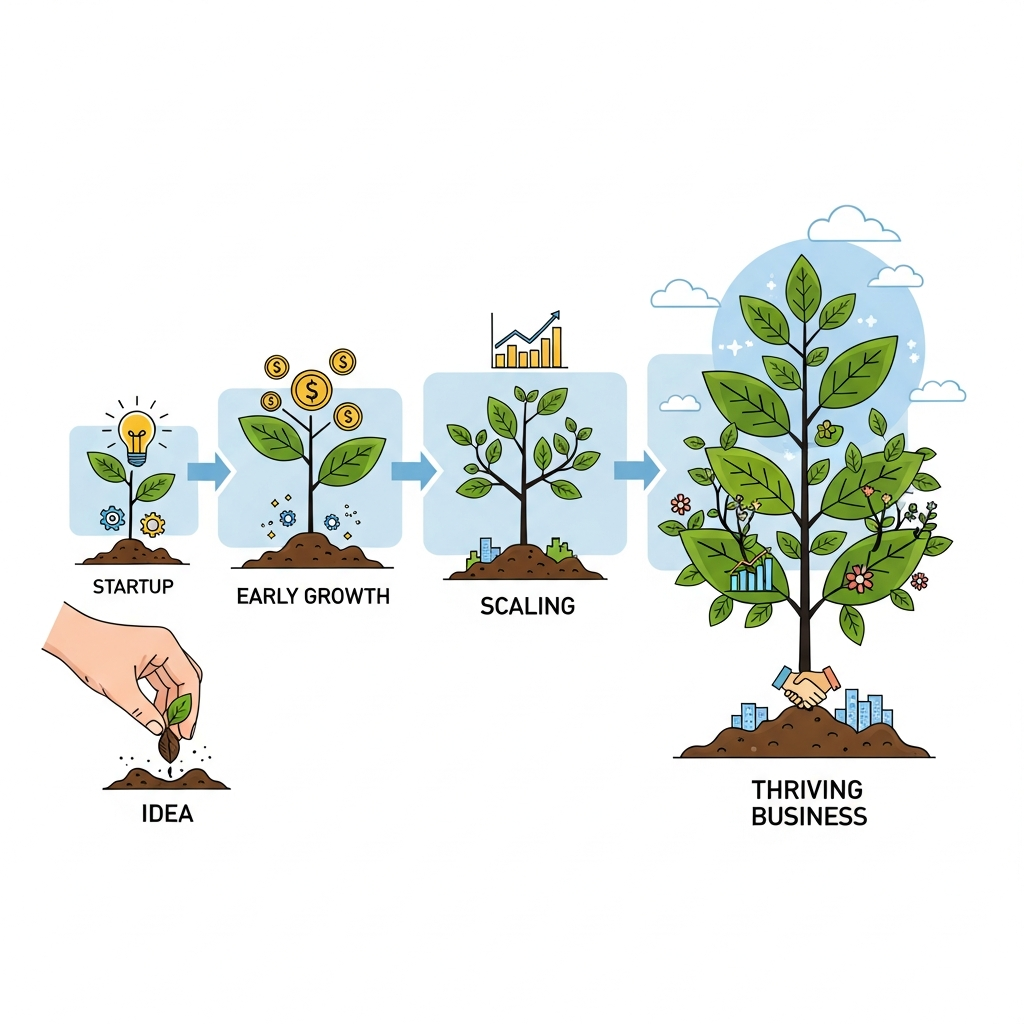
Step 2: Master the Digital Acquisition Funnel
In the modern era, if you can’t acquire customers while you sleep, you don’t have a scalable business. You have a manual labor project. You need a “Funnel”—a journey that takes a total stranger and turns them into a brand advocate.
Content Marketing: The Long Game
Stop shouting “Buy Now!” and start saying “Here is how to solve your problem.” Content marketing (blogs, videos, podcasts) builds authority. When you provide value for free, you build a “reciprocity bank account” with your audience. By the time they see your product, the trust is already established. SEO (Search Engine Optimization) is the backbone here; it ensures that when your potential customer has a midnight panic-search on Google, your business is the answer they find.
Paid Media: The Accelerator
Once you have a funnel that converts, it’s time to use Google Ads, Meta Ads, or LinkedIn Ads. The key is small-scale testing. Don’t drop $10,000 on a campaign on day one. Drop $10 a day. Test headlines. Test images. Only when the data shows a positive Return on Ad Spend (ROAS) do you “crank the handle.”
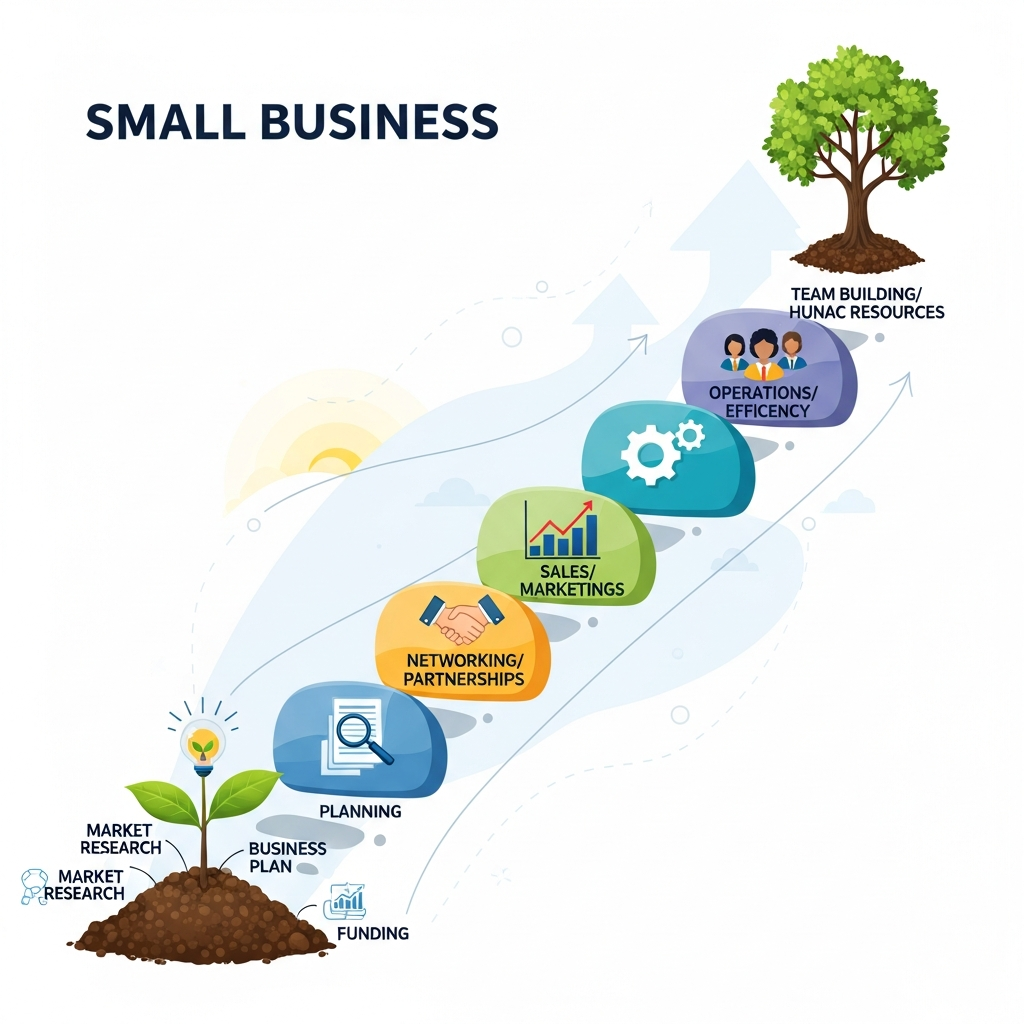
Step 3: Operational Excellence and Automation
Most small businesses fail to grow because the founder is the bottleneck. If every decision—from the color of the napkins to the wording of a refund email—requires your approval, you are stuck. To grow, you must replace yourself with systems.
Standard Operating Procedures (SOPs)
If a task is done more than twice, it needs an SOP. A good SOP is a document (or video) so clear that a reasonably intelligent person could complete the task without asking you a single question. This is how you maintain quality as you scale. Without SOPs, growth leads to chaos, and chaos leads to a damaged brand reputation.
The Tech Stack
Leverage automation tools to do the heavy lifting.
- CRM (Customer Relationship Management): Tools like HubSpot or Pipedrive ensure no lead falls through the cracks.
- Email Automation: Use Klaviyo or Mailchimp to nurture leads automatically.
- Project Management: Asana, Trello, or Monday.com keep the team aligned without constant meetings.

Step 4: Hiring for Cultural and Competency Fit
You cannot grow a large business with a team of one. However, a “bad hire” is more expensive than “no hire.” In the early stages of growth, each new employee represents a massive percentage of your company culture.
Hire for Attitude, Train for Skill
In a small, growing business, you need “utility players”—people who are comfortable with ambiguity and willing to wear multiple hats. Look for people with a “growth mindset.” They should be more interested in solving problems than in staying strictly within their job description.
The First Five Hires
Typically, the first hires should be roles that take the most repetitive, time-consuming tasks off the founder’s plate. This usually means:
- An Operations Coordinator (to handle the “how”)
- A Sales/Account Executive (to handle the “who”)
- A Customer Success Lead (to keep the “who” happy)
>Step 5: Financial Management and Cash Flow
Growth is a cash-hungry beast. Often, the faster you grow, the less cash you have on hand because you are reinvesting every penny into inventory, marketing, and headcount. This is the “Growth Paradox.”
Managing the Cash Gap
The cash gap is the time between when you pay for your inputs (inventory, labor) and when you get paid by your customers. If you have a 60-day cash gap and you double your sales, you might actually run out of money. Small businesses must negotiate better terms with suppliers (pay later) and incentivize customers to pay sooner (deposits or discounts for upfront payment).
When to Seek External Funding
Bootstrapping is noble, but sometimes it’s too slow. If you have a proven model and the only thing holding you back is capital, look into:
- SBA Loans: Lower interest rates, specifically for small businesses.
- Line of Credit: A safety net for seasonal dips.
- Angel Investors/Venture Capital: Only if you are prepared to give up equity and go for a “moonshot” exit.
>Step 6: Strategic Diversification
Once you have dominated your niche and your operations are stable, it’s time to look at horizontal and vertical expansion.
Vertical Integration
Can you bring part of your supply chain in-house? If you run a coffee shop, can you start roasting your own beans? This increases margins and gives you more control over quality.
Horizontal Expansion
This involves taking your existing expertise to a new market. If you have a successful landscaping business in one city, can you replicate the system in the next county over? Or, can you offer a complementary service, like pool maintenance, to the same customer base?
>The Psychology of the Growing Entrepreneur
The biggest obstacle to growth is rarely the market; it’s the entrepreneur’s own ego. Many founders struggle with “The Founder’s Trap”—the belief that “No one can do it as well as I can.” While that might be true in the short term, your job is to build a company where others *can* do it as well as you, or better.
You have to move from being the Chief Doer to the Chief Visionary. This requires a high degree of emotional intelligence and the ability to delegate trust, not just tasks. If you micromanage your team as you grow, you will burn out your best people and create a culture of dependency.
“It doesn’t make sense to hire smart people and tell them what to do; we hire smart people so they can tell us what to do.” — Steve Jobs
Embrace the discomfort of not knowing every detail of your business. If the machine is working, your role is to watch the gauges, look at the horizon, and steer the ship.
>Step 7: Retaining Your Soul (The Brand Identity)
As businesses grow, they often become “corporate” and sterile. They lose the “magic” that made their first customers fall in love with them. To grow sustainably, you must institutionalize your values.
Write down your core values. Not the generic “Integrity” or “Excellence” posters you see in dentist offices, but the real, gritty values that define how you work. “We answer every email within 2 hours” or “We never ship a product we wouldn’t give to our mothers.” As you hire more people, these values serve as the North Star, ensuring that the 100th employee provides the same level of care as the 1st.
>Conclusion: The Infinite Game
Growth is not a destination. There is no point where you “arrive” and everything becomes easy. In fact, bigger businesses have bigger problems—they just have better systems to handle them. The goal of growth isn’t just to increase the numbers on a spreadsheet; it’s to increase the impact you have on your customers, your employees, and your community.
Start small. Fix your unit economics. Systematize your processes. Hire people smarter than you. And never, ever stop listening to the customer. If you do those things with consistency and a bit of wit, you won’t just have a small business that grew; you’ll have a legacy that lasts.
The road to scaling is paved with data, discipline, and a healthy dose of courage. Now, go look at your numbers, find your bottleneck, and start the transition from technician to titan. The market is waiting.